


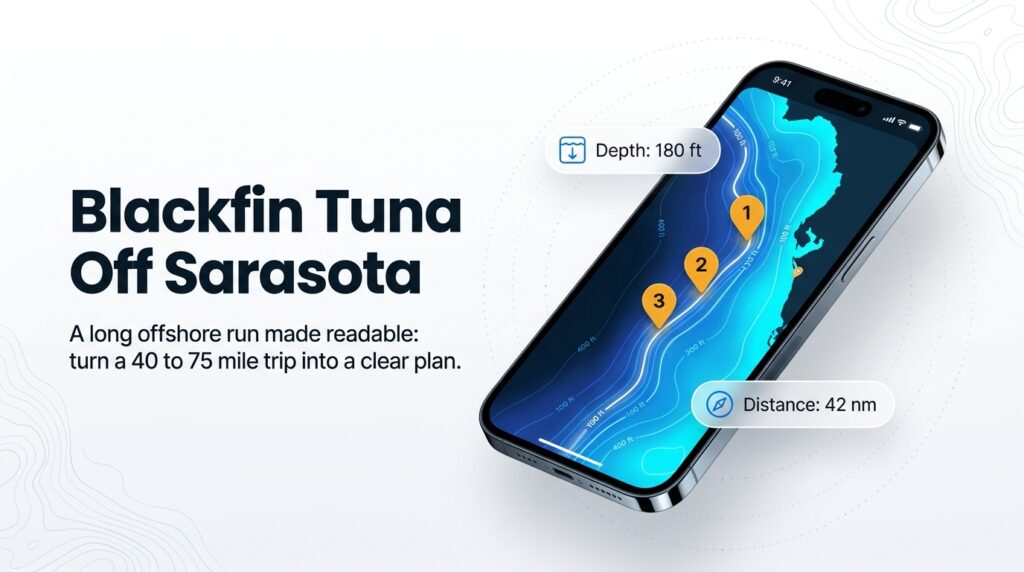
Blackfin tuna off Sarasota mean a long run offshore. Most boats that find them consistently go about 50 to 75 miles offshore, per local charter operators. Tuna are not common for most charters out of this port, and some anglers go 70 miles or farther to find them. A Bradenton/Anna Maria charter operator says they don’t target blackfin specifically but catch them while fishing for other species.
For anyone planning a blackfin tuna fishing trip out of Sarasota, Florida, the fish are here, but reaching them takes a long run, good weather and a plan.
Biology and general tackle are covered in our blackfin tuna species guide. Gulf-wide patterns are in our Gulf-wide blackfin guide, which covers the Gulf of Mexico (officially the Gulf of America in federal usage since 2025). This page covers the Sarasota specifics: where the 100 to 200 ft band sits relative to New Pass, Big Pass and Venice Inlet, when sources say fish show up, how locals fish them, and what state and federal rules require.
Sarasota at a Glance
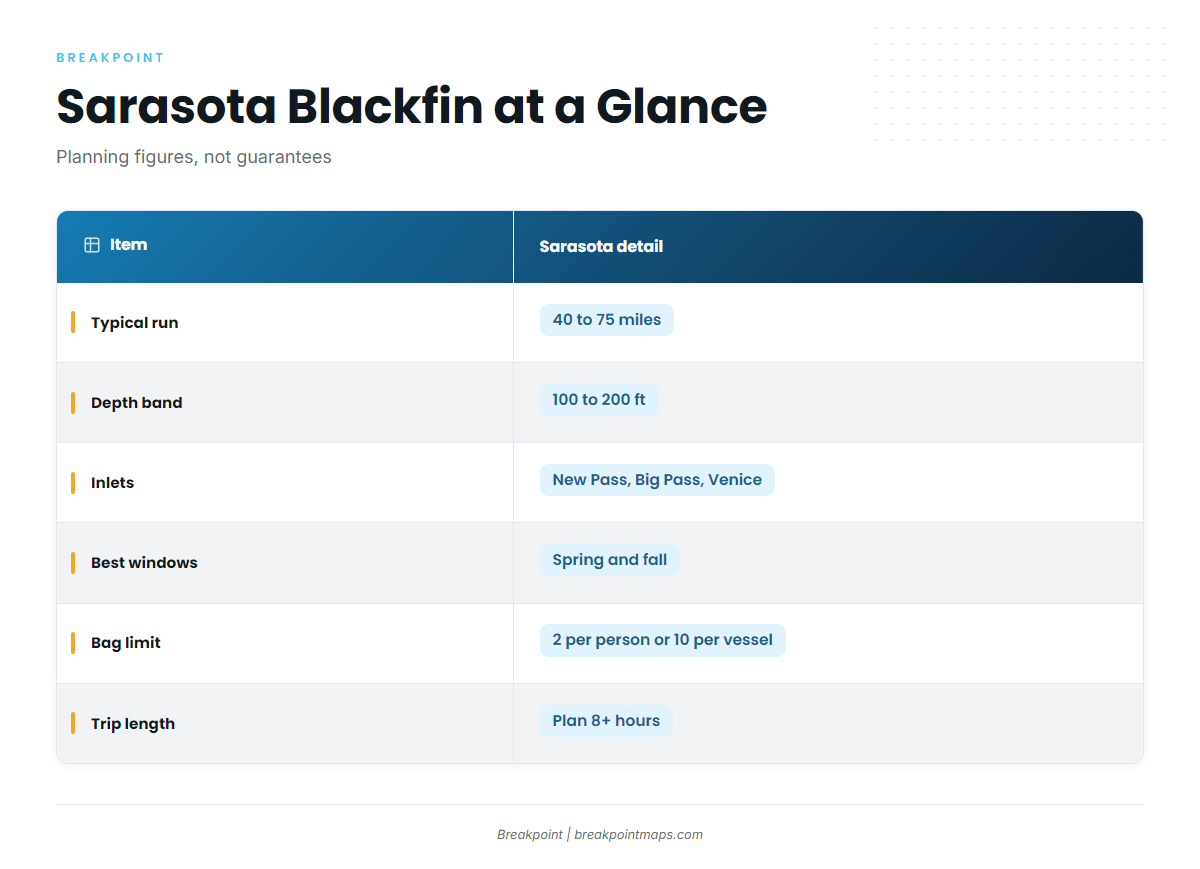
| Item | Sarasota detail |
|---|---|
| Typical run | About 40 to 75 miles, per local charter operators. Reports range from 20 to 80+. This is a planning figure, not a guarantee. |
| Depth band | 100 to 200 ft. Summer reports are 130 to 200 ft, per Salt Water Sportsman. |
| Inlets | New Pass, Big Pass, Venice Inlet |
| Most-cited windows | Spring and fall. Sources disagree; see Habitat below. |
| Common by-catch | Kingfish, amberjack, cobia, occasional wahoo |
| Bag limit | 2 per person or 10 per vessel, whichever is greater, per the Florida Fish and Wildlife Conservation Commission (FWC). Verify before you fish. |
| Trip length | Plan an 8+ hour day, per local charter guidance. |
Regional Differences
Sarasota sits on the wide, gently sloping West Florida Shelf, so blackfin here are tied to mid-to-deep structure rather than a blue-water edge a few miles off the beach. If you have read our Gulf-wide blackfin guide, this is the local version of that story.
The Gulf has a broad continental shelf in many areas, which lets you travel a long way while staying in moderate depths. The 100 to 200 ft band is therefore a long run, and fuel and the weather window decide the day.
Here is how Sarasota compares with other ports, using only what the sources support:
| Port | Distance to tuna water | What holds fish | Notes |
|---|---|---|---|
| Sarasota | 40 to 75 miles is the working band; reports range from 20 to 80+ | Ledges, wrecks, artificial reefs, shrimpers | Long run over a broad shelf |
| Panhandle/Destin | Anglers need to go over 100 miles offshore | Oil rigs | Deeper Gulf water |
| Keys/Atlantic side | Short run | Gulf Stream edges | The Gulf Stream runs closest to shore between West Palm Beach and Miami |
| Tampa Bay/Boca Grande | No comparable catch data found | Similar shelf setup | Narrative comparison only |
Anglers report blackfin around shrimp boats in Southwest Florida in spring, and one forum poster says anchored shrimp boats hold tuna when they sit in 100+ ft of water. Treat that as an angler report, not a rule.
Reef fish and pelagics mix on this coast, and blackfin often show up while you are bottom fishing for grouper and snapper. Some anglers say Florida’s east coast is more consistent for tuna. That is fair, and it is why expectations for this trip should stay realistic.
Yellowfin are an occasional, incidental catch off Sarasota and not a target. That matters for the federal permit question in the Regulations section.
Habitat & Conditions at Sarasota, Florida
Off Sarasota, blackfin concentrate in roughly 100 to 200 ft over ledges, wrecks and artificial reefs that hold bait.
Depth and Structure
Darren Blum told Salt Water Sportsman, "We find large blackfins in 130- to 200-foot depths during summer, fish averaging 20 pounds."
Structure types that show up in local reports:
- Deep ledges and drop-offs
- Wrecks
- Artificial reefs
Relief is scarce across a wide, flat shelf, so bait concentrates on whatever structure exists and tuna follow the bait. One forum angler describes a wreck in about 115 ft north of Sarasota that holds tuna. It is a single, dated report, so use it as a starting idea rather than a destination.
Temperature and Color Breaks
Pelagics hold around temperature changes, color changes and current edges where bait gathers, which is the working principle behind reading satellite layers.
Satellite data has limits. Cloud blocks sea-surface temperature passes, and a chlorophyll edge from two days ago may have moved.
Seasonal Windows
Sources disagree on timing:
- One charter source lists two peak seasons in Sarasota: April through July and September through November.
- The Salt Water Sportsman depth report is specific to summer.
- Forum anglers cite spring around shrimp boats.
- A booking site calls blackfin a year-round target with a peak in the warmer months.
Spring and fall transitions show up most often. Beyond that, plan around the weather window and treat any calendar as a rough guide.
Loop Current and Red Tide
The Loop Current is an occasional factor. Its influence is variable and usually well south and west of Sarasota.
Red tide is a local water-quality issue. Research notes that the largest and most frequent blooms occur on the southern portion of the shelf, the West Florida Shelf. It mostly affects nearshore bait and water. Check current status on the FWC red tide page before you run.
Tactics for Blackfin Tuna off Sarasota
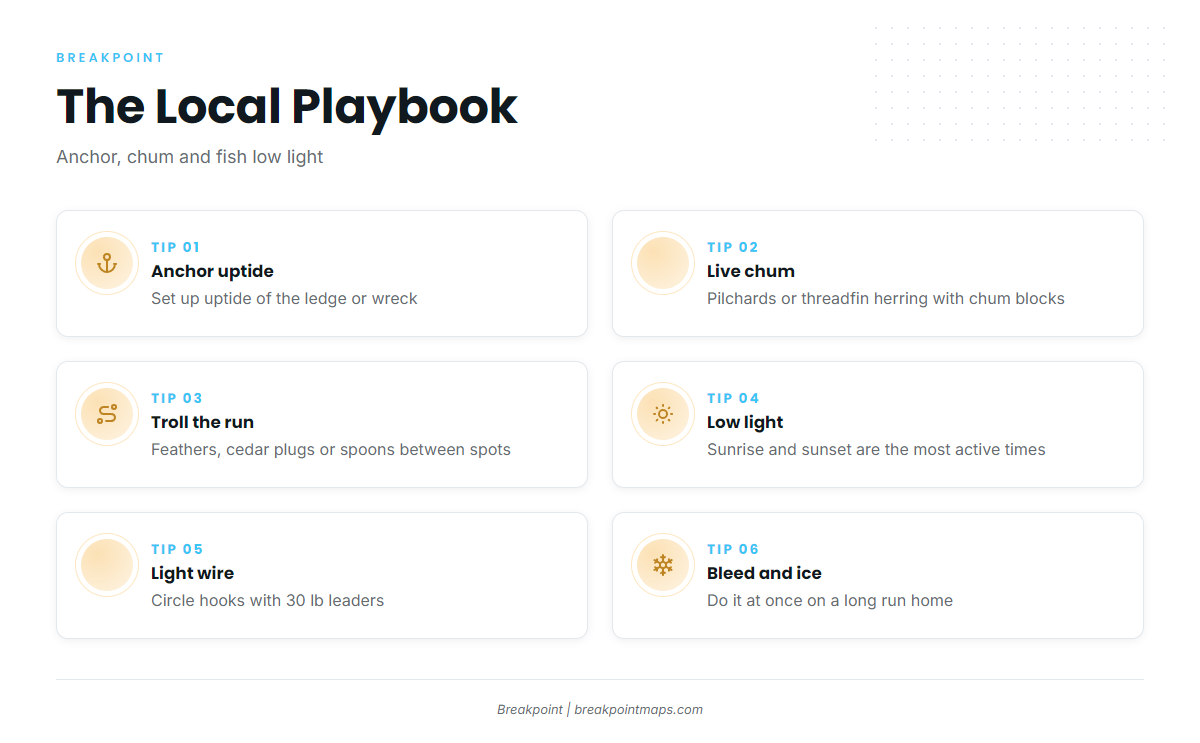
The local approach is to anchor uptide of structure, chum with live bait, and fish the low-light hours. General rigging is covered in our blackfin tuna species guide.
- Anchor uptide and live chum. Use pilchards or threadfin herring. A local forum angler pairs live baits with chum blocks.
- Flat-lines. Drift unweighted live baits back through the chum slick.
- Troll on the run. Pull small feathers, cedar plugs, skirts or spoons to search water between spots, per a local fishing site.
- Vertical jig over structure. Mark bait on the sounder over ledges and wrecks, then drop to the fish.
- Fish the light. Blackfin are most active around sunrise and sunset, per Salt Water Sportsman.
- Terminal tackle. A Sarasota charter source recommends light-wire circle hooks and 30 lb leaders.
- Bleed and ice. Bleed fish right away and get them on ice, which matters on a 40 to 75 mile run home.
Plan the run before you plan the fishing. Carry a fuel reserve, expect an 8+ hour day and wait for a real weather window. Check National Weather Service marine forecasts and National Data Buoy Center offshore buoys before you leave the dock, and keep in mind that forecasts can miss.
Frequently Asked Questions
How far offshore are blackfin tuna off Sarasota?
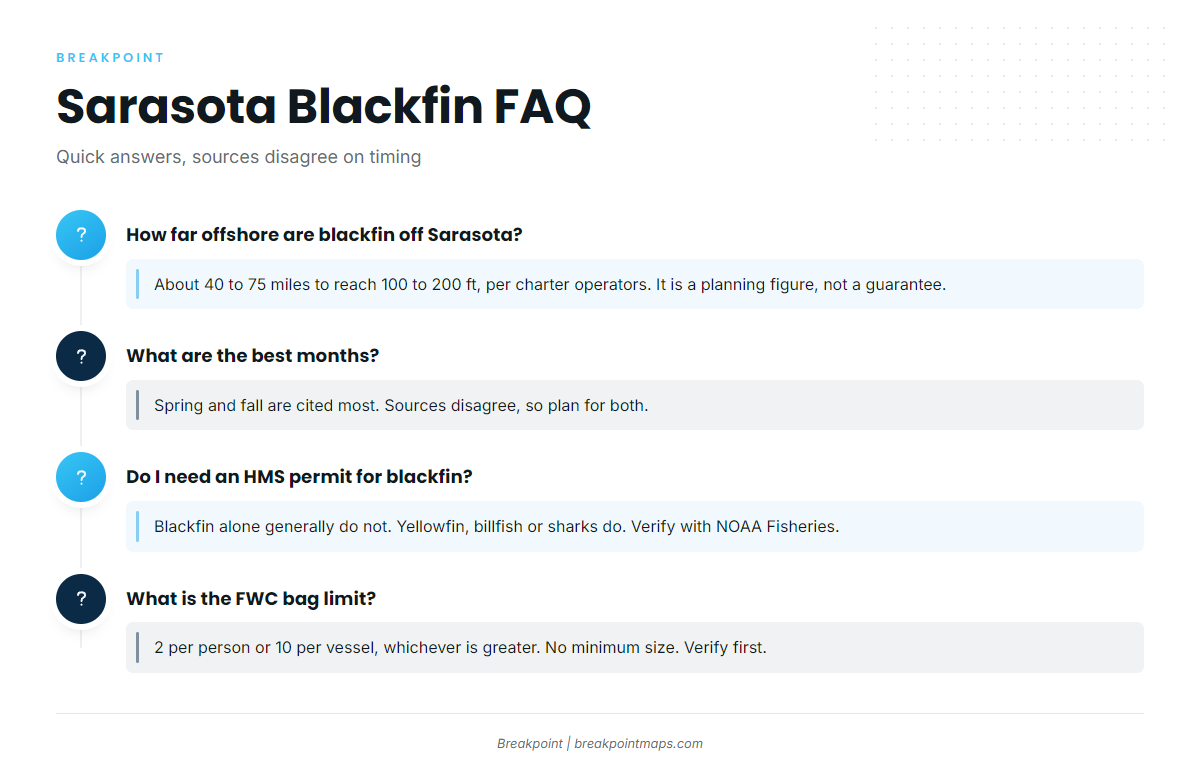
Plan on about 40 to 75 miles to reach the 100 to 200 ft zone, per local charter operators. Reports range from 20 to 80+ miles, so treat that as a planning figure and not a guarantee. Weather, fuel and where the bait is holding decide the actual run.
What are the best months for blackfin off Sarasota?
Spring and fall transitions are most cited. One charter source lists April through July and September through November. Summer depth reports and year-round claims also exist. Sources disagree, so build flexibility into your dates.
Do I need an HMS permit for blackfin tuna?
Blackfin alone generally do not require one, because they fall outside NOAA Fisheries’ Atlantic HMS tuna unit. You do need one if you target or keep yellowfin, billfish, swordfish or sharks. Verify your situation with NOAA Fisheries before you go.
What is the FWC bag limit for blackfin tuna?
The limit is 2 per person or 10 per vessel, whichever is greater, with no minimum size. Limits can change, so verify on the FWC site before you fish.
What depth holds blackfin off Sarasota?
Roughly 100 to 200 ft, over ledges, wrecks and artificial reefs. Darren Blum reported large summer blackfin in 130 to 200 ft, with fish averaging 20 pounds. Structure and bait matter more than any single depth number.
Close
A Sarasota blackfin day depends on four things: the distance across the shelf, structure that holds bait, a timing window where sources disagree, and the rules you fish under. We can’t promise fish, but we can help you decide where to look.
That is where Breakpoint fits into planning blackfin tuna off Sarasota. Before you commit to the run, check OBS SST and Chlorophyll to see where a temperature edge and color change sit relative to the run from New Pass or Venice Inlet. Use Chart Contours to find the 100 to 200 ft band. Satellite passes can be blocked by cloud, and chart layers are not for navigation.