


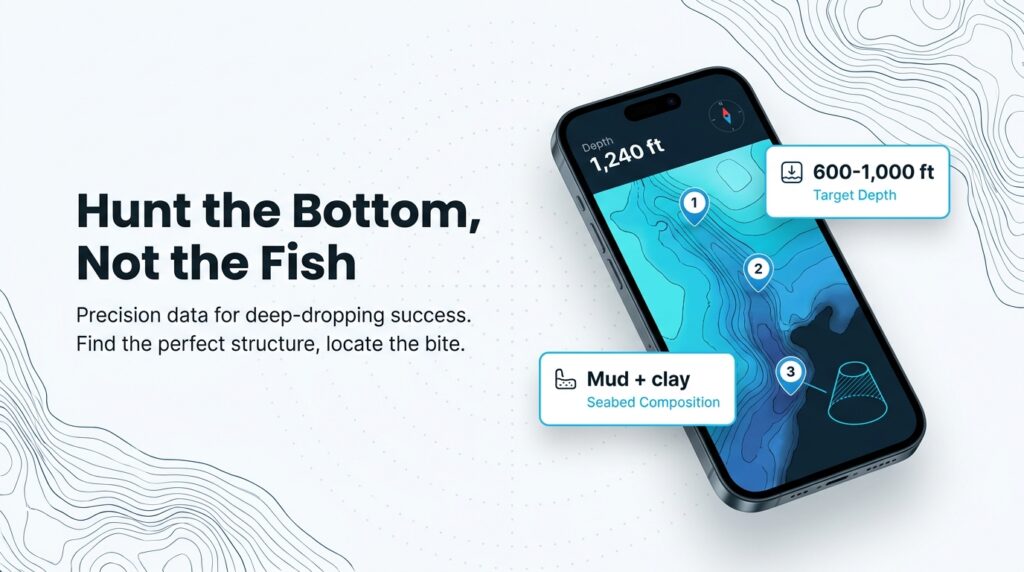
Golden tilefish live in burrows on the mud and clay of the continental slope. NOAA Fisheries and the South Atlantic Fishery Management Council (SAFMC) place the species in 250 to 1,500 ft of water, and most anglers fish it at roughly 600 to 1,000 ft. South Atlantic federal waters are closed to recreational harvest through December 31, 2026. For Gulf rules, check the Gulf Council and Florida Fish and Wildlife Conservation Commission (FWC) directly.
This guide draws on what NOAA Fisheries, SAFMC and experienced deep-droppers report. It covers how to identify the fish, where it lives, what gear it takes, and whether you can keep one.
| Quick facts | Detail |
|---|---|
| Scientific name | Lopholatilus chamaeleonticeps |
| Depth | 250 to 1,500 ft (SAFMC). Most fished at roughly 600 to 1,000 ft. |
| Bottom | Mud and clay on the outer shelf and upper continental slope. Fish live in cone-shaped burrows. |
| Bottom temperature | 49° to 58°F (SAFMC) |
| Range | Nova Scotia to Suriname, including the Gulf (NOAA Fisheries) |
| Stocks | Mid-Atlantic, South Atlantic and Gulf (NOAA Fisheries) |
Overview: Identification and Behavior
Golden tilefish are slow-moving and tied to one patch of bottom, and that shapes how you search for them.
How to Identify a Golden Tilefish
Anglers describe a golden tilefish as having an iridescent blue-green back covered in bright gold and yellow spots, a rosy head and a white belly. The fastest field ID is the fleshy flap on top of the head behind the eyes, often called a crest or adipose flap. It looks like a small rudder.
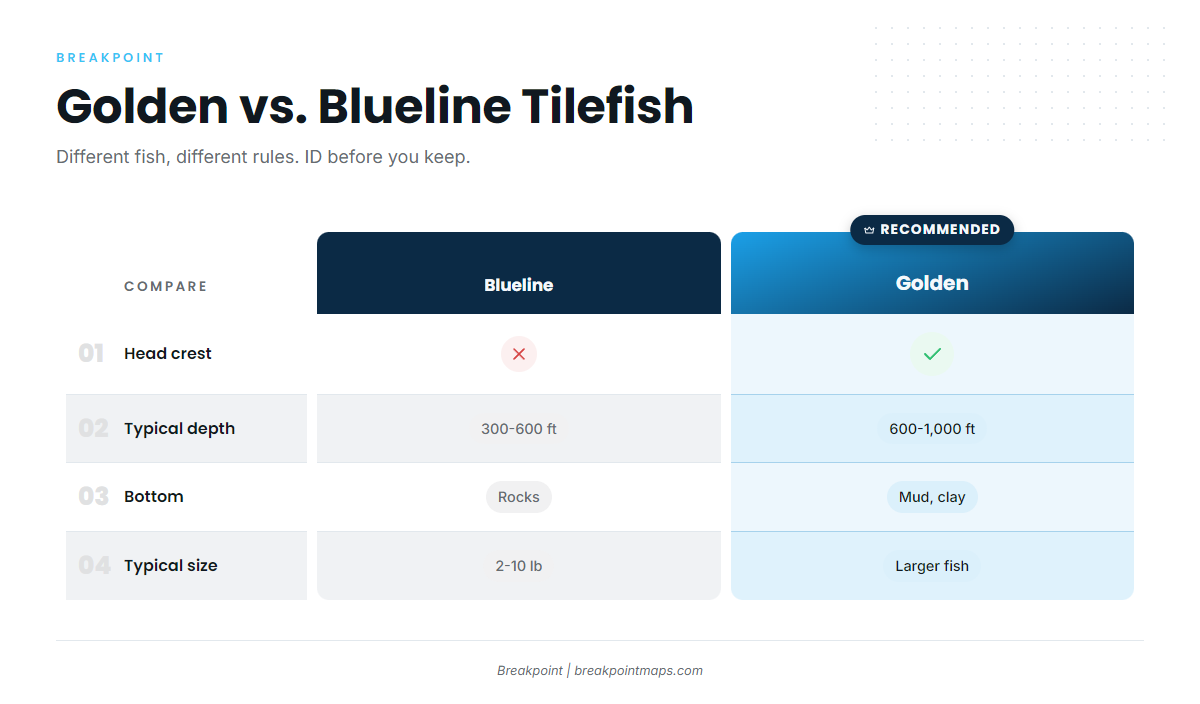
The golden’s closest relative in the same water is the blueline tilefish. This table separates them:
| Golden | Blueline | |
|---|---|---|
| Head | Fleshy crest on top of the head | No prominent crest |
| Typical depth | Roughly 600 to 1,000 ft, anglers report | Roughly 300 to 600 ft |
| Bottom | Soft mud and clay | Rocks and boulders |
| Typical size | Larger fish | Commonly reported at 2 to 10 lb |
| Legal note | Separate season and quota in the South Atlantic | Separate season and quota in the South Atlantic |
Identification matters legally as well. In the South Atlantic, the two species have different seasons and quotas, so a misidentified fish can be an illegal fish. Check the current blueline season with NOAA Fisheries or SAFMC before you fish. You may also hear anglers mention goldface tilefish, another relative found in deep water.
Behavior: A Fish That Lives in the Bottom
According to SAFMC, golden tilefish live in cone-shaped burrows and concentrate in small groups or pods. FishTalk reports that they don’t migrate or move much, so anglers can target them at virtually any time of year.
The species is widely described as long-lived and slow-growing. That is a large part of why managers watch it closely and why the rules change as assessments come in.
Because the fish lives in a hole in the mud, you search the bottom rather than the water column.
Habitat & Range
Depth and bottom type decide where you fish, and the transition from soft to hard bottom is the place to start.
Depth and Temperature
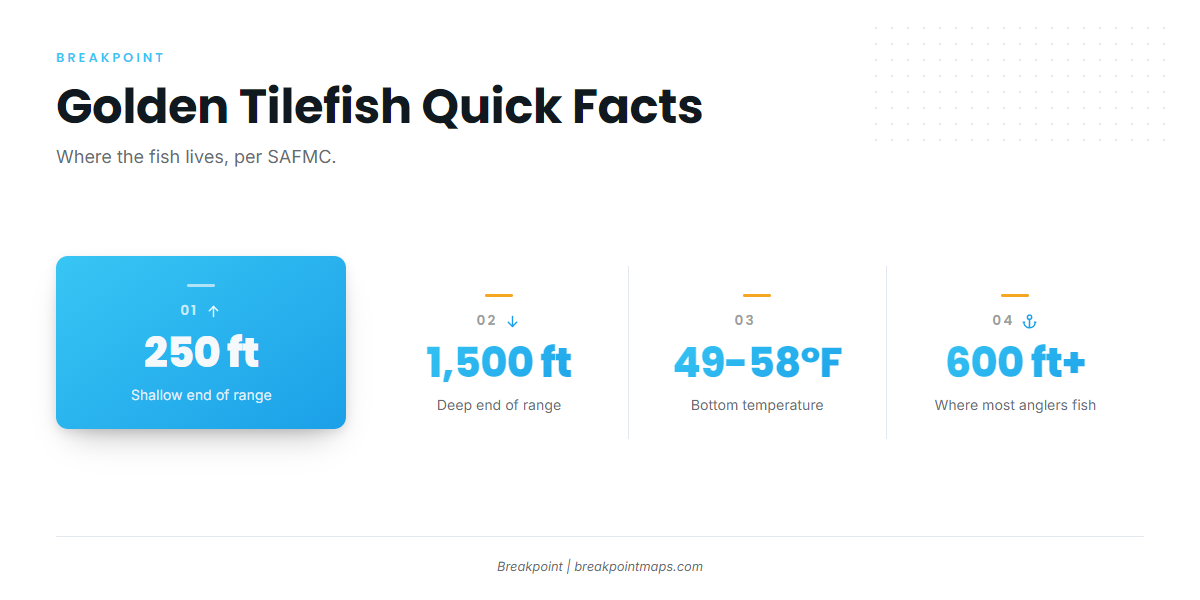
Golden tilefish live on the outer continental shelf and upper slope in 250 to 1,500 ft of water, where bottom temperatures run 49° to 58°F, according to the SAFMC golden tilefish profile. Most anglers fish roughly 600 to 1,000 ft over soft mud.
Angler sources disagree a little on the sweet spot. One publication puts it at 600 to 1,000 ft, and another says 600 to 800 ft. SAFMC’s range is the outer boundary, and the productive band is likely narrower.
Bottom Type: Mud, Clay, and the Transition
A Miami charter captain reports that goldens seek soft bottom such as clay and build conical burrows that they guard. Anglers describe the best fishing where soft bottom meets scattered hard patches. If you can find that seam inside your depth band, you have a place to start.
- Mud and clay hold the burrows. This is the core habitat.
- Scattered hard patches nearby are where anglers report fish concentrating.
- The continental slope gives you the depth and the gradual grade the species favors.
What the Data Can’t See
A note on what the data misses. Productive tilefish mud "looks like nothing at all" on sonar, according to reading mud bottom for goldens. The screen shows a flat or gently sloping line with no marks and no relief. The fish are inside the substrate, not above it.
Bathymetry has the same limit. Much slope bathymetry is coarse, and charts show depth and shape but not burrows. Many anglers run dual-frequency or CHIRP sonar to read bottom hardness, which is worth copying.
Gulf of Mexico
NOAA Fisheries manages golden tilefish as a separate Gulf stock. Anglers commonly cite the Mississippi Canyon area for Gulf tilefish. That comes from secondary sources, so treat it as a place to start reading charts rather than a coordinate.
- Managed as its own stock, apart from the Atlantic
- Soft-bottom slope habitat is the common thread
South Atlantic
Anglers report that the Outer Banks holds both golden and blueline tilefish in roughly 600 to 1,200 ft. That figure comes from a secondary source. Use it as orientation, and check the chart before you commit to a run.
Gulf vs. Atlantic
The Gulf Stream is a logical factor here, not sourced data. Stronger current in the Atlantic means more line scope, a heavier lead and harder bottom-holding than a typical Gulf drift.
Bite timing and moon and current effects on tilefish are poorly documented.
Tactics: How to Deep Drop for Golden Tilefish
Deep dropping means fishing bait on the bottom in hundreds of feet of water, usually with heavy lead and often an electric reel. Golden tilefish call for gear sized to depth and patience with a screen that shows nothing.
If you fish the Mid-Atlantic, note that the Greater Atlantic rules (5 hooks per rod, an 8-fish limit and a Private Recreational Tilefish Permit) apply from Maine to Virginia only.
1. Finding Bottom
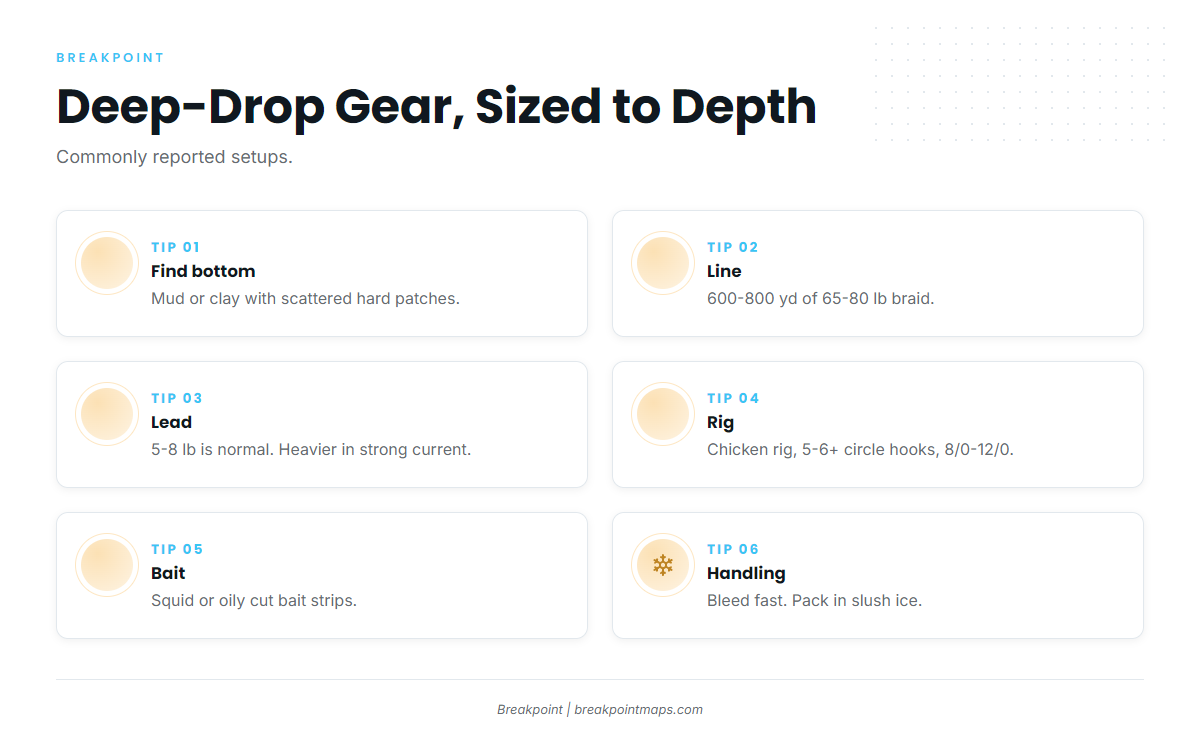
Reading bottom composition is the most important skill in this fishery. Pick a depth band, look for mud or clay with scattered hard patches, and start fishing.
A common mistake is leaving a spot because the screen shows no marks. The fish are in the mud.
2. Gear
There are two common approaches:
- Hand-crank setup: Bent-butt rods are common. Use a conventional reel holding 600 to 800 yd of 65 to 80 lb braid, per FishTalk’s deep-dropping breakdown.
- Commercial-style setup: A commonly described commercial rig uses an electric reel, 100 lb braid, a 300 lb mono backbone and 80 lb mono droppers crimped to circle hooks.
- Lead: A 5 to 8 lb weight is normal, according to the Tackle Room tilefish guide. Some anglers go heavier in strong current.
- Electric reel or not: Hand cranking works with the capacity above. Electric reels make repeated drops at 600 to 1,000 ft practical.
3. The Rig
The standard is a chicken rig, a multi-hook dropper also called a "meat curtain." FishTalk describes at least 5 or 6 circle hooks, sized 8/0 to 12/0. Many anglers add a small glow tube at or near the hooks.
Circle-hook and hook-count rules differ by region. See the Regulations section and confirm with the official source before you rig.
4. Bait and Lights
Squid is the standard bait. Oily cut baits such as bonito, skipjack or barracuda strips stay on the hook, per Miami captain’s tilefish tips. Some anglers use clams.
A deep drop light may help attract fish, though that benefit is angler-reported, not measured.
5. Boat Control
- Set up upcurrent so the drift carries the rig across the target band.
- Keep the line near vertical.
- Re-drop when you lose bottom.
Snowy grouper and yellowedge grouper are commonly encountered deep-water species on the same bottom.
Running to 500 to 1,000 ft of water often means a long offshore trip. Check the weather, the fuel margin and the safety gear before you go.
6. Handling and Table Quality
Tilefish are high in fat, so the fish deteriorates fast. The Tackle Room advises bleeding it immediately and packing it in slush ice. Anglers widely describe the flesh as sweet, white and crab- or lobster-like.
Golden Tilefish Regulations (Gulf and South Atlantic)
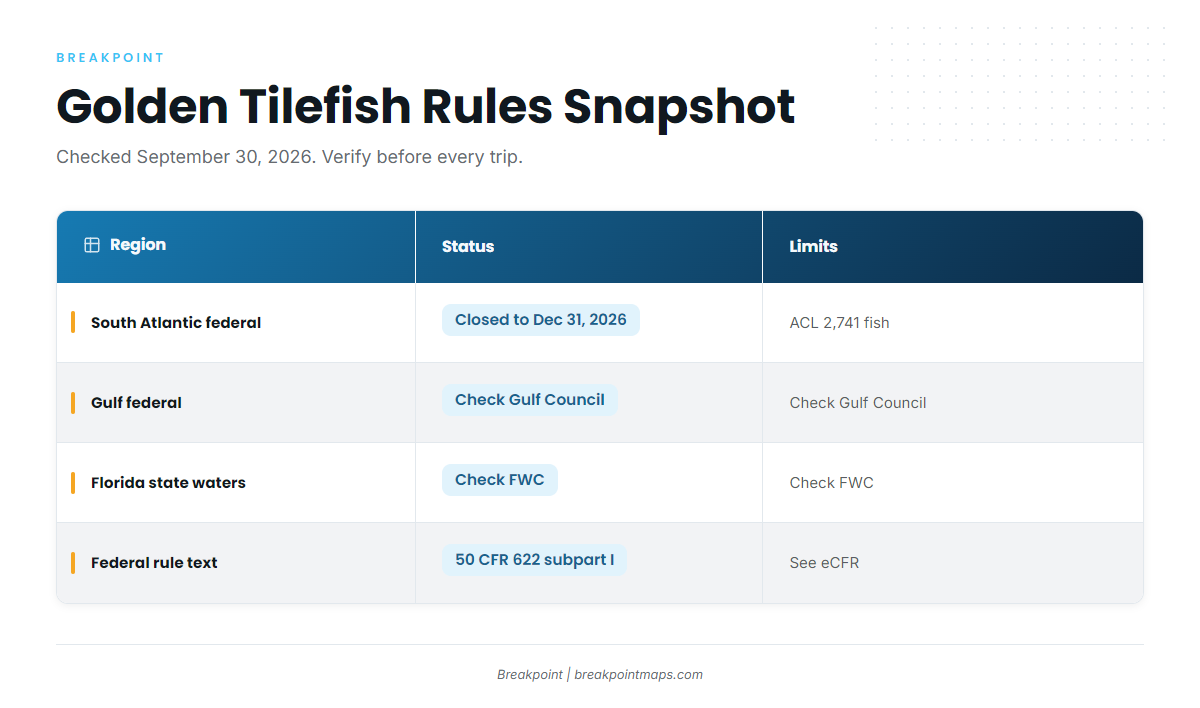
Rules for golden tilefish are shaped by slow growth. They change with assessments and quota projections, so verify before every trip.
- South Atlantic federal status: The 2026 recreational season opened January 1 and closed at 12:01 a.m. on March 27, 2026. It stays closed through December 31, 2026, per the NOAA 2026 season announcement.
- Annual catch limit (ACL): An annual catch limit is the total catch a fishery is allowed each year. The 2026 recreational ACL is 2,741 fish. The season closes when NOAA projects landings will reach it.
- Aggregate bag limit: An aggregate bag limit caps the combined number of several species you can keep. Both the Gulf and the South Atlantic manage deep-water species this way. The exact numbers change, so confirm them with the Gulf Council, SAFMC and NOAA Fisheries.
| Region | Managing body | Status | Limits | Official source |
|---|---|---|---|---|
| South Atlantic federal | SAFMC / NOAA Fisheries | Closed through Dec 31, 2026 | ACL 2,741 fish. Bag limit: check SAFMC. | NOAA season announcement (linked above) |
| Gulf federal | Gulf Council / NOAA Fisheries | Check the Gulf Council | Check the Gulf Council | Gulf Council |
| Florida state waters | FWC | Check FWC | Check FWC | FWC |
| Full federal text | NOAA Fisheries | See regulations | See regulations | federal regulations in 50 CFR |
Swipe the table sideways to see every column.
Descending-device requirements apply to federal reef-fish trips in these regions. The specifics have changed in recent years, so confirm the current details with NOAA Fisheries and the council before you go.
Quotas can close seasons early, so verify the rules before every trip.
Stewardship: Barotrauma and Release
Barotrauma is pressure injury from rapid ascent, which swells the swim bladder and can push the stomach out of the mouth. Fish brought up from hundreds of feet often show it.
Use a descending device for any fish you release. It is a practical way to protect a long-lived, slow-growing fish that NOAA manages by stock. The South Atlantic stock is not overfished and not subject to overfishing, per NOAA’s 2025 assessment, which reflects careful management and is no reason to relax.
Frequently Asked Questions
How deep do golden tilefish live?
SAFMC reports golden tilefish in 250 to 1,500 ft of water, with bottom temperatures of 49° to 58°F. Anglers most often fish roughly 600 to 1,000 ft over soft mud. The productive band is usually much narrower than the full range.
What is the difference between golden and blueline tilefish?
The golden has a fleshy head crest, lives deeper and favors mud. The blueline is shallower (about 300 to 600 ft), found around rocks and commonly reported at 2 to 10 lb. South Atlantic rules differ for each, so correct ID is a legal matter.
Is golden tilefish good to eat?
Yes. Anglers widely describe the flesh as sweet, white and crab- or lobster-like. The high fat content means the fish spoils fast, so bleed it and pack it in slush ice, per the Tackle Room. Check current FDA and EPA advisories for mercury guidance.
Is the golden tilefish season open in 2026?
In South Atlantic federal waters, no. NOAA closed the recreational season March 27, and it stays closed through December 31, 2026. For the Gulf, check the Gulf Council and FWC.
Do I need an electric reel for golden tilefish?
No. A conventional reel holding 600 to 800 yd of 65 to 80 lb braid works, per FishTalk. An electric reel makes repeated drops at 600 to 1,000 ft easier on the angler.
Finding Tilefish Bottom with Breakpoint
Golden tilefish live in burrows, so you hunt bottom type. Find the right depth band where soft bottom meets hard patches, size your gear to the depth, and check the rules before you leave the dock.
Breakpoint’s Hotspots and Fish Intel, read alongside the Chart Contours layer, can help you narrow where the right depth and bottom meet before you run. The aim is a better decision about where to look, not a promise of fish. Chart layers are not for navigation.