


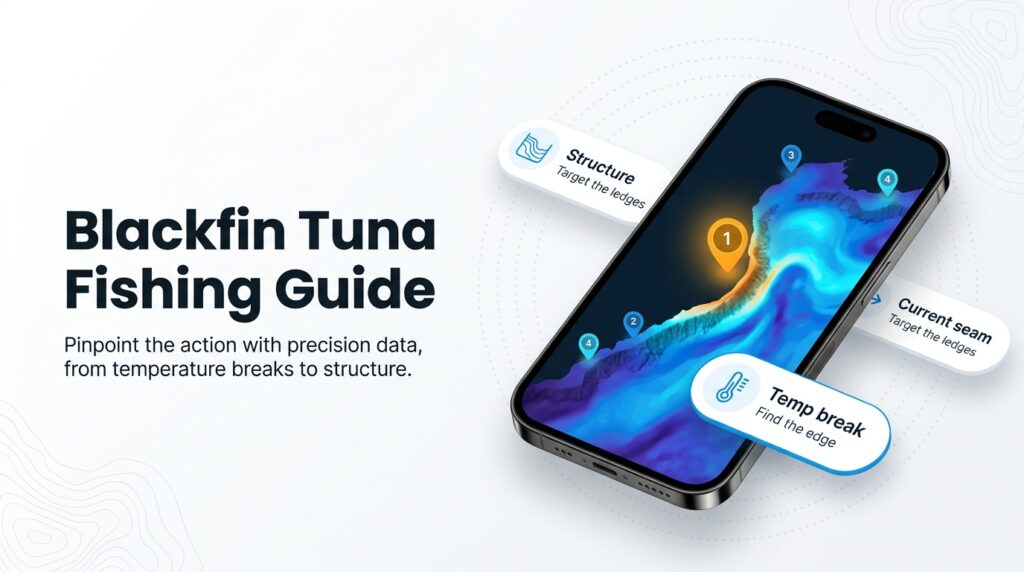
Blackfin tuna (Thunnus atlanticus) are the smallest tuna in the Atlantic, and most run 5 to 20 pounds. They hold near rigs, humps and Gulf Stream edges within center-console range of many Gulf and Southeast ports.
This guide covers how to identify the fish, where it holds, what gear to bring and which rules apply. Interest in the species keeps climbing. According to peer-reviewed research, recreational landings have more than tripled, from about 87,000 fish per year in 1981 to 1985 to about 294,000 per year in 2015 to 2019.
We give sourced specifics and say where the sources disagree. We don’t promise fish. Regional pages go deeper on individual fisheries, and links to them appear below.
Overview
Blackfin are a small, fast, schooling tuna of the warm western Atlantic. They are identified by dusky finlets and short pectoral fins.
Alt text: Blackfin tuna side profile showing dark back, gold lateral band and dusky finlets without bright yellow
What does a blackfin tuna look like?
Blackfin tuna have a dark blue-black back, silver sides, a bronze to gold lateral band, and dusky finlets that are not bright yellow. NOAA’s Atlantic tuna identification guide gives three checks: pectoral fin length, the absence of the yellowfin belly dot-and-line pattern, and finlet color.
Some angler and retail sources describe yellow or yellow-edged finlets. We follow NOAA, which describes dusky finlets rather than bright yellow ones. Light and fish condition can make color look different on deck.
How do you tell blackfin from yellowfin, skipjack and little tunny?
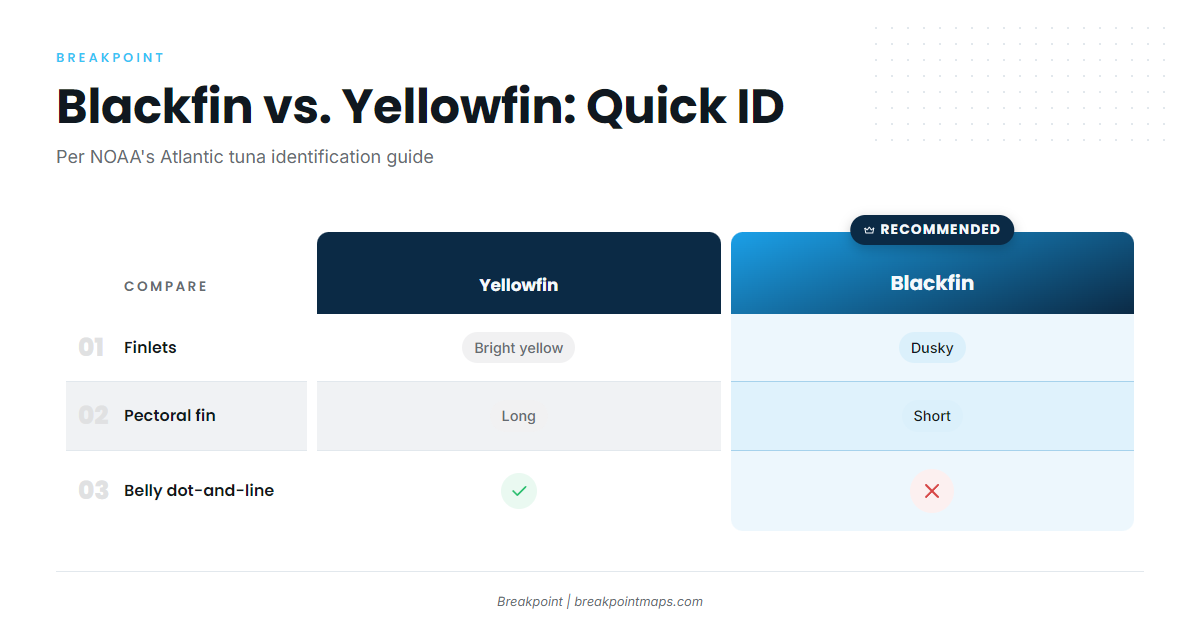
Finlet color, pectoral fin length and belly or back markings separate these four fish fastest.
| Species | Finlets | Pectoral fin | Belly markings | Back pattern |
|---|---|---|---|---|
| blackfin tuna | Dusky, not bright yellow | Short, does not reach past the second dorsal origin | No dot-and-line pattern | Dark blue-black, no stripes |
| yellowfin tuna | Bright yellow | Long, extends beyond the second dorsal origin | Dot-and-line pattern | Dark back, yellow lateral band |
| skipjack tuna | Verify against the NOAA guide | Verify against the NOAA guide | Verify against the NOAA guide | Verify against the NOAA guide |
| little tunny | Verify against the NOAA guide | Verify against the NOAA guide | Verify against the NOAA guide | Verify against the NOAA guide |
Swipe the table sideways to see every column.
The blackfin and yellowfin rows come from NOAA. For skipjack and little tunny, use the same NOAA guide on deck. Little tunny carry spotting and back markings that blackfin lack.
Juvenile yellowfin can pass for blackfin at a glance. When in doubt, check the pectoral fin length and the belly pattern before you keep the fish. Yellowfin fall under different federal rules.
How big do blackfin tuna get?
Most blackfin run 5 to 20 pounds. Regional size varies, and these figures come from charter reports, not agency surveys.
- Northern Gulf rig fish average around 10 to 15 lb, per night rig speed jig reports.
- Florida Keys spring-migration fish and Panhandle fall fish are reported at 20 to 35 lb.
Sources also disagree on averages. One retail source claims a 45 lb average, which contradicts nearly everything else we found. Blackfin size is best read as a range.
How do blackfin tuna behave?
Blackfin school, feed near the surface around bait, and are boat-shy and sharp-eyed. Charter sources report the following:
- They bite most around dawn and dusk.
- They hit topwater lures more readily than yellowfin.
- They form mixed schools with skipjack.
Blackfin also eat well. The meat is lighter and milder than yellowfin, and it works for sashimi or a quick sear. It is best when bled and iced fast. The Tactics section covers handling.
Habitat & Range
Blackfin range through warm western Atlantic waters, including the Gulf of Mexico (NOAA references now use "Gulf of America"), the Florida Straits and the Southeast coast north to about North Carolina. They concentrate where bait, temperature, current and structure meet.
Why do temperature breaks and structure hold blackfin?
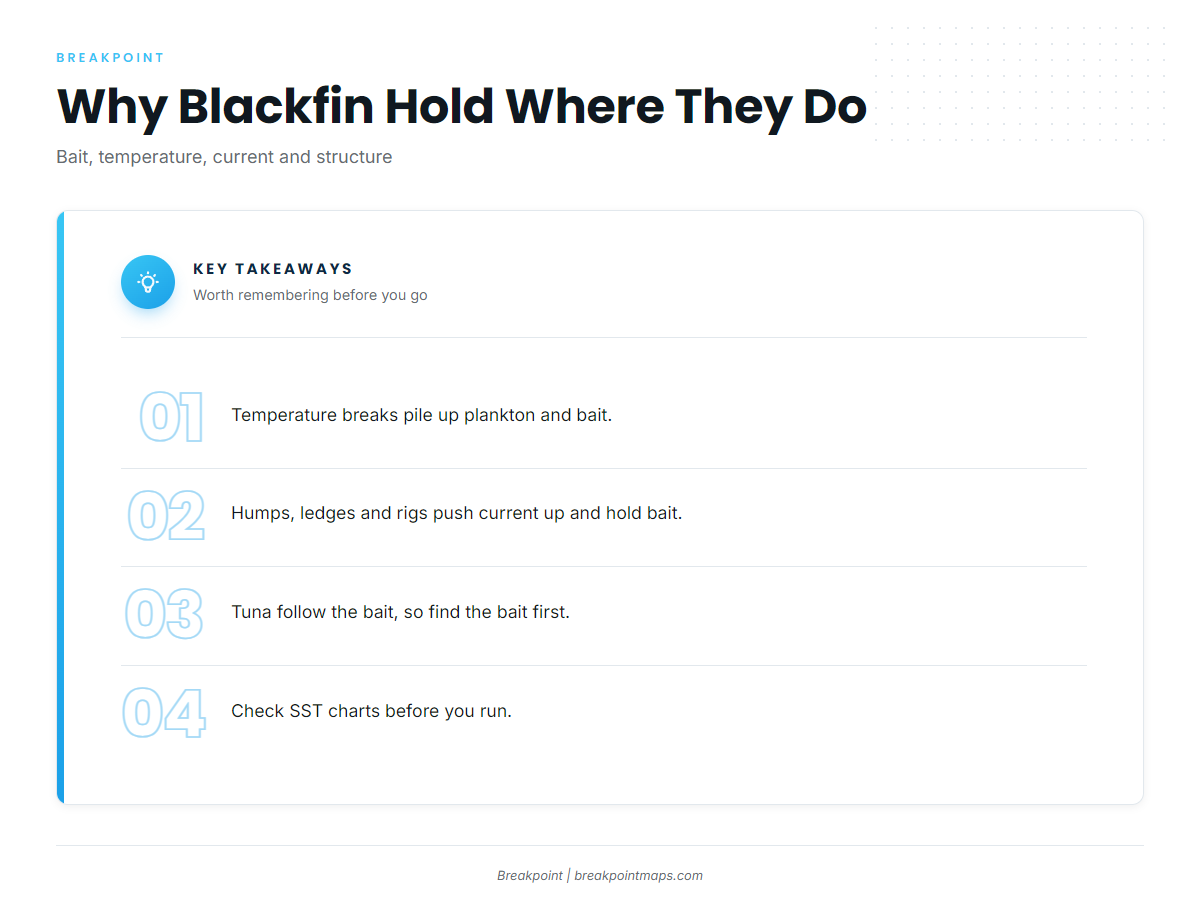
A temperature break or current seam piles up plankton and bait. Structure such as humps, ledges and rigs pushes current up and holds bait in place, and tuna follow the bait.
Structure that holds blackfin includes:
- Oil and gas platforms
- Deepwater humps, such as the Islamorada Hump
- The Gulf Stream edge
- Weed lines
- Reef edges
- Shrimp boats
Sea surface temperature charts show temperature breaks and the Gulf Stream edge before you burn fuel. They see only the surface, which is covered below.
Blackfin in the Gulf of Mexico
In the northern Gulf, blackfin hold around oil and gas platforms and lumps and are caught year-round. Charter reports say night fish hold tight to the rigs and average 10 to 15 lb. Our guide to blackfin tuna fishing in the Gulf of Mexico covers the rig fishery in more depth.
The eastern Gulf and Panhandle fish differently. One charter source reports a season that runs from mid-March to Christmas, with a peak from the August full moon to just after the November full moon, per Emerald Coast charter season reports. For a local example of an eastern Gulf fishery that works differently from the northern rigs, see blackfin tuna off Sarasota.
Blackfin in the Atlantic Southeast
On the Atlantic side, blackfin follow the Gulf Stream, from the Florida Keys humps north to Cape Hatteras. Our page on blackfin in the Atlantic Southeast goes deeper.
- Keys: charter captains in Miami report larger 20 to 35 lb fish on the spring migration, and fish returning in numbers to humps and wrecks in October and November.
- Hatteras: Hatteras winter blackfin reports put fish stacked up from November through April where the Gulf Stream runs closest to shore, holding in 90 to 200 ft over humps and ledges.
Region at a glance
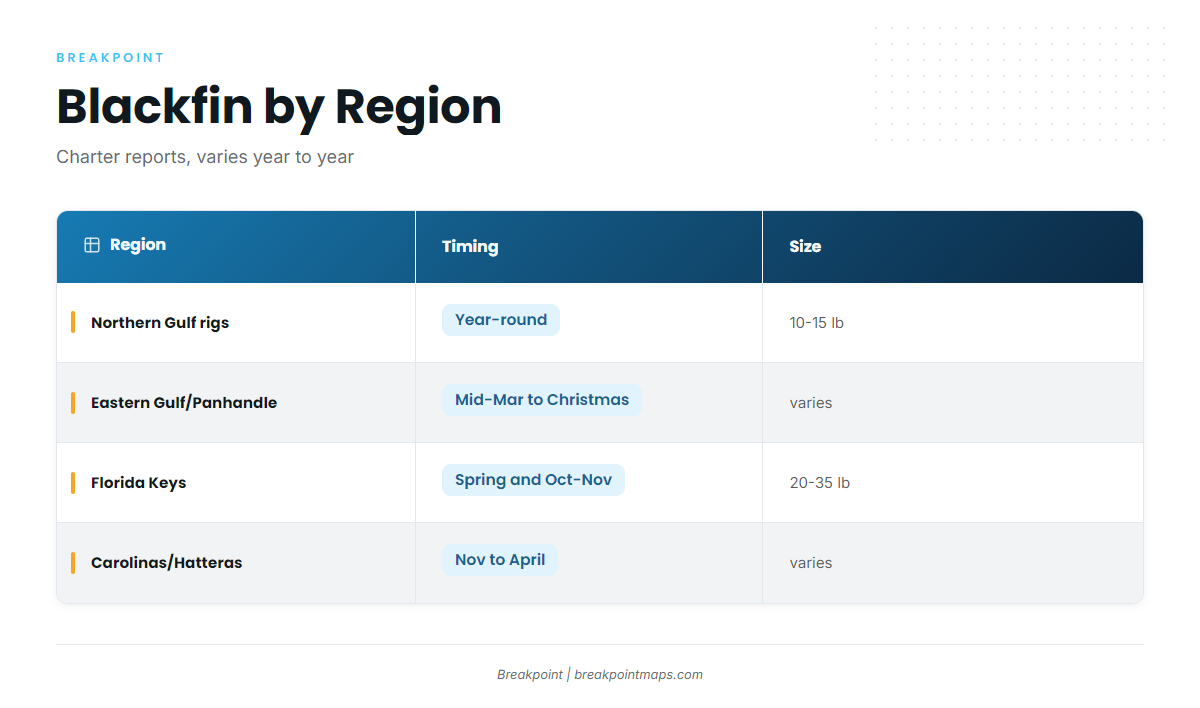
| Region | Typical structure | Timing (charter reports, varies year to year) | Reported size |
|---|---|---|---|
| Northern Gulf rigs | Oil and gas platforms, lumps | Year-round | 10 to 15 lb |
| Eastern Gulf/Panhandle | Rigs, humps, reef edges | Mid-March to Christmas, peak August to November full moons | Varies |
| Florida Keys | Humps, bars, wrecks | Spring migration, return in October and November | 20 to 35 lb in spring |
| Carolinas/Hatteras | Humps and ledges near the Gulf Stream | November through April | Varies |
What the data can’t tell you
Satellite sea surface temperature sees only the surface skin, and clouds block passes. SST does not show subsurface structure or where the bait is today.
Seasonal windows also conflict between sources, and fish move with bait and temperature. Any chart or page, this one included, is useful for choosing where to start looking, but it can’t tell you where the fish are.
Regional guides
- Blackfin tuna fishing in the Gulf of Mexicorigs, lumps and the northern Gulf fishery
- Blackfin tuna fishing in the Atlantic SoutheastKeys humps and the Gulf Stream to Hatteras
- Blackfin tuna off Sarasotaone local example of an eastern Gulf fishery
Tactics
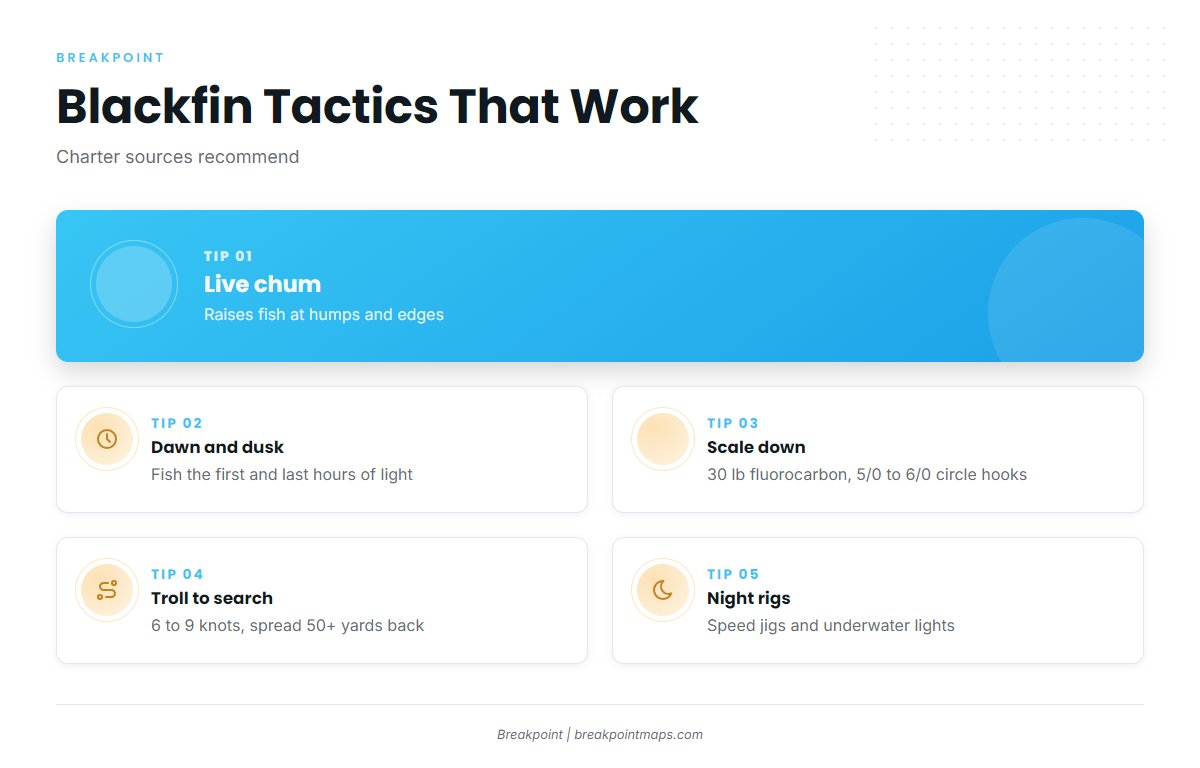
Live bait and live chum outproduce lures. Scale leaders down, and fish the first and last hours of light.
Starter tackle
Charter sources recommend the following:
- A 6 to 7 ft medium-heavy spinning rod
- A 4000 to 8000 size reel
- 30 to 50 lb braid
- 4 to 6 ft of 30 to 40 lb fluorocarbon leader
- 5/0 to 6/0 circle hooks
Humps and edges: live chumming
At a hump or edge, live chum is the most reliable way to raise blackfin. Charter captains report that live pilchards thrown as chum bring fish up, and that a fresh live bait on a kite or flat line "will outproduce lures, chunks or jigs." They run 30 lb fluorocarbon with 5/0 to 6/0 circle hooks.
We’d start with live chum at a hump before trolling blind.
Rigs at night: speed jigs and lights
Night rig blackfin hold tight to the structure and hit vertical speed jigs. Charter reports point to chartreuse, blue or green jigs, and note that underwater lights can draw fish off the rig. The Gulf page on blackfin tuna fishing in the Gulf of Mexico has more on working rigs.
Trolling to search
When fish are scattered, troll small feathers and cedar plugs to find them. Charter captains report running lures at 6 to 9 knots and setting the spread at least 50 yards back, because blackfin are boat-shy. Watch for diving birds and bait spraying at the surface.
Jigging and topwater
Vertical jigging over humps and ledges works when fish are marked below the boat. When blackfin blitz at the surface, cast topwater lures into the school.
Shrimp boats
Chunking bycatch behind shrimp boats is a traditional Gulf tactic. It is common practice rather than a sourced method, so treat it as local knowledge and ask around before you try it.
If you already fish yellowfin
- Blackfin are more boat-shy and leader-shy.
- They are more willing to hit topwater.
- Scale leaders and hooks down.
- Run the trolling spread further back.
Sharks, handling and bleeding
Sharks take hooked blackfin at rigs and humps, so land fish fast and move when sharks show up. Bleed fish right away and get them on ice to protect table quality. The Regulations section covers landing and release rules.
FAQ
Is blackfin tuna good to eat?
Yes. Blackfin meat is lighter and milder than yellowfin, and it works well for sashimi or a quick sear. Quality depends on handling, so bleed the fish right away and get it on ice fast.
How big do blackfin tuna get?
Most run 5 to 20 lb. Charter reports put northern Gulf rig fish around 10 to 15 lb, and Florida Keys spring fish and Panhandle fall fish at 20 to 35 lb. Sizes vary by region and season.
Do I need an HMS permit for blackfin tuna?
Blackfin tuna appear to be the exception to the federal HMS Angling permit requirement. Verify before you fish, especially if you might also hook yellowfin.
What is the difference between blackfin and yellowfin?
NOAA’s identification guide points to three checks. Blackfin have short pectoral fins, dusky finlets, and no dot-and-line belly pattern. Yellowfin have long pectoral fins, bright yellow finlets and the belly pattern. See the ID table above.
Where are blackfin tuna found?
Blackfin range through the warm western Atlantic, including Gulf rigs and lumps, the Florida Keys humps and the Gulf Stream up to Cape Hatteras. They gather where bait, temperature breaks, current and structure meet.
What is the Florida bag limit for blackfin tuna?
Florida FWC lists 2 fish per person or 10 fish per vessel, whichever is greater. Check the FWC page before you fish, since limits can change.
What is the best time of day for blackfin?
Charter sources report the best bites around dawn and dusk. At northern Gulf rigs, the night bite is also well known, with fish holding tight to the structure.
Where to Start Looking
Blackfin move with bait and temperature, so no page can tell you where they are this week. Breakpoint’s Fish Intel hotspots layer recent OBS SST and Chlorophyll, with Chart Contours for the structure, so you can pick a starting edge before you burn fuel. Chart layers are not for navigation.