


Striped marlin (Kajikia audax) are the billfish that Southern California and northern Baja anglers are most likely to see tailing on a calm fall afternoon. The NOAA Fisheries striped marlin profile describes them as a "highly migratory fish living at the top of the food chain in the tropical and subtropical regions of the Pacific and Indian Oceans." Local seasons swing widely from year to year with water temperature, and in some years the fish barely show.
This guide covers how to identify striped marlin, where and when they tend to show up, a baseline approach from search troll to release, and the rules on both sides of the border. It is a summary of the available data, not a promise of fish.
Overview: Identifying Striped Marlin and How They Behave
Striped marlin are the smallest and most commonly encountered marlin in the Pacific Southwest. They have a tall, pointed first dorsal fin, pale blue vertical bars and a slim, compressed body, and they often feed at the surface.
NOAA Fisheries states that striped marlin "are smaller than other marlin species, but can reach a length of 12 feet and weigh more than 450 pounds." Most fish off Southern California will be well under that ceiling.
The stripes are the signature. Animal Diversity Web describes 10 to 20 blue bars running from head to tail. Anglers widely report that the bars glow brighter when a fish is excited or feeding.
Striped Marlin vs Blue Marlin, Black Marlin and Sailfish
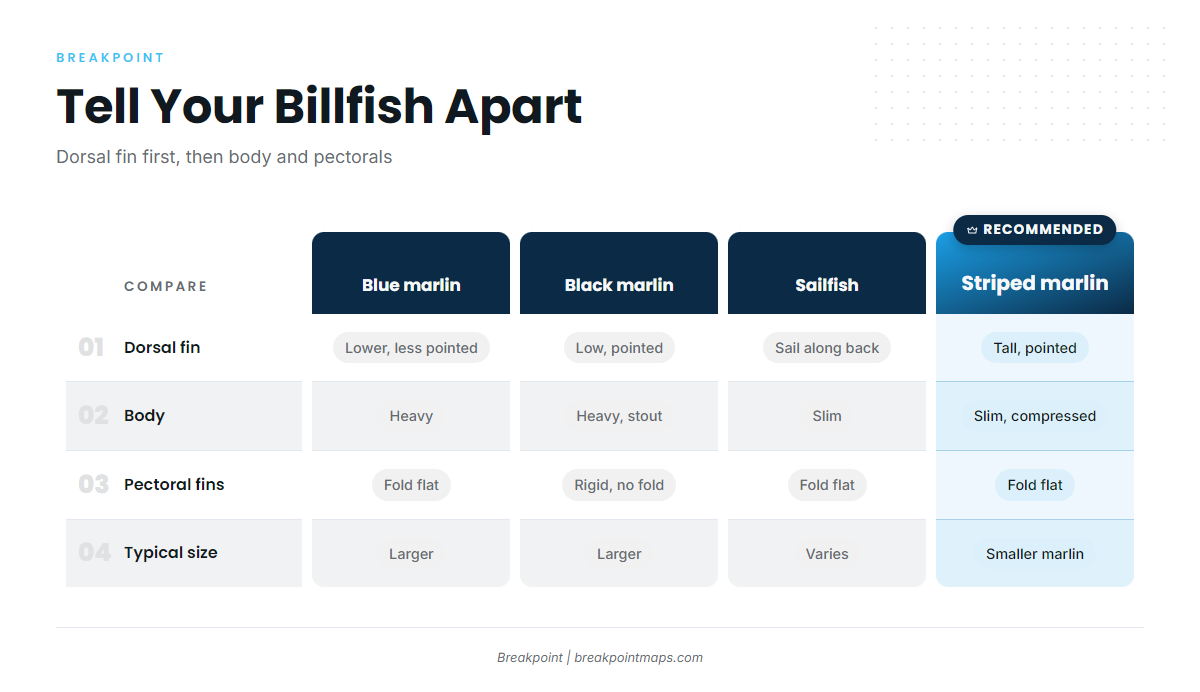
Check the dorsal fin first, then the body and pectorals.
| Feature | Striped marlin | Blue marlin | Black marlin | Sailfish |
|---|---|---|---|---|
| Dorsal fin | Tall and pointed at the front, tapering toward the tail | Lower and less pointed | Lower profile | Long sail running much of the back |
| Body | Slim and compressed | Heavier and thicker | Heavy and deep | Slim |
| Stripes | Pale blue vertical bars from head to tail | Bars present but less prominent | Little to no barring | Bars present, spotted fins |
| Typical size | Up to 12 feet and 450+ pounds per NOAA | Larger and heavier | Larger and heavier | Smaller |
| Pectoral fins | Flexible, pointed | Fold flat | Rigid, cannot fold flat | Fold flat |
Swipe the table sideways to see every column.
Behavior: Tailers, Finners and Surface Feeding
NOAA notes that off Southern California, striped marlin "often feed at the surface on small coastal fish and squid." That habit is why sight-casting is part of this fishery.
According to Marlin Magazine’s striped marlin facts, stripers tail on the surface, which lets anglers pitch baits to individual fish. The magazine also describes them "herding sardines or other small baitfish into tight balls before taking turns slashing through the schools."
Surface signs to watch for:
- A dorsal and tail tip cutting a slick
- A fish finning on the surface while you troll
- A tail waving above the water on a calm day
- Bait balls with fish slashing through them
How it differs here: Pacific Southwest stripers are often hunted by sight in cooler, clearer water than tropical grounds. Surface tailers and finners are a central part of the local game.
Habitat & Range: Where and When Striped Marlin Show Up
Striped marlin range across the tropical and subtropical Pacific and Indian Oceans. Off Southern California and northern Baja they are seasonal visitors that follow warm water and bait. Timing varies from year to year, so treat any month range as a tendency rather than a schedule.
NOAA adds that juveniles concentrate around the tip of the Baja Peninsula, and that fish stay nearshore along the Baja coast before moving into open ocean.
For how the season plays out from the Southern California Bight into northern Baja, see our Pacific Southwest striped marlin guide.
What Brings Them In: Temperature, Bait and Edges
Three things tend to stack up when fish are around:
- Temperature and current edges. Bait lines up along a break.
- Bait. NOAA lists mackerel, sardine, anchovy and squid as prey.
- Structure. Banks, ridges and kelp paddies hold bait, and bait holds predators.
Warm-water years, including El Niño years, tend to bring fish farther north and earlier. Cool years can thin the season sharply.
Satellite and model data have limits:
- A cloud-blocked satellite pass shows no data, which is different from showing no break.
- A model forecast is not an observation.
- Surface temperature says nothing certain about what is holding at depth.
Southern California Season and Commonly Cited Banks
Local reports most often describe late summer into fall as the core window.
Southern California anglers commonly cite the 43, the 181, the 209 and Butterfly Bank. Regional pages cover the detail.
For comparison, Marlin Magazine quotes Capt. Steve Lassley on Magdalena Bay: "From October through early December, the fishing at Mag Bay can be absolutely incredible."
| Region | Presence | What it means for you |
|---|---|---|
| Southern California Bight | Seasonal, water-dependent | Watch temperature and bait before you commit fuel |
| Northern Baja coast | Seasonal, follows warm water | Fish can be nearshore along the coast |
| Cabo and East Cape | Present much of the year | Different fishery, longer window |
How it differs here: Cabo and East Cape fish are present much of the year. The Pacific Southwest fishery is a shorter, water-dependent window that runs from the US side south along the Baja coast.
Tactics: Search, Raise, Switch, Fight, Release
Most striped marlin fishing starts with a search troll of skirted lures along a temperature break or bait line. Once a fish is raised or spotted tailing, you convert it with a bait-and-switch or a pitched live mackerel on a circle hook. No method guarantees a bite.
If you already fish tuna and yellowtail, you have most of what you need: live bait capacity, a trolling spread and a crew that can read birds. The adjustments are patience and hook choice.
Finding Fish: The Sign Checklist
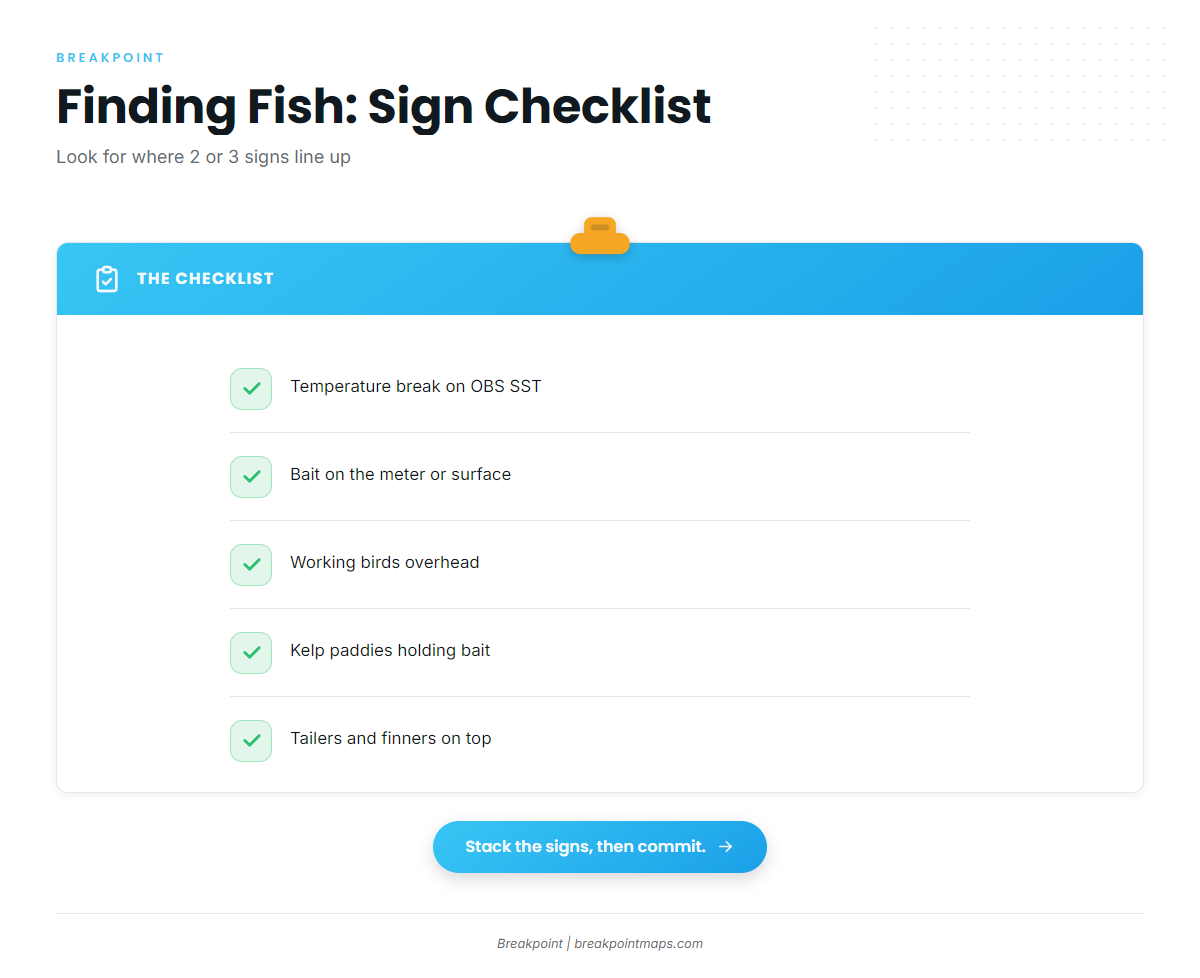
Look for these signs, and keep in mind why each matters:
- A temperature break. Bait stacks along the edge.
- Bait on the meter or surface. Marlin feed on it.
- Working birds. They mark bait near the surface.
- Kelp paddies. They hold bait and draw predators.
- Tailers and finners. The fish is already showing itself.
Fish rarely show on a single sign. Look for places where two or three line up.
Raising Fish with a Search Troll
Most anglers troll skirted lures while searching and keep watch for fish near the surface.
Marlin Magazine’s reported prospecting spread includes a Zuker 3.5-inch in black/purple or Petrolero, a Sevenstrand Tuna Clone and a Mold Craft Wide Range. Treat those as examples, not a prescription. We are not giving a troll speed, since a fish finning on the surface at 8 knots is one scenario and not a rule.
Bait-and-Switch, Step by Step
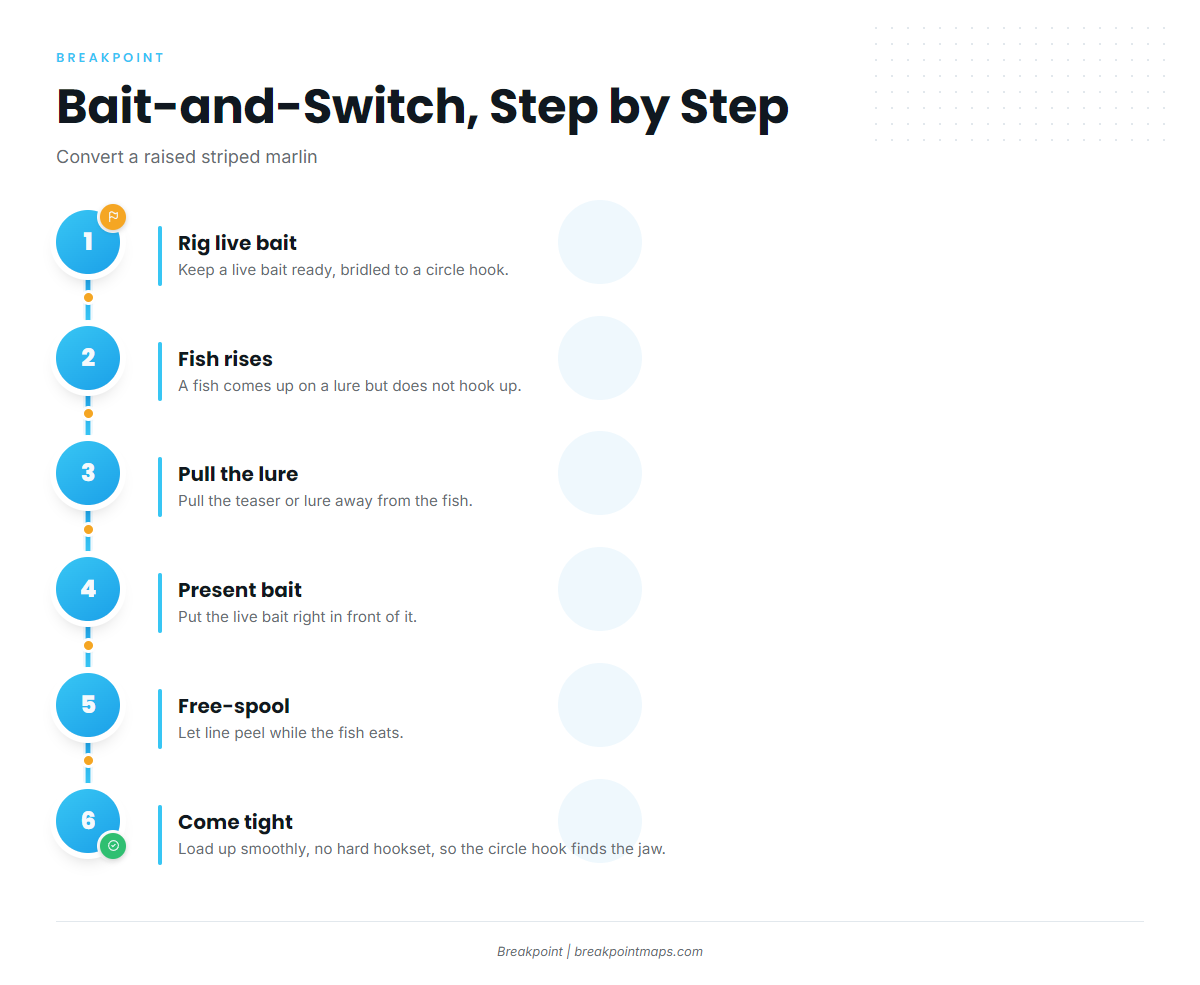
Marlin Magazine calls bait-and-switch "a deadly technique that would work on any billfish, anywhere in the world." Its example is a frisky Pacific mackerel pinned or bridled to a 9/0 Eagle Claw circle hook.
- Keep a live bait ready, already bridled to a circle hook.
- Raise the fish. It rises on a lure but does not hook up.
- Pull the teaser or lure away from the fish.
- Put the live bait in front of it.
- Free-spool while it eats.
- Come tight smoothly without a hard hookset, so the circle hook can find the jaw.
Pitching to Tailers
Cool, clear water and a visible fish call for a quiet approach:
- Come in from behind or the side at low throttle.
- Do not run over the fish.
- Pitch a live mackerel or sardine well ahead of its line of travel.
How it differs here: Sight-casting live mackerel to tailers carries more weight here than in teaser-heavy tropical programs.
Starting Tackle
Common starting points, not mandates:
- Class: 30 to 50 lb
- Live-bait hooks: 7/0 to 9/0 circle hooks
Circle Hooks, Release and Tagging
Circle hooks tend to catch in the corner of the jaw rather than the gut or throat, which favors release. Come tight smoothly and let the hook do the work.
Release steps:
- Keep the fish in the water.
- Control it by the bill with gloves.
- Cut the leader close, or remove the hook if it comes easily.
- Revive the fish with water moving over its gills, idling forward.
- Release it when it is kicking.
CDFW notes that most striped marlin effort is catch and release. The Billfish Foundation runs a large tag-and-release program, and its 2020 conservation record shows 1,963 striped marlin among its records.
Frequently Asked Questions
How do you tell a striped marlin from a blue marlin?
Look for a tall, pointed front dorsal, a slimmer body and pale blue vertical bars. NOAA Fisheries notes striped marlin are smaller than other marlin species. Use the comparison table above, starting with the dorsal fin.
When is striped marlin season in Southern California?
Local reports most often describe late summer into fall as the core window. Warm-water years can shift it earlier or farther north, and cool years can thin it. Our Pacific Southwest guide has regional detail.
What bait works best for striped marlin?
NOAA lists mackerel, sardine, anchovy and squid as prey. Marlin Magazine’s example is a live Pacific mackerel on a 9/0 circle hook. Match the bait to what the fish are already eating.
Can you keep a striped marlin in California?
California allows limited recreational take with a valid license, but confirm the current bag limit in CDFW’s rules. CDFW states sale is prohibited, and most effort is catch and release. Verify before fishing.
Do you need a Mexican license to fish Baja?
Yes, you need to meet Mexico’s licensing requirements, and CONAPESCA is the authority. Check its current requirements and billfish rules before fishing Mexican waters.
Why use circle hooks for marlin?
Circle hooks tend to catch in the jaw corner, which favors survival after release. Come tight smoothly instead of setting hard, and let the hook find its hold.
Conclusion
Success with striped marlin comes down to lining up temperature, bait and structure. Raise the fish with a troll, convert it with a switch or a pitch, and release it well.
Before you go:
- Check current rules with CDFW, and CONAPESCA if you are crossing the border.
- Watch SST and bait signs as the season develops.
- Rig a circle-hook live bait before you leave the dock.
For stock and rule updates, keep an eye on NOAA Fisheries and CDFW.
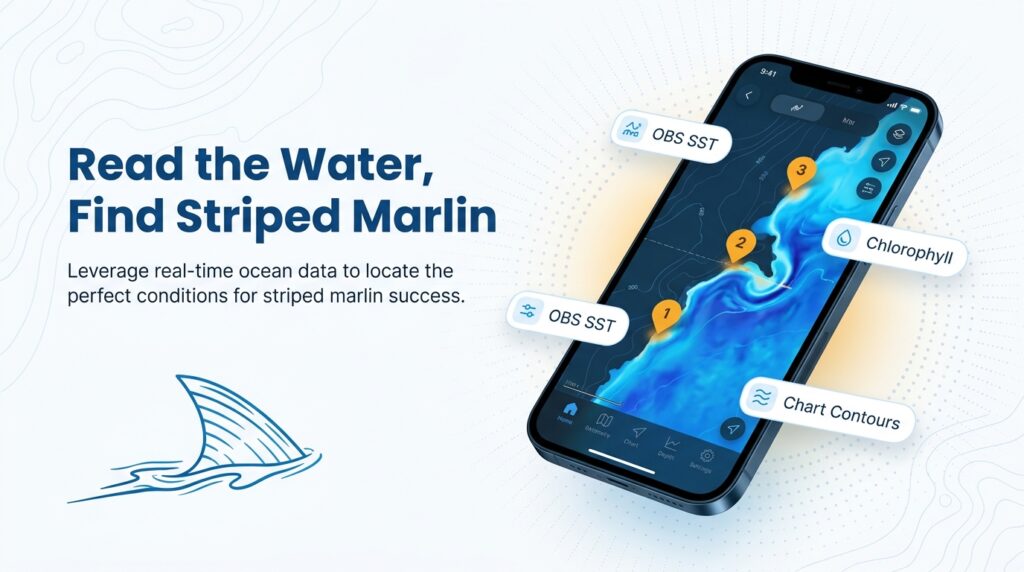
Breakpoint’s Fish Intel and hotspot layers put OBS SST, Chlorophyll and Chart Contours on one screen, so you can see where warm water, bait and structure line up before you burn the fuel. It narrows the search but won’t find the fish for you. Chart layers are not for navigation.