


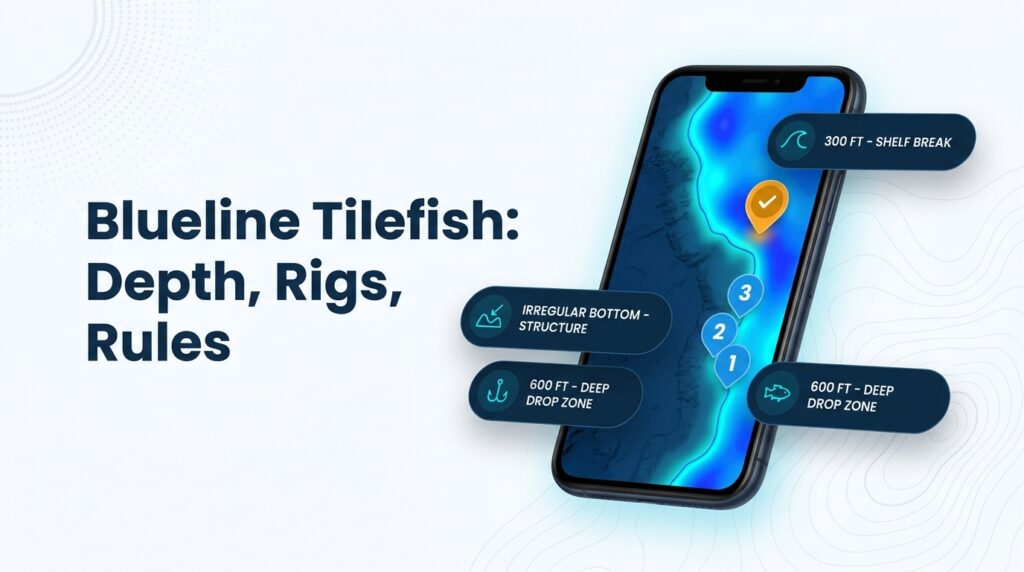
Blueline tilefish fishing means deep dropping heavy lead to irregular bottom hundreds of feet down along the shelf break. The fish is slow-growing and firm-fleshed, and it holds where the shelf edge turns rough. Below: what the fish is, where it lives, how to rig for it and where to confirm whether it’s open.
At a Glance
What: A deepwater tilefish, Caulolatilus microps.
Depth: Usually 240 to 780 ft on irregular bottom along the shelf break, according to the South Atlantic Fishery Management Council (SAFMC).
Method: Deep dropping with circle hooks and heavy lead. Electric reels are common but not required.
Table fare and status: Firm, mild fillets. Check season status before you run, because it may be closed right now. See Regulations.
Overview
The blueline tilefish is a bottom-dwelling tilefish of the Atlantic and Gulf shelf edge, named for a gold stripe underlined in blue that runs from the snout to the eye.
Identification
The NOAA Fisheries species profile describes a narrow gold stripe underlined in blue from snout to eye, a long snout, and a dull olive-gray back over a white belly. Its dorsal and anal fins are long and continuous, "more than half the length of their body," per NOAA.
The species most likely to be confused with it is the golden tilefish (Lopholatilus chamaeleonticeps). SAFMC notes that the blueline lacks the fleshy protuberance behind the head that marks the golden.
Blueline vs. Golden Tilefish
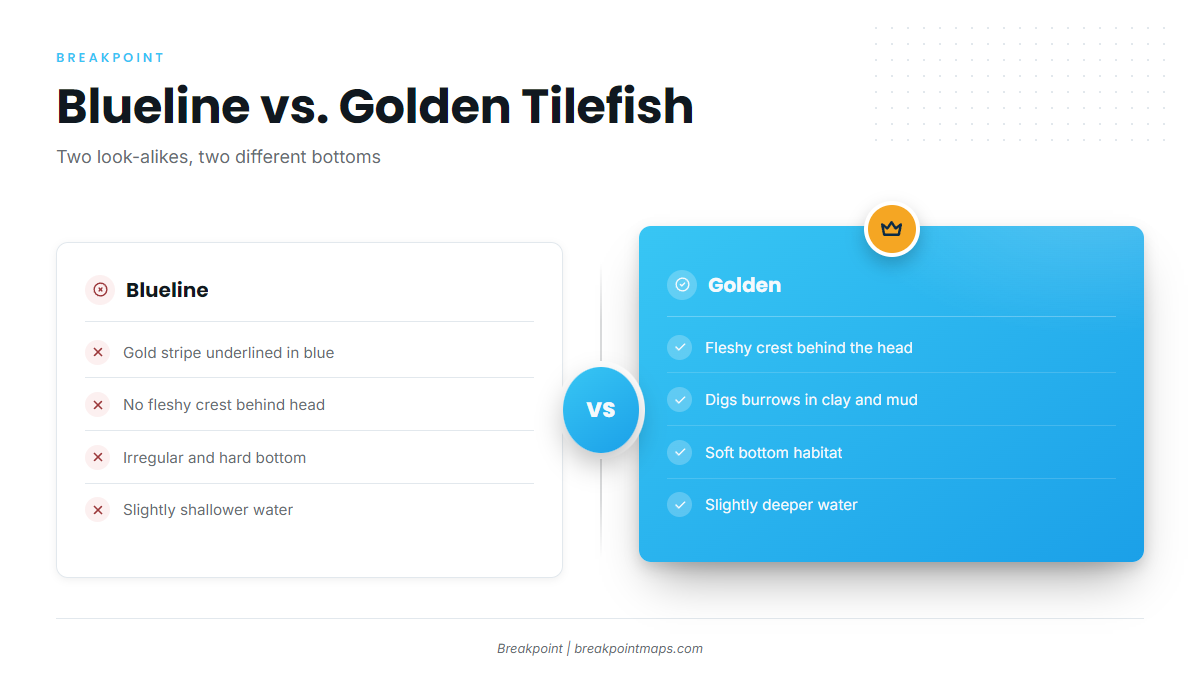
| Feature | Blueline | Golden | Source |
|---|---|---|---|
| Head crest | None | Fleshy crest behind the head | SAFMC |
| Color and stripe | Gold stripe underlined in blue, snout to eye; olive-gray above, white below | See NOAA species profile | NOAA Fisheries |
| Habitat | Irregular and hard bottom | Digs cone-shaped burrows in soft clay and mud | The Tackle Room |
| Depth | Slightly shallower; 240 to 780 ft | Deeper, per The Tackle Room | SAFMC, The Tackle Room |
Goldface and sand tilefish also turn up in this water. Check your state agency’s ID page before keeping one, since they may fall under different limits.
Behavior, Size and Lifespan
SAFMC reports that blueline tilefish grow to 32 inches and live up to 15 years. Most fish caught are far smaller, typically 2 to 10 lb per FishingBooker. Bluelines share habitat with groupers and snappers, according to SAFMC. Their slow growth is why managers treat this stock carefully.
Table Fare
Anglers’ guides describe firm, sweet flesh, and The Tackle Room compares it to lobster.
Habitat & Range
Blueline tilefish live on irregular bottom along the shelf break, usually 240 to 780 ft, according to the SAFMC blueline tilefish profile. SAFMC lists irregular bottoms with sand, mud and shell hash, in bottom water of 59 to 73°F. Regional pages cover local depth bands and spots.
Depth: Why the Numbers Differ
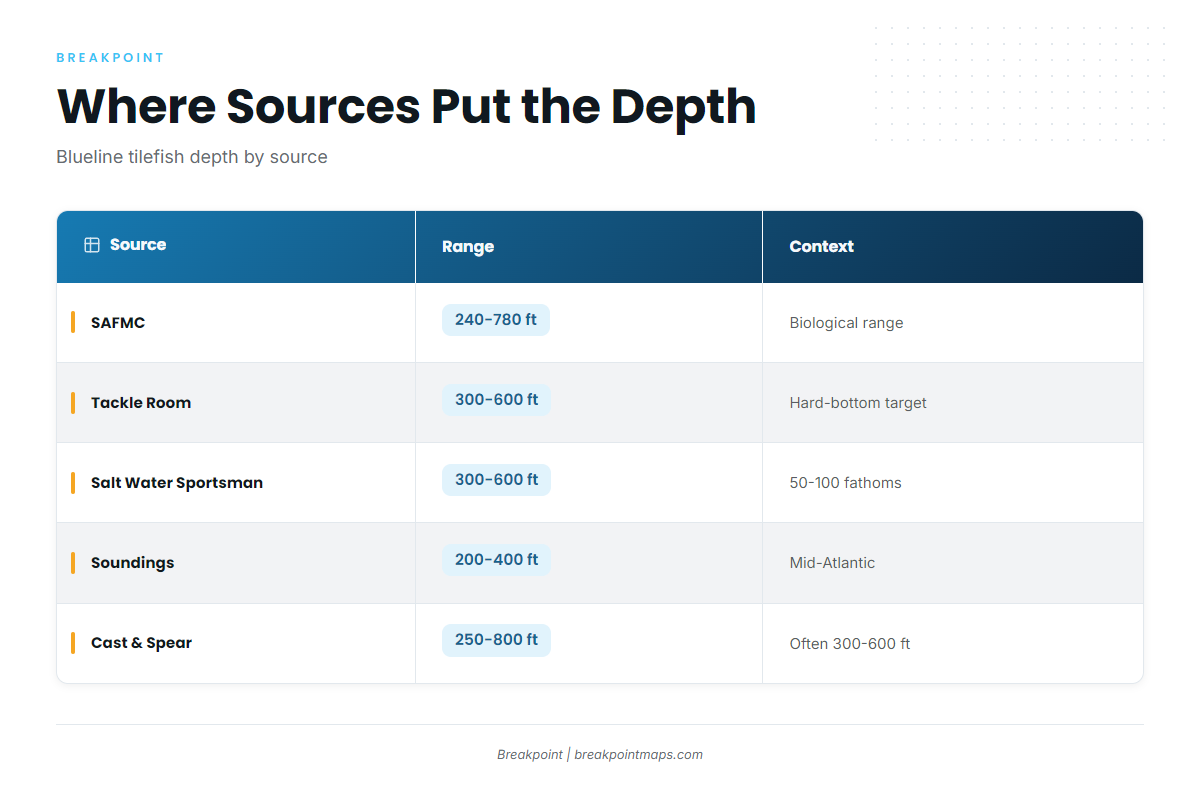
Published depth ranges don’t match. The table shows where each source puts the fish.
| Source | Range | Context |
|---|---|---|
| SAFMC | 240 to 780 ft | Biological range |
| The Tackle Room | 300 to 600 ft | Hard-bottom target band |
| Salt Water Sportsman | 50 to 100 fathoms (300 to 600 ft) | Best action; also catches as shallow as 25 fathoms (150 ft) |
| Soundings | 200 to 400 ft | Mid-Atlantic context; fish caught at 210 ft |
| Cast & Spear | 250 to 800 ft, often 300 to 600 ft | General range and common target band |
Region and season likely explain the spread. The Soundings numbers come from the Mid-Atlantic, and 300 to 600 ft is where most published anglers start. That is our reading, not a documented fact.
Bottom Type and Temperature
SAFMC lists sand, mud and shell hash, while anglers’ guides stress rock and hard bottom. Treat the target as irregular bottom, especially the edges where hard bottom meets soft.
SAFMC gives 59 to 73°F as the bottom water range. Surface SST, such as the OBS SST layer, says little about bottom temperature at 500 ft. Use surface layers for conditions on the day, not for bottom temperature.
Range and Management Areas
Sources differ on range. SAFMC gives Virginia to the Campeche Banks. Salt Water Sportsman gives Massachusetts to the Gulf, with the heart of the population off the Mid-Atlantic coast.
Three management areas apply:
- North of the Virginia/North Carolina line: managed by the Mid-Atlantic Fishery Management Council (MAFMC).
- South of that line: managed by SAFMC under the Snapper Grouper Complex.
- Gulf of Mexico (Gulf of America in federal documents): managed under the Tilefishes Complex, per NOAA Fisheries. From here on, we call it the Gulf.
Regional Differences
Mid-Atlantic. Soundings describes shallower bands, mostly 200 to 400 ft, with bluelines mixed in with black sea bass.
South Atlantic. SAFMC manages the stock, and Snapper Grouper Complex rules apply.
Gulf. The stock falls under the Tilefishes Complex. The tactical sources we found focus on the Atlantic.
Surveys at these depths are thin, and much of what anglers know comes from fishing reports rather than systematic observation.
Blueline Tilefish Fishing: Tactics That Work at Depth
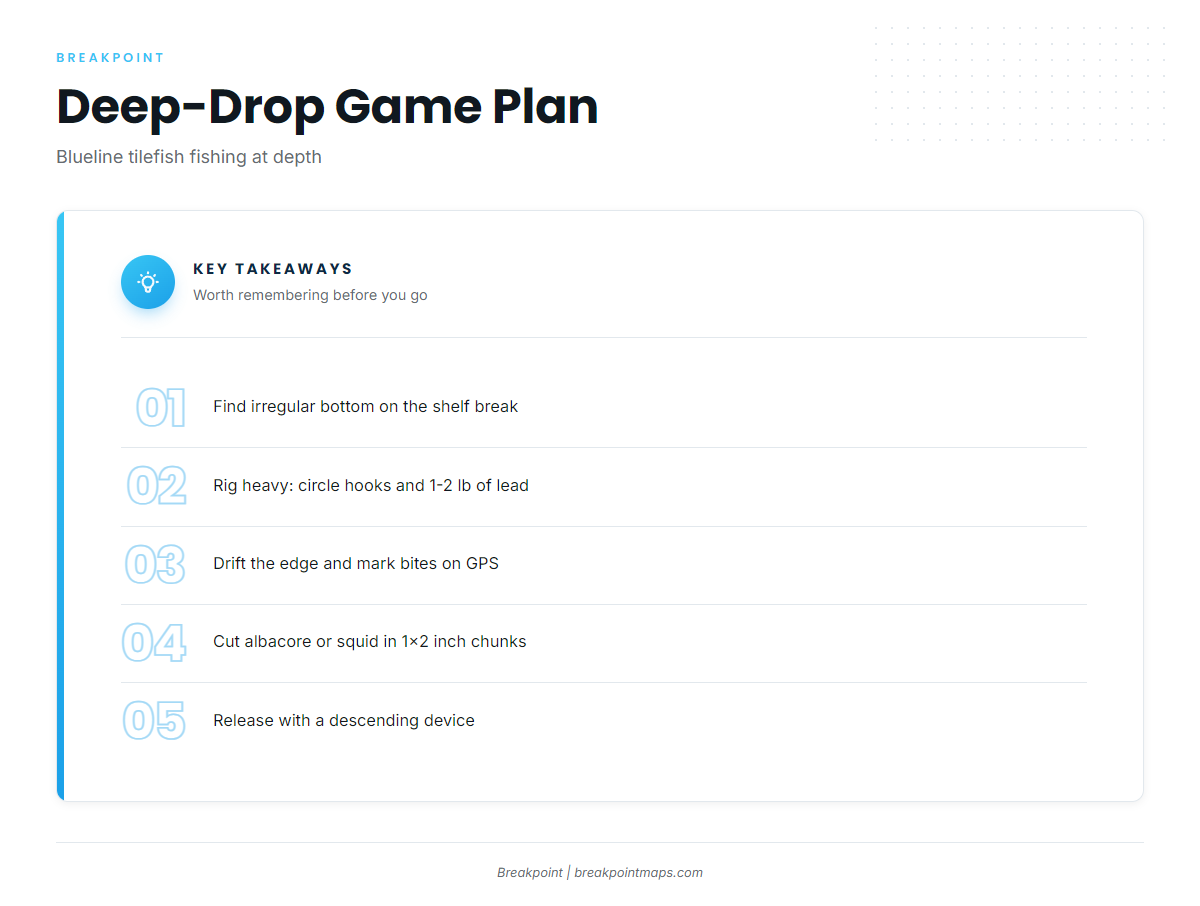
Most blueline tilefish are caught by deep dropping a multi-hook rig with circle hooks and heavy lead to irregular bottom, then drifting and marking bites. Expect to need at least a 1-lb sinker to stay on bottom in 500 ft of moving water.
Gear: Conventional vs. Electric
Electric reels are common but not required. A conventional setup works.
- Salt Water Sportsman setup: a 7-ft medium-heavy conventional rod with a stiff tip, a 20-class conventional reel, 50-lb braid and 100-lb fluorocarbon.
- New Jersey digest: a reel with plenty of multifilament line and a rod stout enough for a 1-lb weight.
- Rig style: a multi-hook rig is the most common setup.
Baseline Deep-Drop Setup
This Salt Water Sportsman rig breakdown and a Soundings deep-drop how-to give the working specs.
| Component | Spec | Source |
|---|---|---|
| Rod, reel, line, leader | 7-ft medium-heavy conventional, 20-class reel, 50-lb braid, 100-lb fluorocarbon | Salt Water Sportsman |
| Swivel | 250 lb | Salt Water Sportsman |
| Hooks | 8/0 circles on two dropper loops 20 inches apart; Soundings gives 6/0 to 10/0 | Salt Water Sportsman, Soundings |
| Weight | 16 to 32 oz bank sinker; Soundings gives 8 to 24 oz | Salt Water Sportsman, Soundings |
New Jersey limits deep-drop rigs to a maximum of 5 hooks per rod. That is a New Jersey rule, so check your own state’s.
Bait
Salt Water Sportsman recommends cut albacore or squid in chunks about 1 by 2 inches, sized so the bait doesn’t gob up the hook. FishTalk reports that cut fish and squid stay on longer than clam.
Finding Bottom on Sonar
The Tackle Room’s sonar guidance says hard bottom at 300 to 600 ft is blueline territory and that a quality bottom machine is essential. Many anglers run dual-frequency CHIRP to separate mud, clay, rock and mixed bottom.
Soundings adds a practical tip: zoom the fishfinder in close to the bottom. Tilefish marks are small, but a decent unit shows them.
Drift and Mark Bites
Drop to bottom, drift, and mark bites on GPS, per Soundings. A captain interviewed by Salt Water Sportsman said, "we often get twice as many bites on the second drift."
Bycatch and Co-Targets
Groupers and snappers share this habitat, per SAFMC, and that includes snowy grouper in the deepwater complex. In the Mid-Atlantic, bluelines mix with larger-than-usual black sea bass, according to Soundings. Each species has its own rules.
Barotrauma and Release
Gas expands as a fish rises from several hundred feet. That can cause a bloated swim bladder, bulging eyes and a stomach pushed from the mouth.
If you’re releasing a fish:
- Minimize time out of the water.
- Use a descending device to return the fish to depth.
- Handle the fish gently and wet.
Check NOAA Fisheries’ release guidance and your council before you run.
Frequently Asked Questions
How deep do blueline tilefish live?
SAFMC gives 240 to 780 ft. Most published anglers target 300 to 600 ft of hard bottom, and Mid-Atlantic reports run shallower, around 200 to 400 ft. See the depth table for the full spread.
What is the difference between blueline and golden tilefish?
SAFMC says the blueline lacks the fleshy crest behind the head that the golden has. NOAA describes the blueline’s gold stripe underlined in blue. Goldens dig burrows in mud, and bluelines hold on irregular bottom.
Do you need an electric reel for blueline tilefish?
No. Salt Water Sportsman publishes a working 20-class conventional setup with 50-lb braid. Electric reels are common for comfort at depth, but they aren’t required.
What bait works for blueline tilefish?
Cut albacore or squid, in chunks about 1 by 2 inches, according to Salt Water Sportsman. FishTalk notes cut fish and squid last longer than clam.
Is blueline tilefish open now, and where do I check?
Check NOAA Fisheries, SAFMC, MAFMC, the Gulf Council, FWC and your state agency before you run.
Are blueline tilefish good to eat?
Yes. Anglers’ guides describe firm, mild flesh, and The Tackle Room compares it to lobster.
Before You Burn the Fuel
Find irregular bottom along the shelf break, rig heavy with circle hooks, drift and mark bites, release fish carefully, and confirm the season first.
Bluelines hold on irregular bottom along the break, roughly 240 to 780 ft. Breakpoint’s hotspots and Fish Intel, along with the Chart Contours layer, can help you shortlist edges worth a drift before you commit the fuel. Chart layers are not for navigation.