


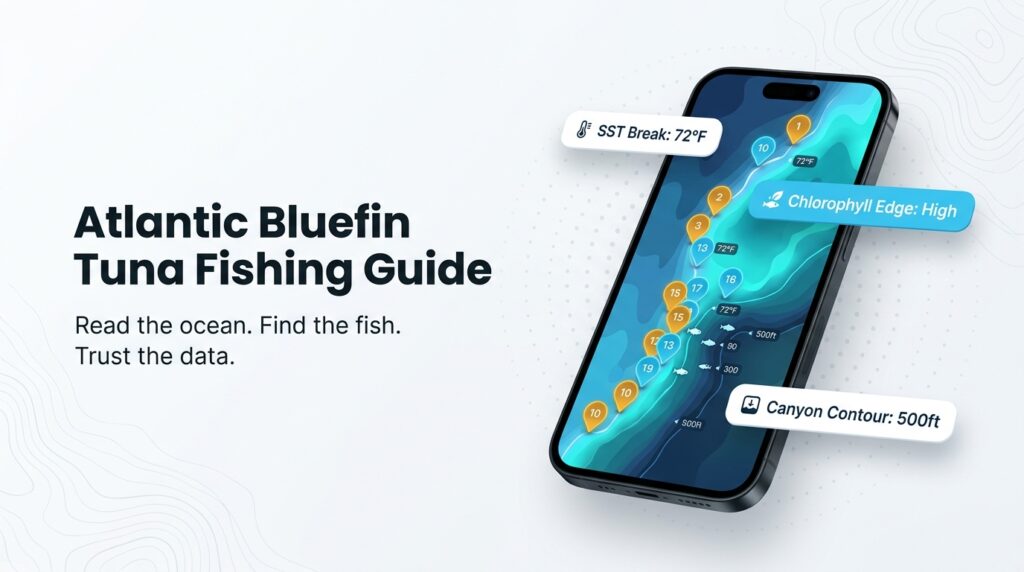
Atlantic bluefin tuna (Thunnus thynnus) are the largest tuna in the Atlantic, and among the most tightly managed fish a recreational angler can target from the Gulf of Maine to the Outer Banks. This guide covers how to identify the fish, where and when it shows up, how it is commonly fished, and the federal rules you need before leaving the dock. NOAA Fisheries’ Highly Migratory Species (HMS) Division sets those rules, and limits can change during the season. By the end you should know whether the fish is worth your fuel and what you need to fish for it legally. If you already chase bluefin elsewhere, the regional comparisons and links to our regional pages are the parts most useful to you.
Before You Go
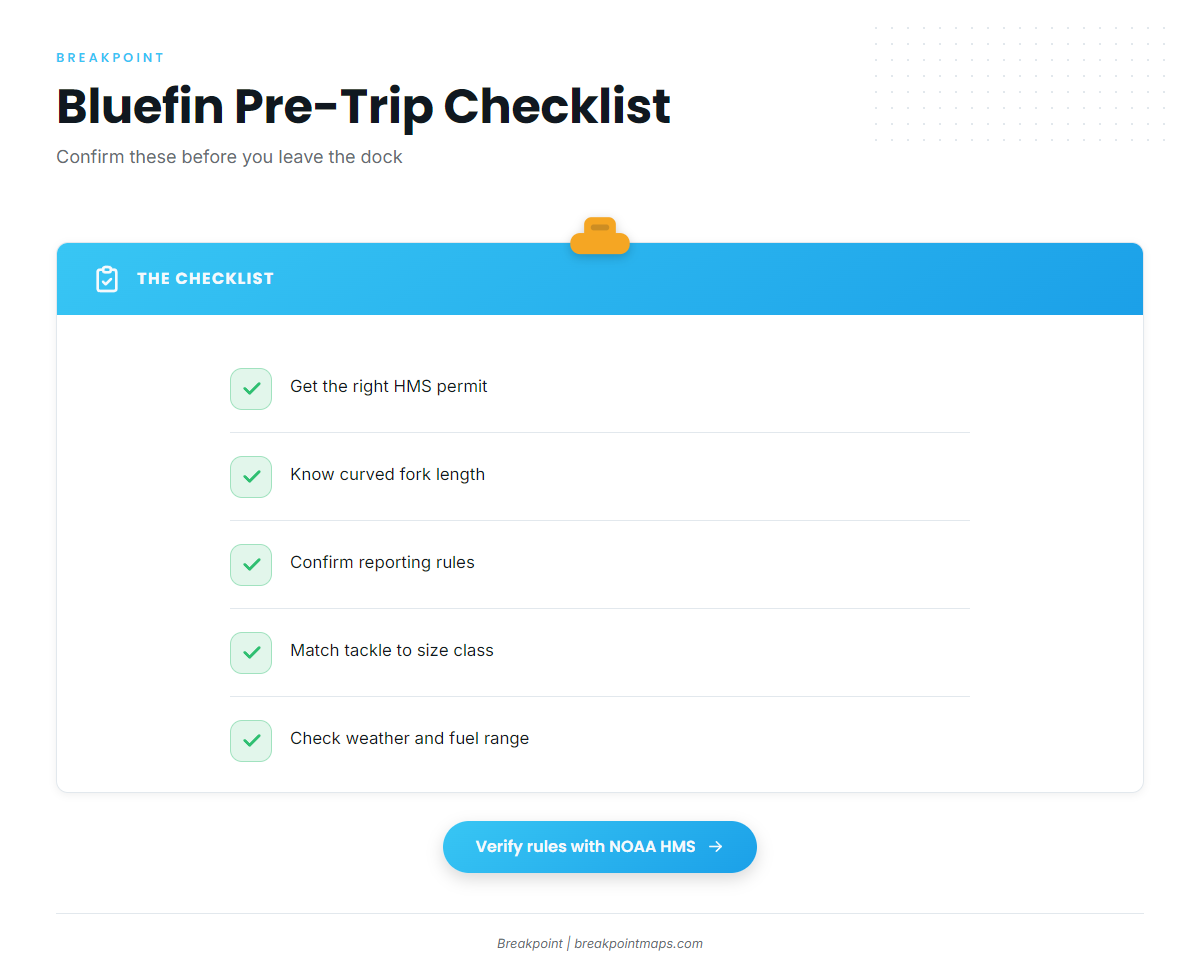
Run through this list before you commit to a trip:
- Permit: An HMS Angling permit is required for recreational bluefin fishing from a private boat. Charter and headboat operators need the Charter/Headboat permit. Verify the categories with NOAA HMS.
- Size classes: Classes are measured by curved fork length, not weight. Know how to measure before you keep anything.
- Reporting: Bluefin catches must be reported to NOAA, and some states run their own reporting or tagging programs. Verify the current requirement, including whether released fish must be reported.
- Tackle class: School fish and giants call for very different gear. Undersized gear means long fights and dead releases.
- Boat and weather: Many fisheries are 20 to 60+ miles out, in cold water, often in winter off the Outer Banks. Weigh a 23 to 30 ft center console against the forecast, fuel range and crew experience. Good preparation for your first tuna also means honest attention to weather, clothing and physical condition. No fish is worth a marginal weather window.
Details and links for each item are in Regulations below.
Overview
Atlantic bluefin can reach nearly 10 feet long, according to the ISS Foundation, which is about 3 meters at the extreme. The common size runs 80 to 200 cm, roughly 31 to 79 inches, and most fish an angler meets will be far smaller than the record class.
Two points matter for everything that follows. Size classes are defined by curved fork length, not weight. And "giant" is a regulatory class with a specific length threshold, not a casual label for any fish over a certain weight. Both come up again in Tactics and Regulations.
How to Identify Bluefin Tuna
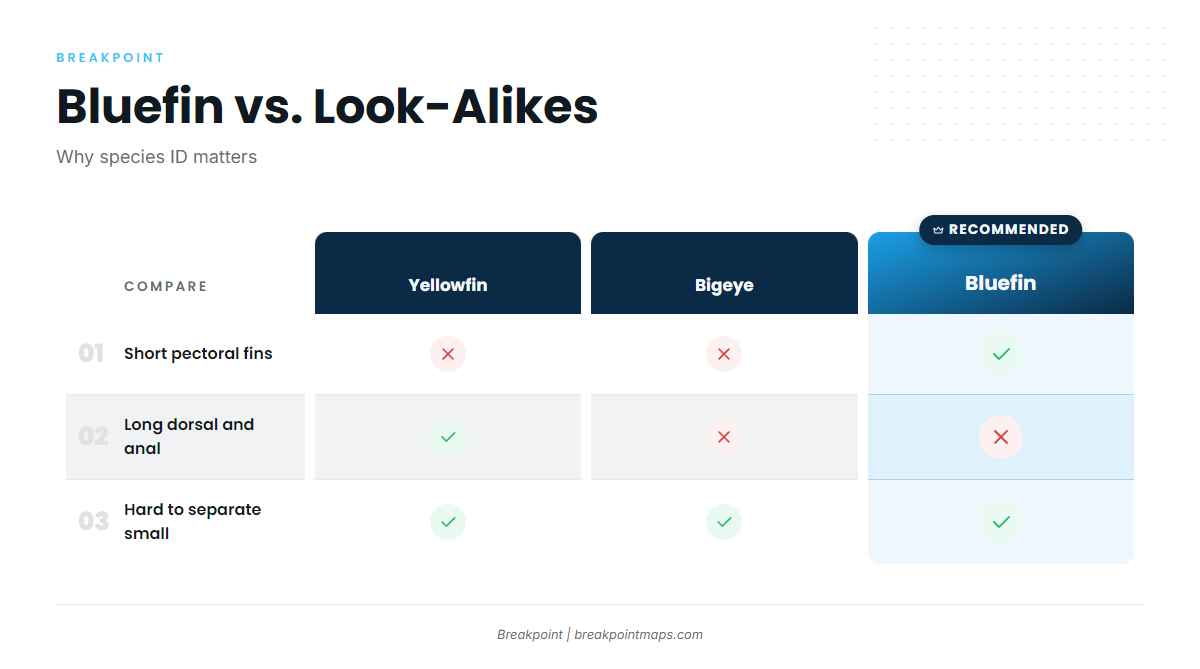
Retention rules differ by species, so a wrong call at the boat is a legal problem. Bluefin, yellowfin, bigeye and blackfin can look alike at a glance, especially at small sizes.
| Feature | Bluefin | Yellowfin | Bigeye | Blackfin |
|---|---|---|---|---|
| Pectoral fin length relative to second dorsal | Short | Verify against NOAA species pages before publishing | Verify against NOAA species pages before publishing | Verify against NOAA species pages before publishing |
| Second dorsal and anal fins on adults | Short, not elongated | Elongated on adults | Verify against NOAA species pages before publishing | Verify against NOAA species pages before publishing |
| Finlet color | Verify against NOAA species pages before publishing | Verify against NOAA species pages before publishing | Verify against NOAA species pages before publishing | Verify against NOAA species pages before publishing |
Swipe the table sideways to see every column.
Check NOAA Fisheries’ species identification pages before relying on any single feature. Small bluefin, yellowfin and bigeye are the hardest to separate. When in doubt, release.
Size Classes
Curved fork length follows the body curve from the tip of the snout to the fork of the tail; it is not a straight-line measurement. NOAA HMS uses it to sort bluefin into classes, and the class decides what you can keep.
| Class | Curved fork length (inches) | What this usually means for you |
|---|---|---|
| Young school | Verify with NOAA HMS on the date you fish | Bluefin must be larger than 27 inches to be kept. Release. |
| School | Verify with NOAA HMS on the date you fish | Common trolled fish in the Mid-Atlantic. Often the recreational retention class. |
| Large school / small medium | Verify with NOAA HMS on the date you fish | Retention depends on the current in-season limit. |
| Large medium | Verify with NOAA HMS on the date you fish | Retention is tightly limited and can change during the season. |
| Giant | Verify with NOAA HMS on the date you fish | Heavy stand-up or harpoon territory. Recreational retention is tightly limited and quota-dependent. |
Size classes are per NOAA Fisheries HMS. Retention by class is covered in Regulations.
Behavior and Biology
Bluefin retain heat through countercurrent heat exchange, which lets them range into cold water as far north as the Gulf of Maine and Canada. They are also highly migratory and, per the ISS Foundation, tend to school by size, so the class you hook usually matches the class around it.
On stock status, ICCAT assesses the western and eastern/Mediterranean stocks separately. The western stock has improved from historic lows and remains under a tightly managed quota, but the assessment carries real uncertainty, including how much the stocks mix on U.S. grounds. For current wording, check NOAA Fisheries.
Habitat & Range
It helps to think in three layers: the coastwide migration, the regional seasons, and what concentrates fish within a region.
Migration and What’s Still Unknown
The broad pattern runs as follows:
- Mid-Atlantic: Fish arrive from late spring.
- New England: Summer and fall.
- Outer Banks: Roughly November into spring.
Science has not settled a good deal here. Spawning in the Gulf of Mexico versus the Slope Sea is still being studied, eastern and western fish mix on U.S. grounds, and timing shifts from year to year. Nobody can promise the fish will be where they were last year.
Season by Region
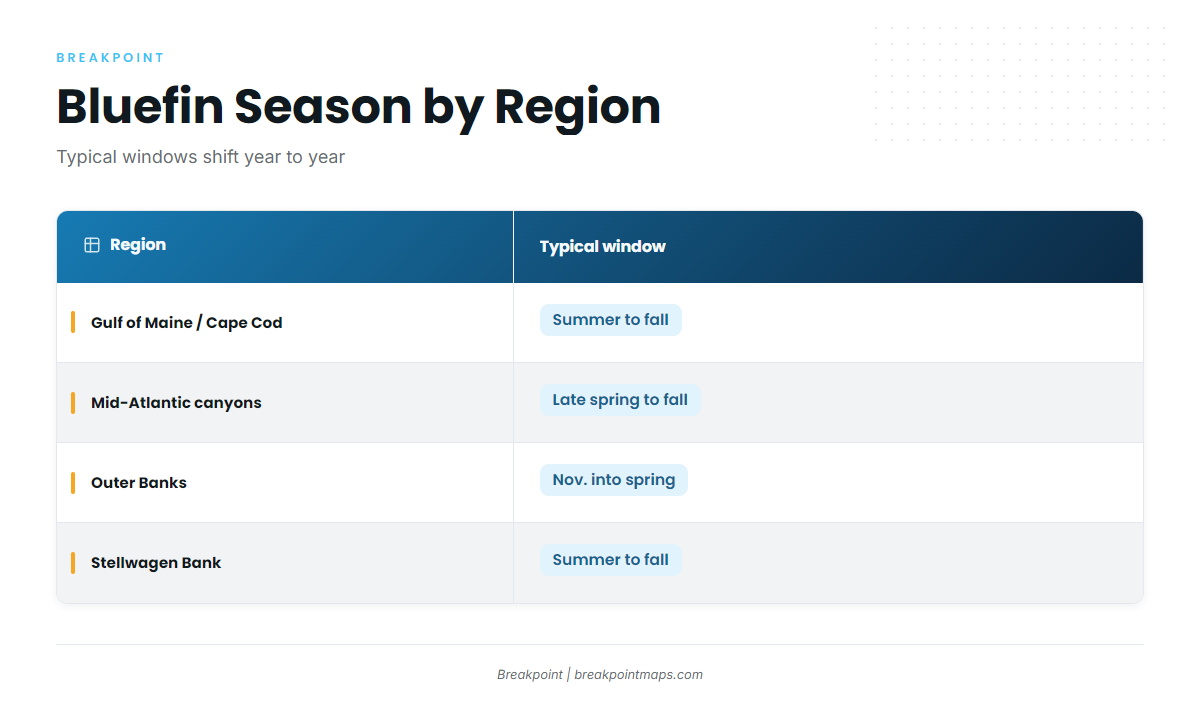
| Region | Typical window | Size classes commonly encountered | Key forage | Common methods |
|---|---|---|---|---|
| Gulf of Maine, Cape Cod and Stellwagen Bank | Typically summer and fall | Medium to giant | Sand eels, mackerel, menhaden | Chunking, casting, jigging, harpoon |
| Mid-Atlantic canyons and lumps (Hudson Canyon, New Jersey lumps) | Roughly late May through December | School to medium | Butterfish, squid, herring | Trolling, chunking, jigging |
| Outer Banks | Roughly November into spring | Medium to giant | Verify locally | Trolling, chunking, casting |
Swipe the table sideways to see every column.
Windows are approximate.
Northeast
Cape Cod’s summer and fall fishery is built around bait. Giant schools move inshore chasing sand eels, mackerel and menhaden. Cape Cod’s inshore bluefin grounds often sit within 5 to 30 miles of shore, around Stellwagen Bank, Peaked Hill Bar and the waters off Chatham. Farther north, the Gulf of Maine and the Northeast canyons draw effort as the season builds.
For a fuller look at how the Northeast bluefin season plays out, see our regional guide.
Mid-Atlantic
From late spring through fall, the lumps and canyons off New Jersey and neighboring states hold school and medium fish. You meet more school-class fish here than in the Northeast, and they are commonly trolled.
Watch the thermocline in summer. When surface water reaches the high 70s, fish often drop below it, so surface temperature alone can mislead you.
Southeast
The Outer Banks winter fishery runs roughly November through spring. It is cold, rough, big-fish water. Some fish come within about 10 miles of the beach early in the season, while the biggest fish in late winter often sit around 50 miles out. Distances vary widely through the season, which makes the boat and weather check above even more important.
We cover the details in our Atlantic Southeast bluefin guide.
Reading the Water
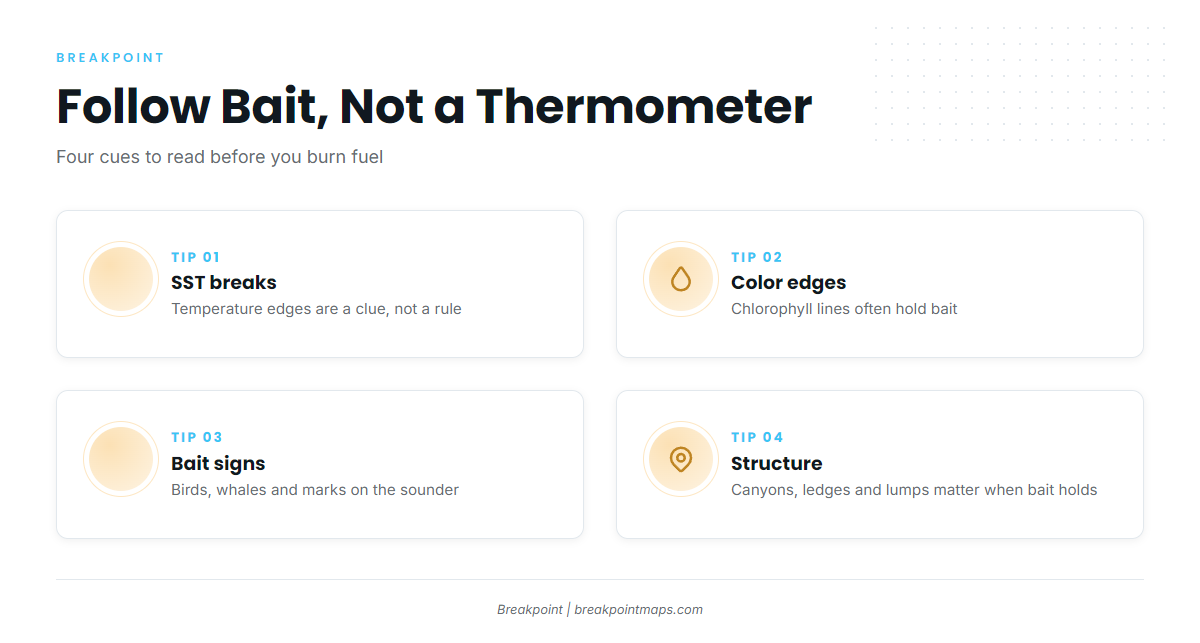
Bluefin follow bait more than temperature, so treat temperature as a clue rather than a rule. Four cues help you decide where to look:
- Sea surface temperature breaks: Fronts where warm and cool water meet concentrate bait.
- Chlorophyll and color edges: Clean blue water pushing against green often marks a bait line.
- Bait signs: Birds, whales and marks on the sounder.
- Structure: Canyons, ledges, shoals and lumps.
Each has limits. Cloud cover blocks satellite SST passes, the thermocline can push fish deep in summer, and structure only matters when bait is holding on it.
Tactics
Everything below is common practice, not a guarantee. Match the method to the size class and the season.
Trolling
Trolling is the usual search method. Anglers cover water over banks, edges and productive lanes with spreader bars and ballyhoo, especially for school and medium fish. They troll until fish show on the sounder or at the surface, then switch to a targeted method.
Newcomers often start here because it covers ground and keeps the crew’s jobs simple.
Chunking and Live Bait
Chunking is typically done at anchor or on the drift, usually on lumps and structure. Live-baiting works when bait is available, and chunking and jigging are commonly combined. Circle hooks are standard with bait; the survival reason is in Handling and Release below.
Casting and Jigging
Topwater plugs suit surface-feeding fish. Vertical jigs suit fish that pin bait deep or suspend under marks on the sounder. In the Northeast, giant fish feeding on sand eels are a classic topwater target, and harpoon remains a traditional New England method. Harpoon is regulated under its own permit category, so verify with NOAA HMS. For more on giant bluefin fishing in the Northeast, see our regional page.
Tackle by Size Class
Gear matched to the class shortens the fight, and shorter fights mean better survival and less risk to the crew.
- School: Lighter stand-up or spinning gear with leaders sized to the fish.
- Medium: Heavier stand-up outfits and stronger leaders.
- Giant: 80 to 130 lb class stand-up gear, or heavy spinning gear built for topwater work.
Specs vary widely by angler and situation.
Handling and Release
According to NOAA Fisheries, recording landings and discards is at the heart of a program that has proven more successful than expected at reducing the number of bluefin discarded dead. Read more on NOAA’s bluefin catch accounting program.
A release checklist:
- Use circle hooks.
- Keep the fight short with appropriate tackle.
- Keep large fish in the water.
- Minimize handling time, and cut the leader near the hook if needed.
- Revive with forward motion when practical.
- Report as required.
Confirm each point against NOAA’s current handling guidance. If you keep a fish, bleed and ice it promptly for meat quality.
Which fish you can keep, and how you report them, is set federally.
Frequently Asked Questions
What permit do I need for bluefin tuna?
Private boats need an HMS Angling permit. For-hire vessels need an HMS Charter/Headboat permit. The permit applies to the vessel. Verify categories and renewal before you fish.
What size bluefin can I keep?
Retention depends on the fish’s curved fork length class and the current in-season limit set by NOAA. Limits can change during the season. See the Regulations section above and confirm with NOAA HMS before each trip.
How do I tell bluefin from yellowfin?
Bluefin have short pectoral fins, while adult yellowfin have long second dorsal and anal fins. Finlet color is another cue. Small fish are hardest to separate, so confirm features against NOAA species pages, and release the fish if you are unsure.
When are bluefin off the Outer Banks?
Roughly November into spring, varying by year. Some fish come close to the beach early in the season, and the biggest fish often sit farther offshore in late winter. See our Atlantic Southeast bluefin guide for the regional picture.
Is Atlantic bluefin endangered?
ICCAT assesses the western and eastern/Mediterranean stocks separately. The western stock has improved from historic lows and remains under a tight quota, but the assessment carries uncertainty, including stock mixing. Check NOAA Fisheries for its current status language.
Do I have to report a bluefin I release?
Confirm NOAA’s current requirement on the day you fish, including whether releases must be reported. Reporting feeds the quota accounting that keeps the fishery open, which is why NOAA asks for it.
Regional Guides
Fishing a specific stretch of coast? Start here.
- Gulf of Maine, Cape Cod and the Northeast canyons: Atlantic Northeast bluefin guide
- Outer Banks and the winter fishery: Atlantic Southeast bluefin guide
Conclusion
Measure to determine size class, follow the bait, and check NOAA before every trip.
Breakpoint’s Hotspots and Fish Intel put OBS SST, Chlorophyll and Chart Contours in one view, so you can see where temperature breaks, color edges and structure line up before you burn the fuel. It won’t promise fish, but it can help you decide where to look. Chart layers are not for navigation.