


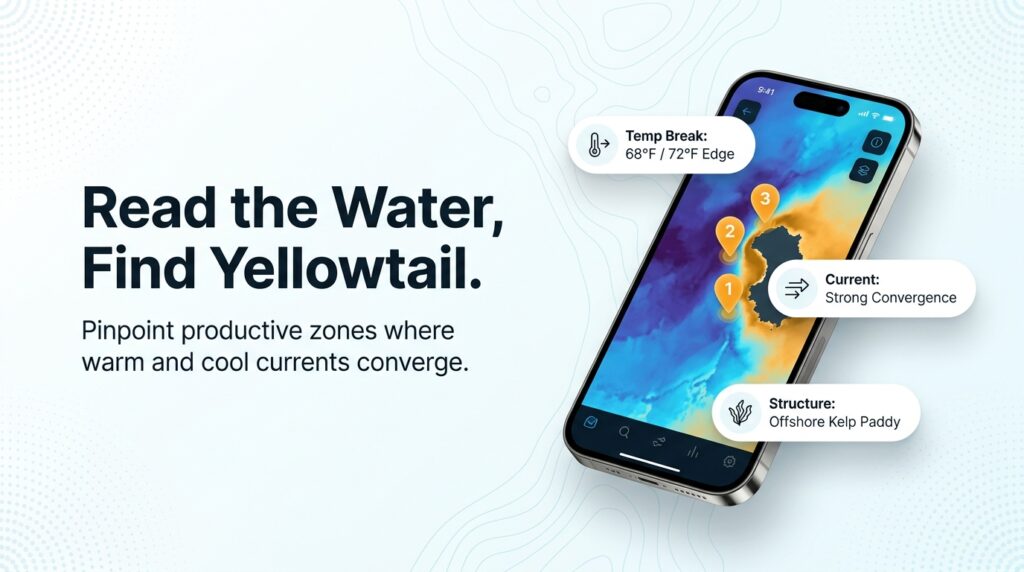
Catalina sits about 22 miles off Los Angeles, according to Saltwater Sportsman, and yellowtail live around it. A 20 to 28 ft trailer boat can make that run. For a boat owner who has mostly fished bass, halibut or rockfish close to shore, California yellowtail fishing is one of the best steps up.
Sport Fishing Mag author Erik Landesfeind described the learning curve this way: "I only knew how to catch them once someone else put me on a school of biting fish." The gap between catching fish and finding them is what this page addresses.
The guide covers identification, habitat, baseline tactics and the rules. Some of it is settled. Some of it nobody can predict, and we say which is which.
Overview: What Is a California Yellowtail?
The California yellowtail (Seriola dorsalis) is a schooling jack in the amberjack family, found from Southern California into Baja. It is prized for hard fights around kelp, islands and banks, and for its eating quality. Anglers know it as the premier nearshore gamefish of the Southern California coast.
Taxonomy. Genetic work separated this fish from Seriola lalandi, the yellowtail amberjack of the southern and western Pacific. A World Aquaculture Society abstract describes California yellowtail as formerly classified as lalandi. Older references and some tackle-shop signs still use the old name, so a California fish labeled S. lalandi is the same animal.
Identification. The Smithsonian species description gives the core markers:
- Blue upper back
- Silvery to white sides and belly
- A narrow bronze or brassy stripe along the middle of the body
- Yellow tail and fins
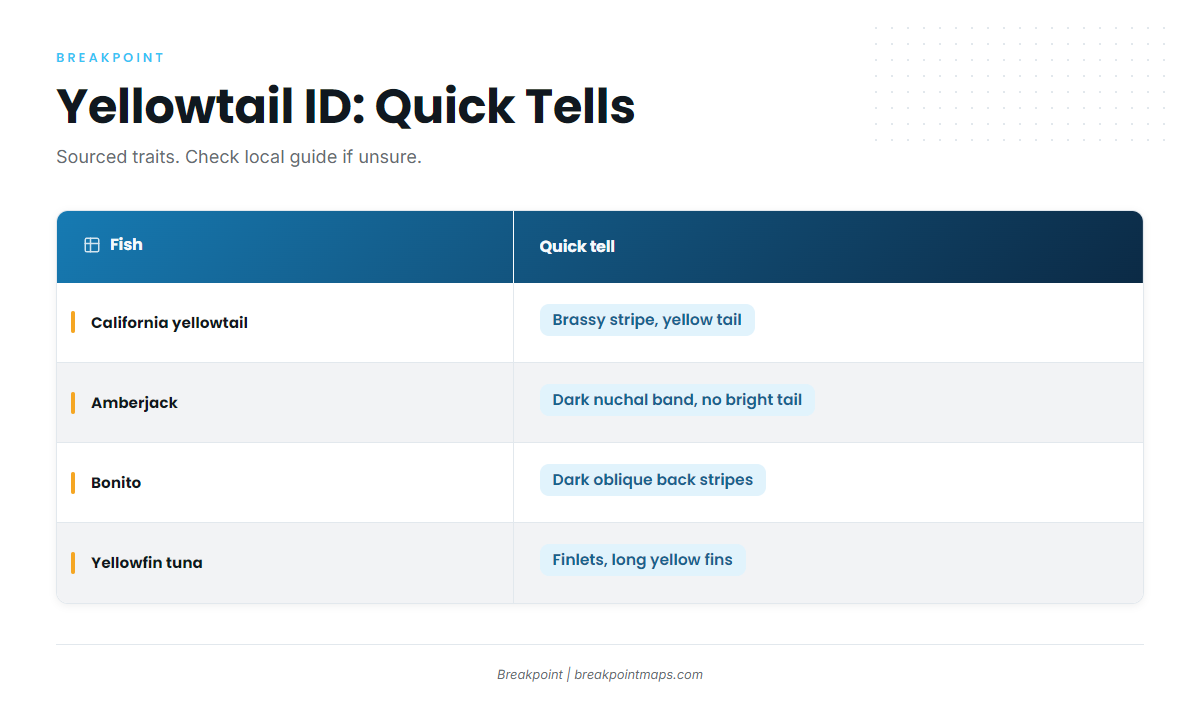
The table below sets yellowtail beside the fish most often mistaken for it. Traits for the other species are general distinguishing features. Confirm anything you’re unsure of against a local guide.
| Fish | Stripe / markings | Tail | Body shape | Quick tell |
|---|---|---|---|---|
| California yellowtail | Brassy stripe along mid-body | Yellow | Torpedo, streamlined | Yellow tail plus bronze stripe |
| Amberjack | Dark band running through the eye | Lacks the bright yellow tail | Deeper, heavier body | Dark eye band, duller tail |
| Bonito | Dark oblique stripes on the back | Dark | Tuna-like, compact | Stripes run across the upper back |
| Yellowfin tuna | Gold stripe, no brassy flank stripe | Dark to yellowish | Thick, football-shaped | Finlets and long yellow fins |
Swipe the table sideways to see every column.
Behavior. Yellowtail school and hold near structure. Saltwater Sportsman puts it this way: "Yellowtail love structure, be it wrecks, reefs or kelp beds." They feed hardest when current pushes forage through a likely spot. Structure plus moving water underlies most of the tactics below.
Size classes. Anglers use a few informal names:
| Class | Typical size | Notes |
|---|---|---|
| Firecracker | About 5 lb | Small fish, per Saltwater Sportsman |
| School fish | About 12 to 20 lb | Per Channel Islands Sportfishing |
| Mossback or home-guard | 30 to 40 lb, up to 40 to 50 lb | A big, resident fish with a thick, dark back |
| State record | More than 63 lb | Per Saltwater Sportsman. Confirm the current record with CDFW |
Diet. Yellowtail eat sardine, anchovy, mackerel and squid. In warm years, pelagic red crabs also enter the diet, according to Saltwater Sportsman. Those forage species are managed federally as coastal pelagic species by NOAA Fisheries and the Pacific Fishery Management Council. Yellowtail themselves are managed by the state and are not covered by a federal plan.
Spawning. In an aquaculture study published in the Journal of the World Aquaculture Society, adults spawned viable eggs at 15 to 22°C. That is spawning temperature research and shouldn’t be read as a target temperature for finding fish.
Habitat & Range
Yellowtail hold near hard structure. Saltwater Sportsman lists wrecks, reefs and kelp beds, and offshore they also gather under floating kelp.
A paddy is a floating mat of kelp drifting offshore. Melton Tackle notes that paddy fish seldom exceed 31 inches, and that larger fish move to inshore reefs and structure. That splits the fishery in two. Paddies hold school fish, while reefs, kelp beds and islands hold the home-guard mossbacks.
Named water worth knowing:
- Catalina and San Clemente Island are the two big yellowtail islands off Los Angeles and Orange County.
- The Channel Islands hold fish off Ventura and Santa Barbara.
- The Coronado Islands sit in Mexican waters just south of San Diego.
For more on the specific waters, see how yellowtail fishing breaks down across the Pacific Southwest.
Seasonal pattern. Landings and captains commonly describe the same rhythm:
- Fish overwinter off Southern California and northern Baja, then push north as water warms in spring.
- School fish are more common in warm summer months, per Channel Islands Sportfishing.
- Home-guard fish can be caught year-round.
"Yellowtail season" therefore depends on which fish you want. Summer is best for schoolies, and big fish are a year-round possibility if you’re willing to work structure.
Warm years. Catalina has fished well year-round in recent years, and "many attribute this to El Niño," warm water and red crabs, according to Saltwater Sportsman. That link is attributed, not proven, and nobody can reliably predict where schools will show up from one year to the next. Channel Islands Sportfishing also reports fish as far north as Washington, which suggests the range can stretch in the right conditions.
Tactics for California Yellowtail Fishing
Finding the fish comes first, and presentation follows.
Finding Fish: Signs, Current and Temperature Breaks
Capt. Duane Mellor, quoted in Sport Fishing Mag, described his approach as looking for small spots with the right conditions and some signal of feeding activity. Conditions alone aren’t enough; you want conditions plus a sign.
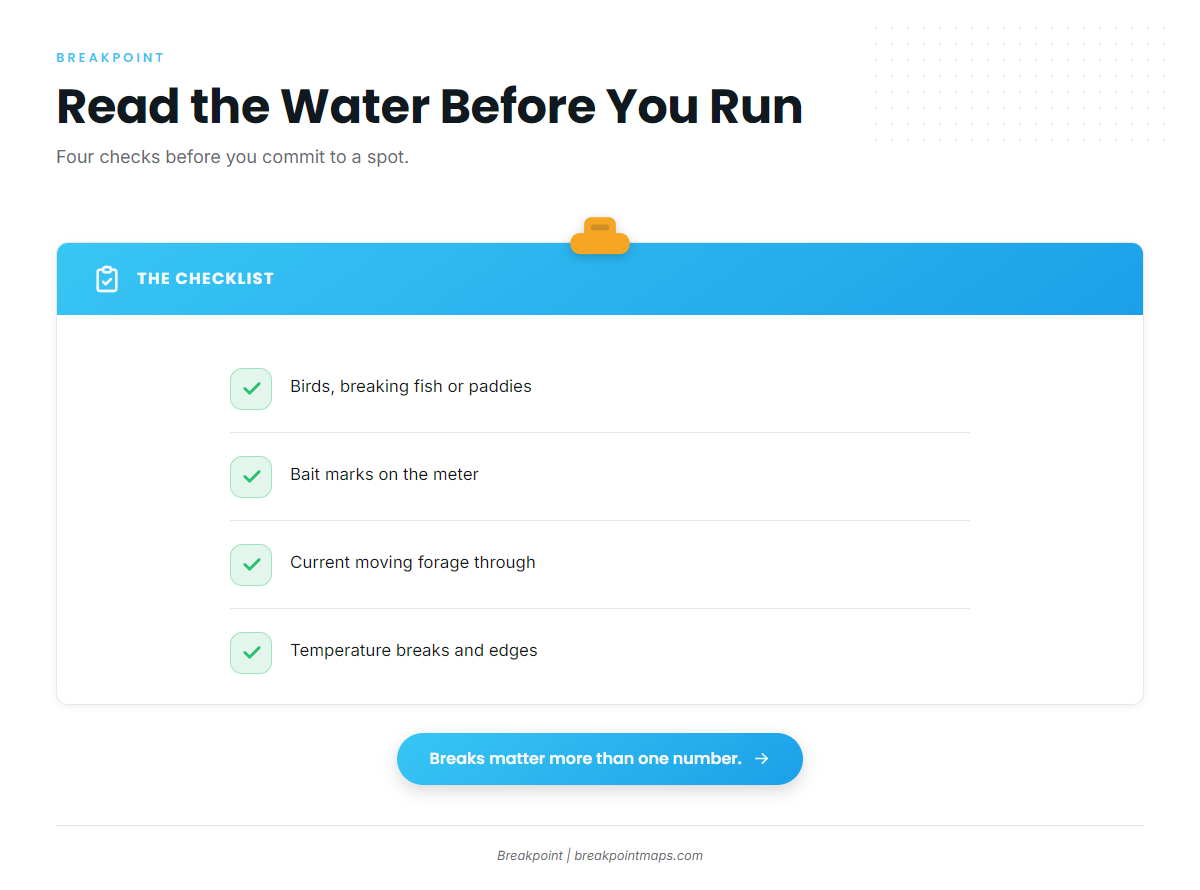
Use this checklist when you arrive on a spot:
- Birds and breaking fish. Diving birds and surface busts mean fish are feeding now.
- Paddies and floating debris. Look for kelp mats and flotsam. Fish sometimes show before your bait hits the water.
- Meter marks. A mark is an arch or cloud on your fish finder. Bait balls over a high spot are worth a stop.
- Chum and slick. Saltwater Sportsman describes streaming chunks of bait behind the boat and watching the stern for fish coming in to feed.
Current matters. Saltwater Sportsman notes yellowtail feed best when current pushes forage through likely spots, so if the bite is dead on slack water, wait for the tide to move.
On temperature, breaks and edges usually matter more than a single number.
Two limits are worth stating. A fish count tells you where boats caught fish yesterday, not where fish are now, and it doesn’t tell you how many boats tried and failed. Sea surface temperature charts show the surface only, and cloud cover can block a satellite pass.
Live Bait and Flylining
Flylining means fishing a live bait on a hook with little or no weight, swimming free. Landings and captains commonly call it the most common approach for yellowtail.
Baits that work:
- Sardine, anchovy and small mackerel, with little or no sinker
- Live squid, which San Diego Tuna Fishing describes as "like candy" to yellowtail
- Squid in cold springs and fin baits in warm years, per Newport Landing
Per Newport Landing, hook placement changes swim in predictable ways:
| Hook location | How the bait swims | When to use it |
|---|---|---|
| Nose | Sideways, away at an angle | Default presentation |
| Collar | Sideways and slightly down | When you want a little depth |
| Belly | Down and away from the boat | When you want to go deep |
Saltwater Sportsman describes a 25 to 40 lb fluorocarbon top shot tied straight to the hook for flylining.
Surface Iron
Surface iron is a lighter metal jig you cast and wind near the surface. It works when fish are showing up top.
BD Outdoors lists common surface iron models: the Salas 7X and Tady 45, which are sardine-sized, and the JRI 7, which is heavier and closer to a mackerel. One angler recommends a rod of at least 8 ft for casting distance. Treat that as a preference rather than a rule.
Yo-Yo Iron
Yo-yo iron is a heavy jig dropped to the bottom and wound up fast, with occasional pauses. Sport Fishing Mag names the Tady 4/0 and the Salas 6X Jr for this work.
It is a speed retrieve rather than a jigging motion. If you’ve jigged Gulf or Atlantic fish with a pumping rod, the technique differs here: you drop, then crank. Surface iron and yo-yo each need their own dedicated rod and reel.
Dropper Loop
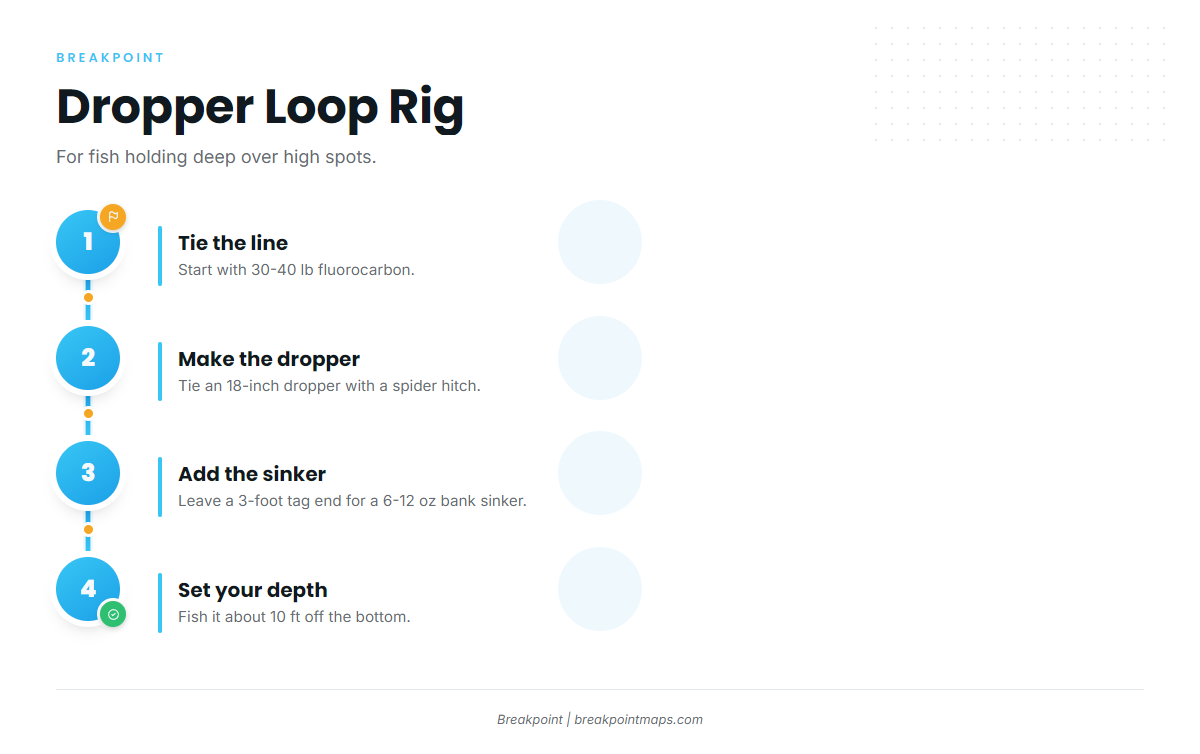
A dropper loop is a bait rig for fish holding deep over high spots. Saltwater Sportsman describes dropper loop rig specs that work:
- Tie 30 to 40 lb fluorocarbon as your main line.
- Make an 18-inch dropper for the hook using a spider hitch.
- Leave a 3-foot tag end to attach a 6 to 12 oz bank sinker.
- Fish it about 10 ft off the bottom.
Gear Setup
BD Outdoors describes a general quiver of four setups:
| Setup | Purpose | Leader | Notes |
|---|---|---|---|
| Live bait rod | Flylining sardine, anchovy, mackerel | 25 to 40 lb fluoro | Light or no sinker |
| Surface iron rod | Casting to showing fish | Per rod and reel | Longer rod helps distance |
| Yo-yo rod | Working deep schools | Per rod and reel | Dedicated heavy-jig combo |
| Sabiki rod | Catching your own bait | Per rig | Backup rod |
One angler’s choice near kelp and rock is 65 lb braid. That is a personal setup and not a standard.
Handling and the Table
Bleed and ice fish promptly. Yellowtail keep well frozen and vacuum packed, according to Channel Islands Sportfishing.
At sushi bars, yellowtail is often sold as hamachi. That name usually refers to farmed Japanese yellowtail, though it’s sometimes used for the local fish too. Either way, California yellowtail is good raw.
Frequently Asked Questions
What is the bag limit for yellowtail in California?
CDFW sets the bag limit. Check CDFW’s ocean sport fishing regulations before you go, since rules change.
What is the size limit, and how is yellowtail measured?
CDFW sets the minimum size and the measurement method. Fillet rules affect how you can prove a fish is legal. Look up the current figures and fillet requirements on CDFW’s site before you fish.
What is the best bait for California yellowtail?
Sardine, anchovy, mackerel and squid are the standard baits. San Diego Tuna Fishing rates live squid as highly effective. Newport Landing reports squid works well in cold springs and fin baits in warm years.
Surface iron or yo-yo iron: when do I use each?
Use surface iron when fish are showing up top and yo-yo iron when fish mark deep on the meter. Sport Fishing Mag describes yo-yo as dropping a heavy jig to the bottom and winding fast. Each needs its own rod and reel.
Do I need a Mexican fishing license for the Coronado Islands?
Yes. Coronado Islands and Baja trips require a Mexican fishing license from CONAPESCA. Verify current terms, including whether each person aboard needs one, on the official CONAPESCA page before you go.
When is yellowtail season in Southern California?
School fish are most common in the warm summer months, and home-guard fish can be caught year-round. Warm years can shift timing, an effect widely attributed to El Niño but not proven.
How do I tell yellowtail from amberjack?
Per the Smithsonian description, yellowtail have a brassy stripe along the mid-body and a yellow tail. Amberjack lack the bright yellow tail and show a dark band through the eye. See the ID table above.
Close: Reading the Water Before You Run
The pieces fit together: know the fish, find the structure and the moving water, match the presentation to what you see, and stay legal. None of it guarantees fish, but it gives you a better place to start looking.
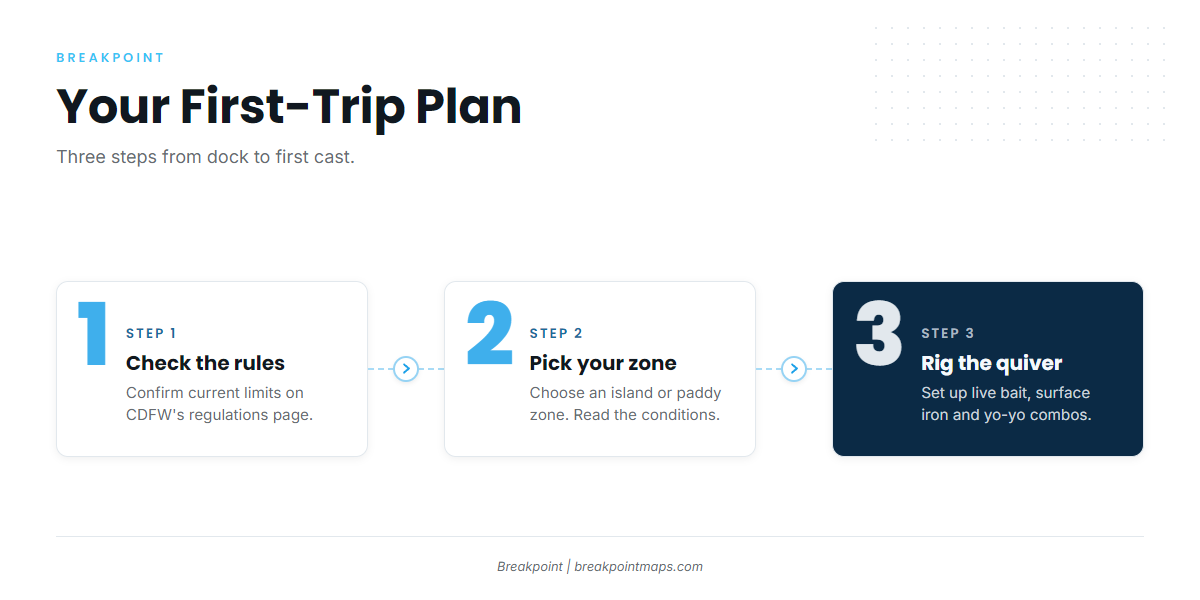
Plan your first trip in three steps:
- Check the regulations. Pull up CDFW’s current yellowtail rules and confirm your license.
- Pick a zone. Choose an island or a paddy area, then read the conditions for a break, an edge or moving water.
- Rig the quiver. Have a live bait rod, a surface iron rod and a yo-yo rod ready.
For regional timing and spots, see how yellowtail fishing breaks down across the Pacific Southwest.
When you’re deciding where to look for California yellowtail, Breakpoint’s hotspots and Fish Intel read temperature breaks and ocean conditions for you and show why each spot ranks where it does. It can’t see through cloud cover, and it won’t promise fish.