Red grouper (Epinephelus morio) is a bottom-dwelling grouper most abundant in the eastern Gulf of America (formerly Gulf of Mexico), according to the NOAA Fisheries red grouper profile. It is present but less abundant in the South Atlantic. Guides and extension agents rate it excellent table fare, and it is catchable year-round wherever seasons allow. This guide covers how to identify the fish, where it lives, how anglers catch it, and the rules that differ by region.
Overview
Red grouper is managed as a "shallow-water grouper." Gag, scamp, black grouper and red grouper can fall under aggregate limits and shared closures, so misidentifying one at the rail can cost you a ticket.
How to identify red grouper
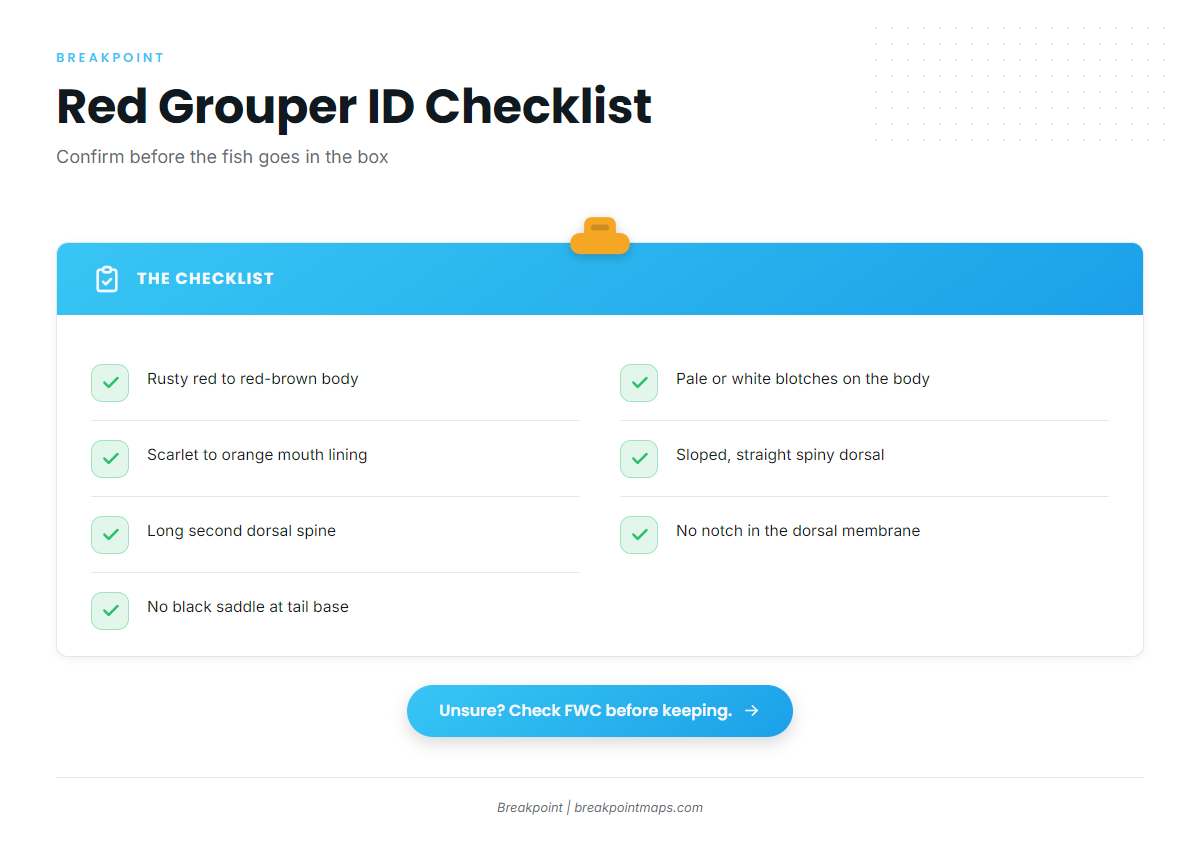
Check the fish in your hands against this list:
- Color: Rusty red to red-brown, darker on the head and upper body, lightening to a pinkish belly. Pale or white blotches run along the body, and the fins often have dark margins.
- Mouth lining: Scarlet to orange, according to Take Me Fishing’s species notes.
- Dorsal fin: The spiny dorsal has a sloped, straight profile with a long second spine and no notch in the membrane. Most other groupers have a notched membrane and a longer third spine, per the South Atlantic Council species page.
- Tail base: No black saddle spot. That spot marks Nassau grouper.
Gag and red grouper fall under different rules. If you are not sure which one is in the box, check the FWC recreational grouper regulations before you leave the dock.
Behavior and biology
Red grouper dig. The Gulf Council species page reports that males are territorial and somewhat sedentary during spawning season, and that they excavate holes as home territories. That is why anglers find reds on potholes, cutouts and "grouper holes" in hard bottom.
Prey is mostly crabs, shrimp and octopus, with small fish taken now and then, according to Take Me Fishing and other guide sources. Much of what is known about the species comes from stock assessments and survey data, and those have limits.
Habitat & Range
Depth and habitat, as each agency or guide describes them:
| Source | Habitat and depth described |
|---|---|
| South Atlantic Council | Ledges, crevices and caverns of rocky limestone reefs and lower-profile live bottom, in 10 to 40 ft of water |
| Take Me Fishing | Adults rest in potholes on, or near the edges of, rocky flat bottoms, in depths up to about 1,000 ft |
Bottom type matters more than depth: look for hard bottom with holes, ledges and cutouts.
On range, the South Atlantic Council describes the natural distribution as North Carolina to Brazil, including the Gulf and the Caribbean. NOAA describes US wild-caught red grouper as coming from Massachusetts to the Gulf. The first describes where the fish lives, and the second where the US harvest comes from.
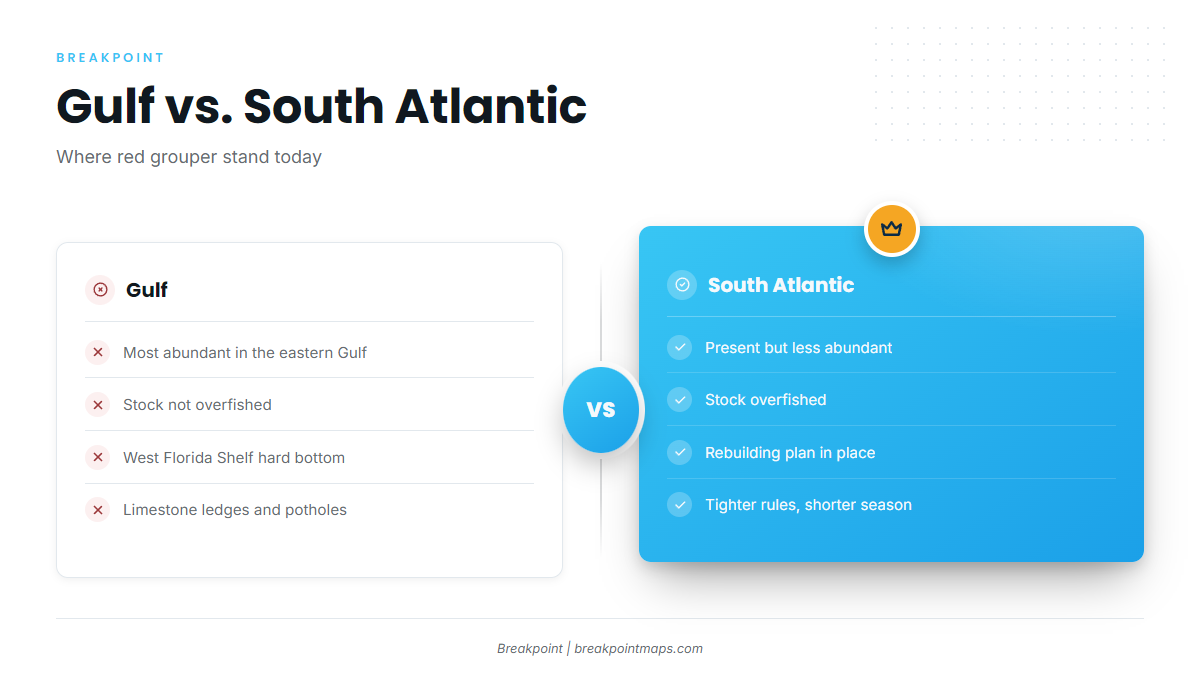
Gulf
The eastern Gulf is the center of abundance, per NOAA, and the West Florida Shelf’s limestone ledges and hard bottom are the signature habitat.
Fishing the Gulf? Reds are the more abundant grouper here, and NOAA lists the stock as not overfished. Rules are in the Regulations section.
South Atlantic
The population here is present but less abundant than in the Gulf, and NOAA lists the stock as overfished under a rebuilding plan. For local structure and conditions, see our guide to red grouper fishing in the Florida Keys.
Moving from the Gulf? Expect fewer reds and tighter rules. The comparison table in Regulations shows the differences.
Tactics
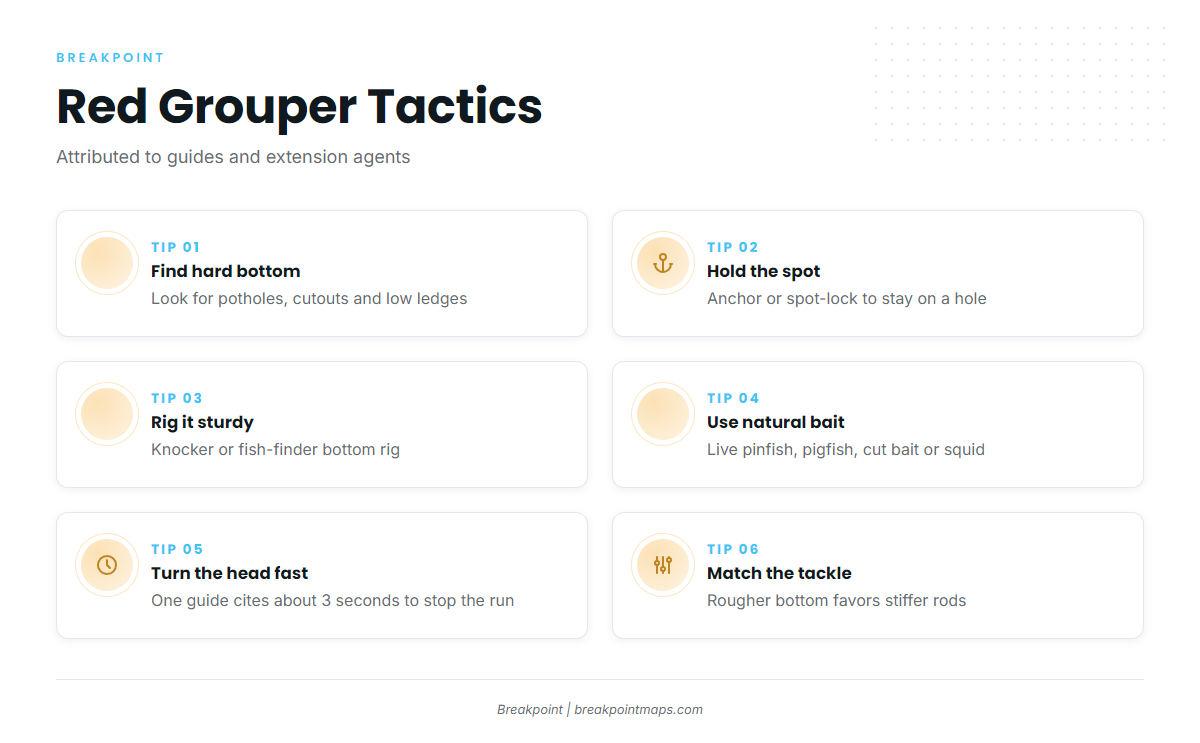
These tactics come from guides and extension agents who fish them.
Finding bottom
Look for these on the sounder:
- Flat hard bottom with potholes and cutouts
- Limestone openings and low ledges
- Small reefs and wrecks
This ties back to the digging behavior above. Anchoring or spot-lock holds a bait on a specific hole, while drifting covers scattered low-relief bottom. Drift fishing and jigging are also alternatives to bottom-dropping.
Rigs and bait
A sturdy bottom rig is the baseline, and the knocker rig and the fish-finder (Carolina-style) rig are common choices. Circle hooks may be legally required, so see Gear requirements below.
For bait, Take Me Fishing points to cut or live bait. Guides name these:
- Live pinfish or pigfish
- Cut bait
- Squid strips, which Salt Strong sizes at 1/2 to 3/4 inch wide and 6 to 12 inches long
Hookset and tackle
The first seconds decide the fight. One Florida guide describes having about three seconds to turn a big red’s head before it reaches "The School of Hard Rocks." If the fish rocks up, the guide’s two options are to reel tight and strum the line, or to take all pressure off and wait for the fish to swim out.
Guidance differs on tackle. UF/IFAS Extension grouper guidance says stiff rods and heavy conventional reels help bring fish up quickly, because grouper rush back to structure. Take Me Fishing says reds, unlike other reef groupers, can be taken on relatively light tackle. Match the tackle to the bottom: the rougher the structure, the more the UF/IFAS view applies.
Seasonal notes
Red grouper can be caught year-round in Florida state waters, but seasons and closures set when you can keep one.
FAQ
Is red grouper season open?
It depends on region and water. In the South Atlantic, recreational red grouper is closed Jan 1 to Apr 30. The Gulf Council decided to eliminate the Feb 1 to Mar 31 closure beyond 20 fathoms, but FWC’s grouper page still lists it, so check FWC before you go.
How do you tell red grouper from gag grouper?
Red grouper has a straight, unnotched spiny dorsal, per the South Atlantic Council, and a scarlet-to-orange mouth lining, per Take Me Fishing. The two species follow different rules. For gag features, use FWC’s identification resources.
What depth do red grouper live in?
Red grouper are common in 10 to 60 ft of water, per NOAA Fisheries. The South Atlantic Council gives 10 to 40 ft for ledges and live bottom. Prioritize hard bottom with holes over any single depth.
Do I need a descending device?
Check NOAA Fisheries for current venting tool and descending device requirements in Gulf federal waters before you fish.
What is the bag limit?
In the South Atlantic, the bag is 3 per person, within a 3-grouper aggregate. In the Gulf, the bag is 2 per person, within a 4-grouper aggregate. Charter captain and crew have a zero bag in Gulf state waters.
Is red grouper good to eat?
Yes. Guides and UF/IFAS describe it as excellent table fare, and NOAA says US wild-caught red grouper is sustainably managed and responsibly harvested.
How Breakpoint Helps
Reds live on hard bottom with holes and ledges, and our hotspots and Fish Intel view and the Chart Contours layer help you find that bottom before you burn fuel searching. Use them to narrow where to drop, then let the sounder confirm. Chart layers are not for navigation, and no map promises fish. Keep this guide’s rules table handy and verify it against the agencies before you fish.