


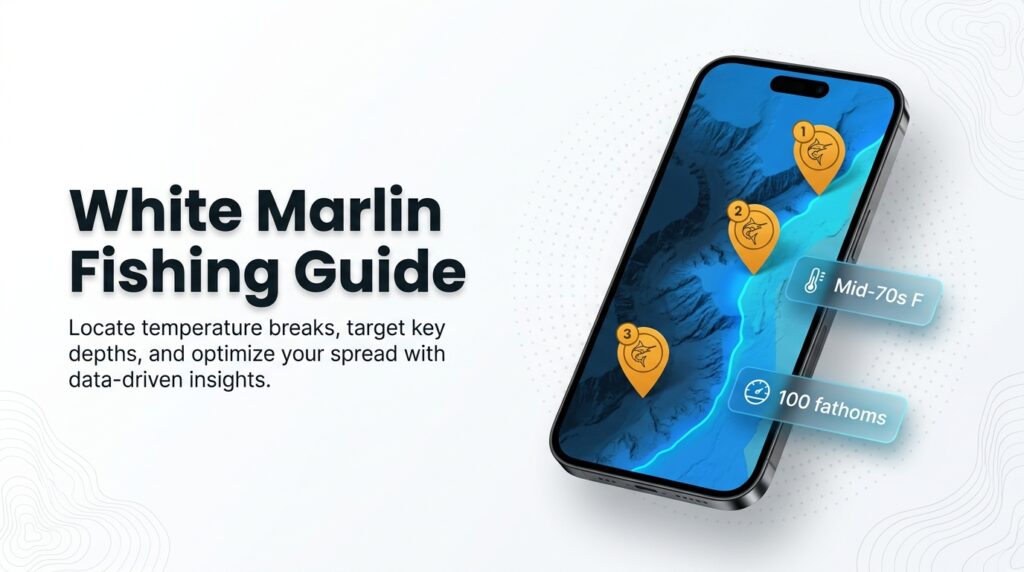
White marlin (Kajikia albida) is an Atlantic billfish of offshore blue water, found from the Gulf of Mexico to the Mid-Atlantic canyons. Fishing for it is almost entirely catch-and-release. It suits anglers who like an acrobatic, light-tackle fish and will put up with careful rigging and a lot of patience. According to Marlin Magazine’s white marlin profile, each fish eats a little differently, and rigging up to 100 baits in a day is "not out of the norm." This guide covers how to identify the fish, where and when to find it by region, how to raise, hook and release it, and the federal rules that apply.
Quick Facts
| Fact | Detail |
|---|---|
| Scientific name | Kajikia albida |
| Typical size | Averages about 60 lb as an adult, per Marlin Magazine |
| Range | Tropical and subtropical Atlantic, Gulf of Mexico and Caribbean, per Marlin Magazine |
| Preferred water | Mid-70s °F, per Marlin Magazine |
| Peak seasons | Gulf and Atlantic Southeast run earlier in the year. Mid-Atlantic peaks in late summer. See the regional guides for specific windows. |
| Federal minimum | 66 inches lower jaw fork length (LJFL) |
Overview: What a White Marlin Is
White marlin belong to the billfish family, Istiophoridae, along with blue marlin, sailfish and spearfish. Of the two Atlantic marlins, it is the smaller and slimmer. Correct identification matters because a look-alike species affects what you may keep and what you must report.
How to Identify a White Marlin
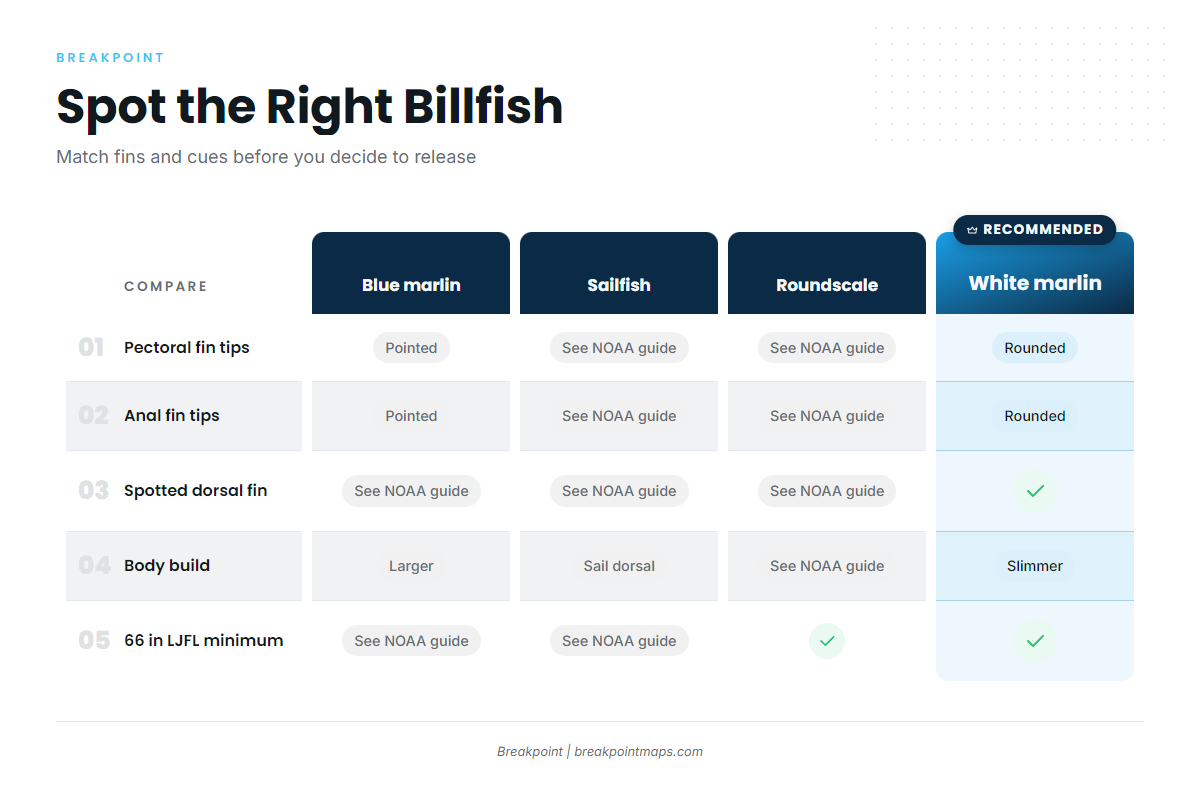
A white marlin has rounded tips on its pectoral and anal fins, a usually rounded dorsal fin covered in black spots, and a slimmer body than a blue marlin. Blue marlin have pointed fin tips. Roundscale spearfish look very similar and share the same 66-inch federal minimum, so check the ID closely.
Marlin Magazine says white marlin "can be recognized by the rounded pectoral, anal, and usually the dorsal fins," and that all white marlin display black spots on the dorsal fin. Judge the fins and dorsal spots together, not one feature alone. Confirm the ID against NOAA Fisheries’ white marlin and roundscale spearfish guide.
Work through the look-alikes in this order:
- White marlin versus blue marlin. Blue marlin are heavier and deeper-bodied, with pointed fin tips. White marlin are slimmer with rounded tips.
- Sailfish. The sail-like dorsal fin is the giveaway.
- Roundscale spearfish. This is the hardest to separate. NOAA Fisheries’ ID guide describes the distinguishing cues, and both species carry the same 66-inch LJFL minimum.
| Feature | White marlin | Blue marlin | Sailfish | Roundscale spearfish |
|---|---|---|---|---|
| Dorsal fin | Usually rounded, black spots | Pointed, lower than body depth | Tall, sail-like | See NOAA ID guide |
| Pectoral fin tips | Rounded | Pointed | See NOAA ID guide | See NOAA ID guide |
| Anal fin tips | Rounded | Pointed | See NOAA ID guide | See NOAA ID guide |
| Body build | Slim | Heavy, deep-bodied | Slender | See NOAA ID guide |
| Key cue | Rounded fins, spotted dorsal | Pointed fins, larger size | Sail | Confirm against NOAA guide |
Swipe the table sideways to see every column.
Even experienced crews misidentify these fish at boatside. When in doubt, release the fish.
Behavior and Diet
White marlin often hunt in groups. According to Salt Water Sportsman, in summer in the Mid-Atlantic they feed in cooperative groups, corralling bait such as tinker mackerel, sardines and squid. That diet explains the usual bait choices: small ballyhoo and squid imitations match the forage, and dredges (multi-armed teasers that imitate a school of baitfish) copy the bait ball.
What experienced crews do differently. They expect more than one fish at a time and rig accordingly. Several small baits ready on pitch rods (rigged baits held ready to drop back to a fish that shows up) is standard practice, covered below.
Habitat & Range: Where and When to Find White Marlin
White marlin live in offshore blue water, along canyons, shelf edges, temperature breaks and color changes. Finding them comes down to finding where water types meet, because bait stacks up there. Major current systems set the stage: the Gulf Stream along the Atlantic coast, and the Loop Current and its eddies in the Gulf. Depth matters too. The 100-fathom curve, roughly 600 ft, is a common reference line along the shelf edge.
Water Temperature
Marlin Magazine says white marlin prefer water in the mid-70s. Warm, clean water meets cooler, greener, more nutrient-rich water, edges concentrate bait, and bait concentrates fish. A temperature break raises the odds of finding fish but guarantees nothing.
Seasonal Movement
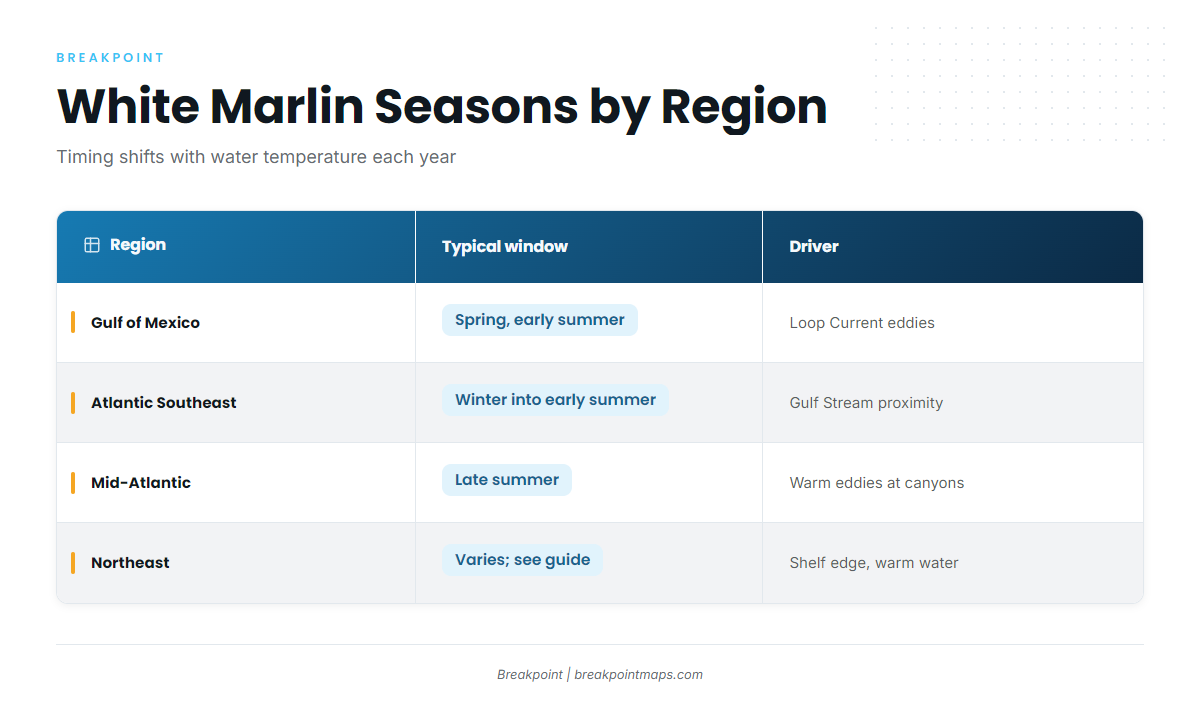
The general pattern runs south to north. Fish show up earlier in the Southeast and Gulf, then the Mid-Atlantic canyon bite peaks in late summer.
| Region | Typical window | Drivers | Regional guide |
|---|---|---|---|
| Gulf of Mexico | Varies; see regional guide | Loop Current and eddies, deep water near shore | Gulf guide |
| Atlantic Southeast | Varies; see regional guide | Gulf Stream proximity | Southeast guide |
| Mid-Atlantic and Northeast | Late summer | Warm eddies, shelf-edge canyons | Northeast guide |
Timing shifts year to year with water temperature, and tagging studies still leave open questions about where individual fish go.
Gulf of Mexico
The Loop Current and its eddies shape where warm blue water pushes into the northern Gulf, and deep water sits close to shore off parts of the northern coast. For fish timing, run distances and local structure, read our regional guide to white marlin fishing in the Gulf of Mexico.
Atlantic Southeast
The Gulf Stream runs close to shore off Florida and the Carolinas, which puts blue water within reach of many ports. Southern waters also carry the earlier winter-to-spring window. Details are in our guide to white marlin fishing in the Atlantic Southeast.
Atlantic Northeast and Mid-Atlantic
The Mid-Atlantic canyons are the center of white marlin fishing in the north: Norfolk, Washington, Baltimore and Poor Man’s. The peak comes in late summer, and Ocean City, Maryland, calls itself the "White Marlin Capital of the World." Anglers there look for eddies of warmer water to spin down the coast carrying white marlin, as described in these Ocean City white marlin tips from FishTrack.
What experienced crews do differently. They track warm eddies and the shelf edge day to day rather than returning to last week’s numbers. Our guide to white marlin fishing in the Atlantic Northeast goes deeper.
Tactics: How to Raise, Hook and Release White Marlin
Trolling is the core method. The rest of the work is getting a fish that follows the spread onto a circle hook and back into the water alive.
Reading the Water
Three Breakpoint layers work together here: OBS SST, Chlorophyll and Chart Contours.
- Find a temperature edge on OBS SST.
- Confirm the color change on Chlorophyll.
- Look for where both cross a canyon wall or the 100-fathom curve (about 600 ft) on Chart Contours.
Cloud can block a satellite pass, and imagery is a snapshot, so edges move. Chart layers are not for navigation.
The Trolling Spread
One Ocean City approach, described in FishTrack’s tips, uses four small ballyhoo and three big baits. The small ballyhoo go on circle hooks on the flat lines and long riggers, and the larger baits go on the short riggers and shotgun. A starter spread looks like this:
- Small circle-hooked ballyhoo (dinks, meaning small, lightly rigged baits) on the flat lines and long riggers
- Larger baits on the short riggers and shotgun
- 2 squid-chain teasers
- 2 dredges
Rig ballyhoo so they swim straight, since a bait that spins or skips will not get eaten. That is part of why crews rig so many.
What experienced crews do differently. In the Northeast, light-tackle white marlin tactics from On The Water describe a canyon spread of spreader bars, ballyhoo and skirted lures that catches marlin consistently.
Teasers and Dredges
A teaser is a hookless lure that raises fish. A dredge is a multi-armed teaser that imitates a small school of bait under the boat. FishTrack’s Ocean City spread pairs two squid-chain teasers with two mullet or ballyhoo dredges.
Bait-and-Switch and Pitch Baits
In a bait-and-switch, you tease the fish to the boat with a hookless teaser, pull the teaser away, and present a hooked bait. A pitch bait is a rigged bait on a ready rod that you drop back to a fish that appears behind the boat. Salt Water Sportsman says crews rig two or three dinks on pitch-bait rods for the times when two or more whites show up at once.
Crew roles matter here: clear the teaser, drop the bait back, free-spool, then come tight without jerking.
Chunking and Live Bait
Chunking means chumming with cut bait to bring fish into the slick. It is used in the canyons, and the Atlantic Northeast guide covers when it fits. Live bait also works. According to On The Water, a live eel, scup, mackerel or bluefish rigged on a circle hook and cast to a tailing marlin "will often be devoured." Marlin Magazine lists goggle-eyes, sardines, herrings and ballyhoo as acceptable kite baits.
Tackle
White marlin suit light stand-up tackle. On The Water says a 10000-size spinning reel with 30 to 50 lb braid is all that’s needed for light-tackle fishing, and that downsizing converted a much higher percentage of bites.
Circle Hooks
Circle hooks tend to hook in the jaw, which speeds release and improves survival. In billfish tournaments, NOAA Fisheries requires non-offset circle hooks when fishing natural bait or a natural/artificial combination. Outside tournaments, circle hooks are recommended for release but not required.
Releasing a White Marlin
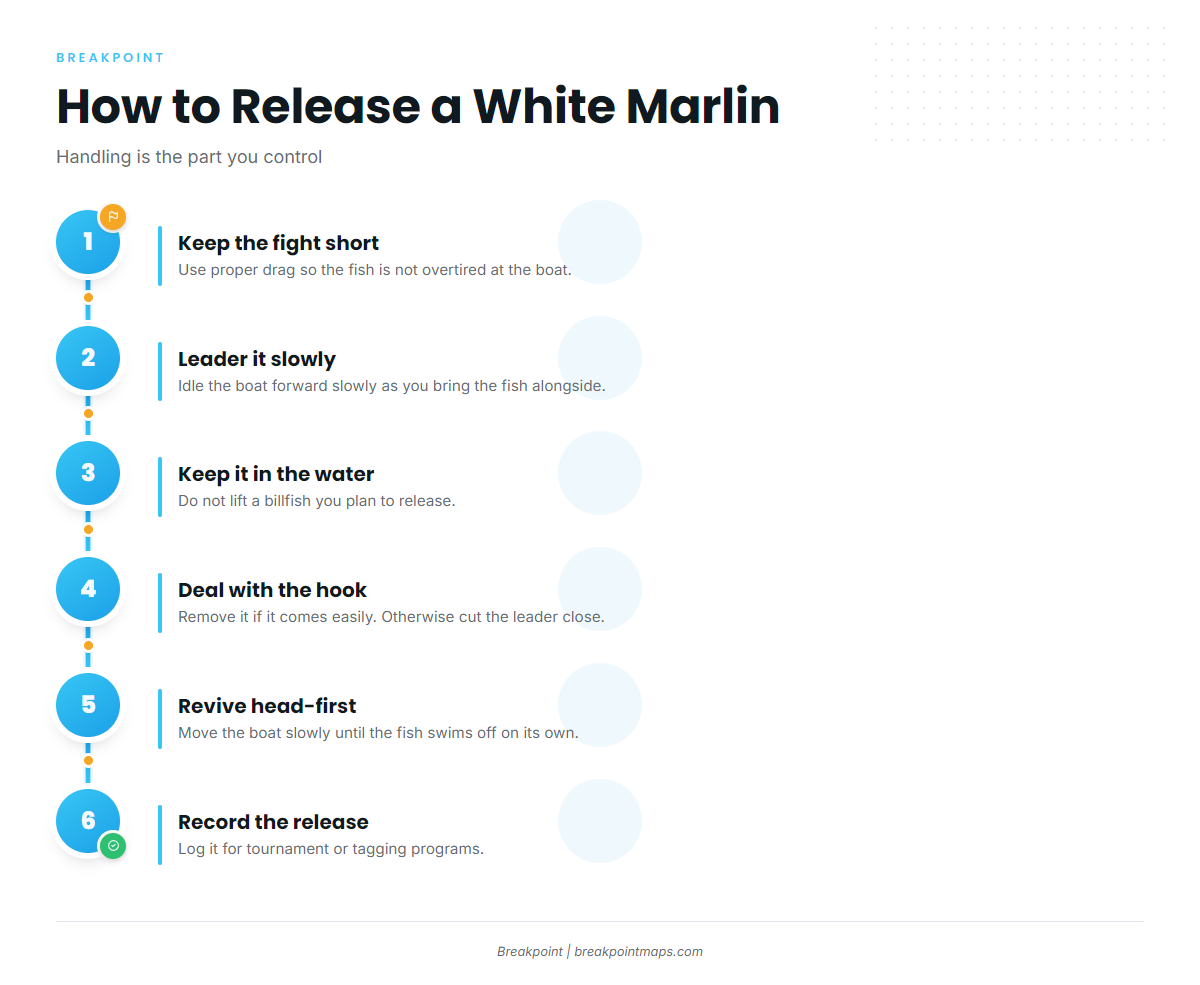
Follow this checklist, and cross-check it against NOAA Fisheries’ billfish handling guidance:
- Keep the fight short. Use proper drag and do not play the fish to exhaustion.
- Leader the fish slowly. Keep the boat idling forward.
- Keep the fish in the water. Do not lift a billfish you intend to release.
- Remove the hook if it comes easily. Otherwise cut the leader close to the hook.
- Revive the fish head-first. Hold it in the water with the boat moving slowly until it swims off.
- Record the release. Tournament and tagging programs may require it.
Release survival is not 100%, and handling is the part you control.
Frequently Asked Questions
What is the difference between a white marlin and a blue marlin?
White marlin have rounded pectoral and anal fin tips and a spotted, usually rounded dorsal fin. Blue marlin have pointed fins and are heavier and larger. White marlin average about 60 lb as adults, according to Marlin Magazine. Confirm the ID against NOAA Fisheries’ guide when in doubt.
When is white marlin season?
It depends on the region. Fish arrive earlier in the Gulf and Southeast, and the Mid-Atlantic canyon bite peaks in late summer. Timing shifts with water temperature each year. For local windows, start with our guide to white marlin fishing in the Atlantic Northeast.
Do you need a permit to fish for white marlin?
Yes. A federal HMS Angling permit is required to fish for white marlin from a recreational vessel in federal waters, and for-hire trips use a Charter/Headboat permit. Buy or renew the permit at hmspermits.noaa.gov.
What is the minimum size for a white marlin?
The federal minimum is 66 inches LJFL, measured from the tip of the lower jaw to the fork of the tail. Roundscale spearfish share that minimum.
What do white marlin eat?
They feed on squid, tinker mackerel and sardines, often hunting in cooperative groups. Salt Water Sportsman describes them corralling bait schools in the Mid-Atlantic in summer. That diet is why small ballyhoo and squid-style teasers work well in a spread.
How do you tell a white marlin from a roundscale spearfish?
The two look very similar, and anglers often confuse them. Use the distinguishing cues in NOAA Fisheries’ ID guide. Both share the 66-inch minimum, so when you cannot tell, release the fish.
How do you release a white marlin?
Use a circle hook, keep the fight short, and keep the fish in the water. Remove the hook if it comes easily, or cut the leader close to it. Revive the fish head-first with the boat moving slowly until it swims off. NOAA Fisheries publishes billfish handling guidance.
Closing Note
Identify the fish first, since the look-alikes carry the same size limit. Find the edge, then the bait, then the fish. Raise fish with teasers and dredges, hook them on circle hooks, and release them in the water. Check the rules with NOAA Fisheries and your state agency before every trip.
If you want help deciding where to start looking, Breakpoint’s hotspots and Fish Intel layer OBS SST, Chlorophyll and Chart Contours to point you toward likely water. Cloud can block a satellite pass, and a break is where to look, not a guarantee.
Regional guides: Gulf of Mexico · Atlantic Southeast · Atlantic Northeast