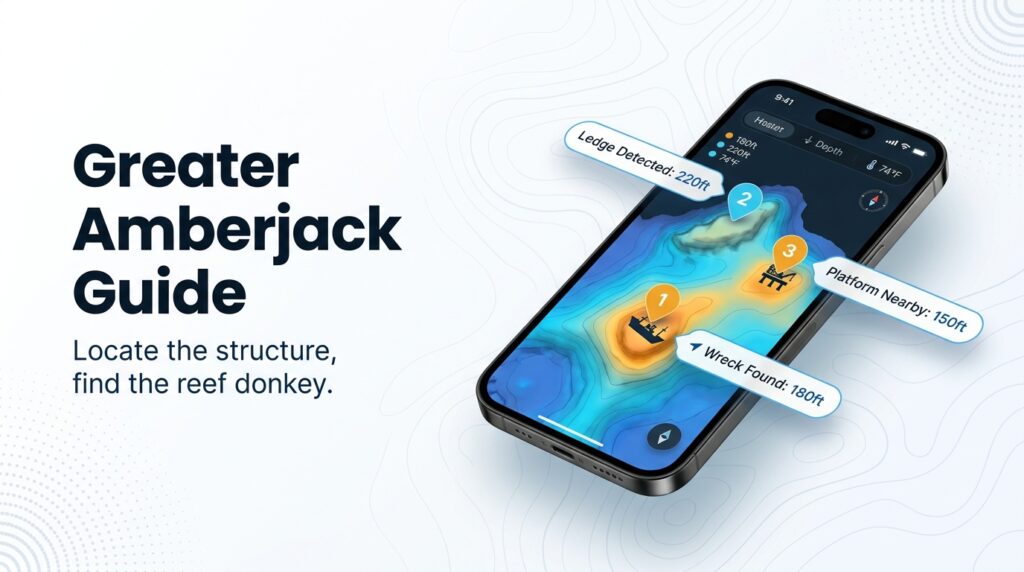
Greater amberjack (Seriola dumerili) is the biggest jack most offshore anglers will ever hook. It picked up the name "reef donkey" because it pulls hard for the nearest wreck, rig or ledge and doesn’t quit. This guide covers what the fish is, where it lives, how people catch it and how the rules differ by coast.
There are two stocks with two rulebooks, one in the Gulf of Mexico and one in the South Atlantic, according to NOAA’s greater amberjack profile. The 2026 Gulf federal recreational season is open now and closes October 14. Details are in the Regulations section.
Regional and local Breakpoint pages cover specific water. This page covers the fish: how to identify it and keep it legal, where it lives, how anglers catch it and how the rules differ by coast.
Quick Facts
| Fact | Detail |
|---|---|
| Scientific name | Seriola dumerili, jack family |
| Max size | Up to 6 ft and about 200 lb, most commonly up to 40 lb. Lives up to 17 years. |
| Typical depth | Commonly 60 to 240+ ft, varies by region |
| Main structure | Wrecks, artificial reefs, ledges, oil and gas platforms |
| Regulations | Two stocks, two rulebooks. See Regulations. |
Overview
Greater amberjack is the largest member of the jack family in the Gulf of Mexico and Atlantic Southeast. It is a structure-oriented predator known for hard, deep runs toward wrecks and rigs. NOAA manages it as two separate stocks.
Identification
NOAA lists these marks:
- A dark stripe from the snout, through the eye, to the first dorsal fin. It darkens when the fish is excited or feeding.
- An amber stripe along the side.
- A brownish or bluish-gray back and a silvery-white belly.
- Brown eyes.
- Yellow juveniles with 5 or 6 dark vertical bars.
Check the head bar and eye color before anything goes in the box.
Lookalikes
Three fish get mistaken for greater amberjack, and a wrong call can mean keeping an illegal fish.
| Species | Key tell | Why it matters |
|---|---|---|
| Almaco jack | Taller, sickle-shaped second dorsal lobe | Common mix-up. Different fish, different rules. |
| Banded rudderfish | Yellow eyes and a yellow stripe. Juveniles show bars. | Brown eyes on a greater amberjack, yellow on a rudderfish. |
| Lesser amberjack | Gill-raker count | Hard to separate by eye. |
A lesser amberjack is separated by gill rakers, 11 to 19 in a greater and 23 to 26 in a lesser, according to Take Me Fishing’s gill raker count guidance. If you are in doubt, confirm with your state agency. When you are unsure, release the fish.
Behavior
Greater amberjack school around structure and feed aggressively. When hooked, they run straight for cover, which is where "reef donkey" comes from. It also explains why heavy tackle and good boat handling matter later in this guide.
On the Table
Anglers generally regard greater amberjack as good eating. We make no health claims here. Check with your state agency for food-safety guidance.
Habitat & Range
Greater amberjack are structure fish, so finding the structure is most of the work.
Depth depends on your water. Practitioner guides put the range at about 60 to 240 ft and 80 to 240 ft. Deeper Gulf structure often holds fish at 150 to 200 ft. Treat those as planning figures, not rules.
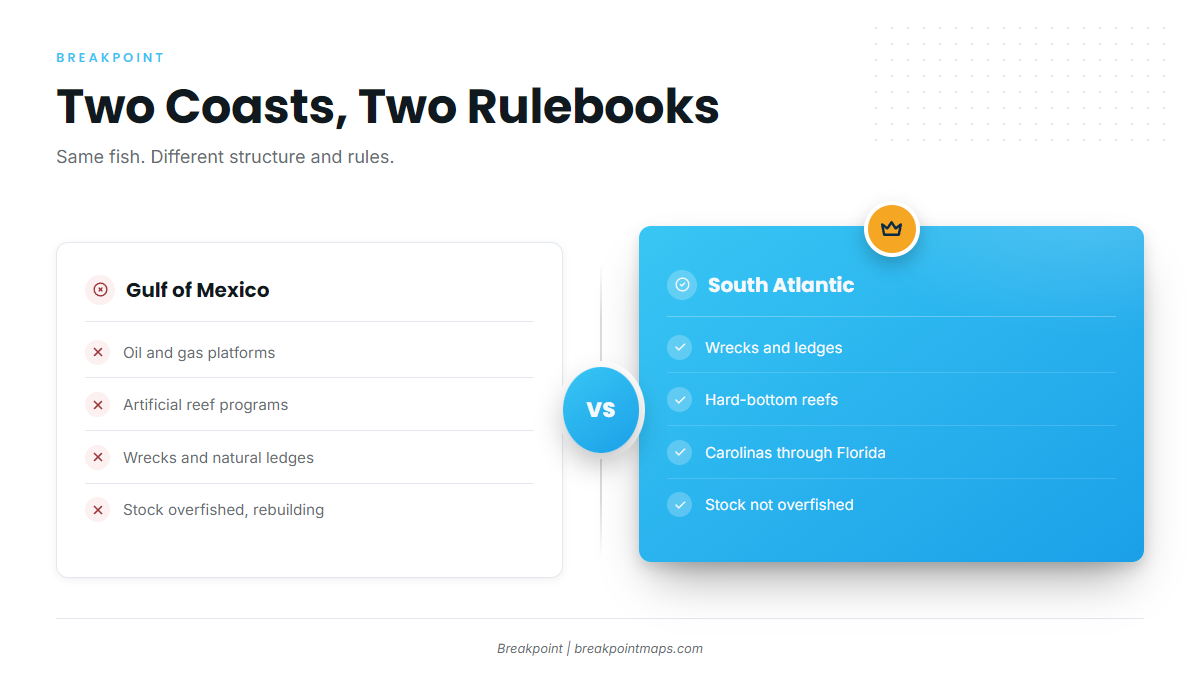
The table below compares the two coasts.
| Gulf of Mexico | Atlantic Southeast | |
|---|---|---|
| Main structure | Oil and gas platforms, artificial reefs, wrecks, natural ledges | Wrecks, ledges, hard-bottom reefs |
| Range | Gulf-wide | Carolinas through Florida |
| Rulebook | Gulf Council and NOAA | SAFMC and NOAA |
Gulf of Mexico
The Gulf has the widest mix of structure: oil and gas platforms, artificial reef programs, wrecks and natural ledges. Runs to deep structure can be long.
Atlantic Southeast
Fish here hold on wrecks, ledges and hard-bottom reefs from the Carolinas through Florida. The fish is the same, but the structure and the rulebook differ.
Seasons
Practitioner sources disagree on the best months. One guide says spring, March through May, when fish stage before spawning. Others say February through June. Some note that summer fish shift deeper. Spawning timing also varies by source.
- The Gulf stock has been overfished since 2001 and is still rebuilding, per NOAA.
- Depth ranges and spawning timing vary by source.
- Size limits differ by jurisdiction. Verify yours.
Tactics
Every number below is a common practitioner starting point, not a rule. Adjust to your water and your fish.
Finding Fish
Amberjack often hold above the structure rather than on it. Fish are commonly suspended above the wreck, around 15 to 40 ft over the relief. Mark them on sonar before you drop.
Live Bait
Live bait is the baseline method. Common choices include:
- Blue runners (hardtails)
- Pinfish
- Cigar minnows
Texas Saltwater Fishing Magazine advises that bigger and livelier is better. In Gulf waters, natural bait requires non-stainless circle hooks. See Regulations.
Jigging
For vertical or butterfly jigging, drop to the bottom, then work the jig up with hard lifts of 2 to 3 ft. Follow with a controlled drop on semi-slack line. In The Spread’s amberjack guide walks through the cadence.
Tackle
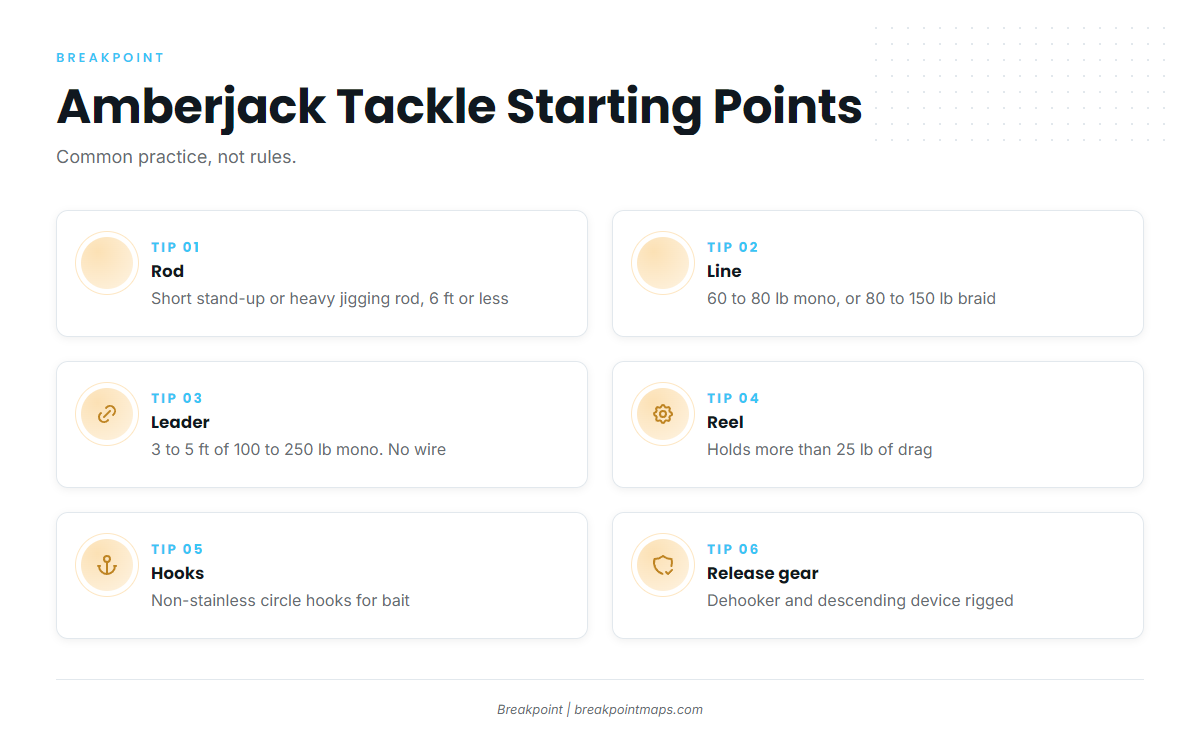
These are common starting points:
- A short stand-up or heavy jigging rod, 6 ft or less (Texas Saltwater Fishing Magazine)
- 60 to 80 lb mono, or 80 to 150 lb braid
- 3 to 5 ft of 100 to 250 lb mono leader. No wire is needed.
- A reel that holds more than 25 lb of drag. One retailer suggests 20 to 25 lb of strike drag.
- Non-stainless circle hooks for bait
- A dehooking device
- A descending device, rigged and ready
Fighting Off Structure
On hookup, have the helm pull off the rig or reef, as Louisiana Sportsman advises. Then let the hook do its work. In The Spread advises pointing the rod at the fish, reeling tight and never swinging on a circle hook.
Release
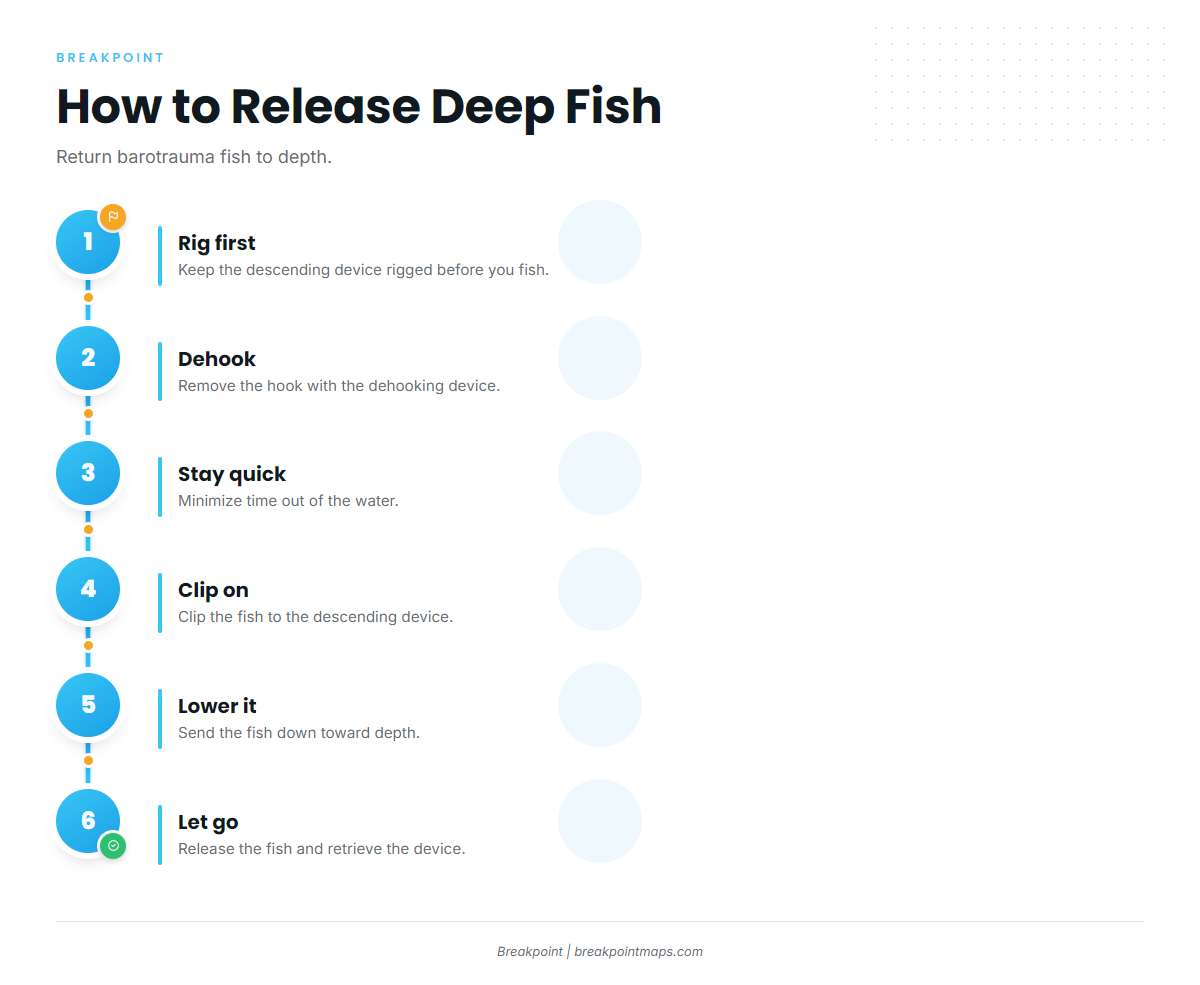
Fish pulled from depth suffer barotrauma, a pressure injury, and returning them to depth improves their odds. The sequence:
- Keep the descending device rigged before you fish.
- Remove the hook with the dehooker.
- Keep the fish out of the water as briefly as you can.
- Clip the fish to the descender.
- Lower it toward depth.
- Release it and retrieve the device.
Frequently Asked Questions
When is greater amberjack season in the Gulf?
The 2026 federal recreational season runs September 1 to October 14 in federal waters. State waters may differ. NOAA Fisheries publishes the season announcement, so confirm there and with your state agency before you go.
How do you tell greater amberjack from almaco jack?
Look at the head first. A greater amberjack has a dark stripe from the snout through the eye and brown eyes. An almaco jack has a taller, sickle-shaped second dorsal lobe. When you are unsure, release the fish.
How deep do amberjack live?
Commonly 60 to 240+ ft on structure, and the number varies by region. Deeper Gulf structure often holds fish at 150 to 200 ft. Fish often suspend above a wreck, so mark them on sonar first.
What is the size limit?
Check 50 CFR 622 for the Gulf, or SAFMC and your state agency elsewhere. Limits use fork length, the snout to the fork of the tail. They differ between the Gulf and the South Atlantic and change over time.
Are amberjack good to eat?
Anglers generally rate them well. We make no health claims here. Check with your state agency for food-safety guidance.
Closing
Confirm the ID before anything goes in the box, look for structure first, and keep a descending device rigged every trip. The two stocks have separate rulebooks, so check the one that applies to your water.
Breakpoint’s hotspots and Fish Intel can help you shortlist wrecks, ledges, artificial reefs and platforms, along with conditions worth checking before the run. They help you decide where to look and do not promise fish.
Chart layers are not for navigation.