


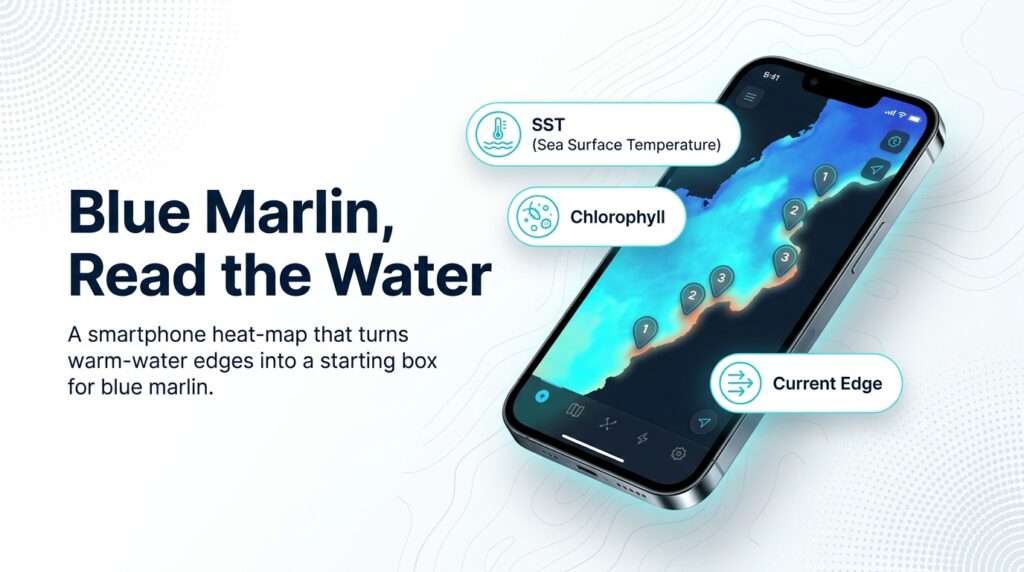
A blue marlin is realistic from your own boat if you can reach blue water, carry tackle heavier than your mahi setup, hold the federal permit, and fish the right season. This guide covers how to identify the fish, where and when it shows up in the Gulf of Mexico, the Atlantic Southeast and the Atlantic Northeast, a starter spread and tackle, and the current rules.
For center console owners, trolling from a center console is not much different from trolling for dolphin or wahoo. The run to billfish water is usually longer, and center consoles rarely have fighting chairs. Preparation matters more than horsepower.
We read the ocean data and the rulebooks so the explanation comes with numbers, and we say where the science runs out.
Go/no-go check
Run these four items before you commit fuel and a day to blue marlin fishing.
| Item | What to confirm |
|---|---|
| Range | Can you reach blue water at the shelf edge or beyond with a fuel reserve? The run is usually longer than a typical mahi trip. |
| Tackle | Do you have 50 to 130 lb class gear? See the Tackle subsection below. |
| Permit | You need a federal HMS permit. See Regulations for what to verify. |
| Season | Is your region’s window open? See the season table under Habitat & Range. |
Overview
Blue marlin (Makaira nigricans) is the largest Atlantic billfish. It is a tropical, open-ocean predator and is most often confused with white marlin. Correct identification matters because size limits and retention rules differ by species.
North Carolina’s blue marlin profile describes a body that is cobalt blue on top, shading to silvery white on the belly. It has approximately 15 blue vertical bars on the sides and an upper jaw elongated into a spear. The first dorsal fin has a high crest that slopes sharply down and runs along most of the back.
Identification: blue marlin vs white marlin and look-alikes
The clearest cue against white marlin is fin shape. Blue marlin have pointed dorsal and anal fins, and white marlin have rounded ones. The remaining cells in the table are left open until we verify them against NOAA Fisheries species pages.
| Species | Dorsal fin shape | Dorsal and anal fin tips | Typical size | Lateral line |
|---|---|---|---|---|
| Blue marlin | High crest at the front, sloping sharply down along the back | Pointed | 200 to 600 lb in most sport fisheries | Verify with NOAA |
| White marlin | Verify with NOAA | Rounded | Smaller than blue marlin | Verify with NOAA |
| Sailfish | Verify with NOAA | Verify with NOAA | Verify with NOAA | Verify with NOAA |
| Roundscale spearfish | Verify with NOAA | Verify with NOAA | Verify with NOAA | Verify with NOAA |
Swipe the table sideways to see every column.
A wrong ID at boat side can become a violation, so settle it before anything comes over the rail.
Size and records
Sources disagree on typical size, likely because each draws from a different mix of fisheries. Charter-platform sources put typical fish at 200 to 400 lb. In The Spread’s tackle notes say 200 to 600 lb in most sport fisheries. North Carolina’s profile gives a ceiling of 14 feet and roughly a ton.
The IGFA all-tackle record is 1,402 lb, caught off Vitória, Brazil. IGFA keeps separate Atlantic and Pacific categories for what is one species. The largest fish are generally female.
Diet and behavior
Per North Carolina’s profile, blue marlin feed on squid and pelagic fishes such as dolphin, tunas, mackerels and flyingfish. Lure size and color are chosen to imitate those prey.
Behavior is unpredictable. In The Spread describes blue marlin following a spread for a quarter mile without committing, or short-striking a pitch bait several times and never eating it. Treat that as practitioner observation, not a rule.
Habitat & Range
Blue marlin follow warm, blue offshore water. They concentrate where temperature and current edges stack up bait, so timing depends on when that water reaches your coast.
Temperature
Practitioner sources (Huk, charter sites) put blue marlin in water from 70 to 85°F. The scientific literature puts the lower tolerance limit near 68°F. Fish in the tagged-fish temperature data spent time in water averaging 27.3°C (about 81°F) in summer and 25.9°C (about 79°F) in winter.
These figures describe different things. The practitioner range is where anglers find fish, and the tag data is where tagged fish spent time. Neither is a hard line.
Edges and structure
A temperature break works like a fence line: bait piles up along it, and predators work the line. Look for:
- Color changes where clean blue water meets green
- Current edges and rips
- Weedlines
- Canyon walls
- Eddies and upwelling over seamounts
Know what the data cannot see. A satellite SST pass cannot see through cloud, so a gap in an SST image is missing data, not cold water. Surface temperature also says nothing direct about the thermocline where fish may be feeding. We read SST and chlorophyll layers daily, and cloud gaps are the first thing we check.
Region by region: how blue marlin fishing differs
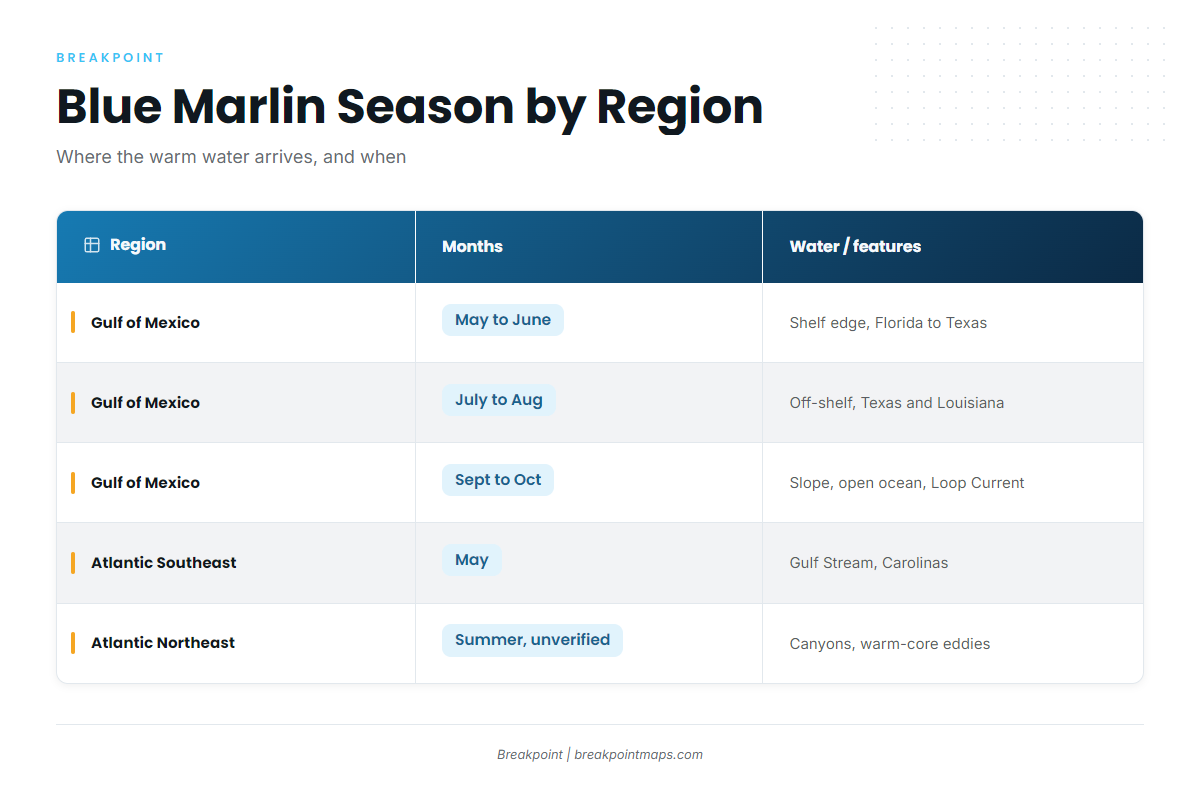
Gulf of Mexico. Tagging work from Texas A&M Galveston tagging research shows a clear seasonal pattern. From May to June, fish use an expansive shelf edge area from Florida to Texas and into the Bay of Campeche. In July and August they shift off the shelf into open ocean, concentrated off Texas and Louisiana. In September and October they are mostly on the slope and in open ocean, with a smaller area of use in the northeastern Gulf near the Loop Current. (NOAA’s federal materials now use "Gulf of America.") For local detail, see our guide to blue marlin fishing in the Gulf of Mexico.
Atlantic Southeast. The literature describes the Gulf Stream as a highway for blue marlin migration, which is why the Outer Banks and South Florida both see fish. Carolina Sportsman names May as one of the best Carolina months. Treat any other month claims as "verify locally." For local detail, see blue marlin fishing in the Atlantic Southeast.
Atlantic Northeast. Think canyons (Norfolk, Baltimore, Hudson), warm-core eddies spun off the Gulf Stream, and a short summer window. NOAA’s tagging findings show fish at higher latitudes in warmer months. Exact canyon timing varies year to year. For local detail, see blue marlin in the Northeast canyons.
| Region | Months | Water/features | Source |
|---|---|---|---|
| Gulf of Mexico | May to June | Expansive shelf edge, Florida to Texas and into the Bay of Campeche | Kraus, Wells & Rooker 2011 |
| Gulf of Mexico | July to August | Open ocean, concentrated off Texas and Louisiana | Kraus, Wells & Rooker 2011 |
| Gulf of Mexico | September to October | Slope and open ocean, smaller area near the Loop Current | Kraus, Wells & Rooker 2011 |
| Atlantic Southeast | May (one of the best Carolina months) | Gulf Stream water; other months verify locally | Carolina Sportsman |
| Atlantic Northeast | Summer; exact timing unverified | Canyons and warm-core eddies | NOAA tagging study |
What we still don’t know
The NOAA satellite tagging study followed 66 blue marlin tagged from 2001 to 2021 across the North Atlantic. It found migrations connecting the west and east Atlantic, and it also found long-term residency in small sub-regions. Movements appear to be driven at least in part by temperature, dissolved oxygen and light.
Less well resolved is whether fish respond to their own physiology or to prey that is responding to those conditions. Spawning is another gap. North Carolina’s profile gives North Atlantic spawning as July through September. Anyone claiming to know exactly where blue marlin will be on a given day is guessing.
Tactics
Most private boats troll lures, and a 4-lure spread is a sound start. It is the same trolling you already do for mahi, with bigger lures and heavier gear.
Trolling spread
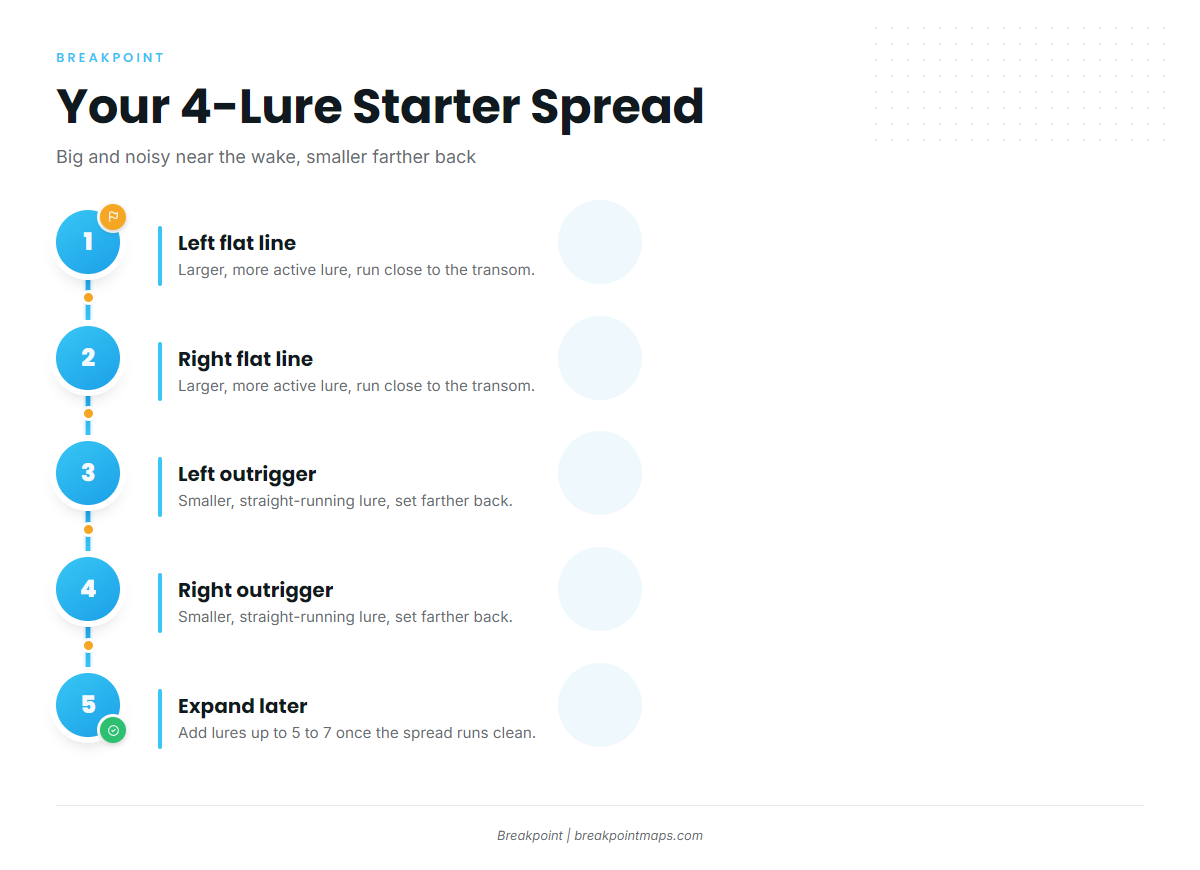
Per Marlin Magazine’s four-lure spread, one of the easiest ways to catch a blue marlin is to troll four large lures: two from the outriggers and two flat lines from the transom.
- Left flat line: larger, more active lure, close to the boat.
- Right flat line: larger, more active lure, close to the boat.
- Left outrigger: smaller, straight-running lure, farther back.
- Right outrigger: smaller, straight-running lure, farther back.
Big, noisy lures near the wake draw fish up, and smaller lures farther back catch fish that hang back. Retailer sources describe expanding to 5 to 7 lures once you are comfortable.
Troll speed depends on who you ask. Some sources say 6 to 8 knots and others say 7 to 9 knots. The higher figures come from sources centered on Kona, Bermuda and the tournament circuit, so start at the lower range for U.S. water and adjust to how your lures run.
Per Carolina Sportsman, you can keep catching dolphin and wahoo while trolling for marlin.
Natural baits and bait-and-switch
According to a retailer source, rigged ballyhoo, mullet and mackerel trolled slower, around 5 to 7 knots, are a proven option. Natural baits are also used as pitch baits.
In a bait-and-switch, hookless teasers raise the fish and a pitch bait goes to it once it is up. With circle hooks, the mechanics change how you feed the bait:
- Do not jerk.
- Let the fish eat and turn.
- Come tight with steady pressure as the hook sets in the corner of the jaw.
Tackle
The specs below come from In The Spread:
- 50 to 130 lb class conventional reels
- Roller-guide rods, stand-up or chair
- Leaders of 300 to 600 lb mono, 15 to 30 feet
- Drag capable of sustained pressure at 30+ lb
Center consoles rarely have fighting chairs, so plan for stand-up gear and a harness.
Hookup, fight and release
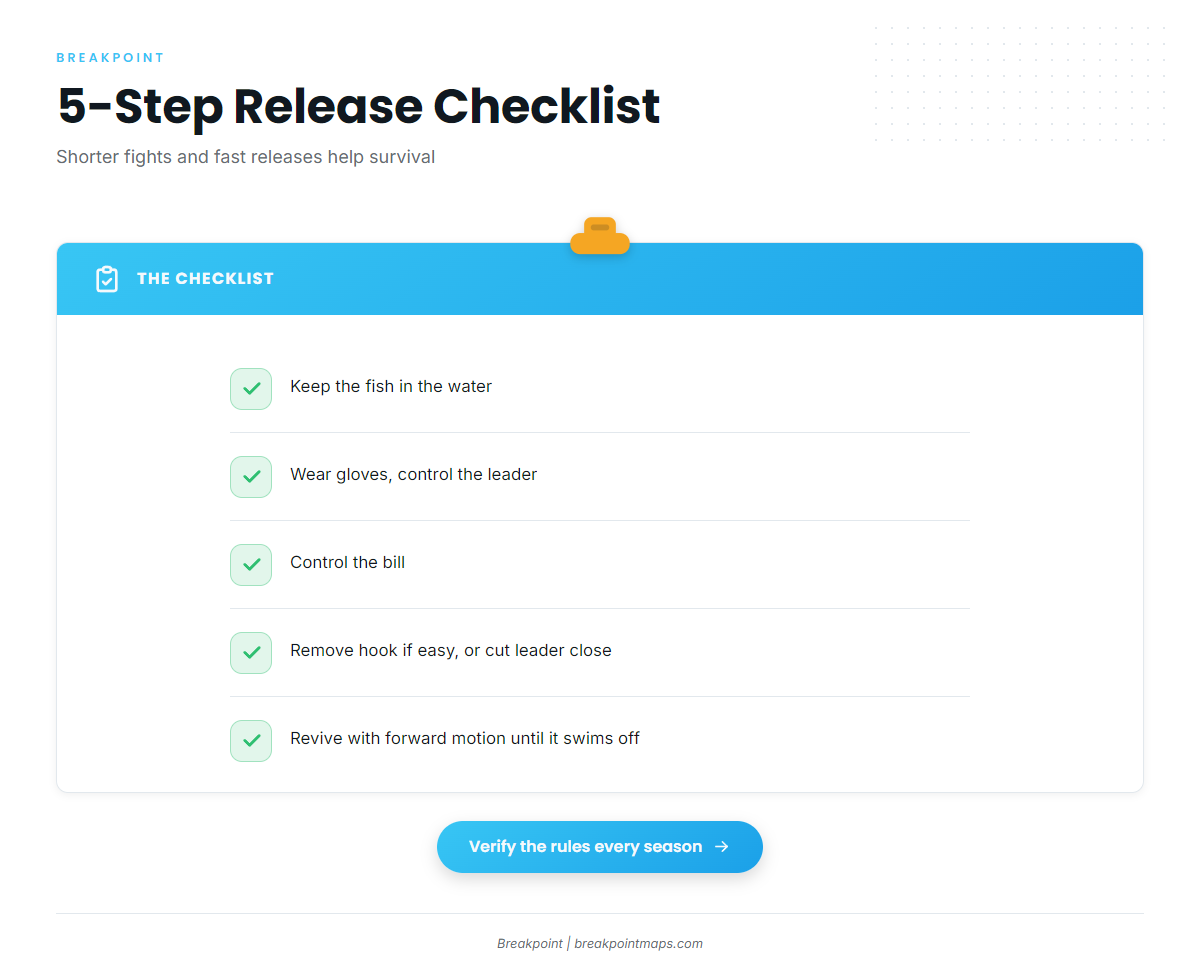
In The Spread gives 45 minutes to 2 hours as a practical average fight. Shorter fights improve survival on release. The driver, the angler and the leader person all have to work together.
A basic release checklist:
- Keep the fish in the water.
- Wear gloves and control the leader, keeping hands clear of wraps.
- Control the bill.
- Remove the hook if it is easy. Otherwise cut the leader close.
- Revive the fish with forward motion until it swims off.
If you tag fish, The Billfish Foundation’s tagging program runs the largest private tag-and-release database in the world, with 260,000 records from 150,000 anglers.
Frequently Asked Questions
How do you tell a blue marlin from a white marlin?
Blue marlin have pointed dorsal and anal fins, while white marlin fins are rounded. Blues also show a high dorsal crest that slopes sharply down, per North Carolina’s species profile, and they are much larger, growing to 14 feet and roughly a ton.
What water temperature do blue marlin like?
Practitioners cite 70 to 85°F. The scientific literature puts the lower tolerance near 68°F. Tagged fish averaged about 79 to 81°F on the surface. These numbers describe different things, so treat them as a range, not a cutoff.
Can I keep a blue marlin?
Keeping one is legal only under current NOAA HMS size, permit and reporting rules, which you should verify before fishing. Most recreationally caught blue marlin are released, and circle hooks with quick, careful handling improve their odds.
Do I need a permit to fish for blue marlin?
Yes, a federal HMS permit is required to fish for Atlantic billfish. Confirm the exact permit type and how to get it on the NOAA Fisheries HMS site. Your state may add its own rules, so check with your state agency too.
When is blue marlin season in each region?
In the Gulf, fish are present from May to October, shifting from the shelf edge to open ocean. In the Carolinas, May is one of the strongest months. In the Northeast, it is a summer window that varies year to year. Verify local timing before you go.
Can you catch a blue marlin from a center console?
Yes. Carolina Sportsman notes the trolling is similar to mahi and wahoo trolling. You need a longer run, 50 to 130 lb class stand-up gear, and a coordinated crew. Center consoles rarely have fighting chairs, so plan around that.
Conclusion
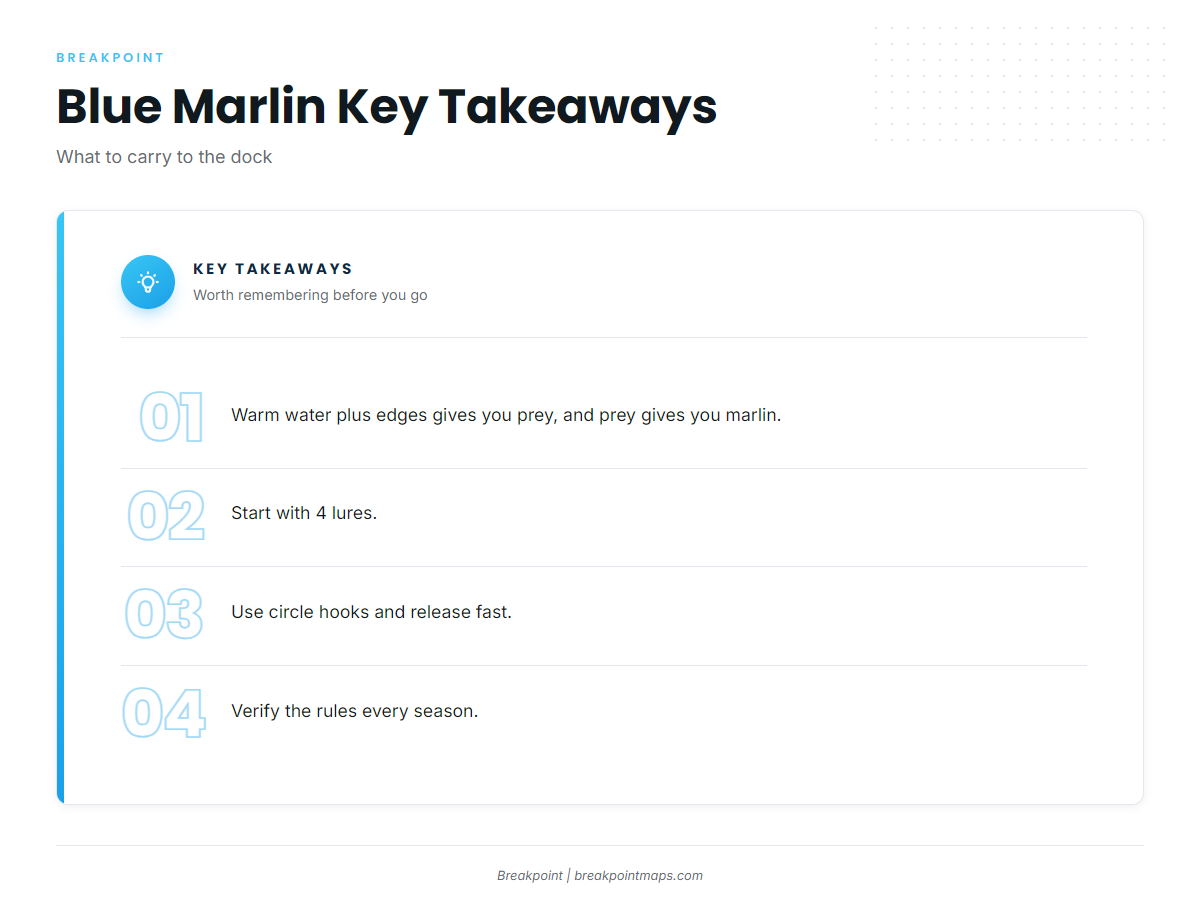
Warm water plus edges gives you prey, and prey gives you marlin. Start with 4 lures, use circle hooks, release fast, and verify the rules every season.
Breakpoint’s Hotspots and Fish Intel read OBS SST, Chlorophyll and current features together, so you can pick a starting box before you burn the fuel. The data improves the decision about where to look, but it does not promise fish.