Off Southern California, yellowfin are a warm-water visitor, and some years they barely show. The fishery depends on water that arrives from the south, and no one can say in advance whether it will come, how far north it will push, or how long it will stay.
For biology, general tactics and tackle, start with our yellowfin tuna species guide. This page covers what that guide doesn’t: what drives the fishery here, where to look and how to decide.
"Pacific Southwest" here means Southern California plus the northern Baja waters most San Diego trips fish. Long-range boats run much farther south. What this page can offer is a better basis for deciding where to look, not a promise of fish.
Regional Differences
Off California, yellowfin behave like a seasonal arrival rather than a resident fishery. According to NOAA’s El Niño ocean indicators feature, yellowfin are more commonly seen and caught off California during El Niño periods. That single point explains most of the year-to-year swing.
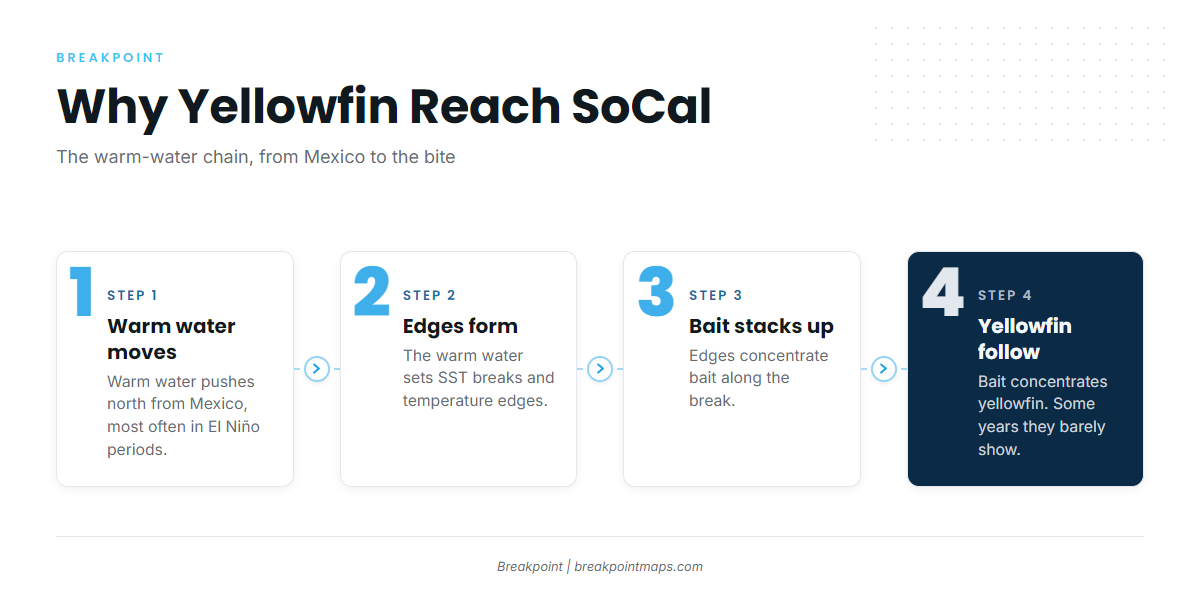
The chain of cause runs in four steps:
- Warm water pushes north from Mexico.
- That warm water sets up SST breaks and edges.
- The edges concentrate bait.
- The bait concentrates yellowfin.
If the chain breaks at step 1, the season stalls.
Size is the other regional trait. Pacific yellowfin grow to more than 400 lb, and the 427-pound IGFA record came from off Cabo San Lucas. NOAA Fisheries recognizes two Pacific stocks, an Eastern Pacific stock and a Central and Western Pacific stock. Southern California and Baja anglers fish the Eastern Pacific stock, which NOAA’s 2023 assessment reported as not overfished and not subject to overfishing.
| Factor | Pacific Southwest | General or elsewhere |
|---|---|---|
| Presence | Seasonal, warm-water dependent | Varies by region |
| Main driver | Warm-water intrusion, tied to El Niño | Varies |
| Stock | Eastern Pacific | Varies (Central and Western Pacific is a separate stock) |
| Common associations | Kelp paddies, porpoise | Varies |
| Size potential | IGFA record of 427 lb, off Cabo San Lucas | Varies |
Why the season swings year to year
A study of ENSO thermocline shifts found that in El Niño years the eastern and central Pacific thermocline deepens, and that this shifts yellowfin fishing grounds. The study covers the central and western Pacific, so treat it as a general mechanism and not a Southern California forecast.
Reported timing varies:
- A SoCal tournament angler’s account says yellowfin typically show up around July and leave by September as the warm water cools.
- One San Diego charter operator says July through September is best.
- Another charter page says late spring through early fall.
The window varies with ENSO, so plan around a range of dates.
Overlap with bluefin, dorado and skipjack
A San Diego charter operator notes that yellowfin school with other tuna of similar size and swim alongside dolphins, porpoises and whales. Bluefin can overlap in some years, so be able to identify what is on the line before you commit to a plan.
Habitat & Conditions in the Pacific Southwest
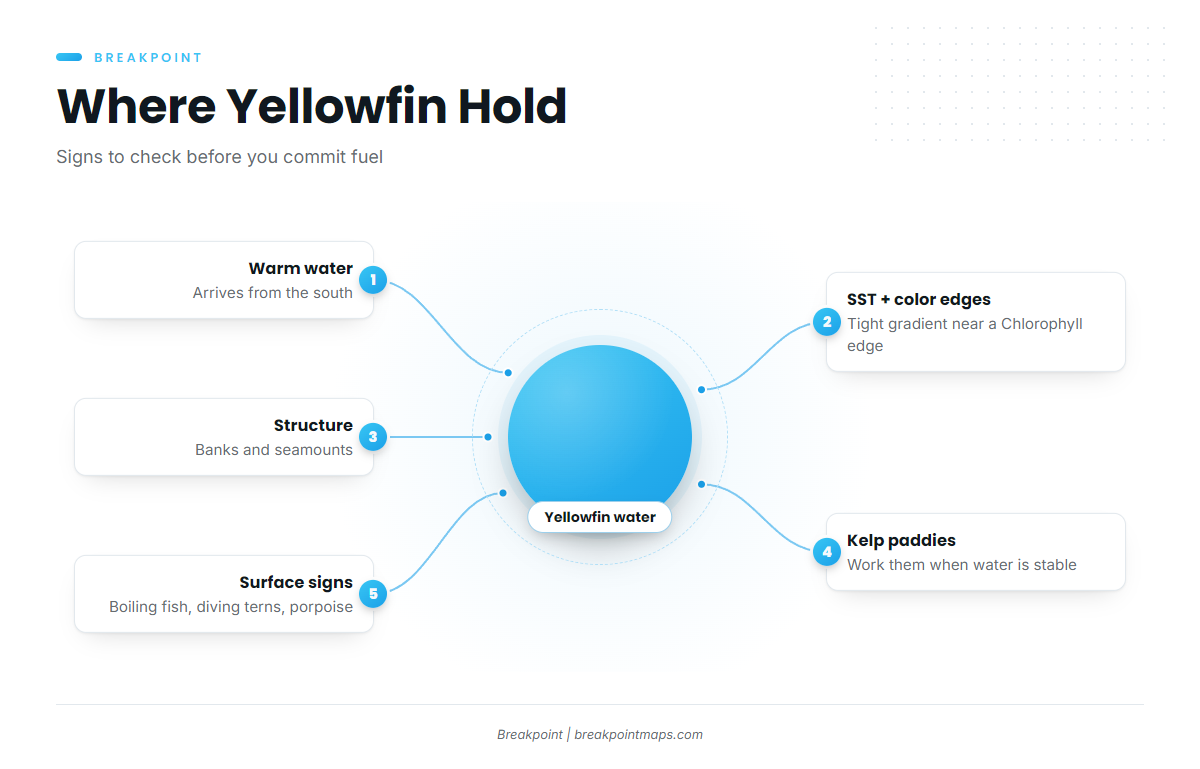
Yellowfin off Southern California tend to hold where several things overlap: warm water pushing up from the south, a temperature or color edge, structure such as banks and seamounts, and floating kelp paddies. Where those coincide, there is a reason to stop and fish.
Reading SST breaks and Chlorophyll edges
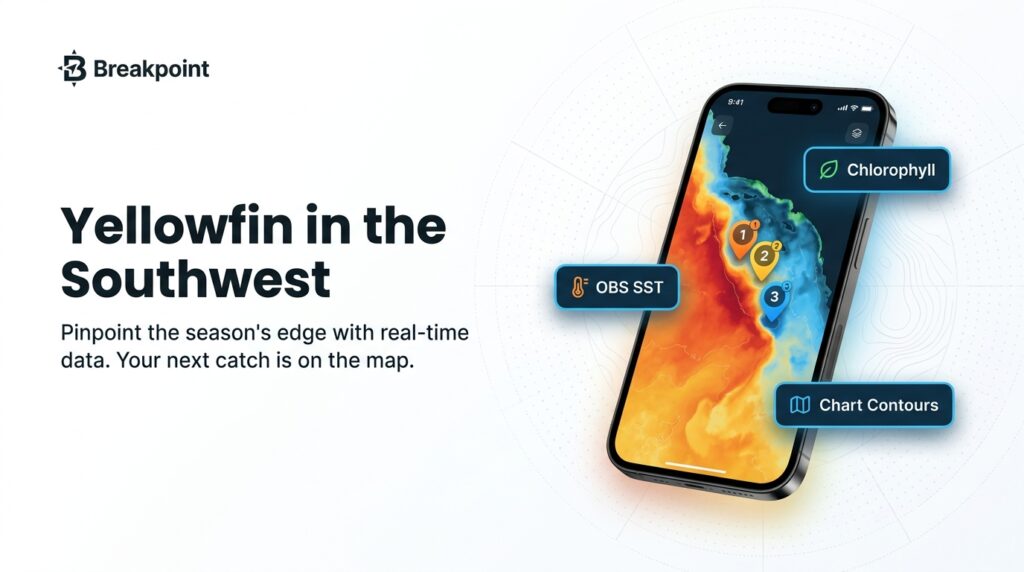
Start with OBS SST and look for a tight temperature gradient, where warm and cooler water meet. Then check Chlorophyll for a color edge nearby. Overlay Chart Contours to see where that edge crosses structure. An edge that sits on a bank or ledge is worth more of your fuel than one in open water.
The science points the same way. Research on chlorophyll and seamounts at Isla del Coco found yellowfin showed higher abundances in shallow and warmer waters, with high concentrations of chlorophyll-a, and in surrounding seamounts. That study is from another location, so it supports the general association but not a Southern California map.
The data has limits:
- Cloud cover blocks satellite passes, so an edge can move while the imagery stays old.
- A warm edge does not guarantee fish.
- Individual paddies are too small to see on any satellite layer.
Chart layers are not for navigation.
Banks, high spots and structure
San Diego fish reports commonly reference the Coronado Islands, 9-Mile, 43 Fathom, the 302 and 371, Upper Hidden, and Tanner and Cortes. Treat these as names to look up. Read each position from a current chart and the day’s water, not from this page.
Kelp paddies and moving fish
According to the Saltstrong angler, tuna that have settled into a zone become associated with kelp paddies. If water conditions haven’t stabilized, yellowfin stay on the move, hopping from zone to zone every few days.
In practice:
- Stable water: work paddies. Fish that have settled tend to hold on them.
- Unstable water: cover ground. Fish may be gone by the time you arrive.
Dorado and skipjack also sit under paddies, so a paddy that produces other species is still worth a look.
Signs yellowfin are near
Watch for:
- Fish boiling on bait at the surface
- Terns diving on fish just below the surface
- Porpoise schools
- Kelp paddies
- Bait marks on the sounder
The first two come from the Saltstrong angler. The porpoise association comes from a San Diego charter operator.
Tactics for Yellowfin Tuna Fishing in the Pacific Southwest
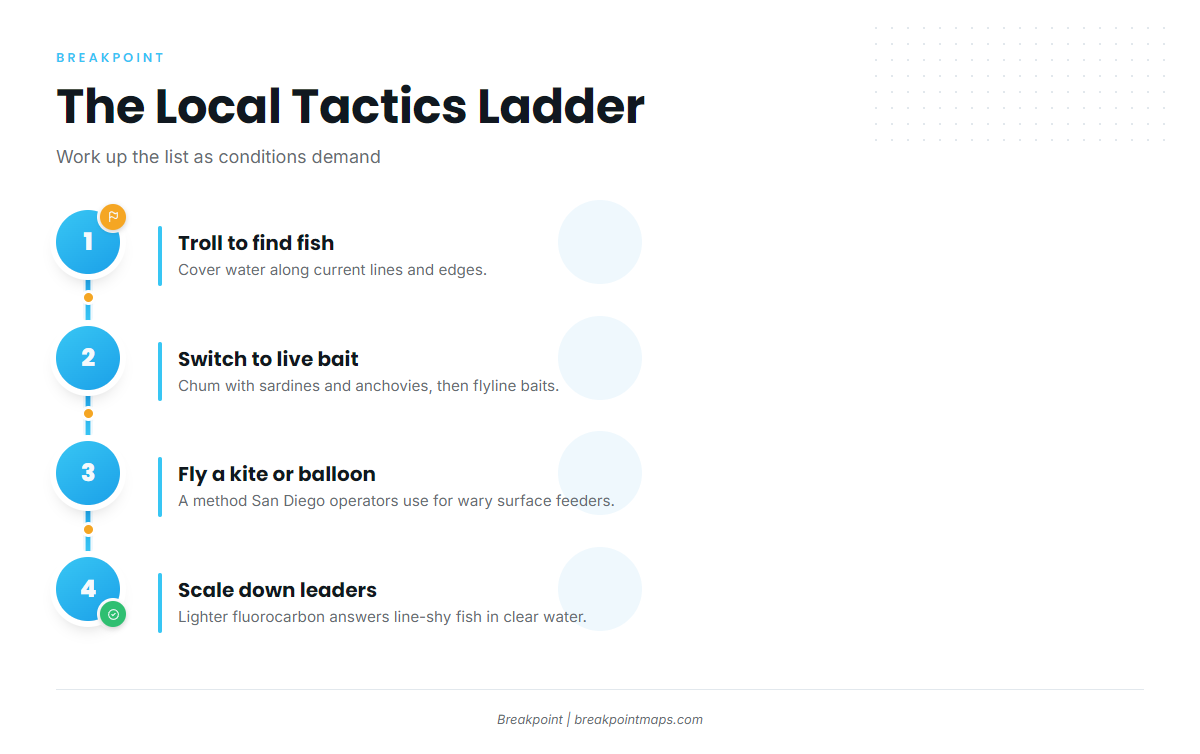
Fishing here usually runs in a sequence: troll to locate fish, switch to bait once you find them, then adjust the presentation for wary fish. The general rigging in the species guide still applies. What follows is what changes locally.
Troll to find them
A San Diego charter operator lists rapalas, topwater jigs, cedar plugs and feathered trollers as the most popular choices. Troll along current lines and edges to cover water. Trolling finds the school, and the day usually continues from there.
Switch to live bait and chum
The local fleet standard is live sardine and anchovy chum with flylined baits. A San Diego charter operator says anchovies and sardines work for smaller fish and mackerel for larger ones. The same operator recommends 25 lb fluorocarbon to flyline a sardine. That is one operator’s recommendation and not a rule, but lighter fluorocarbon is the local answer to line-shy fish in clear water.
Kite and helium balloon
San Diego operators list kite and helium balloon fishing as a method for wary, surface-feeding fish.
Choosing a trip from San Diego
Trip length sets the target. According to Point Loma’s long-range schedule, 16 to 23 day winter and spring trips to the Revillagigedos and Clipperton target world-record class yellowfin. Shorter trips fish closer to home.
| Trip length | Typical season (per operator) | What’s targeted |
|---|---|---|
| Overnight to 1.5 day | Check with landing | Check with landing |
| 2 to 2.5 day | Check with landing | Check with landing |
| 4 to 6 day | Spring favorites | Yellowfin and other species, per Point Loma |
| 8 to 12 day | Fall and early summer | A wide variety of fish including tuna along "The Ridge," per Point Loma |
| 16 to 23 day | Winter and spring | World-record class yellowfin and wahoo, Revillagigedos and Clipperton |
To read a fish count, divide the number of fish by the number of anglers, then note the trip length. San Diego landing reports have shown 54 yellowfin for 16 anglers on a 2.5 day charter and 109 yellowfin for 23 anglers on a 2 day charter. A count without both figures tells you very little.
Frequently Asked Questions
When is yellowfin season in San Diego?
It varies. One SoCal angler reports fish arriving around July and leaving by September. Charter operators cite July through September, or late spring through early fall. The season depends on El Niño and warm-water intrusion, so check current fish reports before you commit.
Do I need a Mexican fishing permit on a San Diego boat?
Fishing in Mexican waters requires a permit issued by CONAPESCA. Each person who fishes from a boat needs their own individual permit, and foreign nationals can apply for one.
Are yellowfin and bluefin in SoCal at the same time?
They can overlap in warm years, and the mix varies. Yellowfin also school with other similar-sized tuna. Check current fish reports and be ready to identify what you hook before you plan around one species.
Why are some years so much better than others?
NOAA reports yellowfin are more commonly caught off California during El Niño periods. A study of ENSO thermocline shifts also found that thermocline changes move yellowfin fishing grounds. Warm water is the prerequisite, and it arrives unevenly from year to year.
Where to Go From Here
Our hotspots feature scores yellowfin water in the Pacific Southwest from conditions like SST and Chlorophyll, pointing you at water worth checking. It can’t see through cloud cover, it doesn’t replace a fish report, and chart layers are not for navigation.