Overview
In the Atlantic Southeast, the Gulf Stream runs close enough to the beach that the edge, rather than a canyon, decides your day. That shapes where you run, when you go and how you rig for white marlin. Biology, identification and tackle basics are in our white marlin species guide, so this page stays regional.
It covers Gulf Stream edges, timing by sub-region from Oregon Inlet south to Florida’s east coast, local spreads and current rules. The goal is a better decision about when and where to run, and it makes no promise of fish.
North Carolina has the deepest record for white marlin in this region. The record thins out south of it.
Regional Differences
White marlin peak off the Outer Banks from about mid-August through mid-September, the anchor window for Southeast white marlin season. That calendar can’t be fixed in advance. The Gulf Stream’s position shifts week to week, and last year’s dates are a guide, not a schedule.
The Gulf Stream Sits Close
The Mid-Atlantic fishery works differently. According to the Maryland DNR fishing site and Anglers Journal, the largest summer fishery runs between Cape Cod and Cape Hatteras, and schools ride warm-water eddies along the continental shelf. Canyon anglers chase those eddies.
In the Southeast, the Stream itself is the highway. Fish Nation uses that word for the way migrating white marlin move along it. The nutrient-rich water off the Outer Banks is a summer feeding ground, and the fish come to the edge.
A Calendar That Changes by Port
Boats fishing out of Oregon Inlet start seeing whites in late July and keep finding them through August. September is peak, and Carolina Sportsman reports some whites ranging below Cape Hatteras and fished out of Hatteras Inlet.
Spring and late fall are less certain. Marlin Magazine says fish might be around in the spring and later in the fall, but weather windows get trickier. A spring peak at Hatteras isn’t a sound basis for planning a trip.
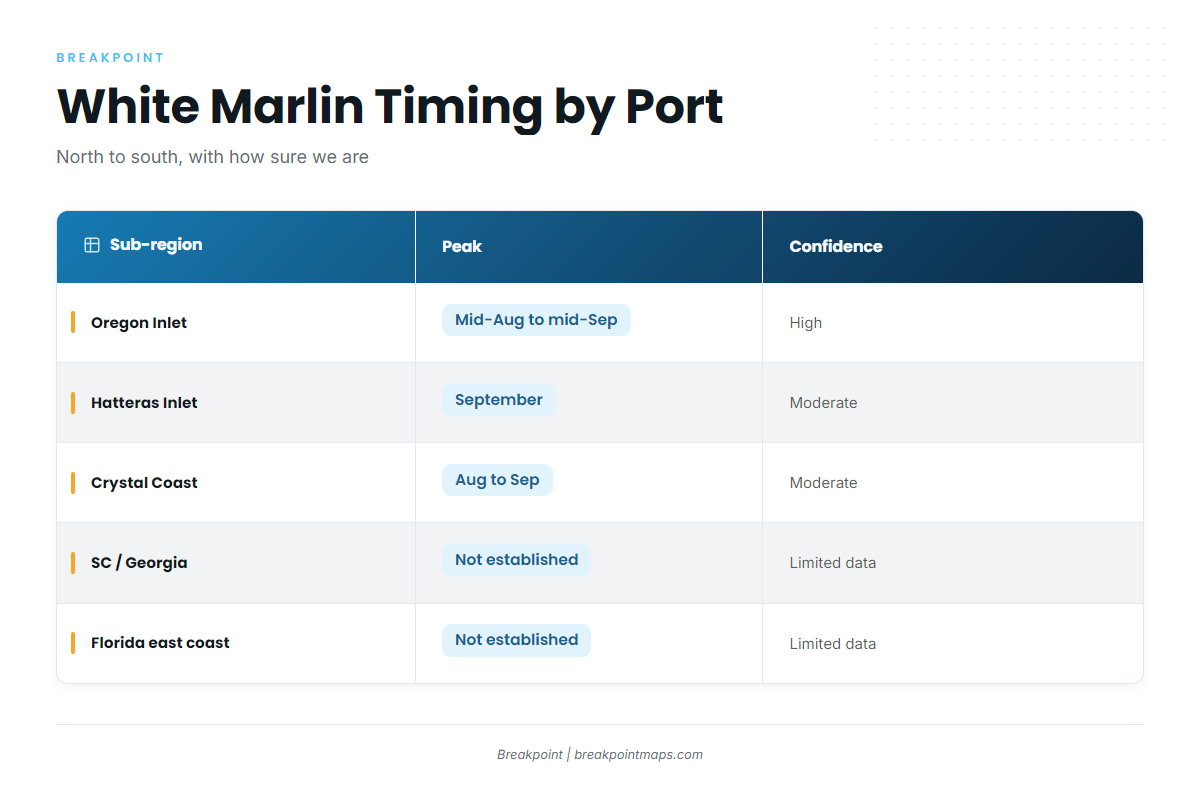
The table below runs north to south.
| Sub-region | Months | Peak | Confidence / Source |
|---|---|---|---|
| Outer Banks: Oregon Inlet | Late July through September | Mid-August to mid-September | Marlin Magazine, Salt Water Sportsman |
| Outer Banks: Hatteras Inlet | Late summer into September | September | Carolina Sportsman |
| Morehead City / Crystal Coast | Summer into early fall | August to September (Carolina coast overall) | Salt Water Sportsman, coast-wide |
| South Carolina / Georgia | Varies by year. Ask local charters. | Not established | SCDNR, GA DNR |
| Florida east coast | Incidental | Not established | Sailfish dominate |
Sailfish dominate the east coast billfish picture in Florida. A white marlin off Florida is an opportunistic bonus. For a dedicated white marlin trip, the Outer Banks has the record behind it.
A Different Species Mix
The Outer Banks fishing seasons show how the species overlap. Blue marlin peak in June, and white marlin and sailfish are most plentiful in August and September. Marlin Magazine also reports a good showing of whites in the transition, after the blue marlin bite slows and before sailfish fully arrive.
Yellowfin tuna, dolphin and wahoo often turn up on the same run, so a mixed day is more likely than a pure white marlin day.
Habitat & Conditions in the Atlantic Southeast
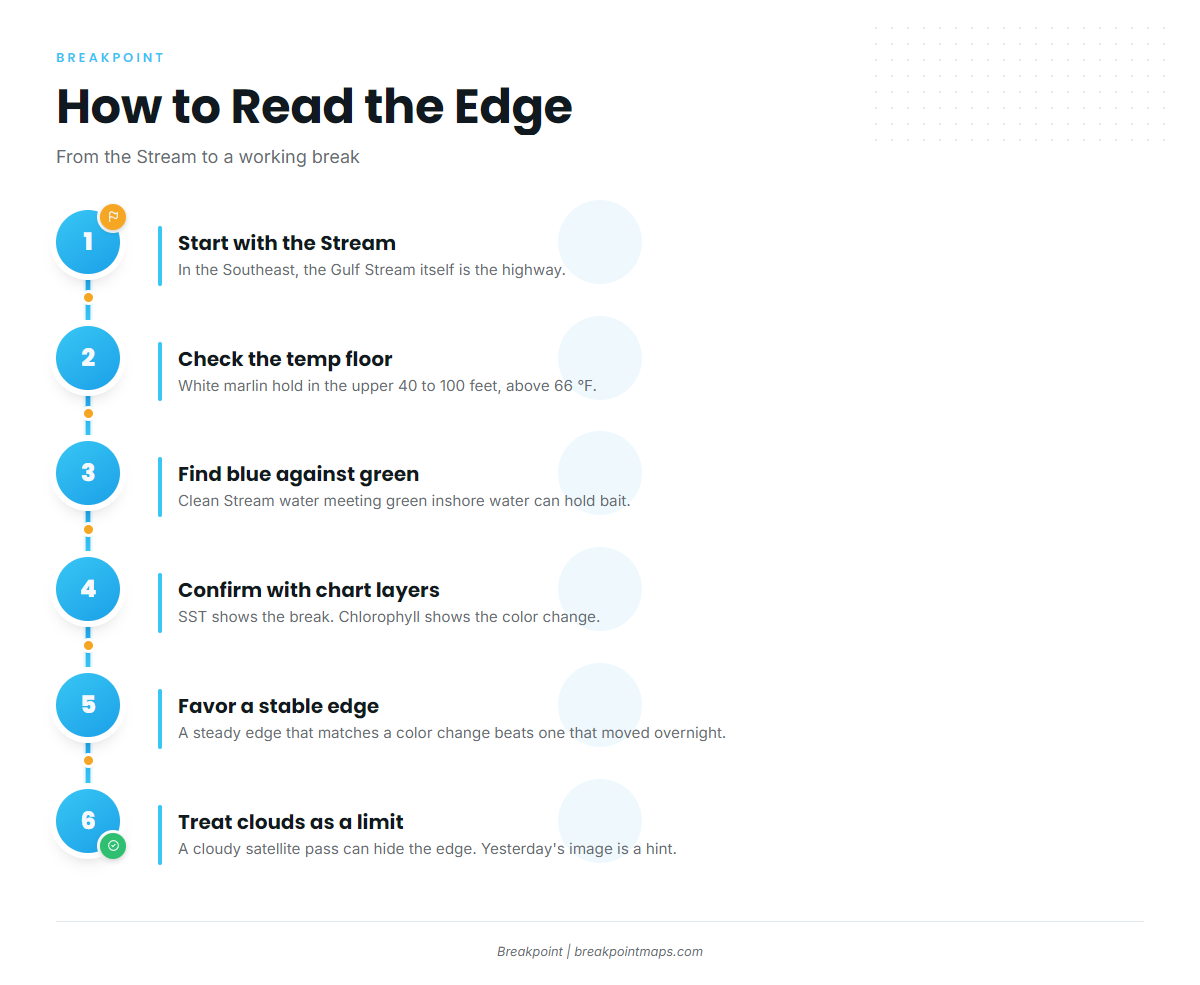
The NC Division of Marine Fisheries reports that white marlin inhabit the upper 40 to 100 feet of the water column in water warmer than 66 °F. Treat 66 °F as a floor rather than a target. A cloud-blocked satellite pass can hide the edge entirely, and when that happens, yesterday’s image is a hint, not a map.
Water Temperature and the Break
The Tackle Room says white marlin prefer water in the mid-70s °F. Treat 66 °F as the hard floor and the mid-70s as a general lean.
A break forms where warm, clean Gulf Stream water pushes in from the east against green inshore water full of plankton. Blue water against green with a temperature break likely holds bait, with billfish in pursuit.
Marlin Magazine notes that captains favor blended blue-green water in defined pools that have been stable in an area. Weed lines add surface structure along those edges. Which edge holds fish changes from day to day.
Reading the Charts
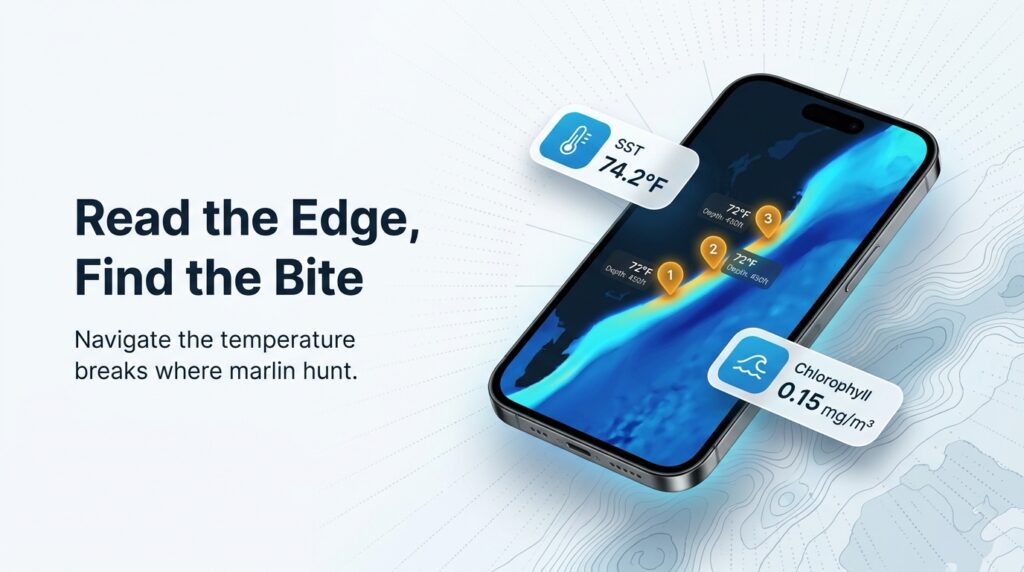
Each satellite layer answers a different question:
- SST shows where the temperature break sits.
- Chlorophyll shows the color change, blue against green.
- Altimetry hints at eddies and current direction.
A stable edge that lines up with a color change is a better bet than a sharp edge that moved overnight, because stability means bait has had time to stack up. Chart layers are not for navigation.
How Far You’ll Run
One Outer Banks charter operator estimates pelagic fish can be 40 to 80 miles out, and says whites have been found about 50 miles offshore where the Stream pushes bait against the shelf. That is a charter’s estimate, not a survey.
Local anglers use names like the Big Rock and The Point for productive water off North Carolina. No coordinates are given for either. The Charleston Bump is a known offshore feature.
Peak months fall in hurricane season, as Marlin Magazine points out. If you run a small boat, plan fuel and weather margins conservatively.
Tactics for the Atlantic Southeast
Rigging basics are in our white marlin species guide. What follows covers what changes off the Carolinas.
White marlin are sneaky, and each one eats differently. As Marlin Magazine puts it, "you can expect to miss a few, or more." The Tackle Room adds that they slap at baits without committing.
The Ballyhoo Spread
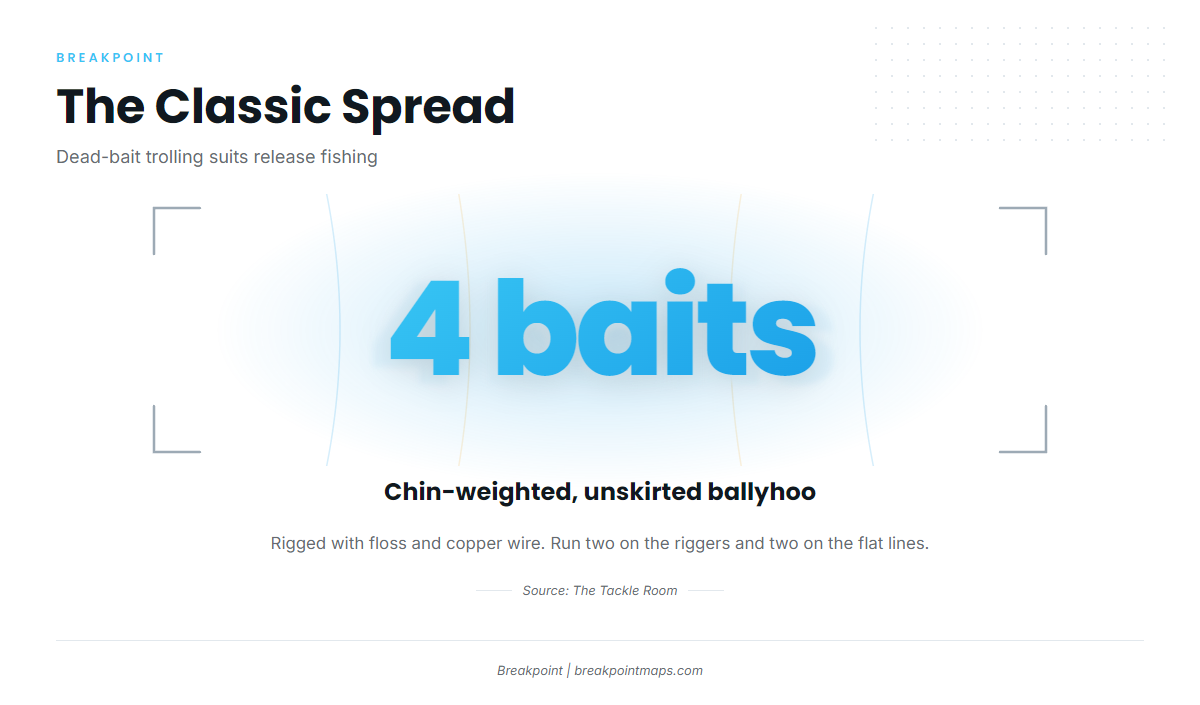
The Tackle Room describes the classic spread as four chin-weighted, unskirted ballyhoo rigged with floss and copper wire, two on the flat lines and two on the riggers, with teasers and dredges set short off each corner.
Marlin Magazine says dead-bait trolling suits release-focused fishing. It also notes that rigging up to 100 baits a day is not unusual when fish are thick.
Dredges and Teasers
A dredge is a multi-armed teaser that imitates a school of baitfish. HUK notes that most marlin boats run one per side, rigged with dozens of ballyhoo or mullet. The work is labor intensive but necessary, so build the rigging load into your crew plan.
Pitch-Baiting and the Drop-Back
When a white marlin bites, give it a drop-back right away so the fish does not strip the bait off the hook, per Marlin Magazine. When a fish comes up on a teaser, the basic move is to switch it to a circle-hook pitch bait. Circle-hook rules are covered under Regulations below.
Tackle and Speed
Satfish describes white marlin as exciting on 20 to 30 lb tackle, and says most anglers rig leaders as wind-on leaders. Some Outer Banks charters run 30 to 50 lb class tackle.
Satfish also lists a trolling speed of 6.5 to 8.5 knots with ballyhoo or small skirted lures. That is a published range rather than a rule, so adjust to what the baits are doing in the water.
Frequently Asked Questions
When is white marlin season on the Outer Banks?
Fish show in late July and peak from about mid-August through mid-September, per Marlin Magazine and Salt Water Sportsman. The Gulf Stream’s position shifts year to year, so treat those dates as a guide, not a guarantee.
Who manages white marlin in the Atlantic Southeast?
NOAA Fisheries Atlantic HMS manages white marlin in federal waters. The South Atlantic Fishery Management Council does not manage billfish. Council rules apply to species like dolphin and wahoo.
What is the minimum size for keeping a white marlin?
The minimum is 66 inches lower jaw fork length, per NOAA Fisheries. Roundscale spearfish look similar and share the landings limit, and retention can close midyear, so verify the fish and the rules before you keep one.
Do I need an HMS permit on a charter?
The charter vessel generally needs the HMS Charter/Headboat permit. Confirm it with the captain before booking, and verify current requirements on NOAA HMS.
Closing
Start with the Stream: find the break, match your port’s calendar, fish the spread, and check the current NOAA Fisheries rules before you go. No bite is guaranteed, and offshore fishing never offers one.
Breakpoint’s hotspots feature scores white marlin conditions in the Atlantic Southeast using the layers you already read, like OBS SST and Chlorophyll, so you can decide where to look. No score promises fish.