


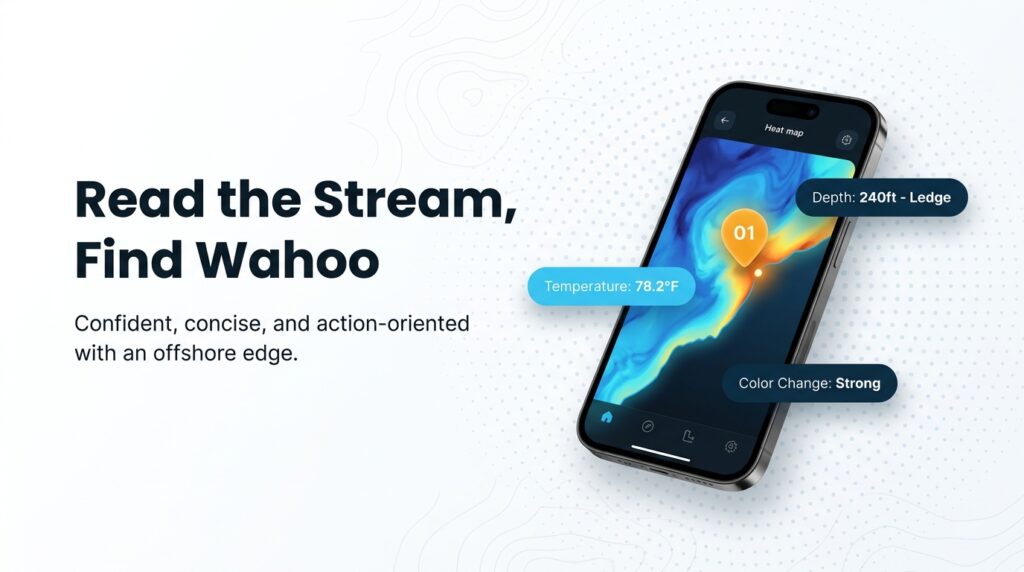
The Gulf Stream sits a short run off Southeast Florida and a long one off the Carolinas, and that difference shapes season, run distance and tactics across the region. This page covers wahoo fishing in the Atlantic Southeast, from North Carolina through South Carolina and Georgia to Florida’s east coast. For biology, gear basics and why the species is worth chasing, start with our wahoo species guide.
The NC Division of Marine Fisheries describes wahoo migrating north through the Gulf Stream in summer, returning to the tropics in winter, and spawning off the Southeast in the summer months. That migration is the backdrop for everything below.
The sections that follow cover the edge, depth, temperature, month and port to think about, what to pull behind the boat, and which rules apply, each with a named source. We read the Stream from satellite passes every day, and we say where the numbers come from and where they run out.
Regional Differences
Off the Carolinas, the fall peak runs roughly September through early December, depending on the source and where the Stream sits. Off Southeast Florida, the Stream is close enough to fish more of the year.
Distance to the Stream drives the trip. Off Palm Beach to Miami it is a short run. Off the Carolinas it is farther out, which means more fuel, more hours and more weight on the weather window. Off Georgia it is a long run, and wahoo patterns there are not well documented.
How the Sources Disagree on Timing
Published sources split on timing.
- Salt Water Sportsman: captains quoted in Salt Water Sportsman say the season runs May to November off the Mid-Atlantic and North Carolina, peaking September to October. Capt. Jason Snead of the Outer Banks says, "We start to see the fish in May," when water temperature hits the middle 70s. Capt. Kenny Koci of Hatteras Inlet says, "There isn’t a month that hasn’t produced ‘hoos."
- InTheSpread: InTheSpread’s fall wahoo guide puts the North Carolina peak at October through early December, when the Stream runs warm against cooling shelf water and sets up a sharp temperature break.
Both can be true, since the Stream shifts year to year and the window shifts with it.
South Florida follows a cooler-season, more year-round pattern in practitioner reports. Georgia has thin sourcing: the water is the same Stream edge, but the run is long and the local pattern is poorly documented.
A meander can move the productive edge by miles in a week, which is why we plan by the latest pass instead of the calendar.
Sub-Region Comparison
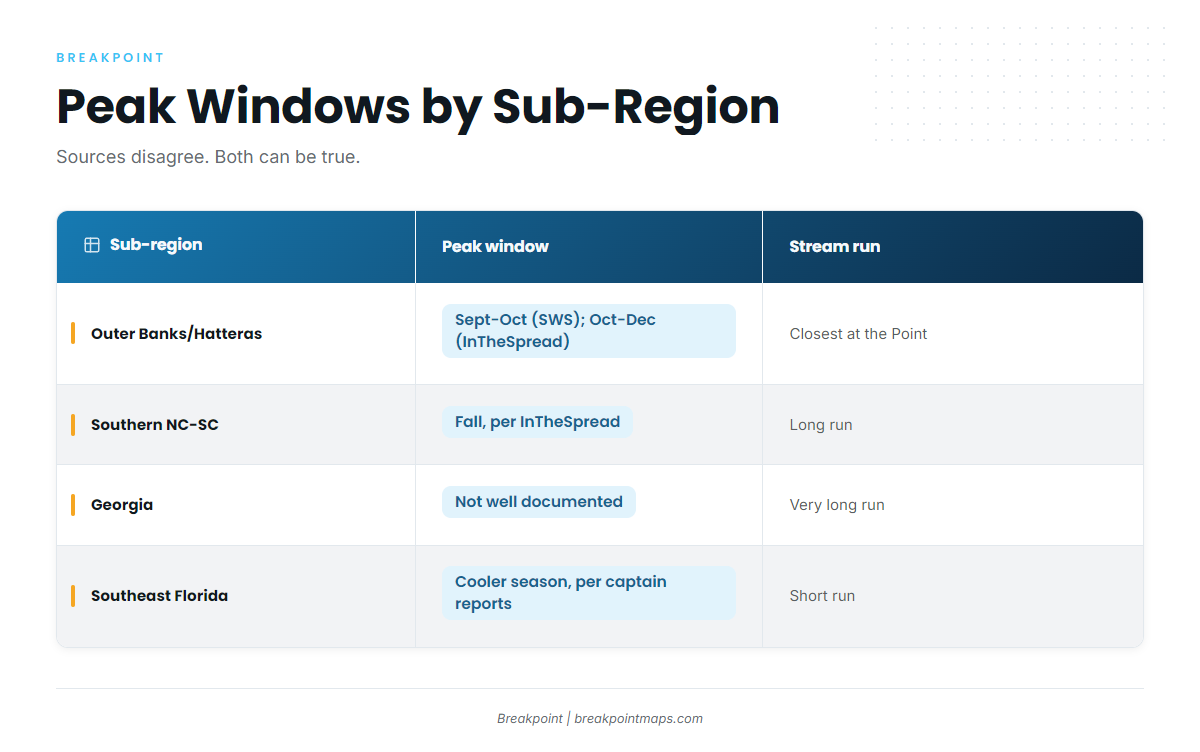
| Outer Banks / Hatteras | Southern NC to SC (Morehead City to Charleston) | Georgia | Southeast Florida (Palm Beach to Miami, Jupiter) | |
|---|---|---|---|---|
| Typical Stream distance | Closest of the Carolina stretch | A long run | Very long; not well documented | A short run |
| Peak windows as sourced | Sept to Oct (Salt Water Sportsman); Oct to early Dec (InTheSpread) | Fall, per InTheSpread | Not well documented | Cooler season, per practitioner reports |
| Primary approach | Ledge and edge trolling with planers; high speed on fast days | Ledge and edge trolling with planers; high speed on fast days | Not well documented | Edge trolling with tide-window timing (InTheSpread) |
| Notes | Port: Hatteras. Dolphin and blackfin tuna are co-targets. | Ports: Morehead City, Murrells Inlet, Charleston. Dolphin and blackfin tuna are co-targets. | Same Stream edge, long run | Port: Jupiter. Tide windows matter off Jupiter and Palm Beach. |
Swipe the table sideways to see every column.
Habitat & Conditions in the Atlantic Southeast
Wahoo here stack where a temperature break, a color change and a current rip cross hard structure along the Gulf Stream edge. InTheSpread makes the same point: correlating current rips, temperature breaks and color changes with structure raises your odds.
Structure to know by name:
- Charleston Bump. The best-known bottom feature off the Carolinas.
- The Point off Hatteras. Where the Stream swings close to the coast.
- Ledges and humps off the Outer Banks. Salt Water Sportsman describes them as "valleys and humps."
- Weedlines and floating sargassum. The NC profile notes floating seaweed as a gathering point for the species.
Conditions Checklist
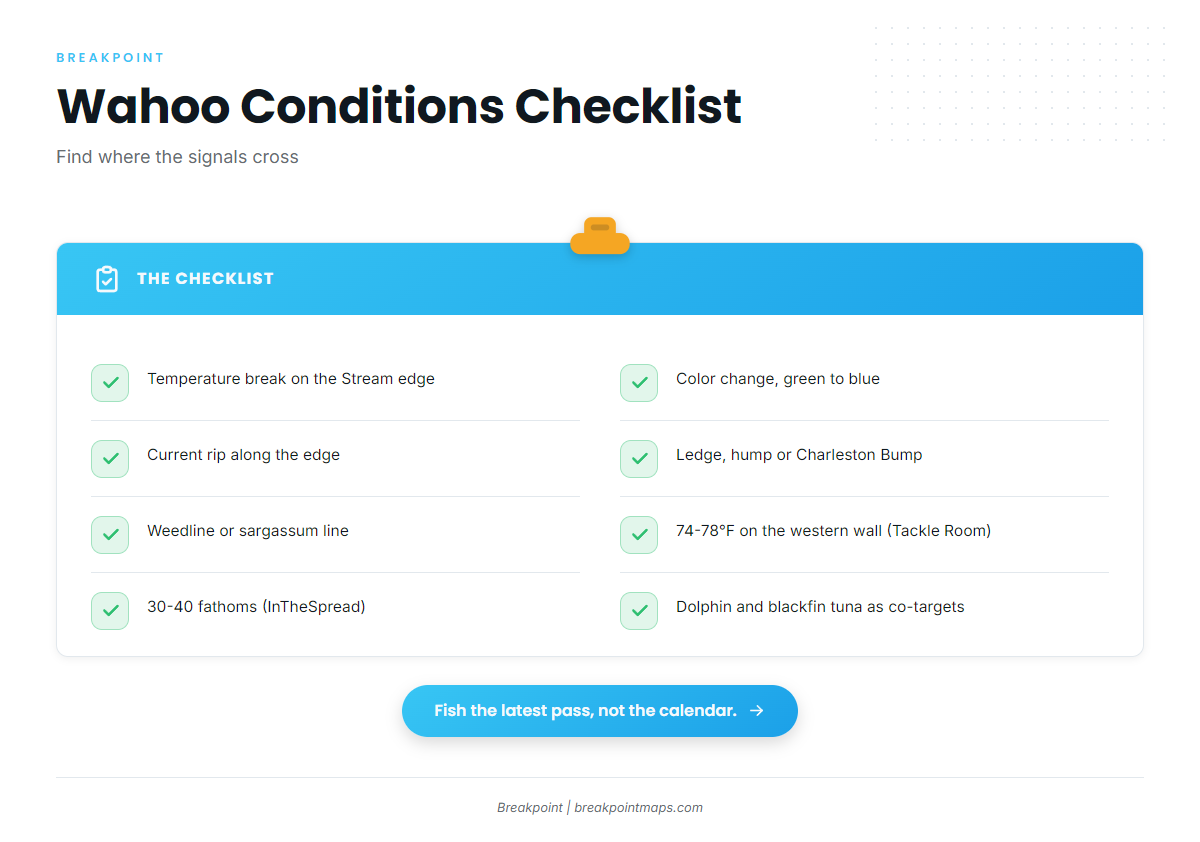
Every number below comes from a named source, and the sources do not all agree.
- Temperature. The Tackle Room’s night tactics reports that 74 to 78°F water on the Gulf Stream’s western wall produces consistently off the Carolinas. Snead reports fish showing up in the mid-70s.
- Depth, InTheSpread’s range. 30 to 40 fathoms, about 180 to 240 ft, "sliding a little deeper or shallow depending on how the water is laying."
- Depth, forum reports. Carolina forum anglers describe ledges at 130 to 180 ft inshore of the Stream break. The two ranges reflect different captains’ preferences and don’t contradict each other.
- Features to line up. Temperature break, color change, current rip, ledge or hump, weedline.
- Co-targets. Dolphin and blackfin tuna work the same water, so a wahoo spread often catches all three.
How We Read the Stream
The routine is simple, and it comes from reading a lot of SST passes.
- Lay the break over the bottom. Put OBS SST over Chart Contours and look for where the temperature break crosses a ledge or hump. The crossing is the target, not the break alone.
- Check the color. Chlorophyll shows the green-to-blue boundary. A color change on the same edge as the temperature break is a stronger sign than either alone.
- Expect movement. A meander or eddy pushes that crossing point around, so last week’s numbers go stale fast.
- Know what clouds hide. A cloud-blocked pass shows no data, which is different from showing no break. If the latest clear pass is three days old, plan for the edge to have moved.
Chart layers are not for navigation.
Tactics for the Atlantic Southeast
Most captains quoted here pull planers and weighted baits on the ledges and go to high speed when the bite is fast or they need to cover water. Keep every setup tied to the water in front of you.
High-Speed Spread
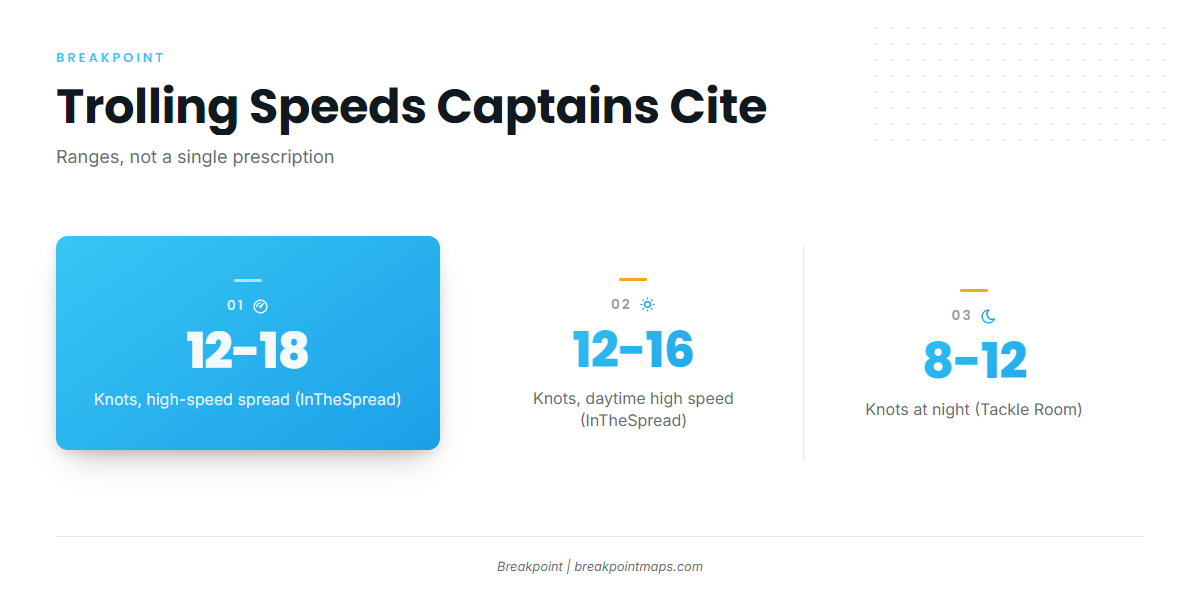
InTheSpread commonly cites 12 to 18 knots for high-speed trolling, with daytime wahoo trolling often at 12 to 16 knots. Treat those as ranges, not a prescription. Per InTheSpread, high speed is used for transit and on fast-bite days in the Carolinas. Salt Water Sportsman reports that heavy skirts or big plugs work on glass-calm days, while Ilanders and SeaWitches produce better in chop.
Slow and Meat Spread
InTheSpread says slow trolling with planer rigs sees heavy use in the Carolinas. Ballyhoo and bonita strips are the general natural baits for that style.
Depth Control
Salt Water Sportsman reports that planer rods catch more wahoo than topwater baits. The Tackle Room says trolling weights matter when fish sit 30 to 50 ft below the surface. More depth control means more gear to manage and more to clear when a fish hits.
Leader and Gaff
InTheSpread uses #9 single-strand wire in the Carolinas, since wahoo teeth are built to slice and wire is the safer choice when bite protection matters. Basic wire rigging is in our wahoo species guide. The Tackle Room recommends a sharp 4 to 6 ft gaff, since wahoo are powerful at the boat and the teeth are dangerous.
Night and Moon
Everything here is anecdotal captain reporting, not science. The Tackle Room reports:
- Full-moon windows of 10 PM to 2 AM off the Carolinas
- New-moon action starting within 30 minutes of dark
- Night trolling speeds of 8 to 12 knots
- Working a weedline marked during the day, slowly, after dark
InTheSpread reports pronounced tide windows off Jupiter and Palm Beach. Satellite data can’t show a moon bite, but it can show whether the edge is still where you left it.
Frequently Asked Questions
When is the best time for wahoo in North Carolina?
Fall. Salt Water Sportsman puts the peak at September to October, and InTheSpread puts it at October through early December. Fish can show in May when water reaches the mid-70s. The Stream’s position shifts the window from year to year.
When is the best time for wahoo on Florida’s east coast?
Practitioner reports point to the cooler season and a more year-round pattern, helped by the Stream running close to shore. Tide windows off Jupiter and Palm Beach matter, per InTheSpread.
What is the wahoo bag limit in the South Atlantic?
Check the SAFMC wahoo page for the current limit, and verify before you go. Dolphin limits are different, so do not borrow them.
How fast should you troll for wahoo?
InTheSpread commonly cites 12 to 18 knots for high-speed trolling, and The Tackle Room reports 8 to 12 knots at night. Many Carolina captains also slow-troll planers on ledges. Match speed to the bite and the conditions.
Does the Charleston Bump closure affect recreational anglers?
Not for rod-and-reel. Per SAFMC, the closure applies only to vessels with pelagic longline gear aboard, from February 1 to April 30, off NC, SC and GA between 34°N and 31°N.
Closing
Find the break and the structure, then fish the latest pass rather than the calendar. That is the short version of wahoo fishing in the Atlantic Southeast.
Breakpoint’s hotspots feature scores wahoo in the Atlantic Southeast. It helps you decide where to look and does not promise fish. Scores lean on satellite passes, and cloud cover blinds them. Chart layers are not for navigation.