


Meta description: Swordfish fishing in the Pacific Southwest, explained by depth, season and local tactics. Where Southern California broadbill sit, how anglers fish them, and which rules apply.
Overview
Most swordfish caught in the Southern California Bight are now taken in daylight on baits dropped well below 700 ft. That method changed the fishery. NOAA Fisheries reported the surge in recreational swordfishing off Southern California as anglers began "going deep during the daytime," a technique borrowed from East Coast recreational and commercial fishermen. That story dates from 2020, and the deep daytime drop has since become standard practice.
For the basics, our swordfish fishing guide covers the fundamentals: biology, gear classes and how each method works. This page covers what changes on this water.
The regional snapshot:
- Where: the Southern California Bight, with San Diego landings such as Point Loma and H&M as common bases.
- Season: late summer through fall into winter. Local charter and booking sources cite the September to early January peak as the core window. Those are practitioner reports, not agency data.
- Method: daytime deep-drops, with night drifting as the shallower alternative.
NOAA describes Pacific swordfish as "highly migratory," traveling "thousands of miles across international boundaries," so no season guarantees fish in any given week.
"Pacific Southwest" here means Southern California waters toward northern Baja, not the Southwest Pacific of Australia and New Zealand.
Regional Differences
Off Southern California, swordfish are fished deep by day and shallower by night because the fish move up and down with their food. Four things set this water apart:
- Daytime deep-drop is the local norm. NOAA notes the technique came from East Coast recreational and commercial fishermen.
- The fish rise at night. That opens up shallower presentations after dark. The reason is covered in the habitat section below.
- A long harpoon tradition. Southern California has a history of spotting swordfish at the surface and working them from the bow, though it is a footnote to today’s deep-drop fishery.
- Fast-moving practice. Local technique is still being worked out, and much of what anglers share is practitioner knowledge rather than published science.
This page separates three kinds of evidence: tagging research shows where the fish are, local anglers report where they catch them, and some things nobody can yet say. The distinction matters most when we get to depth.
Habitat & Conditions in the Pacific Southwest
Swordfish habitat here depends less on the surface than on what happens at 700 ft and deeper, where their prey spends the day. Depth, structure and timing matter more than surface color alone.
Why the Fish Are Deep by Day
California Department of Fish and Wildlife (CDFW) acoustic tracking work indicates diel movement, with swordfish appearing to "follow the deep scattering layer, and small prey."
The deep scattering layer is a band of small fish, squid and plankton. It sits deep in daylight and rises after dark, and swordfish follow it. That is why both tactics exist: the fish are deep when the layer is deep and shallower when it rises.
The Depth Numbers, Reconciled
Two sets of numbers circulate, and they measure different things.
- Tagging: NOAA and the Pfleger Institute of Environmental Research (PIER) found swordfish spend most of the day deeper than 700 ft.
- Angler reports: booking-site sources give reported daytime drop depths of roughly 1,000 to 1,800 ft, and 200 to 500 ft at night.
Tagging measures where the fish are. Drop depth describes where anglers put baits, often near the bottom of the daytime range, and bottom depth, drift and current shift those numbers too. Treat the angler figures as reported practice, not measured fact.
Structure: Canyons and Banks
Structure concentrates food. Saltwater Sportsman lists canyons along the Bight that drive "nutrient-laden upwellings": Hueneme, Dume, Redondo, San Gabriel, Newport, Carlsbad and La Jolla. Offshore banks and seamounts matter too; we treat them here as a category, not a list of named spots.
Upwelling along the California Current feeds productivity, which is the general reason edges near steep bottom hold bait.
| Structure type | Why it matters |
|---|---|
| Canyon heads and walls | Upwelling and steep relief concentrate prey |
| Offshore banks | Raise bottom into the food chain’s path |
| Seamounts | Isolated relief that holds bait and predators |
SST, Chlorophyll and What the Satellites Miss
Anglers widely use sea-surface temperature (SST) breaks and chlorophyll edges as indirect clues to where bait concentrates. That is angler logic, not a sourced swordfish finding, and the data has limits:
- Satellite SST reads only the skin of the ocean, while daytime fish sit hundreds of feet down.
- Cloud and fog block passes, and marine layer days leave gaps.
- Chlorophyll shows surface productivity, not where the deep scattering layer is sitting.
Experienced anglers say as much. Melton Tackle frames spot selection as 25% informational context, 25% historical context, 25% electronics and a quarter dumb luck.
Warm Years and Shifting Timing
El Niño and marine heatwaves change water temperature and prey in the California Current.
Tactics for the Pacific Southwest
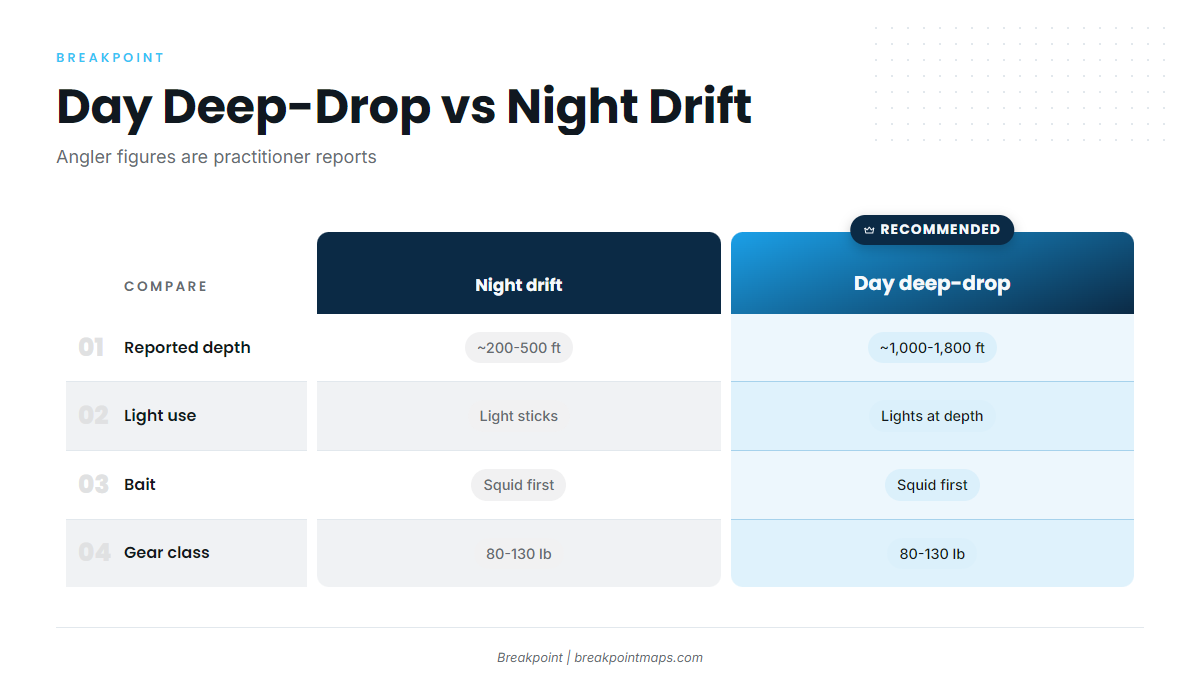
Most Southern California swordfish are now caught on daytime deep-drops with squid baits and electric reels, with night drifting under lights as the shallower alternative. The rigging basics are in the species guide; what follows is what changes on Southern California water.
Day Deep-Drop vs Night Drift
| Day deep-drop | Night drift | |
|---|---|---|
| Reported depth | Tagging: more than 700 ft (NOAA/PIER); anglers report about 1,000 to 1,800 ft | Anglers report about 200 to 500 ft |
| Light use | Lights on or near the bait at depth | Light sticks, per practitioner sources |
| Bait | Squid first, then bonito strips and mackerel fillets | Same bait family |
| Gear | Electric reels, 80 to 130 lb class, braided line | 80 to 130 lb class, braided line |
Angler figures in the table are practitioner reports. Squid leads because it matches the prey that follows the deep scattering layer; that is reasoning, not a citation.
What to Ask Your Captain
Before you book, ask:
- Do you fish daytime deep-drops, nights, or both, this time of year?
- What depths have you been dropping to lately, and why?
- Do you release or keep swordfish, and do you tag?
- How do you use SST and chlorophyll data when choosing an area?
- What happens if weather closes the offshore window?
- Does the trip enter Mexican waters, and if so, which permits do I need?
Handling, Release and Tagging
NOAA notes that data on the survival of released swordfish is still needed. Anglers can contribute through the Southwest Fisheries Science Center’s Cooperative Billfish Tagging Program, which began in 1963 and supplies tags to anglers. When in doubt on handling, follow the program’s guidance and your captain’s.
Frequently Asked Questions
What depth do anglers fish for daytime swordfish in Southern California?
NOAA and PIER tagging shows swordfish spend most of the day deeper than 700 ft. Anglers report dropping baits to roughly 1,000 to 1,800 ft. The tagging figure is measured; the angler figures are practitioner reports, and drop depth shifts with bottom depth, drift and current.
When is swordfish season in Southern California?
Late summer through fall into winter. Anglers commonly cite September to early January as the peak. Warm-water years may shift timing.
Who regulates swordfish off California?
NOAA Fisheries and the PFMC manage swordfish under the West Coast HMS plan. CDFW handles state licensing and rules. CONAPESCA governs Mexican waters. Verify current rules with each agency before you fish.
Can I tag and release a swordfish?
Yes. NOAA’s Cooperative Billfish Tagging Program has supplied tags to anglers since 1963. NOAA notes that the survival of released swordfish is still being studied, so follow the program’s guidance on handling.
Conclusion
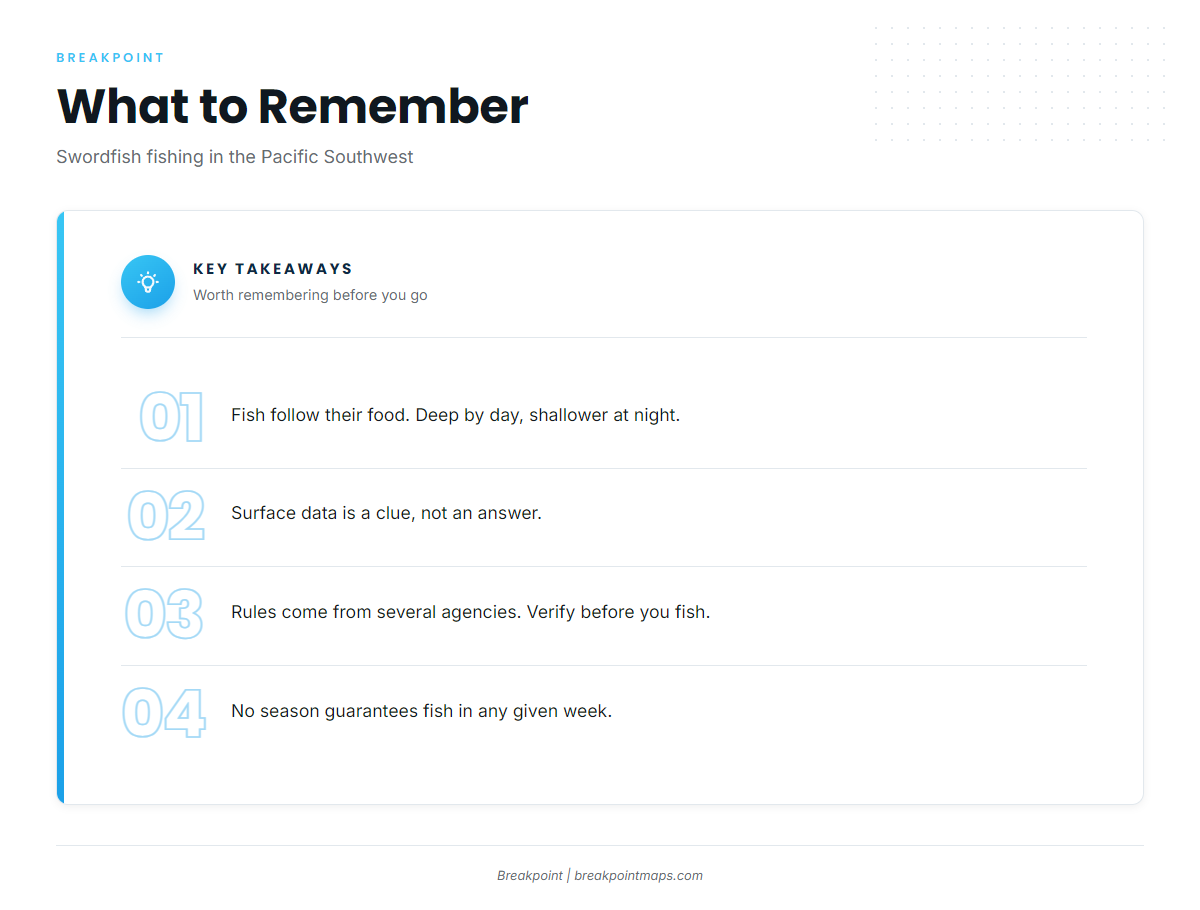
Swordfish follow their food deep by day and shallower at night, and surface data gives only a partial clue to where that food sits. Rules come from several agencies and change, so check them before you go. The fish also travel far beyond any one region, and no season guarantees them.
Breakpoint’s hotspots feature scores areas for swordfish in the Pacific Southwest using satellite temperature, chlorophyll and bottom contour data. It can help you decide where to look, but it cannot promise fish.
Chart layers are not for navigation.