


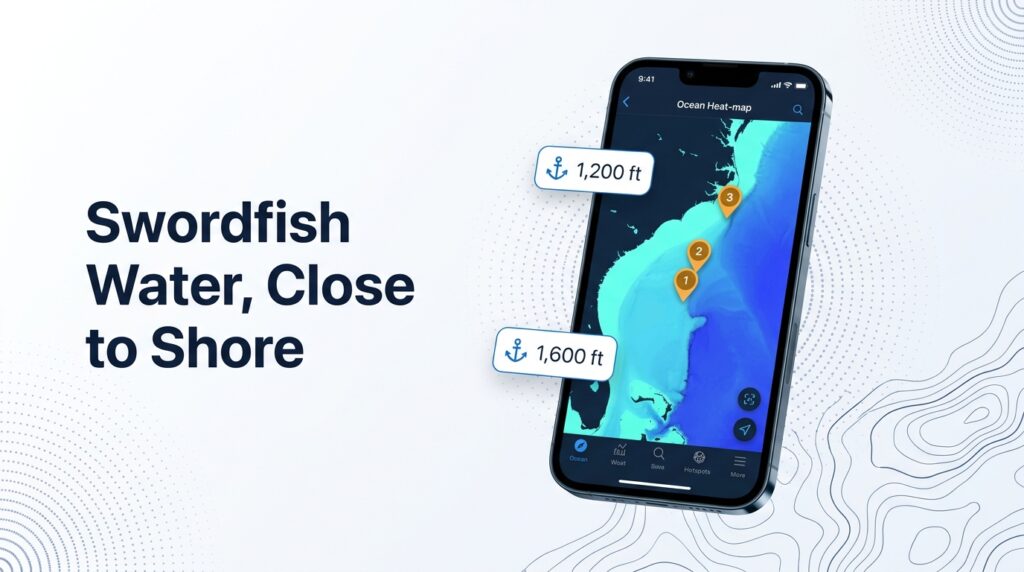
Deep swordfish water sits unusually close to shore here. Islamorada charter Fish Headquarters reports fishing "25 – 45 miles off of Islamorada, in 1500′ – 2000′ of water." That fact defines swordfish fishing in the Atlantic Southeast, and it shapes everything below.
For biology and general gear, start with our swordfish species guide. This page covers only what changes between the Florida Keys and the Outer Banks, moving south to north: the Florida Straits and the Keys, Miami to Palm Beach and Jupiter/Stuart, the Charleston Bump and Blake Plateau, then Hatteras.
Detail is strongest for South Florida and thins out to the north. The region matters to the stock itself: per NOAA’s North Atlantic swordfish profile, swordfish spawn "off the southeast coast of the United States from April through August."
Nothing here promises fish. It should help you decide where to look, how deep to drop, and what to report.
Regional Differences
The Gulf Stream runs close to a steep shelf edge along South Florida, which puts 1,500 ft and deeper within a practical run of port. Farther north, the deep water sits farther offshore. The current concentrates bait along the edge and sets the pace of your drift, and both matter more than any single waypoint.
From a Night Fishery to a Day Fishery
Per The Tackle Room, before daytime deep-dropping took hold, swordfish were "almost exclusively a nighttime target." Night drifting is still fished today, but dropping baits to the bottom near steep ledges by day opened the fishery to center consoles and shorter trips.
South to North: How the Region Changes
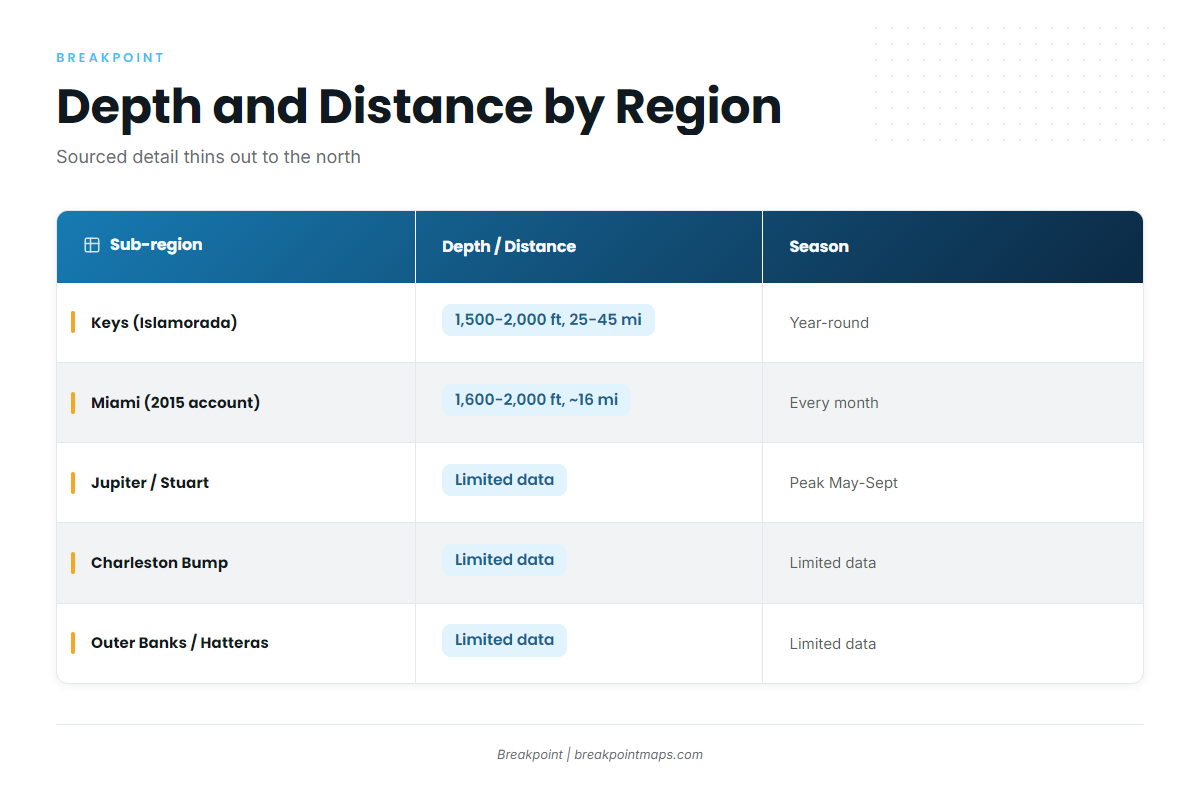
- Florida Straits and the Keys: Fish Headquarters reports 25 to 45 miles offshore in 1,500 to 2,000 ft.
- Miami: A captain quoted in a 2015 Coastal Angler article described fishing "about 16 miles offshore in 1,600 to 2,000 feet of water."
- Jupiter/Stuart: Stuart charter Hate 2 Lose reports fish year-round, with a peak "between May and September" and May through November as the most consistent months.
- Charleston Bump, Blake Plateau, Hatteras: Captains fish these features. Ask local captains or state fishery agencies for current details.
| Sub-region | Depth | Distance | Season | Source | Confidence |
|---|---|---|---|---|---|
| Florida Straits / Keys (Islamorada) | 1,500 to 2,000 ft | 25 to 45 mi | Year-round | Fish Headquarters (charter) | Moderate, charter-reported |
| Miami to Palm Beach | 1,600 to 2,000 ft | About 16 mi (Miami) | Every month, more in summer | Coastal Angler captain | Moderate, single dated account |
| Jupiter / Stuart | Limited data | Limited data | Peak May to Sept; May to Nov most consistent | Hate 2 Lose (charter) | Moderate, charter-reported |
| Charleston Bump / Blake Plateau | Limited data | Limited data | Limited data | None found | Low |
| Outer Banks / Hatteras | Limited data | Limited data | Limited data | None found | Low |
Swipe the table sideways to see every column.
Swordfish are caught year-round, with summer stronger. A Miami captain describes fish in every month of the year.
Day or Night for Your Trip
If you are booking a charter, the day-or-night call comes first. Fish Headquarters says night trips "generally yield more bites and overall fish" than day trips. Fish Miami Charters says fish are "more concentrated near structure during the day." Bud N’ Mary’s is candid about variance: some trips yield no bites, others "a bite every drop." Plan for a long day and treat a bite as a bonus.
Habitat & Conditions in the Atlantic Southeast
Most daytime deep-dropping targets "1,200 to 1,800 feet, with 1,200 to 1,600 a reasonable place to start," according to InTheSpread’s daytime depth guidance. Fish hold deep near the bottom by day and rise with the deep scattering layer at night.
Why Daytime Swordfish Sit Deep
Per NOAA, swordfish have "special eye muscles and a heat exchange system" that let them hunt in deep, cold water, which is why the daytime fishery works at 1,000 ft and below. Fish Headquarters describes daytime fish “on the bottom at 1,000 to 1,400 feet,” and InTheSpread puts the bait target at 1,200 to 1,800 ft.
The Deep Scattering Layer
The deep scattering layer sits at about 900 to 1,500 ft, per InTheSpread. Per Phenix Rods, it shows on a bottom machine as a thin band of plankton and baitfish, so finding it tells you where the food is. FishingBooker’s daytime swordfish tactics notes anglers dropping to as much as 5,000 ft, which is usually unnecessary.
Steep Ledges and Why Drift Control Matters
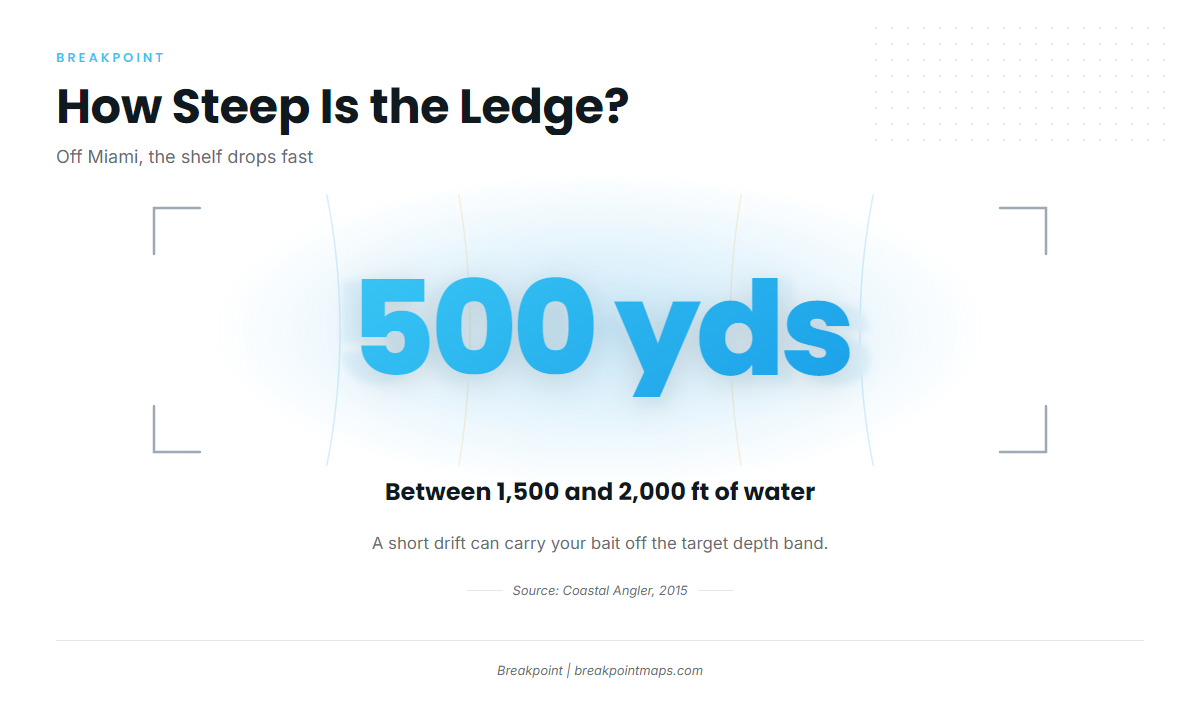
Off Miami, the ledge is steep. In the words of a 2015 Coastal Angler account, "the difference between 1,500 and 2,000 feet of water is about 500 yards." A short drift can carry your bait off the target band, so position and drift direction decide whether the bait fishes the right depth.
Current, Temperature Edges, and the Moon
- Current: Its strength sets how much weight you need, covered in the Tactics section.
- Edges are commonly watched. A captain quoted by SatFish mentions using a current layer to pick deep-drop spots.
- Moon: Per the Marine Stewardship Council, the commercial night fleet "usually targets swordfish when the moon is full." That is commercial practice and not proof of a recreational bite window.
What We Could Not Verify
- Charleston Bump and Blake Plateau: ask local captains about depths, fish positions, and seasons.
- Outer Banks and Hatteras: ask local captains about seasons and structure.
State fishery agencies can point you to current guidance for these areas.
Tactics for Swordfish Fishing in the Atlantic Southeast
Daytime deep-dropping here means heavy weight, a controlled drift into the current, and a bait that survives 20 minutes on the bottom. The regional adjustments are weight, drift, and bait toughness. Baseline rig construction is in the baseline deep-drop rig in the species guide.
Weight, Drift, and Bottom Time
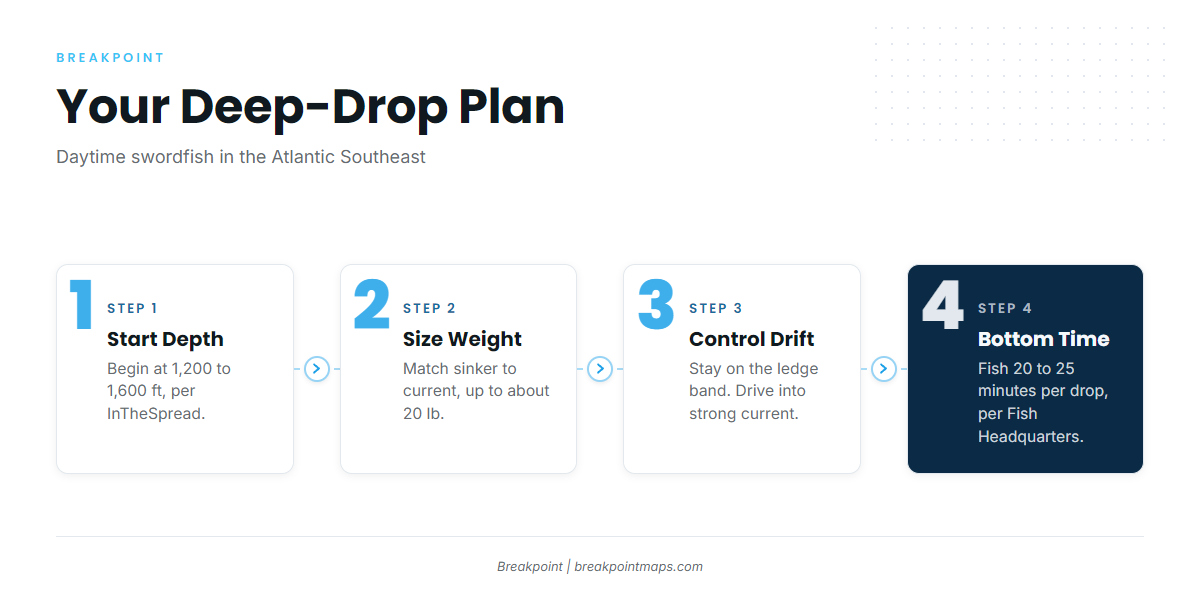
Weights run up to about 20 lb, depending on current. Fish Headquarters uses 20 lb sinkers, and a Coastal Angler captain uses "up to 20 pounds depending on current." Per FishingBooker, breakaway sinkers are popular against strong current, and captains either drive into a strong current or bump-troll in light current.
At these depths, per InTheSpread, you must account for "a half-mile or more" of line stretch. That stretch dulls bite detection and delays the hook set, so a long, patient sweep works better than a quick jerk. Plan on about 20 to 25 minutes of bottom time per drop, per Fish Headquarters.
The depth-and-weight plan in three lines:
- Start at 1,200 to 1,600 ft and adjust from there.
- Size the weight to the current, up to about 20 lb.
- Drift to stay on the ledge band rather than crossing it.
Rig Components and Lights
- Leader: The 2015 captain uses a 300 lb leader, one captain’s setup.
- Breakaway weight: Up to about 20 lb.
- LED deep-drop light: Per InTheSpread, a green or blue light "above the bait" is close to standard.
- Reel: The 2015 captain uses electric reels.
Bait: Bonito Belly vs. Illex Squid
Per The Tackle Room’s rigging guide, bonito bellies and bonito "tacos" beat squid because the tough skin resists tearing. Argentinian illex squid is the standard backup when bonito is not available. Toughness matters because the bait sits on the bottom for 20 to 25 minutes, and a bait that shreds before the fish arrives does no work.
Circle Hooks or J Hooks: A Split in Practice
The Tackle Room recommends circle hooks for all daytime work. A Coastal Angler captain used standard J hooks, sizes 1/0 to 12/0, single or double. Captains disagree. Check the Regulations section and NOAA HMS for any legal hook requirement.
The Night Alternative
Night drifting is the traditional method, and charter-reported bite counts run higher (Fish Headquarters). The full-moon context from the Habitat section applies here.
| Factor | Daytime deep-drop | Night drift |
|---|---|---|
| Where the fish are | Near the bottom, roughly 1,000 to 1,800 ft | Higher in the water column |
| Weight | Up to about 20 lb, per current | Limited data |
| Bite rate (charter-reported) | Fewer bites per trip | More bites per trip |
| Trip timing | Depart before daylight (Fish Headquarters) | Evening |
Landing and Release
Per Phenix Rods, prep flying gaffs, gloves, and a tail rope before the fish is boatside. The fish can be hogtied by bending it into a C shape and wrapping the rope around the bill. Everyone on deck should keep track of where the bill is.
Release fish you do not keep without removing them from the water, in a manner that ensures they have a good chance of survival.
Safety Line
Wind blowing against the Gulf Stream stacks steep seas. Check the forecast wind direction against the current.
Frequently Asked Questions
What depth do you fish for daytime swordfish in South Florida?
InTheSpread puts most daytime deep-dropping at 1,200 to 1,800 ft, starting at 1,200 to 1,600 ft. Islamorada charters report fishing 1,500 to 2,000 ft. The deep scattering layer, where the food is, sits at about 900 to 1,500 ft.
Do I need an HMS permit for swordfish?
Yes. You need an HMS Angling permit for a private boat, or a Charter/Headboat permit for a for-hire vessel.
How do I report a swordfish I kept?
Report landings to NOAA within 24 hours of returning from a trip, online at hmspermits.noaa.gov/catchReports or by phone at (888) 872-8862. Confirm the current process on the primary NOAA page before your trip.
When is swordfish season in Florida?
Swordfish are caught year-round. A Stuart charter cites a May to September peak and May to November as most consistent. NOAA reports spawning off the Southeast coast from April through August.
Day or night for a first swordfish trip?
Charters report more bites at night. Daytime puts fish near structure on the bottom and takes longer drops. Both are legitimate choices, and neither guarantees a fish.
Before You Run
Start in the 1,200 to 1,600 ft band, match your weight to the current, and control the drift so the bait stays on the ledge. Report any kept fish within 24 hours.
Breakpoint’s hotspots feature scores swordfish in the Atlantic Southeast so you can compare areas before you run. Cloud cover can block satellite sea-surface temperature, and a score is a starting point, not a promise. Chart layers are not for navigation.