Swordfish fishing in the Gulf of Mexico is a year-round fishery, and daytime deep-dropping is the dominant method. The shelf edge off the Mississippi River delta drops steeply, putting deep water unusually close to Venice, Louisiana, which is why that port anchors so much of the effort.
For the fundamentals (anatomy, gear basics, why the fish move vertically), start with our swordfish species guide. This page assumes you’ve read it. In short, swordfish hold deep by day and rise at night, so Gulf anglers drop deep in daylight and drift shallower water after dark.
Federal agencies, including NOAA, call this water the Gulf of America. Most anglers and charts still say Gulf of Mexico, and this page uses both where it matters.
Below you’ll find where the fish hold, which conditions to read, what local captains report works, and the permit and reporting steps. The goal is a better decision about where to look, not a promise of fish.
Regional Differences
Gulf swordfish differ from the general picture in four ways: spawning happens year-round, deep water sits close to shore off the delta, the Loop Current shapes where fish and bait gather, and offshore platforms add structure you won’t find in most of the Atlantic.
- Year-round spawning. Pew’s Gulf swordfish fact sheet reports that Gulf spawning runs year-round, peaking from late April to July, and that fish mature at 5 to 6 years.
- Deep water close to the delta. The shelf edge off the Mississippi River delta drops steeply, which is why Venice is a hub.
- The Loop Current. Warm water and its eddies set up temperature and color edges that concentrate bait. Details are in the next section.
- Rigs and platforms as structure. Platforms off Louisiana and Texas hold bait, and anglers fish them for swordfish.
Who manages Gulf swordfish
NOAA Fisheries’ Atlantic Highly Migratory Species (HMS) division manages swordfish, not the Gulf of Mexico Fishery Management Council. The Council matters on this trip only for reef fish you keep alongside a swordfish. Gulf fish belong to the North Atlantic stock, managed internationally through ICCAT (the International Commission for the Conservation of Atlantic Tunas).
What we don’t know
Whether Gulf fish behave as a distinct resident group is unsettled.
Habitat & Conditions in the Gulf of Mexico
By day, local captains report baits fished at depths from 1,000 to 2,000 feet near canyon walls and steep shelf edges. At night, the fish rise and anglers drift shallower water nearby. Treat that range as reported and typical, not as a rule.
| Area | What we can say | Confidence |
|---|---|---|
| DeSoto Canyon | Primary deep structure within reach of Destin and Orange Beach | Reported by charters |
| Mississippi Canyon and the Spur | Steep bottom close to Venice. "The Spur" is local shorthand | Reported by charters |
| Texas and Louisiana shelf break | Deep edges plus platforms | Reported, one record catch |
| Florida Middle Grounds edge | Little published detail | Exploratory |
DeSoto Canyon
DeSoto Canyon is the main deep structure within reach of Florida Panhandle and Alabama ports, including Destin and Orange Beach.
Mississippi Canyon and the Spur
Steep bottom sits close to Venice, an area anglers call "the Spur." Study it on a chart rather than treating it as a set of coordinates.
Texas and Louisiana shelf break and platforms
Rig and floater fishing ties into the shelf break here. For precedent, a 2016 Texas state record swordfish weighed 412 lb and was hooked at about 1,350 ft on a bonito belly. That is one old catch, not a current report.
Florida Middle Grounds edge
Published detail on swordfish here is limited. Treat it as exploratory water.
Loop Current and eddies
The published evidence is mostly on larvae. Research in the northern Gulf found larval densities near frontal zones and areas close to the Loop Current typically ran higher. That points to fronts as productive water, but it doesn’t show where adult fish hold on a given day. The larval research is a reason to prioritize edges, not a guarantee.
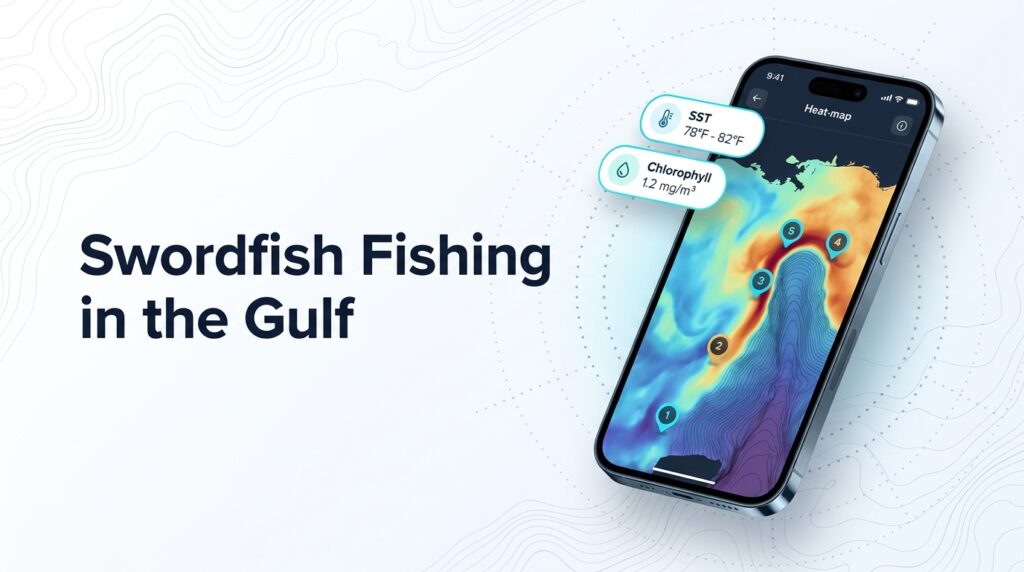
Warm Loop water meeting cooler Gulf water forms temperature and color edges, and bait gathers along them, so anglers start there. Loop Current position and eddy shedding shift, and any forecast of them is only a forecast.
Reading SST and chlorophyll
The data you already use applies here: satellite sea surface temperature (SST), chlorophyll imagery, bathymetry and offshore buoys.
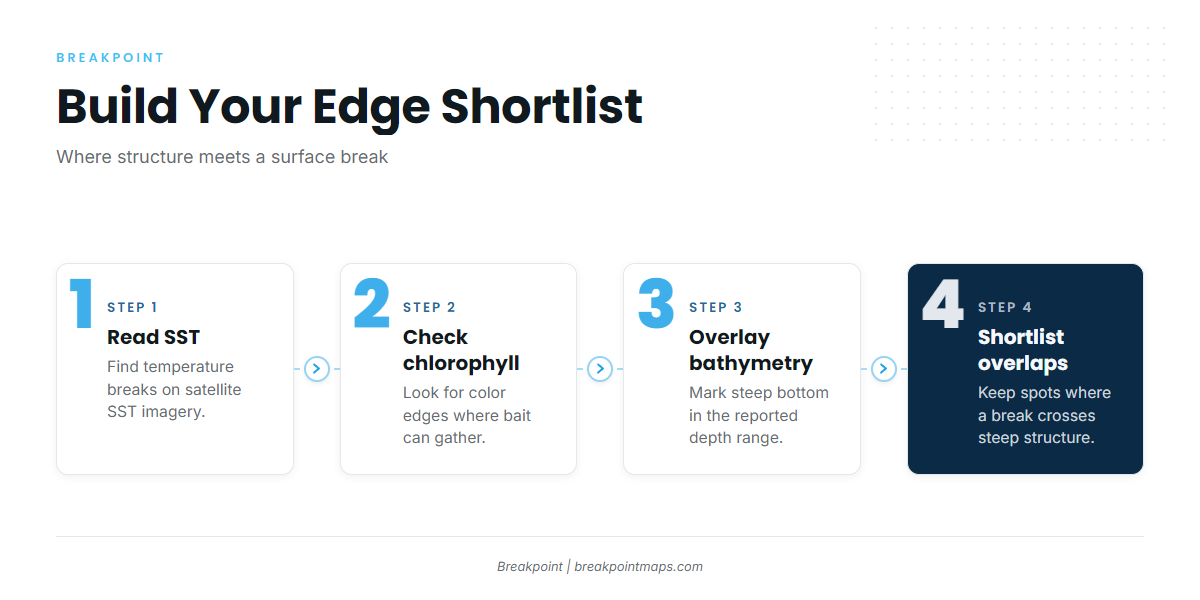
- Find a temperature or color break on the SST and chlorophyll imagery.
- Find where it crosses steep bottom in the depth range above.
- Put that overlap on your shortlist.
Cloud blocks satellite passes, and a surface edge doesn’t always reflect conditions at 1,500 ft.
Moon phase
Many captains prefer darker nights for the night drift, but the link is anecdotal. How far and how predictably swordfish move vertically each day is not well measured.
Tactics for the Gulf of Mexico
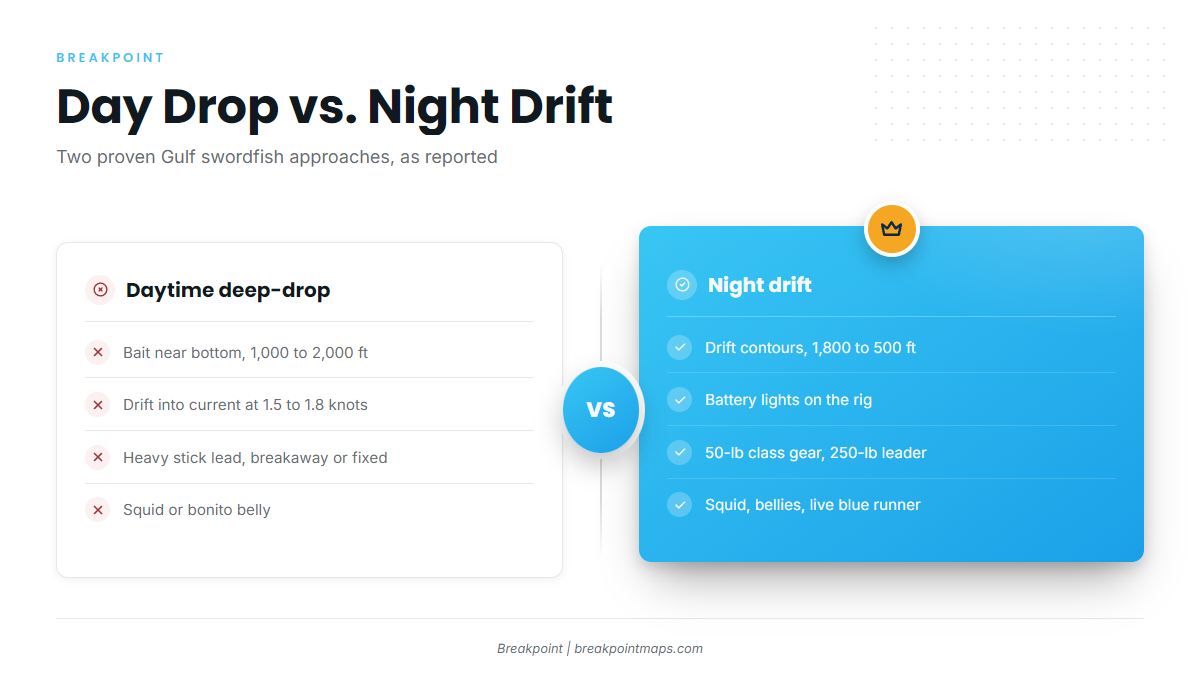
Most Gulf swordfish are now caught on daytime deep drops, with the bait held near bottom while the boat drifts into the current. Night drifting with lights remains a proven alternative across shallower contours. Leader and hook basics are in our swordfish species guide. What follows covers what changes in Gulf current.
The daytime deep-drop sequence
Conditions change the order, but this is the general shape:
- Pick the edge. Choose where structure and a surface break overlap, from the Habitat section.
- Position up-current of the target depth. We’d start the drop on the up-current side so the bait settles into the zone instead of past it.
- Drop to near bottom. Local captains report the 1,000 to 2,000 ft range from the previous section.
- Hold the drift. Local captains report moving the boat into the current at about 1.5 to 1.8 knots to keep the line vertical and the bait in the zone.
- Watch the rod tip and stay patient..
Heavy electric reels are standard because of the depth and line capacity involved. Stick leads are heavy, and how heavy depends on your current.
Night drift with lights
Mossy Oak describes a long drift across depth contours from about 1,800 ft on the deep side to 500 ft on the shallow edge. The rig is 50-lb class gear with about 25 ft of 250-lb fluorocarbon leader and a 9/0 to 11/0 J-hook, plus battery lights on the rig. The same source notes that pinpointing a single spot isn’t critical. Platforms off Louisiana and Texas are common night targets.
Breakaway or fixed lead
A fixed leash keeps the weight connected and suits lighter current. A breakaway sheds the weight once you come tight or if it hangs bottom. Match the choice to your lead, your current and how you plan to come tight.
Baits
Squid, bonito and mahimahi bellies, and live blue runners are all reported to produce bites. The Texas record came on bonito belly.
Daytime versus night approach
| Daytime deep-drop | Night drift | |
|---|---|---|
| Depth | About 1,000 to 2,000 ft near bottom (reported) | Drift across about 1,800 to 500 ft contours |
| Lead | Heavy stick lead, breakaway or fixed | Breakaway weight per Mossy Oak |
| Bait | Squid, bonito belly | Squid, bellies, live blue runner |
| Lights | Not a defining feature | Battery lights on the rig |
Ports and run logistics
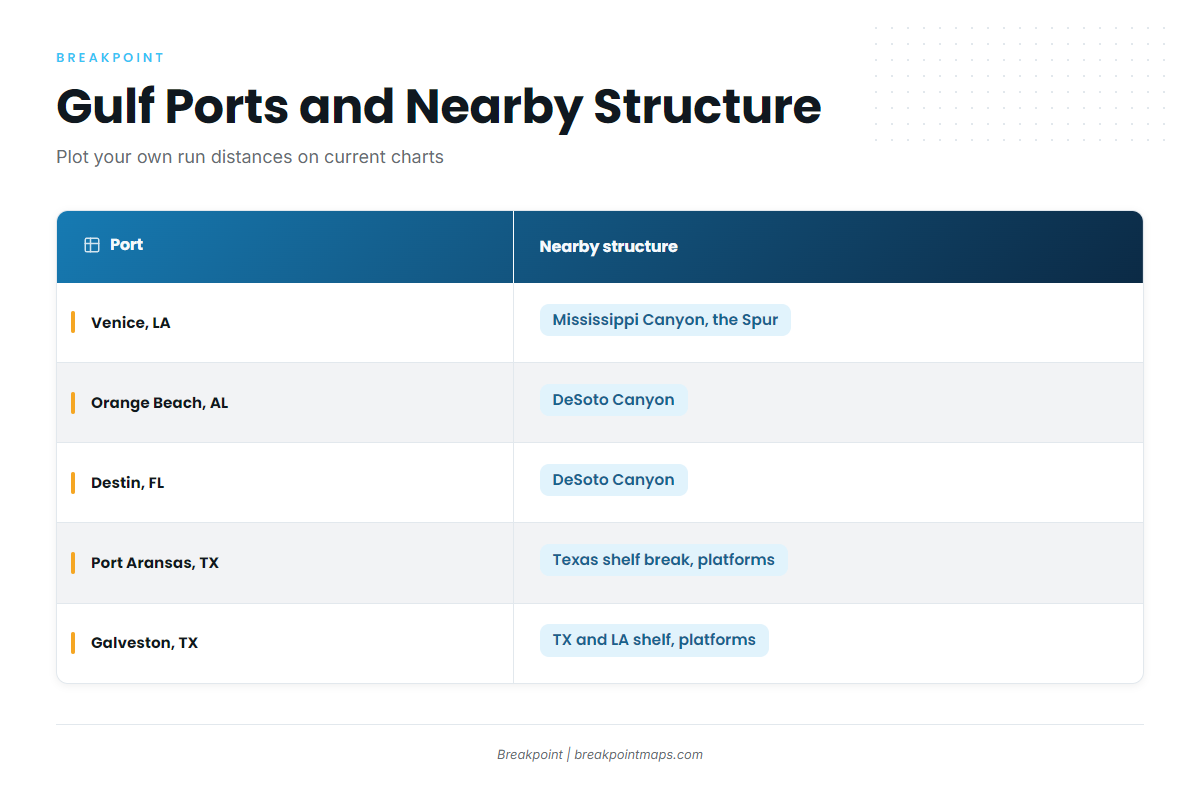
| Port | Nearby structure | Notes |
|---|---|---|
| Venice, LA | Mississippi Canyon and the Spur | Steep shelf close to port |
| Orange Beach, AL | DeSoto Canyon | Panhandle and Alabama access |
| Destin, FL | DeSoto Canyon | Panhandle access |
| Port Aransas, TX | Texas shelf break and platforms | Rig fishing |
| Galveston, TX | Texas and Louisiana shelf and platforms | Rig fishing |
Plot your own with current charts.
On a charter. A Venice operator describes offshore trips as 9 to 10 hours dock-to-dock, leaving before daylight, and describes pairing a morning of tuna with afternoon drops.
On a private boat. Plan fuel with a reserve and pick a settled weather window.
Swordfish Fishing in the Gulf of Mexico: Regulations
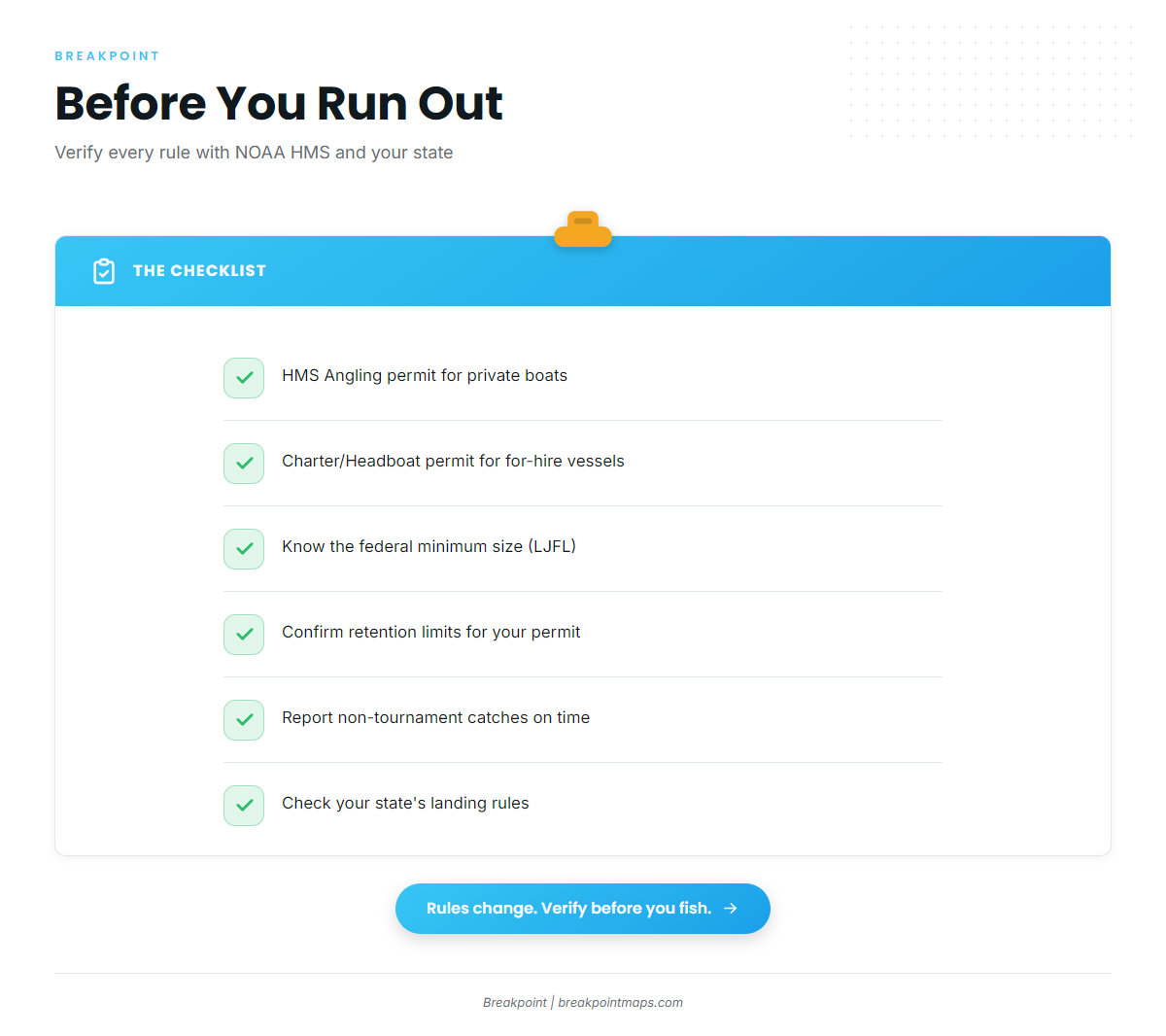
Recreational swordfish in the Gulf are managed federally by NOAA Fisheries Atlantic HMS. You need an HMS permit and the fish must meet the federal minimum size. Check NOAA HMS for reporting rules.
- Permits. Private boats need an HMS Angling permit. For-hire vessels need an HMS Charter/Headboat permit. Confirm both with NOAA Fisheries Atlantic HMS.
- Minimum size. The federal recreational minimum is 47 inches lower jaw fork length (LJFL), or 25 inches cleithrum to caudal keel. LJFL runs from the tip of the lower jaw to the fork of the tail.
- Retention limits. These vary by permit category. Confirm with NOAA HMS.
- Reporting. Check NOAA Fisheries HMS for the catch reporting rules, including the deadline and method.
- State landing rules. Florida has its own rules, so check FWC first. Then check LDWF (Louisiana), TPWD (Texas), ADCNR (Alabama) and MDMR (Mississippi) for your landing state.
- Gulf Council note. Swordfish are not a Gulf Council species. Reef fish kept on the same trip follow Gulf Council and state rules.
| Rule | Value | Agency |
|---|---|---|
| Permit (private) | HMS Angling permit | NOAA Fisheries Atlantic HMS |
| Permit (for-hire) | HMS Charter/Headboat permit | NOAA Fisheries Atlantic HMS |
| Minimum size | 47 in LJFL, or 25 in cleithrum to caudal keel | NOAA Fisheries Atlantic HMS |
| Retention limit | Varies by permit category | NOAA Fisheries Atlantic HMS |
| Reporting | See NOAA Fisheries HMS for current rules | NOAA Fisheries Atlantic HMS |
| Florida landing rule | Separate state rules | FWC |
Rules change. Verify with NOAA HMS and your state agency before you fish.
On a charter. The vessel’s Charter/Headboat permit covers passengers. Confirm with your captain before the trip.
Frequently Asked Questions
When is the best time to fish for swordfish in the Gulf of Mexico?
Fish are available year-round. A Gulf Shores charter reports a May through September peak. Weather windows matter more in winter.
What permit do I need for Gulf swordfish?
Private boats need an HMS Angling permit. For-hire vessels need a Charter/Headboat permit. Both come through NOAA Fisheries Atlantic HMS. Verify current requirements before you fish, because rules change.
What is the minimum size for swordfish?
The federal minimum is measured as lower jaw fork length, from the lower jaw tip to the fork of the tail. The minimum is 47 inches, or 25 inches cleithrum to caudal keel. Florida adds its own landing rules, so check FWC as well.
How deep do you fish for swordfish during the day?
Local captains report about 1,000 to 2,000 ft near bottom. The 2016 Texas record was hooked at about 1,350 ft. Treat the range as typical, not as a rule.
Do charter passengers need their own swordfish permit?
Generally no. The vessel’s Charter/Headboat permit covers passengers. Confirm with your captain, and check state landing rules for where you dock.
Closing
Swordfish sit deep by day and rise shallower at night. Start where a Loop Current or eddy edge crosses steep structure, and sort out your permit and reporting before the run. The larval research suggests fronts matter, though it can’t tell you where a fish is today.
If you want a shortlist before you burn the fuel, Breakpoint’s hotspots feature scores swordfish in the Gulf of Mexico from OBS SST, Chlorophyll and Chart Contours. Cloud can blank a satellite pass, and chart layers are not for navigation. Treat it as a starting point for the decision you still make on the water.