Meta description: Swordfish fishing in the Atlantic Northeast, explained by canyon: when fish arrive, how warm-core eddies and SST breaks set the bite, night drift versus day drop, and who regulates it.
Overview
Swordfish fishing in the Atlantic Northeast runs roughly June to October, per On The Water. The fish sit along the shelf-edge canyons from Hudson northeast to Block, Atlantis, Veatch, Hydrographer and Oceanographer, near the 100-fathom line. Anglers work them two ways: the night drift and the daytime deep drop.
For biology basics and general rigging, our swordfish species guide covers the fundamentals. This page covers this water specifically.
According to NOAA’s North Atlantic swordfish profile, the average fish in the fishery runs 50 to 200 lb, and the 2022 assessment found the stock "not overfished and not subject to overfishing."
Season windows differ by source and by latitude. The Tackle Room reports June through November for the mid-Atlantic canyons (Norfolk, Baltimore, Hudson, Wilmington). The northern canyons run a narrower window.
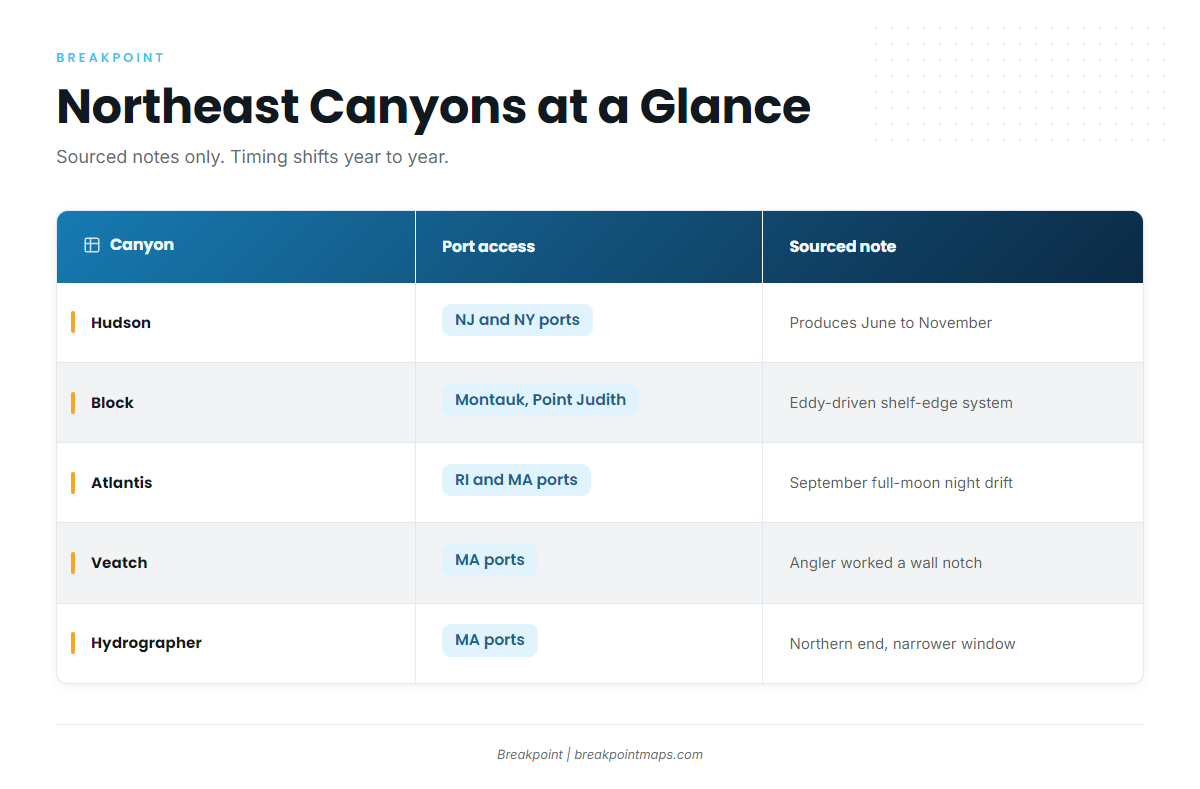
| Canyon/Area | General port access | Sourced notes |
|---|---|---|
| Hudson | NJ and NY ports | Produces June through November (The Tackle Room, mid-Atlantic framing) |
| Block | Montauk and Point Judith | Part of the eddy-driven shelf-edge system |
| Atlantis | RI and MA ports | September full-moon night drift anecdote (On The Water, 2016) |
| Veatch | MA ports | An angler on the Noreast forum reported a productive trip working a notch in the canyon wall |
| Hydrographer/Oceanographer | MA ports | Northern end of the canyon run, with a narrower window |
Timing shifts from year to year with where warm water sets up. No source we found pins peak weeks by canyon.
Regional Differences
Northeast swordfish are seasonal visitors that follow warm water north. Published research in Fisheries Oceanography and Frontiers in Marine Science describes swordfish moving north to forage after waters warm in June, using warm-core eddies on migrations to northern feeding grounds.
They don’t come here to spawn. NOAA places Western North Atlantic spawning far south, in the Sargasso Sea and upper Caribbean from December to March, and off the southeast U.S. from April through August. The fish in the canyons are feeding fish.
The night drift is the regional tradition. One New England captain’s account says most Northeast anglers "consider full darkness the best time to fish," and explains the logic this way: "As the moonlight draws up the squid, the swordfish follow." The article dates to 2016, so treat it as the traditional view.
The daytime deep drop is newer. Northeast captains borrowed it from Florida bluewater anglers, where it is well established; on Northeast canyon walls it is still being worked out.
The two approaches, and the northern edge of the range:
- Night drift: Northeast tradition, tied to moon phase and squid baits near the surface.
- Day drop: Imported from Florida, fished deep on canyon structure.
- Georges Bank: Historic harpoon grounds at the northern edge of the range.
On Georges Bank, On The Water notes that surface-basking swordfish were once common "but overfishing took care of that," and that the stock has since rebounded.
Fish on top shouldn’t be part of the plan. A 2023 swordfish tagging study found that when swordfish made shallow daytime forays, they showed potential surface basking on "less than 2% of days."
Habitat & Conditions in the Atlantic Northeast
Bait stacks on boundaries, and swordfish patrol them. In this region the boundaries that matter are canyon walls, warm-core eddy edges and sharp temperature breaks. The best spots combine more than one.
Canyons and the 100-Fathom Line
The named grounds are Hudson, Block, Atlantis, Veatch, Hydrographer and Oceanographer. Irregular relief, meaning walls, humps and notches, drives upwelling that concentrates bait, giving swordfish something to hunt against.
NOAA’s April 2026 monument release describes the Northeast Canyons and Seamounts area (4,913 square miles) as home to "Atlantic tunas and swordfish." The release announced NOAA rescinding the regulation that prohibited commercial fishing there. It says nothing we could find about recreational rules, so check the Federal Register notice before assuming any change.
A note on charts: chart layers are not for navigation, and some offshore survey data is old. Chart Contours show where relief is likely, not what a drift will do over it.
Warm-Core Eddies
Warm-core eddies spin clockwise, push north and then west along the shelf, and cause upwelling on the leading edge. Eddies spun off in June, July and August bring swordfish into the region, according to On The Water (2016).
They can also reach closer than you’d expect. Anglers on the Noreast forum note that eddy water "can pop up 2 to 10 miles inshore of the 100." Research in some regions also finds swordfish concentrated in and near warm-core rings, especially in years when more rings form.
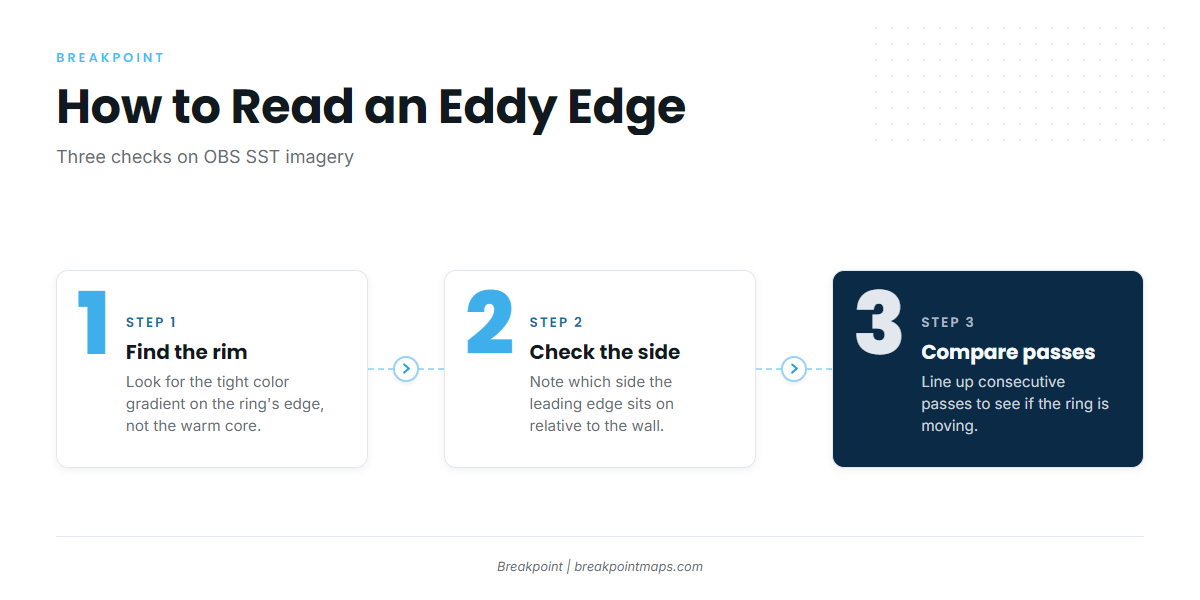
To read an eddy on OBS SST imagery:
- Find the rim. Look for the tight color gradient on the ring’s edge rather than the core.
- Note the leading edge. Check which side faces the wall, since that is where upwelling sets up.
- Compare consecutive passes. An eddy that moved between two clear days is not where the last image left it.
SST Breaks and Temperature Ranges
Scientific sources cite an 18 to 22°C preference, about 64 to 72°F. The On The Water captain prefers "the low to mid-70s" and says fish turn up from the high 60s to the 80s.
Breaks matter most on the wall. The same captain writes that a break "of two or more degrees… we will often choose this edge to drift above all others, as long as it is not too far up on the flats." That combines two boundaries, temperature and structure, over depth where the fish live.
Treat Chlorophyll as a secondary signal. A color edge can mark where bait gathers, but no source we found ties chlorophyll directly to swordfish catches.
Moon Phase
On The Water (2016) recommends "three days either side of the full moon." The captain also gives an Atlantis Canyon September full-moon anecdote: his boat got two bites and boated one fish, and two other boats had three fish between them. The commercial fleet also tends to target the full moon, per the Marine Stewardship Council’s fishery description. No source we found quantifies how moon phase changes daytime depth.
What the Data Can’t See
- Clouds. A blocked satellite pass is a gap, not a signal. Lean on the last clear pass, note its age, and assume the eddy has drifted since.
- Depth. Surface temperature says nothing direct about conditions at 1,500 ft.
Tactics for Swordfish Fishing in the Atlantic Northeast
Choose a method based on your boat, your crew and the moon. Both work in these canyons, and neither is a sure thing.
General deep-drop rigging is in the species guide. What follows covers what changes here.
Night Drift
- Drift pattern: Practitioner sources favor short, targeted drifts over structure rather than one drift all night.
- Bait: The On The Water captain called "large loligo squid" his bait of choice. Local loligo reportedly draws more bites than pre-packed illex. Mackerel works but can draw sharks. Swordfish often strike a bait several times before eating it, so rig it to survive.
- Lights: Green or blue LEDs are close to standard and sit above the bait.
- Moon: Fish the three days either side of the full moon.
Daytime Deep Drop
- Depth: In The Spread puts deep dropping depth range at 1,200 to 1,800 ft. Northeast reports put drifts at 1,500 to 1,600 ft over canyon humps. One described ideal is starting around 1,600 ft on the leading edge of a warm-core eddy.
- Gear: Electric reels are standard. Some anglers still hand-crank a Penn 70 with a mile of braid.
- Two rods: Fighting a fish off two rods improves landing odds when the fish is out of gaff range.
- Season reference: The Tackle Room’s canyon guide lists June through November for the mid-Atlantic canyons.
- Learn it from an experienced crew;.
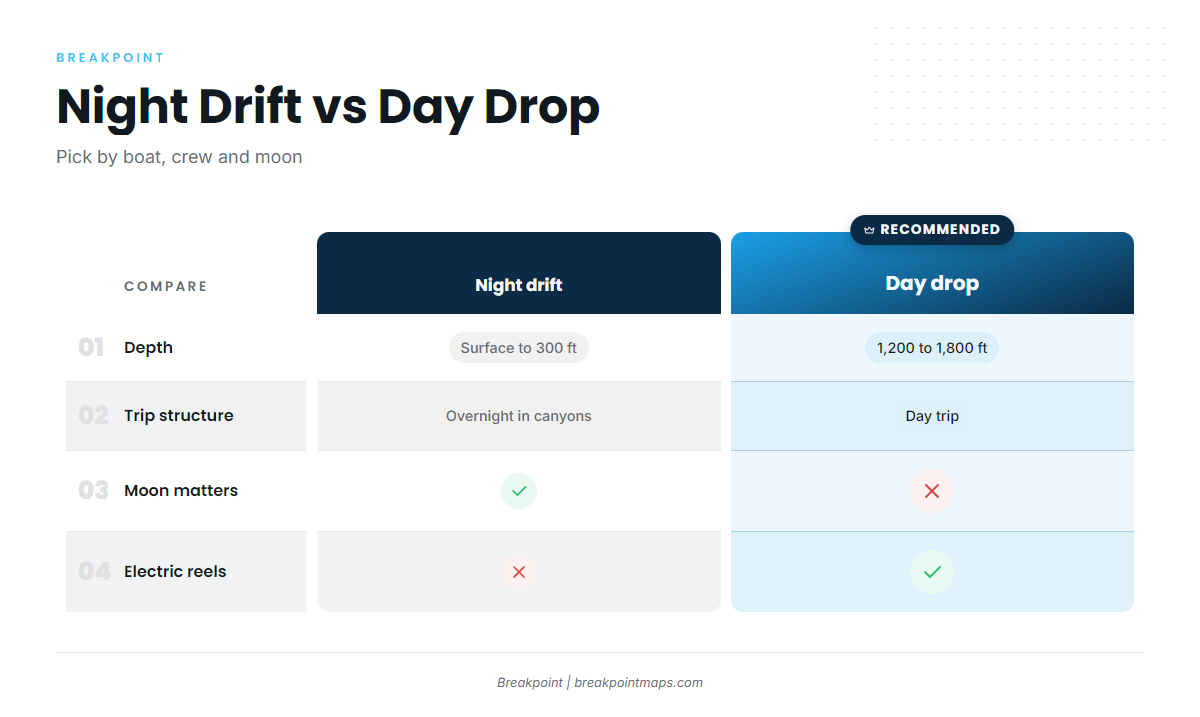
Night Drift vs Day Drop
| Night drift | Day drop | |
|---|---|---|
| Timing | After dark, traditionally around the full moon | Daylight |
| Depth | Surface to a few hundred feet | 1,200 to 1,800 ft |
| Bait | Loligo squid, with green or blue LEDs | Squid-type baits, deep |
| Gear | Standard offshore setups, rigged for repeated strikes | Electric reels common |
| Moon relevance | High | No source quantifies the effect |
| Trip structure | Overnighting in the canyons | Run out and drop in daylight |
With either method, the aim is the same: put the bait where boundaries overlap.
Frequently Asked Questions
When is swordfish season in the Northeast?
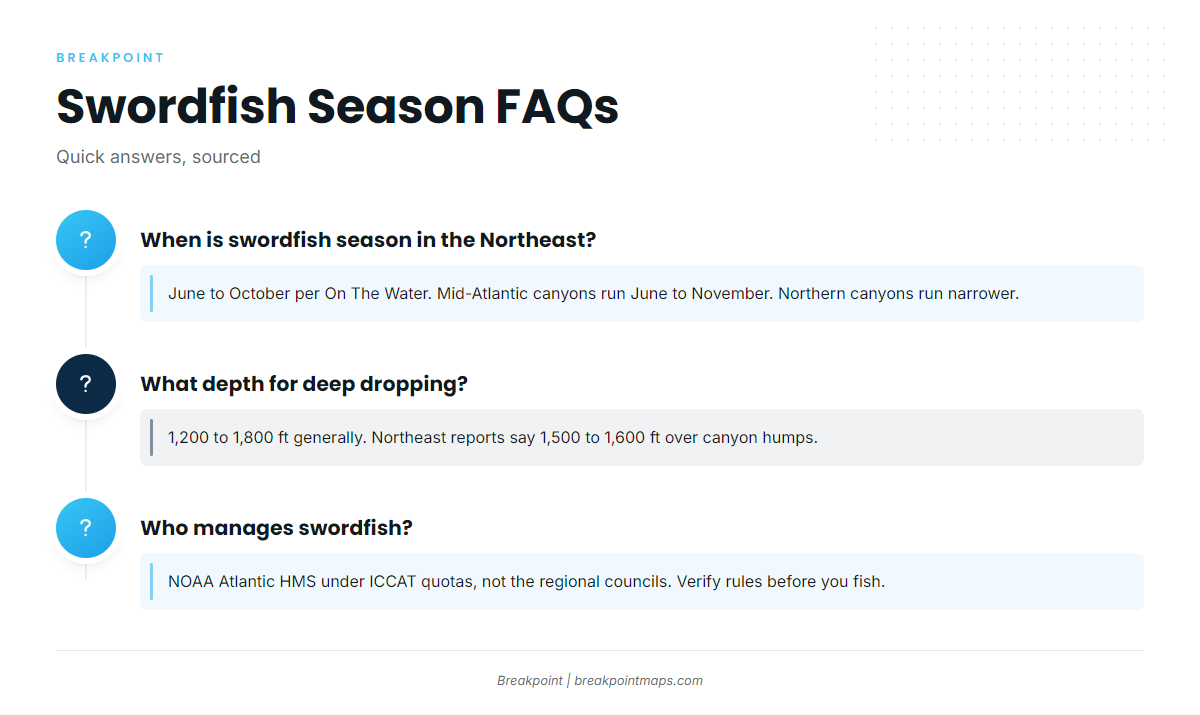
Swordfish are within reach of sport anglers roughly June to October, per On The Water. The Tackle Room reports June through November for the mid-Atlantic canyons. The northern canyons run a narrower window, and timing shifts with where warm water sets up.
Should I fish at night or during the day?
Night drifting is the Northeast tradition, tied to the full moon. Daytime deep dropping came north from Florida. The right choice depends on your crew, your boat and the moon, and neither method is guaranteed.
What depth should I deep drop?
Sources put daytime deep dropping at 1,200 to 1,800 ft. Northeast reports describe drifts at 1,500 to 1,600 ft over canyon humps. Start near 1,600 ft on the leading edge of a warm-core eddy when you can find one.
Who manages swordfish?
NOAA Fisheries’ Atlantic HMS Management Division manages swordfish under ICCAT-derived quotas. The regional fishery management councils do not. Permits, size limits and reporting rules change, so verify them on NOAA HMS and your state agency before fishing.
Close
Warm water arrives with the eddies, bait stacks on the breaks, and the canyon walls give swordfish something to hunt against. That is the basic shape of swordfish fishing in the Atlantic Northeast.
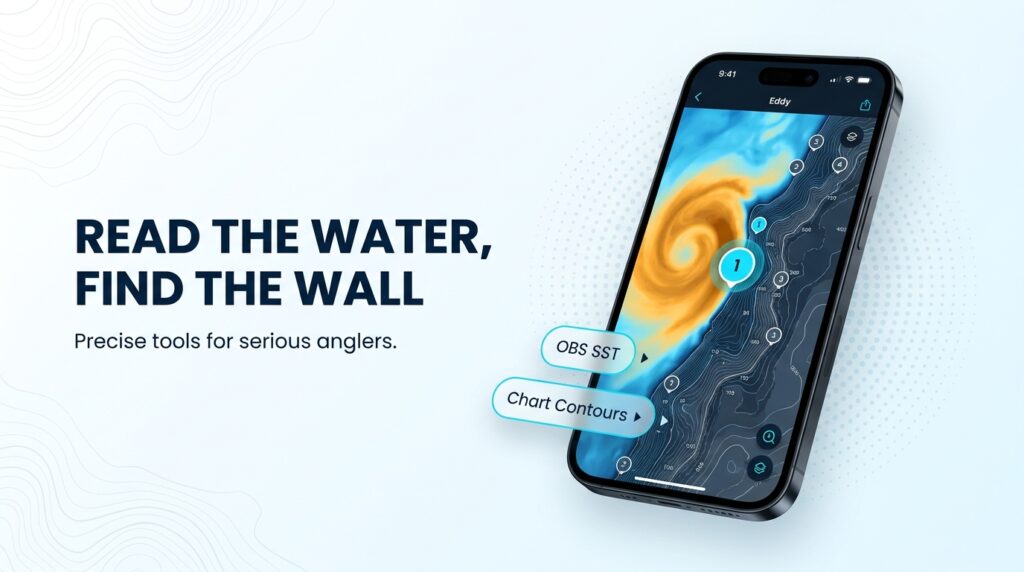
Our hotspots feature scores swordfish conditions across the Atlantic Northeast using OBS SST, Chlorophyll and Chart Contours. Scores are a forecast, not a promise. Clouds can block satellite passes, and chart layers are not for navigation. The tool can help you decide which wall to drift first, but it won’t find the fish for you.