Overview
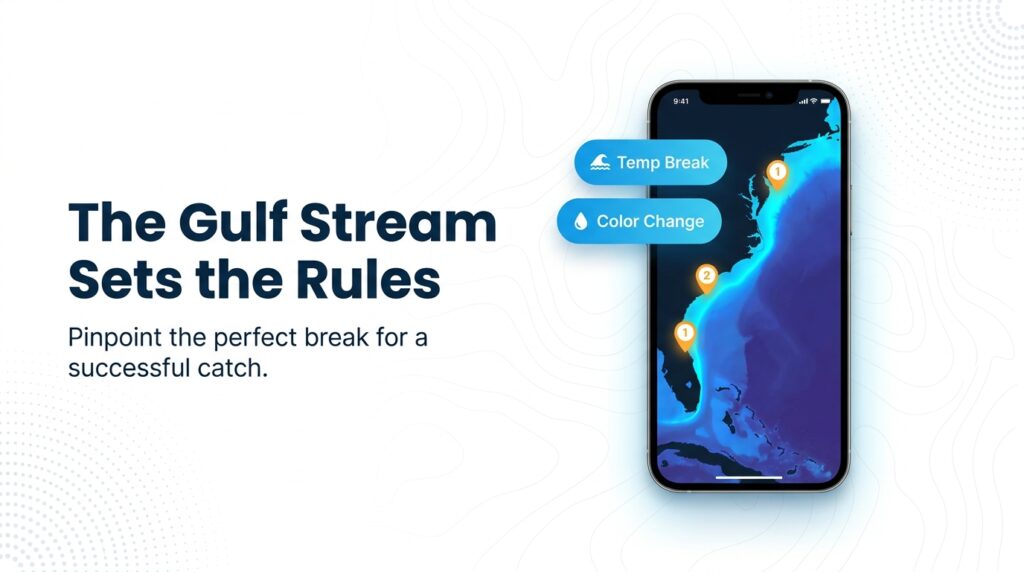
The Gulf Stream governs sailfish fishing in the Atlantic Southeast. Its distance from shore, its current, and the fronts that push against it determine where and when the fish show up.
For biology, general tackle and basic technique, start with our sailfish species guide. This page covers what changes in this region, which we define as Florida’s Atlantic coast from the Keys north through Georgia and the Carolinas.
Below you’ll find when fish run by port, what wind, depth and water to look for, which local methods fit which stretch of coast, and the rules that apply.
We are a map and data company, and we’ve organized what the Stream, the fronts and the rulebooks are doing into better decisions about where to look. Everything below is a tendency, not a guarantee.
Regional Differences
Southeast Florida peaks in winter, when cold fronts move fish south along a narrow shelf. Sailfish reach the Carolinas in summer, when warm Gulf Stream water pushes toward the shelf.
Sailfish are present in some numbers year-round off Southeast Florida, with a pronounced winter peak. In summer, FWC’s sailfish species profile notes that fish move inshore to shallow water and spawn near the surface off Southeast Florida.
Sailfish Alley runs from Fort Pierce to Miami, close to the coast. Florida tourism materials also credit Stuart with the title of Sailfish Capital of the World, and Stuart’s Sailfish Capital designation is official.
Southeast Florida: Miami and the Florida Keys
Off Miami, the Gulf Stream runs close to shore. According to Miami charter reporting, the drop-off concentrates sailfish in roughly 100 to 300 ft. On this narrow shelf, fishing tends toward kites close to the reef edge.
Around Key West, peak Keys sailfish months run November to January and again in April to early May. Miami’s prime window is often described as December through early June, per Marlin Magazine.
Southeast Florida: Jupiter and Palm Beach
The shelf is narrow and the Stream sits close. This is kite and live-bait country near the reef edge, with traditional depths of 100 to 200 ft, per Salt Water Sportsman.
Treasure Coast: Stuart and Fort Pierce
According to Marlin Magazine’s Florida sailfish report, the season typically begins in mid-November and can run into late February or early March. The shelf extends farther offshore here, so you cover more ground.
Capt. VJ Bell told Marlin Magazine he trolls dead baits for sails about 90% of the time off Stuart and Fort Pierce.
Carolinas and Georgia
According to North Carolina’s sailfish species profile, sport fishermen land sailfish off North Carolina from May through October. Regional angler reporting says fish show up regularly on the Outer Banks trolling grounds from June through September, and local anglers call the heat of late July and August "Sailfish Central."
Sails often come up in a mixed spread alongside dolphin, wahoo and marlin rather than as a dedicated target.
Sails appear along the Gulf Stream edge well offshore.
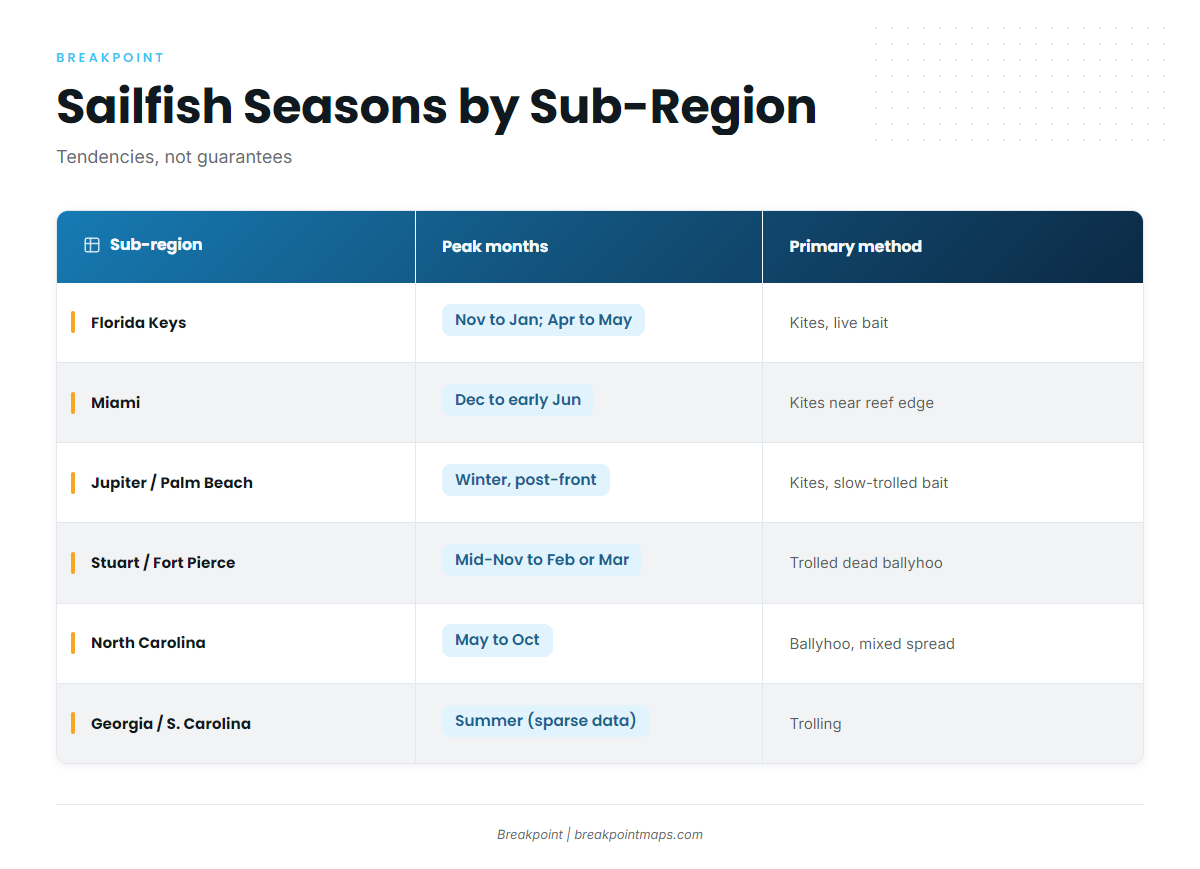
Seasonal Snapshot
| Sub-region | Peak months | Typical depth | Primary method |
|---|---|---|---|
| Florida Keys | Nov to Jan; Apr to early May | Offshore waters | Kites, live bait |
| Miami | Dec to early Jun | 100 to 300 ft | Kites near the reef edge |
| Jupiter / Palm Beach | Winter, post-front | 100 to 200 ft | Kites, slow-trolled live bait |
| Stuart / Fort Pierce | Mid-Nov to late Feb or Mar | 100 to 200 ft (wide shelf) | Trolled dead ballyhoo with dredges |
| North Carolina | May to Oct (Jun to Sep regular; late Jul to Aug heat) | 120 to 300 ft | Ballyhoo in a mixed spread with teasers |
| Georgia / South Carolina | Summer | Gulf Stream edge, offshore | Trolling |
Habitat & Conditions in the Atlantic Southeast
The classic sail day off Florida is a north wind blowing against the north-setting Gulf Stream, usually right after a cold front.
Wind Against Current
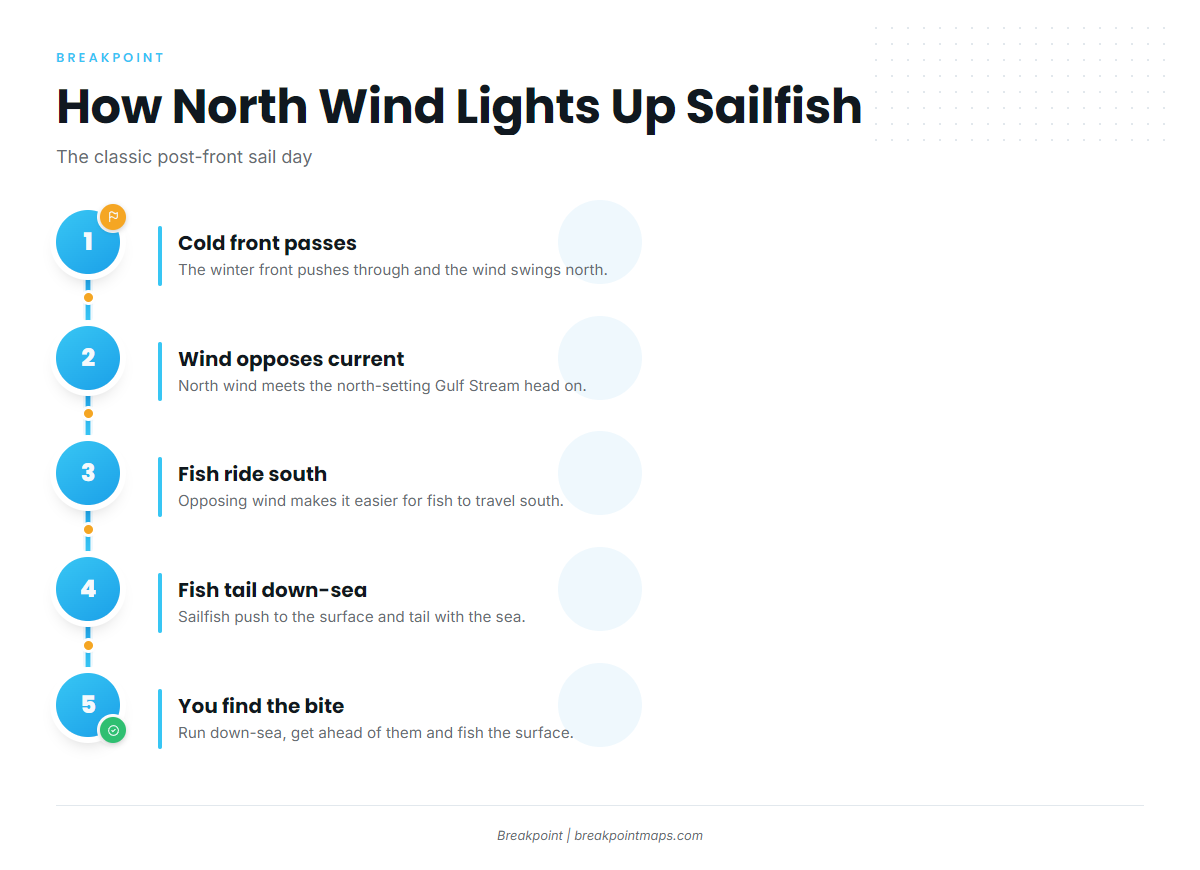
North wind opposes the north-setting current, which makes it easier for fish to travel south, so they push to the surface and tail down-sea. Marlin Magazine describes the post-front north wind as prime time and notes that a strong north current plus north wind brings fish up to tail.
Spring changes the picture. According to spring sailfish wind patterns reported by Salt Water Sportsman, wind direction matters less then, and a southeast wind can fish as well as a northeast one, or better.
When the wind is light, fish can’t use it against the current. They often slide inshore into lighter current, and anglers follow them there, per Marlin.
Conditions usually matter more than the calendar. According to Miami charter reporting, a good post-front November day can beat a poor April day. Even so, the bite varies when conditions look right.
Depth and Edges
Traditional Southeast Florida depths are 100 to 200 ft, per Salt Water Sportsman. Off Miami, the drop-off concentrates sailfish in 100 to 300 ft. A local charter operator also describes the Biscayne Bay green-water edge: Biscayne Bay pushes green water onto the reef edge, where it meets the Gulf Stream and forms a boundary that holds bait.
Off North Carolina, sailfish are generally found in 120 to 300 ft and 77 to 82°F, per the state’s Division of Marine Fisheries.
Fish work the rips, eddies, color changes, temperature breaks and grass lines along the inshore edge of the Gulf Stream. The reef edge and the drop-off are the first two places to search.
Bait and Birds
Locals name goggle-eyes, pilchards, blue runners and ballyhoo as the working baits. Some South Florida crews anchor outside the reef in roughly 75 to 120 ft to catch ballyhoo before they fish, per local charter reporting.
Bait concentrations and working birds are the most direct signs of where to look.
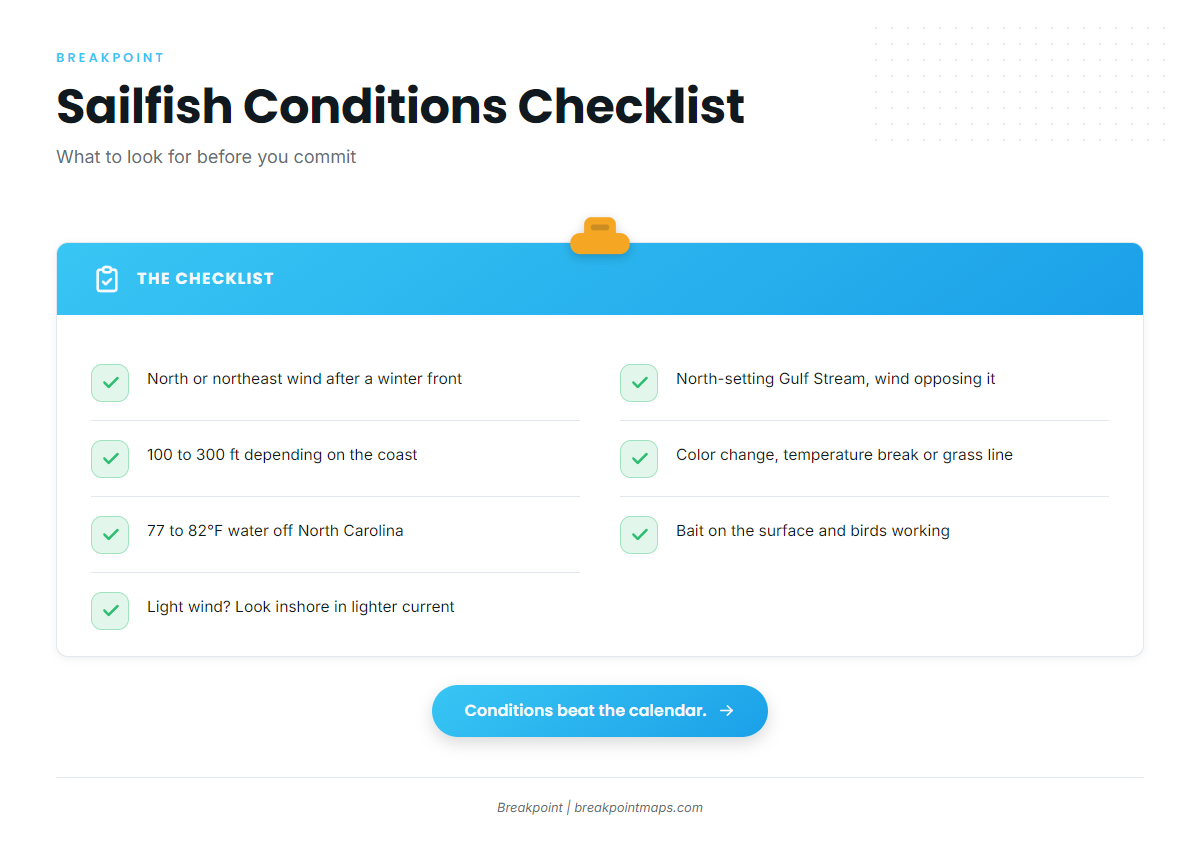
Conditions Checklist
- Wind: north or northeast after a front in winter. In spring, southeast can work too.
- Current: north-setting Gulf Stream, with wind opposing it.
- Depth: 100 to 200 ft off Southeast Florida, 100 to 300 ft on the Miami edge, 120 to 300 ft off North Carolina.
- Water: a color change, temperature break, rip or grass line.
- Temperature: 77 to 82°F off North Carolina.
- Life: bait on the surface or on the sounder, and birds working.
- Light wind: look inshore in lighter current.
What the Data Can’t See
Satellite and model data narrow the search, but they don’t locate the fish.
- Cloud cover blocks satellite SST, so a clean temperature map can be a day or more old.
- A temperature break on the map is a place to check, not a guarantee.
- The Gulf Stream edge moves day to day.
- A wind forecast is a forecast.
Tactics for the Atlantic Southeast
Kites with live bait dominate the narrow-shelf water from Miami to Palm Beach. Trolling takes over where the shelf widens off the Treasure Coast and in the Carolinas. That is the core of sailfish fishing in the Atlantic Southeast.
General circle-hook rigging is covered in our species guide.
Kite Fishing (Southeast Florida)
Most boats run 2 kites, 1 on each side, with 2 to 3 baits per kite. That puts 4 to 6 live baits on the surface. It is a light-tackle fishery built around 20-lb class gear, per local charter and tackle reporting.
Kites keep baits splashing at the surface where post-front fish are feeding, and you often see the strike.
You will hear anglers say a sailfish "lit up." Vertical bars show along its flanks when the fish is excited or hunting.
Slow-Trolling Live Bait
When there is no wind for kites, slow-trolling live baits keeps you fishing. It suits light-wind days, when fish slide inshore into lighter current.
Trolling Dead Ballyhoo With Dredges (Treasure Coast)
On the wider shelf, trolling covers more ground. Where fish are spread out, crews troll ballyhoo on circle hooks with dredges. Capt. VJ Bell’s roughly 90% dead-bait approach, reported in Marlin Magazine, fits that pattern.
Carolina and Georgia Mixed Spreads
Trolling ballyhoo is the common method along the coast, and sailfish charge up the wake to teasers. Run teasers and dredges inside a spread built for dolphin, wahoo and marlin. If you fish tournaments, confirm circle-hook compliance for natural baits with your event and NOAA HMS rules.
Long Gulf Stream runs are best done with at least one other boat.
Sight-Casting to Tailing Fish
On strong north-wind days, fish tail down-sea on the surface. Run down-sea, get ahead of them and pitch a live bait.
Circle Hooks, Handling and Release
In billfish tournaments, federal rules require non-offset circle hooks with natural bait, and J-hooks and offset circle hooks are not allowed with natural bait. Keep the fish in the water and revive it before release.
Tagging through The Billfish Foundation is optional. What happens to a fish after release is hard to know, which is why every fish deserves careful handling.
Frequently Asked Questions
When is sailfish season in the Atlantic Southeast?
Southeast Florida peaks in winter. The Treasure Coast runs mid-November to late February or March, per Marlin. The Keys peak November to January and April to early May. North Carolina runs May to October, per the state’s Division of Marine Fisheries. Treat all of these as tendencies.
Do I need an HMS permit for sailfish?
Private boats need an HMS Angling permit. Charter and headboat vessels need an HMS Charterboat/Headboat permit, which covers everyone aboard.
What is the minimum size for sailfish?
The federal minimum is 63 inches LJFL. Confirm the current retention limit and the landing-report requirement with NOAA Fisheries HMS and FWC before keeping any fish.
When are sailfish off North Carolina?
May through October, per the state’s Division of Marine Fisheries. Regional angler reporting says they show up regularly from June to September, with peak heat in late July and August. They are found in 120 to 300 ft and 77 to 82°F.
What wind is best for sailfish in Florida?
North or northeast after a cold front, blowing against the Gulf Stream, so fish tail down-sea. In spring, southeast can fish as well, per Salt Water Sportsman.
Where the Hotspots Fit
Breakpoint’s hotspots feature scores sailfish using the same variables covered here: SST edges on OBS SST, color changes on Chlorophyll, and the reef edge on Chart Contours. A score helps you decide where to look and doesn’t promise fish. Chart layers are not for navigation.