


Confirm with each agency before you fish.
Overview
Mahi-mahi fishing in the Pacific Southwest is a warm-water, sometimes-there fishery. Local anglers commonly cite a July to October run, with the core in August and September in warm years. The fish sit mostly around kelp paddies 15 to 60 miles off Southern California and northern Baja.
For biology, rigging basics, and eating quality, start with our mahi-mahi species guide. This page covers only what changes here.
Locals and Baja captains call the fish dorado, agencies say dolphinfish, and the scientific name is Coryphaena hippurus.
Three things separate this fishery from Florida or the Gulf: water temperature, floating kelp, and live bait. The rest of this page is built around them.
Check a same-week fishing report before you commit fuel or a booking. This page does not replace one and does not promise fish; it should help you decide where to look.
Regional Differences
Southern California sits at the northern edge of the eastern Pacific range, so the fish visit seasonally rather than live here.
According to Saltwater Sportsman, the SoCal mahi migration brings big schools north from Baja California Sur. The window "may last only a few weeks or sometimes more than a month" in late summer and fall. In other years the fish stay out of range for most private boats.
Sources differ a little on timing. SatFish describes fish present usually from late spring through early fall, as warm water follows the northward warm push. Both can be true: fish can show early in a warm year, but the dependable core is late summer into fall.
Most fish here are school-size, with the occasional bull.
Why Last Year’s Calendar May Not Apply
El Niño and La Niña shape how many dorado reach Southern California and how far north they push. ENSO is the Pacific’s shifting pattern of warm and cool surface water. Warm years bring more fish, and bring them farther north. In cold summers, per fishcity.app, the fish may not show at all.
For a best-case picture, fishcity.app describes strong El Niño summers with 10 to 15 fish per stop on live sardines, schoolies of 10 to 15 lb, and bulls pushing 40 lb or more. Treat that as an upper bound, not a plan.
What We Don’t Know
Nobody can forecast ENSO strength or sea surface temperature well enough to promise a season. The biology is also less settled than you might expect. NOAA’s Pacific mahimahi profile says the Pacific stock is not formally assessed, that scientists assume populations are stable, and that management is precautionary. We also have no 2026 season data, so plan around conditions rather than a calendar.
Mixed-Bag Trips
Dorado usually come mixed with other species. On multi-day summer trips out of San Diego, catches are dominated by bluefin tuna, yellowfin tuna, dorado, and yellowtail, which "will account for 95% of your catch."
Summer 3/4-day, full-day, and longer San Diego trips target dorado. Common destinations are the Coronado Islands and Middle Banks, per FishingBooker’s San Diego dorado trip options.
If You Fish Florida or the Gulf, Here’s What’s Different
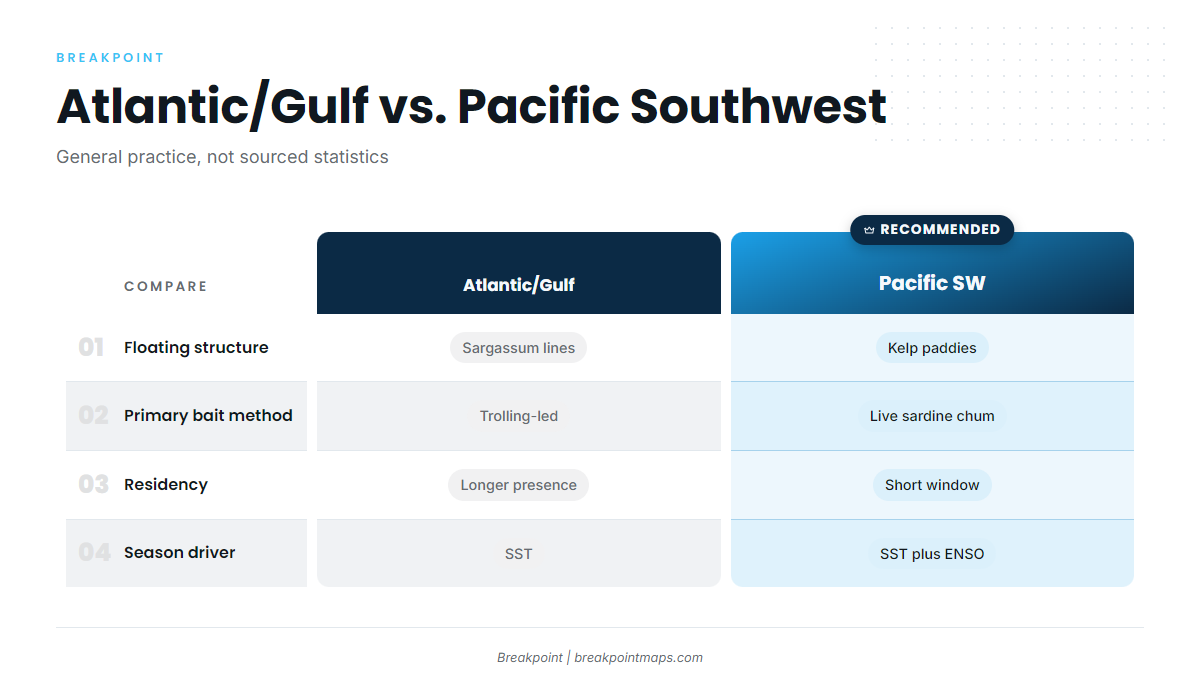
| Factor | Atlantic/Gulf (general practice) | Pacific Southwest |
|---|---|---|
| Floating structure | Sargassum weed lines | Kelp paddies (Saltwater Sportsman) |
| Primary bait method | Trolling-led | Live sardine chum and fly-lining (fishcity.app) |
| Residency | Longer seasonal presence in core range | Short window at the range edge |
| Season driver | Sea surface temperature | Sea surface temperature, with ENSO swings |
The Atlantic/Gulf column is general practice, not sourced statistics.
Habitat & Conditions in the Pacific Southwest
Temperature is the gate. Fishcity.app cites 68°F as the floor and 72°F and up as when fish stack on paddies. That is angler practice, not agency data.
NOAA says mahi-mahi feed in surface waters during the day, which is why surface temperature and floating structure matter so much here.
Temperature and Season Quick Reference
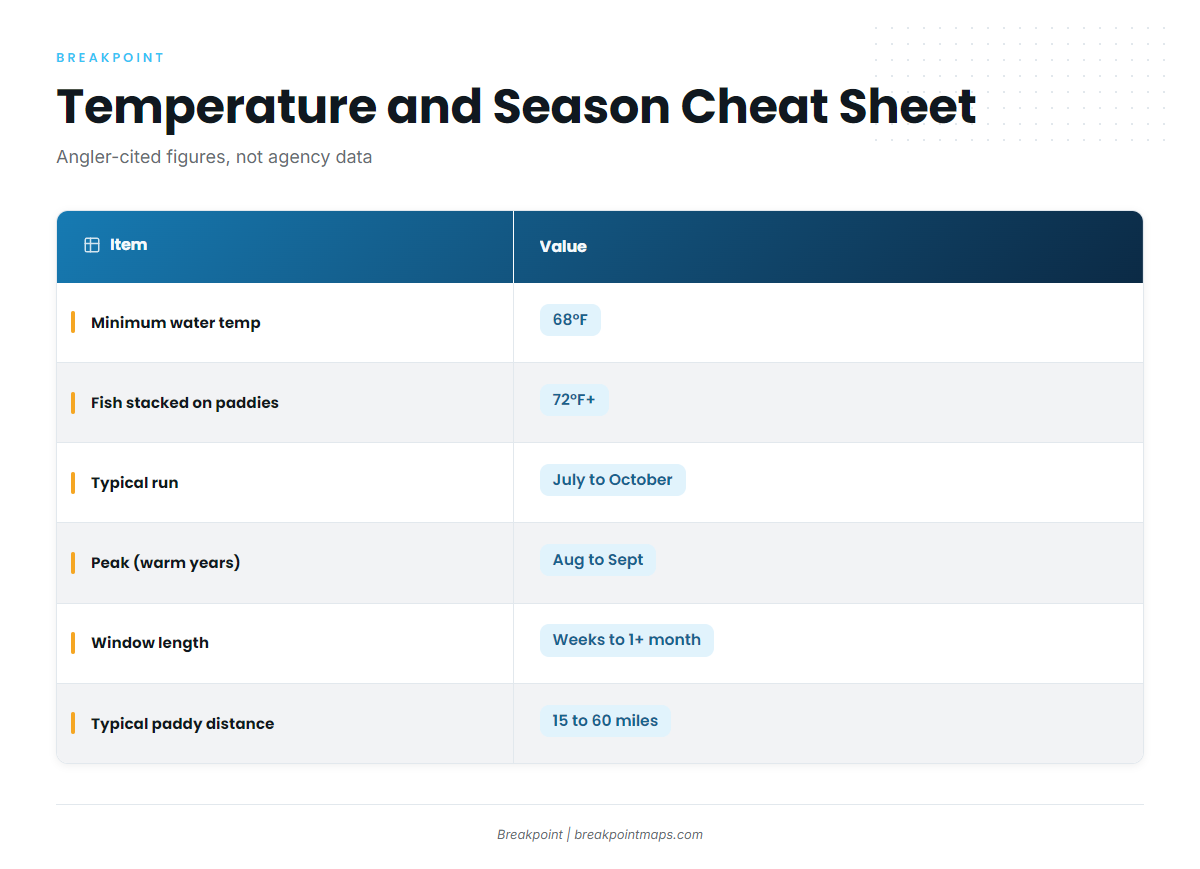
| Item | Value | Source |
|---|---|---|
| Minimum water temp cited | 68°F | fishcity.app (angler practice) |
| Fish stacked on paddies | 72°F and up | fishcity.app |
| Typical run | July to October | fishcity.app |
| Peak (warm years) | August to September | fishcity.app |
| Window length | A few weeks to 1+ month, late summer/fall | Saltwater Sportsman |
| Typical paddy distance | 15 to 60 miles out | fishcity.app |
Kelp Paddies and Paddy Hopping
The fishery centers on "floating clumps of dislodged kelp that attract bait and gamefish," per Saltwater Sportsman. Paddy hopping means running from paddy to paddy and working each one briefly before moving on.
Where Fish Are Typically Reported
Fishcity.app names these areas for warm-water years:
- 9-Mile Bank
- 43-Fathom Spot
- The 302 and the 371
- The Coronado Islands vicinity
Out of San Diego, offshore dorado fishing mostly means beyond the 9-Mile Bank. Dana Point and Newport are departure ports for the northern part of the region, and we make no catch claims for them. The Coronado Islands are in Mexican waters; see Regulations below.
Reading Breaks and Chlorophyll, and What the Data Can’t See
Look for sea surface temperature breaks where warm water edges against cooler water. Chlorophyll edges show where bait concentrates, and paddies tend to collect along these seams. This is general practice, not a guarantee.
The data has blind spots:
- Cloud cover blocks satellite passes.
- Individual paddies are too small to show on satellite imagery.
- Sea surface temperature is a surface reading only.
- Fleet reports confirm what the charts suggest.
Chart layers are not for navigation.
Tactics for the Pacific Southwest
Locally, you find fish by trolling and catch numbers with live bait on the paddy. Standard trolling spreads are covered in the species guide; here is the local adjustment.
Between paddies, local anglers commonly troll cedar plugs and green/yellow feathers at 6 to 8 knots to locate schools, per fishcity.app. A mixed spread works too: feathers or small chuggers off the riggers and a cedar plug way back.
Working a Paddy
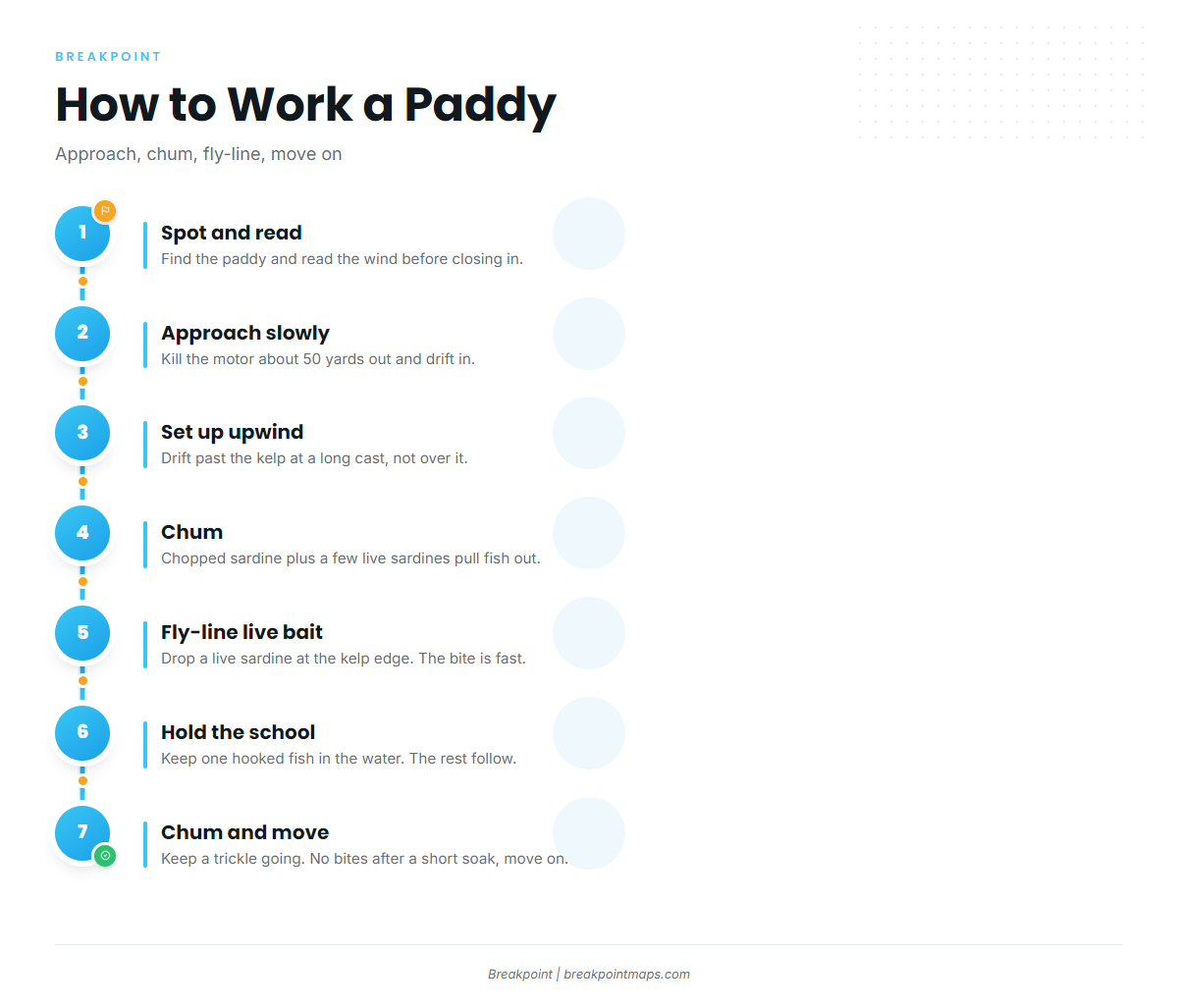
- Spot the paddy and read the wind before you close in.
- Approach slowly. Kill the motor about 50 yards out and drift in.
- Set up upwind so the drift carries you past the kelp at about a long cast away, not over it.
- Chum with chopped sardine, plus a few live sardines, to pull fish out from under the kelp.
- Fly-line a live sardine to the kelp edge. The bite is fast and visual.
- Keep one hooked fish in the water to hold the school. The rest follow it to the boat.
- Keep a trickle of chum going. If nothing shows after a short soak, move to the next paddy.
On a small private boat, someone has to manage the hooked fish while the others cast, so sort the roles before you pull up.
The Most Common Mistake
Running right on top of the paddy. Most fish patrol a wide perimeter, so a close approach puts them down.
Frequently Asked Questions
When is mahi season in Southern California?
Local anglers commonly cite July to October, with an August to September peak in warm years, per fishcity.app. Saltwater Sportsman adds that the window can last only a few weeks or a bit more than a month. ENSO conditions swing it from year to year.
What water temperature do dorado need?
Anglers cite 68°F as the floor and 72°F and up for fish stacked on paddies. That is local angler practice, not agency data. Sea surface temperature is a surface reading, so use it to narrow your search rather than to guarantee fish.
What is the California bag limit for dolphinfish?
Check the current CDFW Ocean Sport Fishing Regulations for the dolphinfish daily bag and size limits, and verify before fishing, since limits can change between seasons.
Do I need a Mexican license at the Coronado Islands?
The Coronado Islands are in Mexican waters, so Mexican rules apply there. On a party boat, ask the landing what it arranges.
Closing
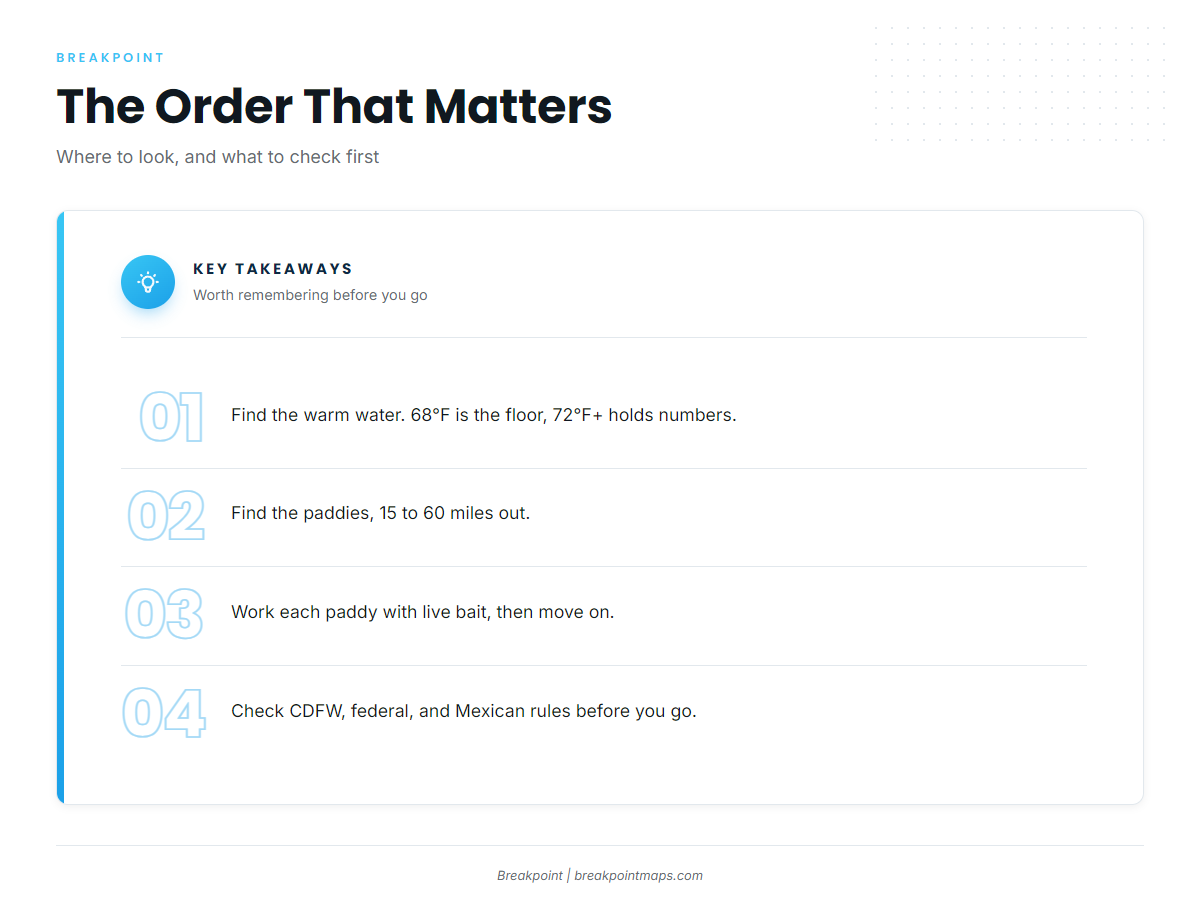
Find the warm water, find the paddies, work them with live bait, and check the rules before you go.
Breakpoint’s hotspots feature scores mahi-mahi areas in the Pacific Southwest from layers like OBS SST and Chlorophyll, as one way to narrow where to look. Chart layers are not for navigation, and cloud-blocked satellite passes leave gaps, so pair the chart with a same-week report.