Overview
This page covers cobia fishing in Georgia, South Carolina, and Florida’s Atlantic coast, where two management stocks meet and the rules change at the Florida-Georgia line. Biology, gear basics, and general background are in our cobia species guide; nothing here repeats them.
We lay out what the agencies and the water tell us, where sources agree, where they conflict, and what nobody can predict. The sections below cover when the fish show up, where they hold, how people fish them here, and which rules apply. Rules differ by state and by state versus federal water, so we summarize them in a dated table at the bottom of the page.
Regional Differences
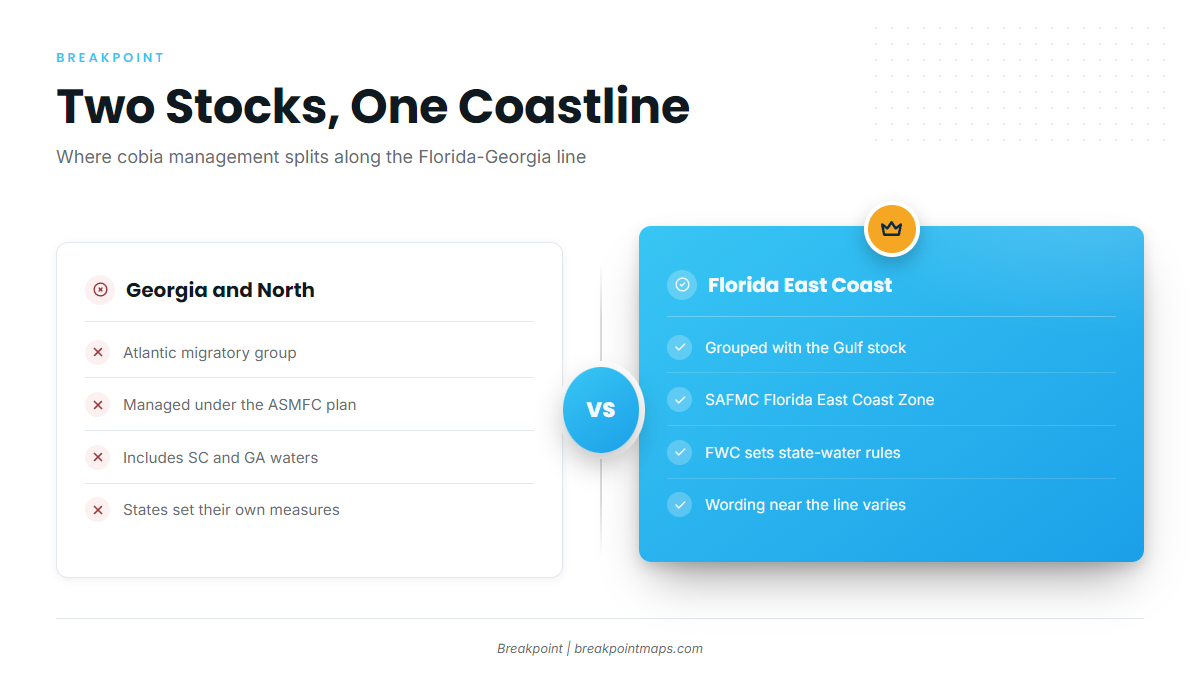
Cobia here belong to two stocks. Fish from Georgia north are the Atlantic migratory group, while fish off Florida’s east coast are managed with the Gulf migratory group. ASMFC recognizes two cobia stocks: one along the Atlantic coast from Georgia north, and one along the east coast of Florida through the Gulf. That split shapes cobia fishing in the region more than anything else.
A naming note: NOAA now writes "Gulf of America," while ASMFC and SAFMC documents use "Gulf of Mexico." We use "Gulf" in running text.
The Stock Boundary at the Florida-Georgia Line
ASMFC’s "Georgia north" phrasing does not correspond to a precise line on a chart, and sources word the boundary slightly differently. If you fish near the state line, confirm the exact boundary with ASMFC and SAFMC before you go.
Three layers of authority apply:
- Interstate: the ASMFC Interstate Fishery Management Plan, with a southern region running North Carolina through Georgia.
- Federal council: the South Atlantic Fishery Management Council (SAFMC), which sets federal rules for the Florida East Coast Zone separately from federal waters off Georgia.
- States: Florida Fish and Wildlife Conservation Commission (FWC), South Carolina Department of Natural Resources (SC DNR), and Georgia Department of Natural Resources (GA DNR).
Management moved from federal to interstate hands in 2019, when management shifted to ASMFC. That item documents the transition only and does not describe today’s rules.
Florida’s Long Season vs. the SC and GA Spring Push
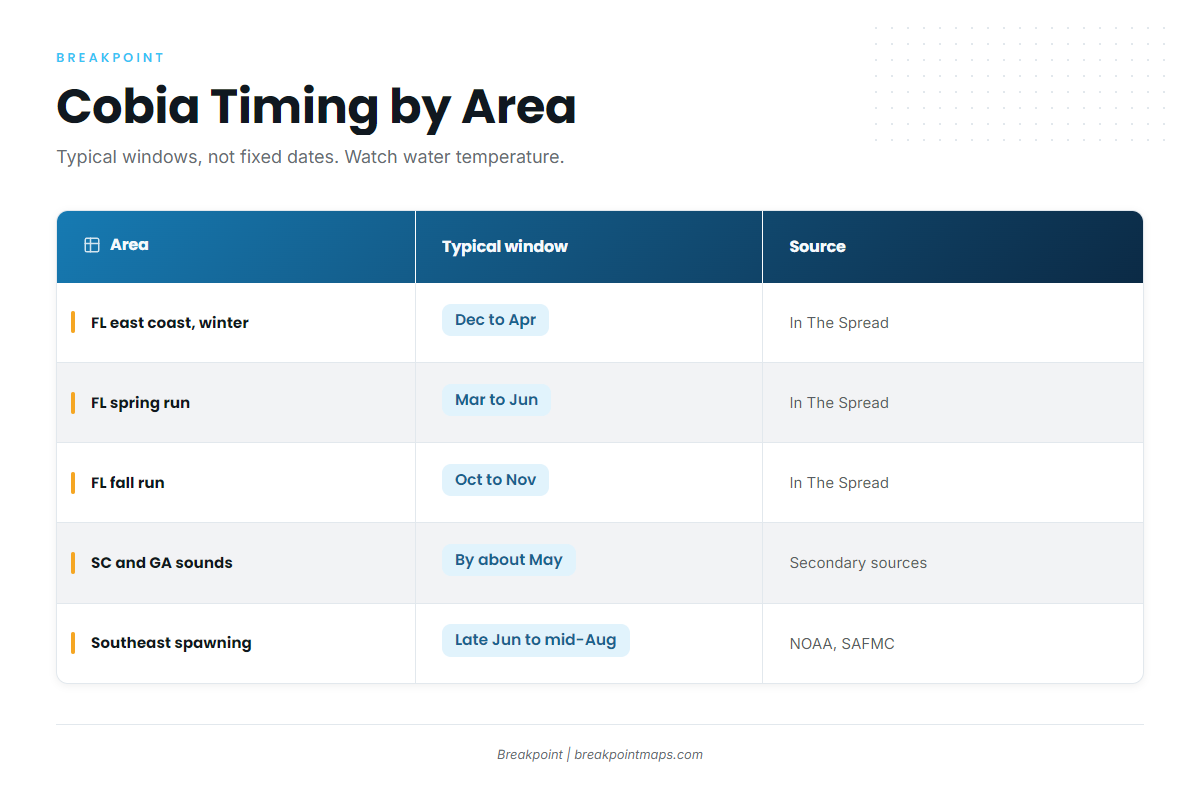
Florida has the longest window. According to In The Spread, Florida’s spring and fall runs bracket a winter pattern. From December to April, fish congregate around wrecks, reefs, and harbors. In late March they start moving up the coast, reaching Daytona Beach first and then pushing north toward Jacksonville, and the spring run lasts March through June. A fall run follows in October and November.
Farther north, secondary fishing sources describe the run filling coastal estuaries such as South Carolina’s Port Royal Sound by about May.
Sources conflict on spawning. A 2020 Coastal Review piece puts peak spawning in May for South Carolina, while NOAA Fisheries and SAFMC give a Southeast spawning window of late June to mid-August. We present both without resolving the gap.
| Area | Typical window | Source |
|---|---|---|
| Florida east coast, winter | Dec-Apr | In The Spread |
| Florida east coast, spring run (Daytona toward Jacksonville) | Mar-Jun | In The Spread |
| Florida east coast, fall run | Oct-Nov | In The Spread |
| SC and GA sounds (Port Royal Sound, Hilton Head, Beaufort) | Arrivals by about May | Secondary fishing sources |
| Southeast spawning | Late Jun-mid-Aug | NOAA Fisheries, SAFMC |
Timing follows water temperature more than the calendar, so watch temperature instead of locking in dates.
Sound Fish vs. Beach Fish
South Carolina offers inshore sound fish in Port Royal Sound and nearby Lowcountry waters, often in murkier water where the approach is baiting and waiting.
Florida leans toward beach and inlet fish. According to In The Spread, sight fishing along beaches and inlets is productive, with many fish following rays nearshore.
How This Differs from Gulf Cobia
Stock status differs. NOAA Fisheries cobia status lists the Gulf stock as not overfished but subject to overfishing, based on a 2020 assessment. ASMFC’s last assessment found Atlantic cobia not overfished and not experiencing overfishing.
Tower sight fishing originated in the Gulf. According to Sport Fishing Magazine, the boat design began in the northern Gulf, where many boats carry towers and elevated casting platforms, and it has since spread up the Atlantic coast.
Farther north, the Atlantic group continues into the Mid-Atlantic and Chesapeake in summer.
Habitat & Conditions in the Atlantic Southeast
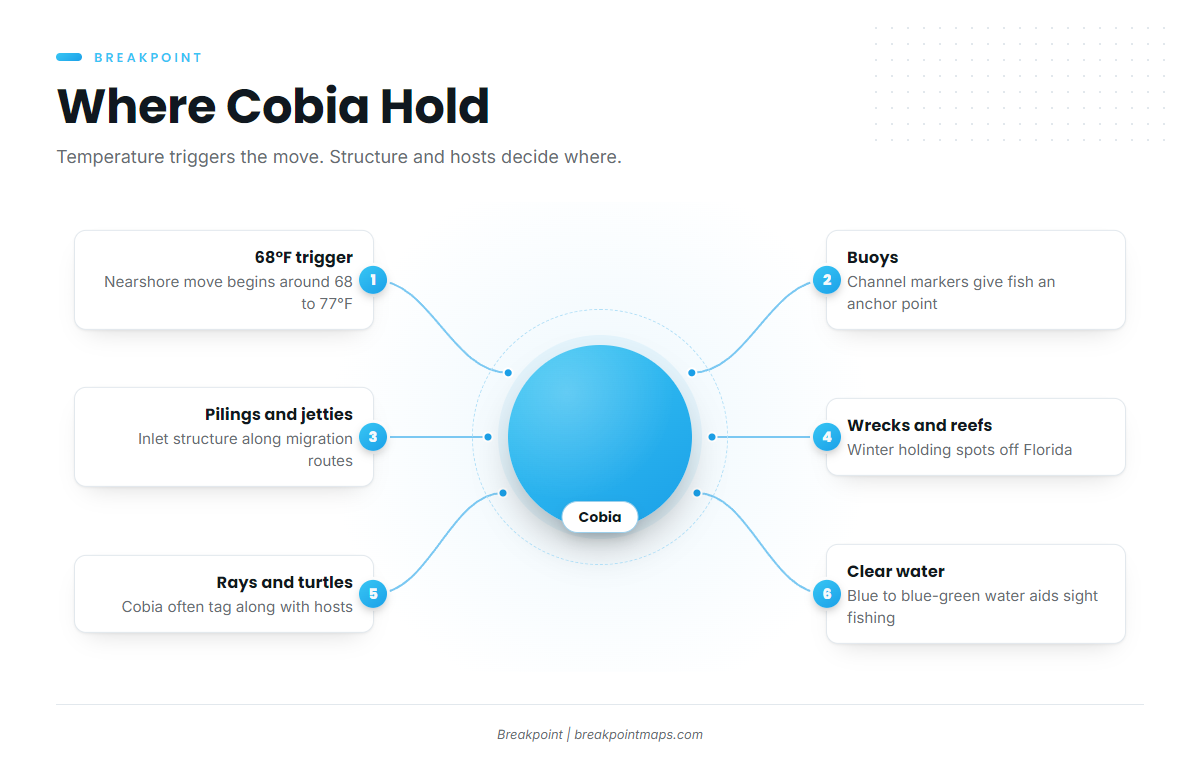
Temperature drives movement. Structure and living hosts decide where fish hold once they arrive.
Water Temperature Is the Trigger
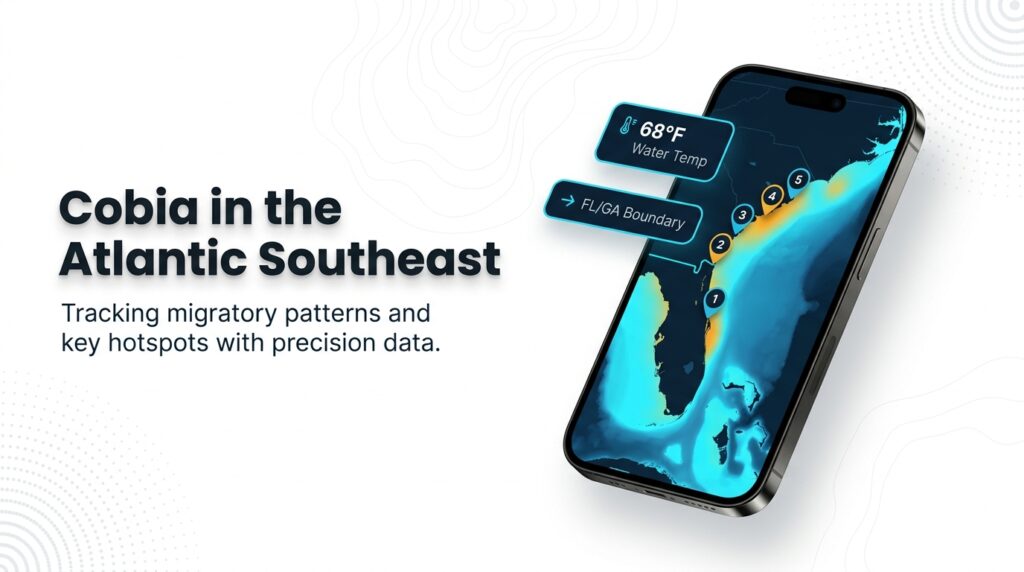
Cobia move nearshore when water reaches about 68°F. ASMFC gives the range as 68-77°F (20-25°C), so watch for the 68°F edge pushing north along the coast.
For a tighter target, a North Carolina captain named Aaron Kelly says cobia prefer water between 68 and 73.5°F. That is a Mid-Atlantic source rather than one from Georgia, South Carolina, or Florida, so treat it as a reference point.
The range is a trigger rather than a calendar. Surface temperature does not guarantee fish, a cold snap can stall a push, and satellite temperature data can miss what is happening under cloud or below the surface.
Structure: Buoys, Pilings, Wrecks, and Reefs
SAFMC’s cobia species profile says cobia inhabit inlets, bays, and mangroves and are frequently seen around buoys, pilings, and wrecks. They may be seen migrating in late spring through coastal waters and bays.
In practice, channel markers, inlet jetties, and nearshore artificial reefs and wrecks give migrating fish something to orient to, so check them first.
Living Hosts: Manta Rays, Sea Turtles, Sharks
SAFMC notes that cobia are occasionally found tagging along with sharks, rays, and turtles. In Florida, In The Spread notes many fish following rays nearshore along beaches and inlets.
Sight fishing works best in clear, blue to blue-green water with light wind and calm seas. The Gulf Stream edge and color changes can concentrate bait offshore in general.
Tactics for the Atlantic Southeast
Much of the published cobia tactics writing comes from North Carolina, the Chesapeake, and tackle retailers, and we note where a method originates. For basics, see our notes on general cobia tackle setups.
Retailer sources describe these common setups:
- Reels: spinning, in the 5000-6000 class.
- Rods: 7.5 to 8 feet, medium-heavy to heavy power.
- Braid: 65-80 lb.
- Leader: 40-50 lb fluorocarbon in clear water, stepping up to 60-80 lb in murky water or when chumming.
Sight Casting from Towers and Elevation
Elevation lets you see brown fish over brown water. Keep the sun at your back.
Pace the fish, match its speed, and run parallel to its line. Slow, steady searching produces more shots than running hard, because engine sound and vibration affect fish behavior.
One North Carolina captain keeps one rod rigged with a live eel and another with a bucktail. The angler casts when the boat is within 25 yards, then motors away from the fish after the bite to set the hook.
For bucktails, Salt Water Sportsman describes throwing 2-3 oz jigs so they land past the fish and cross its line of sight. Retailer sources favor pink, chartreuse, or bright orange.
Rays and Turtles
When you see a ray, slow down and circle wide, since cobia may be nearby even if you cannot see them. Cast ahead or off the wingtips, and do not line the host.
Retailer and magazine sources report this as common practice; it is not a tested Southeast protocol.
Buoys, Channel Markers, and Inlets
Work each marker quietly from uptide, and give fish a look before moving on. This follows from SAFMC’s note that cobia use buoys and pilings.
Shore anglers have options too. A retailer source notes that from May through July, cobia are reachable from pier ends, inlet jetties, and bridge pilings on the Southeast and Mid-Atlantic coast.
Wrecks and Nearshore Reefs
Florida’s December-April fish hold on wrecks, reefs, and harbors, per In The Spread. Jigging is common on deeper structure, and a retailer source cites 3-4 oz jigs for wrecks in 80-100 feet.
Sounds and Channels: Live Bait and Bottom Fishing
Live eels, menhaden (pogies), and blue crabs are the common baits, with live crabs often fished over hard bottom. Bottom fishing with natural bait is a primary method in Florida, per In The Spread. When chumming in murky sound water, step up your leader.
Handling and Release
Large fish carry most of the reproductive weight. SAFMC lists maturity at 36 inches for females and 24 inches for males, and NOAA Fisheries gives fecundity of 375,000 to 2 million eggs per spawning event.
Keep handling simple: minimize time out of the water, do not horse fish at the boat, and carry a dehooker for their hard, bony mouths. Check the agency pages for current release guidance.
Before You Go
- Polarized glasses.
- A water-temperature check on the morning you go.
- A regulations check against the table below.
- Sign-up for the NOAA Fisheries Southeast Text Message Alert Program, which sends fishery openings and closures.
- Both rods rigged: one live bait, one artificial.
Frequently Asked Questions
When do cobia arrive in the Atlantic Southeast?
Florida’s spring run lasts March through June, per In The Spread. South Carolina sounds see fish by about May, according to secondary sources. ASMFC gives a nearshore trigger of 68-77°F. Water temperature decides the timing more than the calendar does.
Is Florida’s east coast Atlantic or Gulf cobia?
ASMFC groups Florida’s east coast with the Gulf stock and Georgia north with the Atlantic stock. Source wording varies slightly, so verify with ASMFC and SAFMC if you fish near the state line.
What is the cobia size limit in Florida?
FWC sets a 36-inch fork length minimum and a bag limit of 1 per person or 2 per vessel, whichever is less. Rules change, so verify with FWC before you fish.
What is the federal cobia season off Georgia?
SAFMC lists a 36-inch fork length minimum in federal waters off Georgia, with closures January 1-April 30, 2026 and November 1, 2026-February 28, 2027. Georgia state waters follow GA DNR rules, so check them separately.
Closing Note
Anglers who watch temperature, read structure, and confirm the rules before leaving the dock will do best with cobia in the Atlantic Southeast. Breakpoint’s hotspots feature scores likely cobia water across the region each day. It is a guide to where to look and not a promise of fish. Chart layers are not for navigation.