Blackfin are in the Gulf year-round, but the peak differs by coast.
Gulf blackfin fishing centers on oil and gas platforms, the shelf edge, and the shrimp fleet, and when it peaks depends on which coast you run from. For identification, tackle, and general behavior, start with our blackfin tuna species guide. This page covers the Gulf.
They disagree on timing: a Dauphin Island charter reports spring and fall as most consistent, while Sport Fishing reports a July through fall peak off Texas. Nobody can predict where a school will sit on a given day, but the information below should help you choose where to look.
NOAA and other federal agencies use "Gulf of America." This page uses "Gulf of Mexico" because that is what most anglers search. If you are looking up rules on agency sites, search for Gulf of America.
This page covers:
- A sub-region timing table
- Water cues that separate a good rig from a dead one
- Tactics that fit Gulf structure
- Regulations, with the agencies to check
Regional Differences
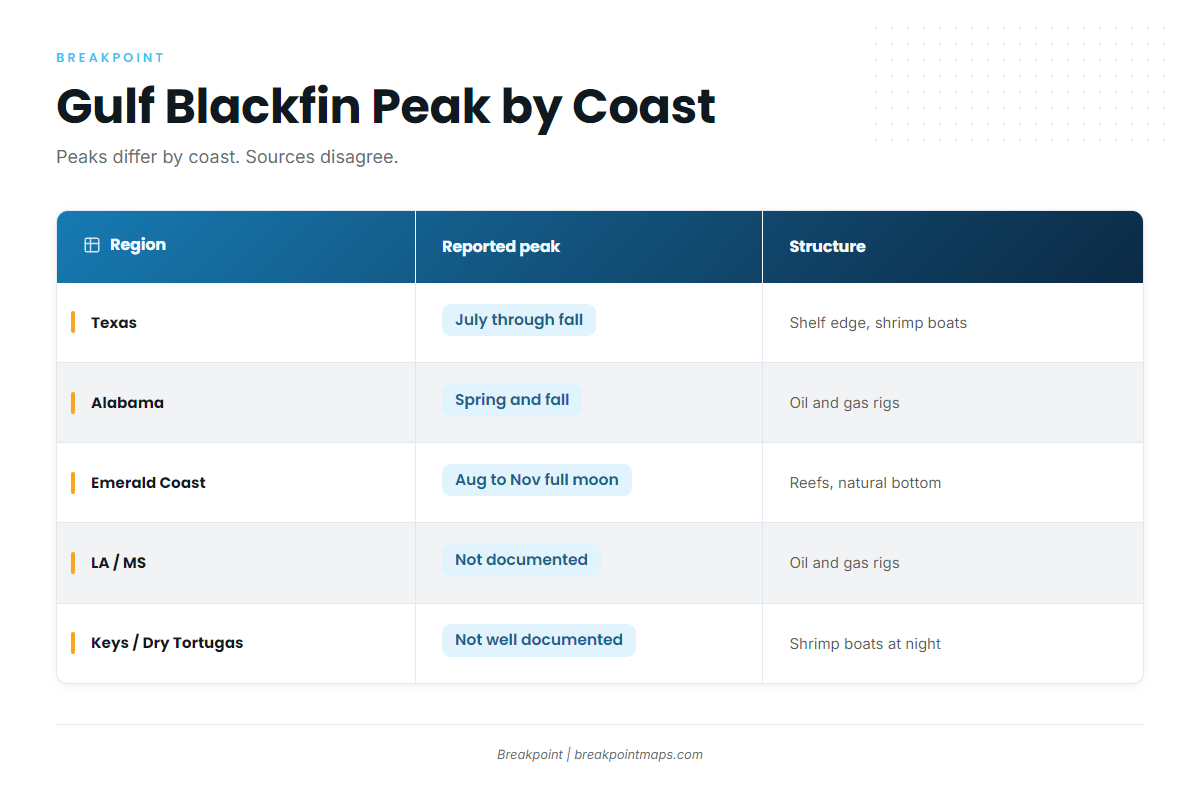
The Gulf fishery runs on man-made structure, a working shrimp fleet, and a summer spawn, and peak timing shifts by coast.
A Dauphin Island charter describes drilling rigs as "the most common targets for tuna trips" out of Alabama. That is one operator’s report, but it matches how the northern Gulf fishes.
Working shrimp boats throw bycatch overboard, and blackfin follow it. The tactics section covers how to fish that.
Florida Sportfishing reports that blackfin spawn offshore June through September in the Gulf, which helps explain the summer aggregations off Texas.
Reports differ on the peak, so each region below gives its own report.
Texas
Texas is a year-round fishery with a July through fall peak, when "footballs" aggregate to spawn. According to Texas blackfin reporting in Sport Fishing, the western Gulf sits close to Alaminos Canyon, where tunas spawn.
Capt. Chad Kinney of Port Mansfield says fish "become really thick offshore, starting around depths of 150 to 180 feet" in July. The same piece reports an average of 17 to 20 lb, with a few fish at 25 to 30 lb. Port Aransas is a major Texas port.
Louisiana, Mississippi, and Alabama Rigs
Farther east, the fishing centers on platforms. A Dauphin Island charter reports blackfin are plentiful all year, with spring and fall the most consistent. The same operator recommends overnight trips, which put more of your time on the fish and less on the run.
Louisiana Sportsman covers chunking at rigs, described in the tactics section. Venice and Orange Beach are major rig-fishing ports.
Florida Panhandle and Emerald Coast
The Panhandle figures below come from an Emerald Coast tackle shop report. It puts the average fish at about 25 lb, with some up to about 35 lb.
- Distance: Prime spots sit 20 to 35 miles out. Some fish show up 5 to 15 miles out over natural bottom or reefs.
- Peak: From the August full moon to shortly after the November full moon.
- Season length: Blackfin are caught from mid-March to Christmas.
Destin anglers should read this as one local shop’s view of the water, not a forecast.
West Florida and the Keys
A West Marine retailer guide describes night fishing with jigs or drifted bycatch behind anchored shrimp boats in the Keys and says anglers often catch dozens.
Gulf Sub-Region Seasons
| Region | Reported peak | Typical distance / depth | Primary structure | Source |
|---|---|---|---|---|
| Texas (Port Mansfield) | July through fall; year-round fishery | 150–180 ft starting in July | Shelf edge, shrimp boats in 150+ ft | Sport Fishing (Capt. Chad Kinney) |
| Alabama (Dauphin Island) | Year-round; spring and fall most consistent | Overnight trips common | Oil and gas platforms | Local charter report |
| Emerald Coast (Destin area) | August full moon to November full moon; caught mid-March to Christmas | Prime 20–35 miles; some at 5–15 miles | Natural bottom, reefs, offshore structure | Local tackle shop report |
| Louisiana / Mississippi | Not documented | Oil and gas platforms | Louisiana Sportsman (tactics only) | |
| Keys / Dry Tortugas | Not documented | Shrimp boats at night (retailer report) | Retailer guide |
Swipe the table sideways to see every column.
Habitat & Conditions in the Gulf of Mexico
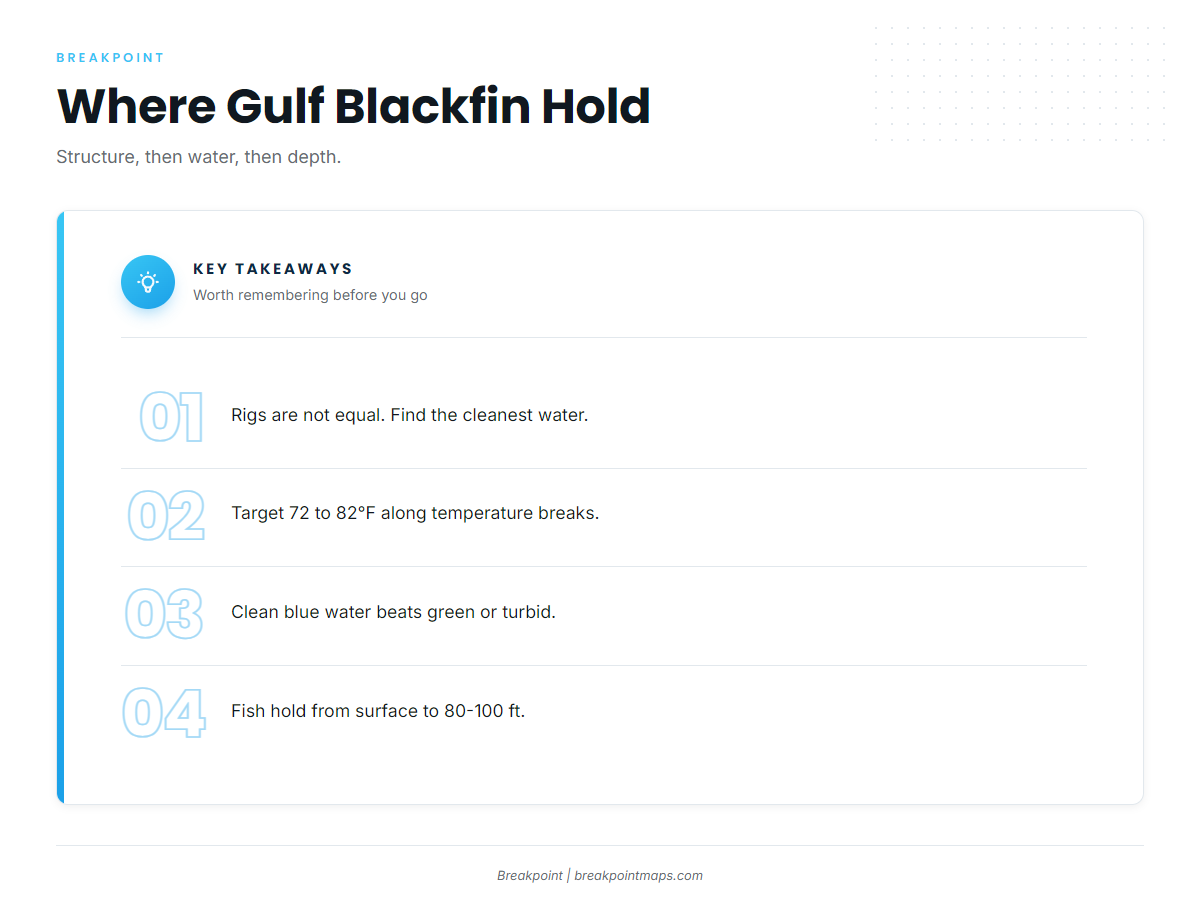
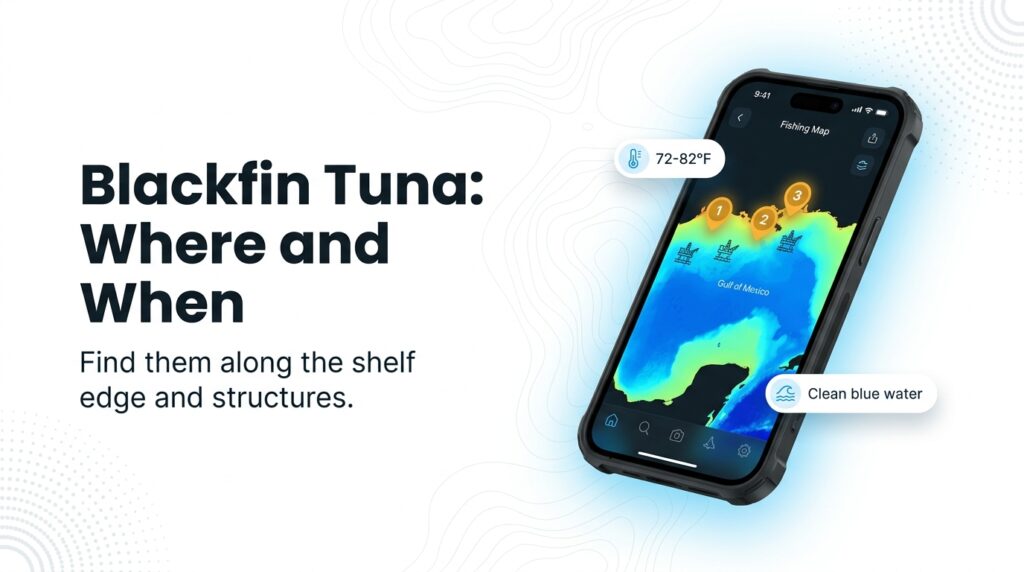
Gulf blackfin hold where structure meets clean blue water in roughly the 72 to 82°F range.
Structure First
Rigs and the shelf edge give blackfin something to hold on, but rigs are not equal. The Dauphin Island charter says it may take searching and running to find the rig with the cleanest, most productive water. Water quality at the rig matters as much as the rig itself.
Then Water
One retailer’s blackfin guide recommends targeting 72 to 82°F along temperature breaks and using satellite sea surface temperature charts to plan. Color matters too: clean blue water holds fish, while green or turbid water, especially near river outflow, usually does not.
The Loop Current adds another layer. It is a tongue of warm, clear water that pushes into the Gulf and sheds eddies, and the edges of those features are where temperature and color change sharply and bait can concentrate. Its position and eddy shedding vary from year to year and week to week, so there is no reliable seasonal position. Check it as a feature on the day rather than planning around a calendar.
What the Data Shows and Misses
Satellite and model layers are good at some things and blind to others.
They show:
- OBS SST: temperature breaks where warm and cool water meet
- Chlorophyll: color changes between blue and green water
- Altimetry: eddy edges and current features
They miss:
- Passes blocked by cloud
- Subsurface temperature and thermocline depth
- Bait that does not show on surface imagery
- Whether fish are actually on a given rig
Chart layers are not for navigation.
Then the Water Column
The same retail guide reports blackfin typically hold from the surface to 80 to 100 ft. That puts them above the amberjack zone and below where bonito cruise. Use your sonar to find the depth on the day.
Rigs Are Not Permanent
Platforms are being removed under decommissioning programs, which changes the structure available. Confirm that a rig is still standing before you plan a run around it.
Tactics for Blackfin Tuna Fishing in the Gulf of Mexico
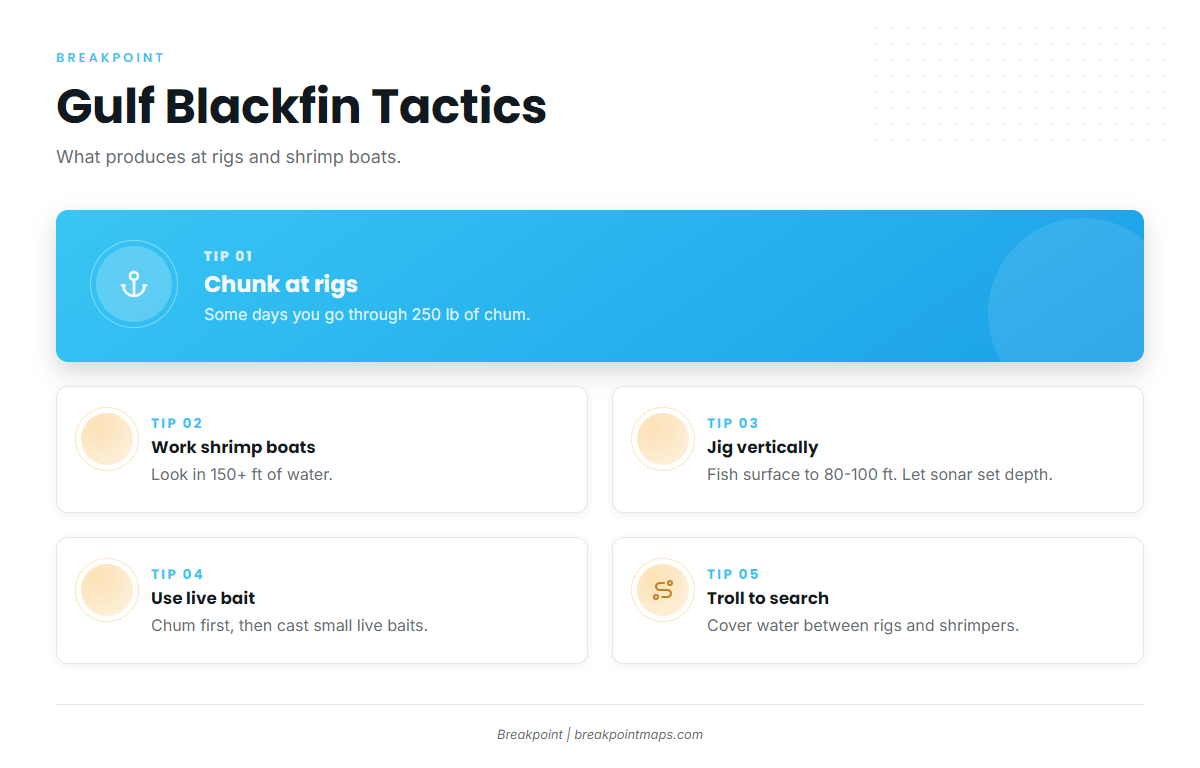
In the Gulf, chunking at rigs and working shrimp boats in 150+ ft produce most blackfin, with jigging, live bait, and trolling filling in.
General setups are covered in rigging and tackle basics in our species guide. This section covers what changes in the Gulf.
Chunking at Rigs
Chunking is the workhorse at platforms. Louisiana Sportsman says that on some days you may go through 250 pounds of chum, so plan your bait accordingly.
- Cut fresh bonito, or blackfin where legal, into chunks.
- Toss them steadily to bring fish up when they are holding deep.
- Drop a baited hook in among the chunks.
Working Shrimp Boats
Kinney, quoted in Sport Fishing, says: "If you find a shrimp boat in deep water (150 feet or more), you should find some blackfin around it." He adds that you "can pull up on a shrimper on the way, troll and catch 15 to 20 very quickly."
That source ties the bite to the Texas summer season. The Keys night approach mentioned earlier, jigs or drifted bycatch behind anchored shrimpers, follows the same logic.
Vertical Jigging
One retailer guide says jigging outproduces trolling ballyhoo on most days.
- Fish the surface to 80–100 ft band, and let sonar set the depth.
- The same guide recommends 30 to 40 lb fluorocarbon leader.
Live Bait
Chum near structure, then cast small live baits.
Trolling
Use trolling as a search tool between rigs and around shrimpers. A how-to site lists feathers, jigs, and diving plugs in silver, blue, or pink, plus cedar plugs, islanders, softheads, and ballyhoo.
Dusk and Night
A retailer guide reports a good dusk bite. Local anglers widely report night fishing around lit platforms.
Sharks
Shark losses at rigs are a common complaint.
Frequently Asked Questions
When is blackfin season in the Gulf?
Blackfin are there year-round, and peaks vary by coast. Texas peaks July through fall, per Sport Fishing. An Alabama charter reports spring and fall as most consistent. A local Emerald Coast report puts the peak from the August full moon to the November full moon. See the sub-region table above.
Do I need an HMS permit for blackfin?
No. Blackfin are not among the tunas that require an HMS Angling permit. State license rules may still apply, so check your state agency.
What is Florida’s blackfin limit?
Florida sets 2 fish per person or 10 fish per vessel, whichever is greater, per FWC. Verify on myfwc.com before you fish.
Closing
Pick your coast and month from the table, then look for structure, clean water in the 72 to 82°F range, and the depth band. Check the rules the week you go.
Breakpoint’s hotspots feature scores blackfin tuna in the Gulf of Mexico from satellite and model data. Cloud cover can block SST passes, and a score is a place to start looking, not a guarantee.