Most albacore off Washington are caught in August and September, according to WDFW’s albacore species page, because the fish are usually more abundant and the weather is normally calmer. That is the planning window for albacore tuna fishing in the Pacific Northwest, and where the fish sit within it depends on the water.
For fundamentals on the species, start with our albacore tuna species guide. This page covers what is different here, focusing on Washington and Oregon from Neah Bay down to Brookings. California rules differ, so check CDFW directly before you fish there.
The core pattern is short:
- Albacore show up offshore on an annual migratory loop around the North Pacific, according to Saltwater Sportsman.
- You find them on temperature breaks and blue-water edges.
- You troll to locate them, then stop on the school.
The run is not fixed, and neither is the distance. Saltwater Sportsman says 15 to 50 miles offshore. Evergreen Coast says 30 to 60 miles off Washington. Sport Fishing Mag reports fish as close as about 22 miles from Ilwaco in some years. Distance follows the water more than the calendar.
Below: when to plan, what water to look for, what spread to run, and what makes it legal.
Regional Differences
Pacific Northwest albacore run on a shorter, weather-limited clock, and the sources disagree on dates. Sport Fishing Mag puts first sightings in late June, with fish staying until weather ends things in late October. Boats.com says mid-June through October. Evergreen Coast says mid-July to early October. WDFW says August and September are the most popular months. Plan around August and September and stay flexible on either side.
Run timing and distance move with year-to-year water conditions. Boats.com attributes a northward shift in the route to changing ocean conditions, though that article dates to 2015, so treat it as background rather than a forecast.
Fish size runs smaller than many anglers expect. Most fish are 15 to 25 lb, with 30-pounders common some days, according to Sport Fishing Mag’s PNW report. Evergreen Coast cites 10 to 30 lb off Washington.
Geography matters too. In a typical summer, twice as many albacore are caught off Washington as off Oregon or British Columbia, according to Saltwater Sportsman. Oregon’s fishery is younger. ODFW’s tuna fishing overview notes substantial growth beginning around 2000 and points anglers to its weekly Recreation Report for current conditions.
Bluefin turn up as well. The Chinook Observer’s 2025 tuna report said more bluefin were encountered off Oregon and Washington that year. WDFW notes that bluefin, skipjack and other species are sporadically caught by anglers targeting albacore. Limits are in the Regulations section.
Season at a glance
| Timing | What typically happens | Source |
|---|---|---|
| Mid to late June | Early sightings possible when warm water pushes close | Sport Fishing Mag; All Rivers Guide Service |
| July | Season generally underway. Evergreen Coast cites a mid-July start. All Rivers cites mid-July to late September as the most consistent stretch | Evergreen Coast; All Rivers Guide Service |
| August to September | Most popular months, usually more abundant fish and calmer weather | WDFW |
| October | Fish can remain, but weather usually ends the season by late October | Sport Fishing Mag |
Timing varies by year. This is a pattern, not a schedule.
Ports
Saltwater Sportsman names these ports for tuna action:
- Westport: largest charter and private fleets in the Northwest.
- Ilwaco: Columbia River access. Fish were reported about 22 miles out in some years (Sport Fishing Mag). Home of the Deep Canyon Challenge tournament.
- Neah Bay: named as a tuna port.
- Garibaldi: home of the Oregon Tuna Classic.
- Newport, Depoe Bay, Charleston, Bandon and Port Orford: all named for tuna action along the Oregon coast.
- Brookings: southern Oregon charter port, per Brookings Fishing Charters.
Charters in brief
Charter days start early. One Washington charter lists departures of 3 to 5 AM and trips of about 12 hours, with fish bled and iced at sea. Weather cancellations are at the skipper’s discretion. Passengers bring their own fishing license. Ask the operator about cancellation and rebooking terms before you book.
Safety
Read this before you commit to a run:
- Bar: Tournament boats time Columbia River bar crossings with the flood tide and scrub the day when bar waves top 12 ft, according to Saltwater Sportsman. Check the bar forecast first.
- Fuel: Plan the round trip, plus a reserve for running to a moved break and for a rougher ride home.
- Forecast and comms: Check the offshore marine forecast. Carry a VHF or satellite phone, per Evergreen Coast. File a float plan.
Chart layers are not for navigation.
Habitat & Conditions in the Pacific Northwest
The consistent signal is the break, not an exact number. Sources give different temperature figures, but they overlap enough to tell you where to start looking. Below are three cues and what to do with each.
Temperature breaks
Albacore water is usually 60 to 66°F, sometimes down to 58°F or up to 68°F, according to a Pacific coast albacore tactics guide from The Tackle Room. The author of the Sport Fishing Mag piece says the fish seem to like 59 to 62°F, and that in El Niño years he has caught them in water as warm as 72°F. Treat those ranges as a starting frame.
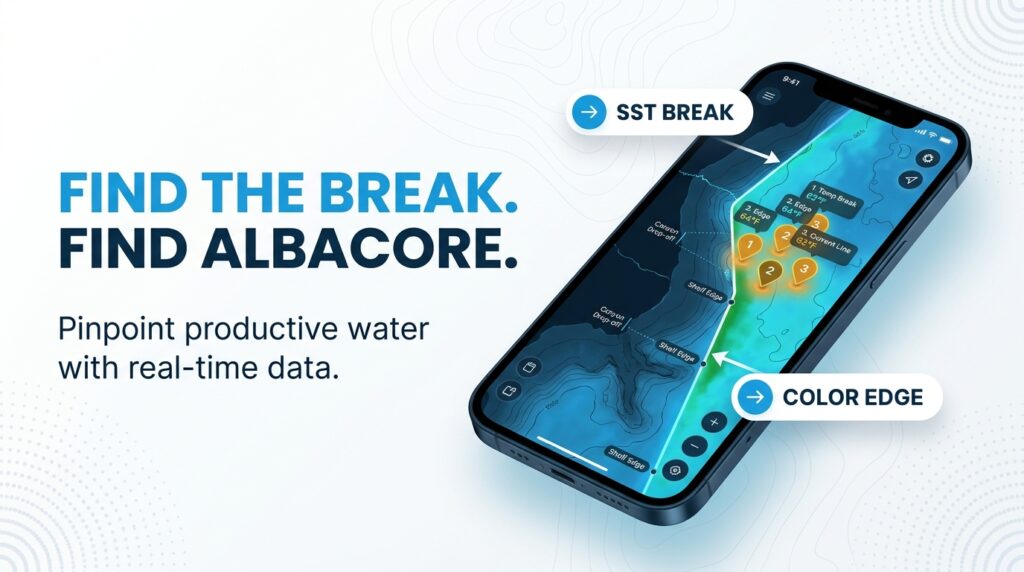
The change in temperature matters more than the number. The same Tackle Room guide points to breaks of 2 to 5 degrees. On an OBS SST view, a break shows as a tight color gradient.
If you find a 2-to-5-degree step inside the mid-60s near your port, start trolling along it. If the water is uniform, keep running.
The night before, download an SST chart and find the break closest to port, as The Tackle Room recommends.
Chlorophyll edges
Productive, plankton-rich coastal water pushes offshore and meets cleaner blue water. Bait concentrates on that edge, according to SatFish and High Class Tackle. Sport Fishing Mag describes the line where blue-gray nearshore water meets indigo blue as "Albacore Alley." Birds wheeling and diving over churning water signal feeding fish.
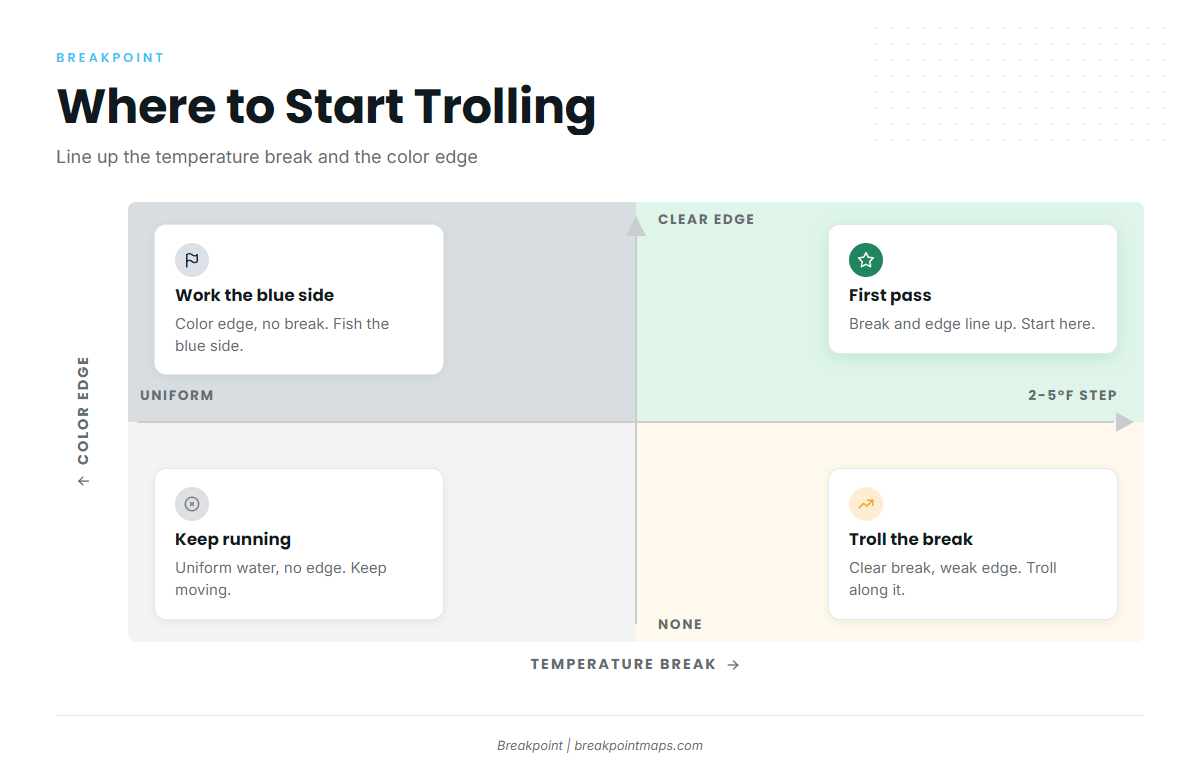
If the temperature break and the color edge line up, that is your first pass. If they are miles apart, work the blue side of the color edge.
Structure
Astoria Canyon gets the strongest endorsement in print. Saltwater Sportsman on Astoria Canyon says: "Astoria Canyon is the key to finding the bait and the fish." Sport Fishing Mag adds that breaks often form at shelf edges, submerged canyons, ridges and seamounts.
If a break crosses the shelf edge or a canyon on your Chart Contours, prioritize that intersection.
What the satellites miss
The data has limits, and it helps to know them before relying on it:
- Cloud: gaps in coverage block SST passes.
- Latency: free services such as tempbreak.com give next-day updates, according to North Bay Fishing Charters, so you are fishing yesterday’s picture.
- Movement: a North Bay charter captain reports seeing a break move 15 miles in one day on multiple occasions.
- Fleet information: captains check NOAA SST daily and talk to other boats, according to All Rivers Guide Service.
Use the chart to choose a starting point, then use the water temperature gauge to confirm it.
Tactics for the Pacific Northwest
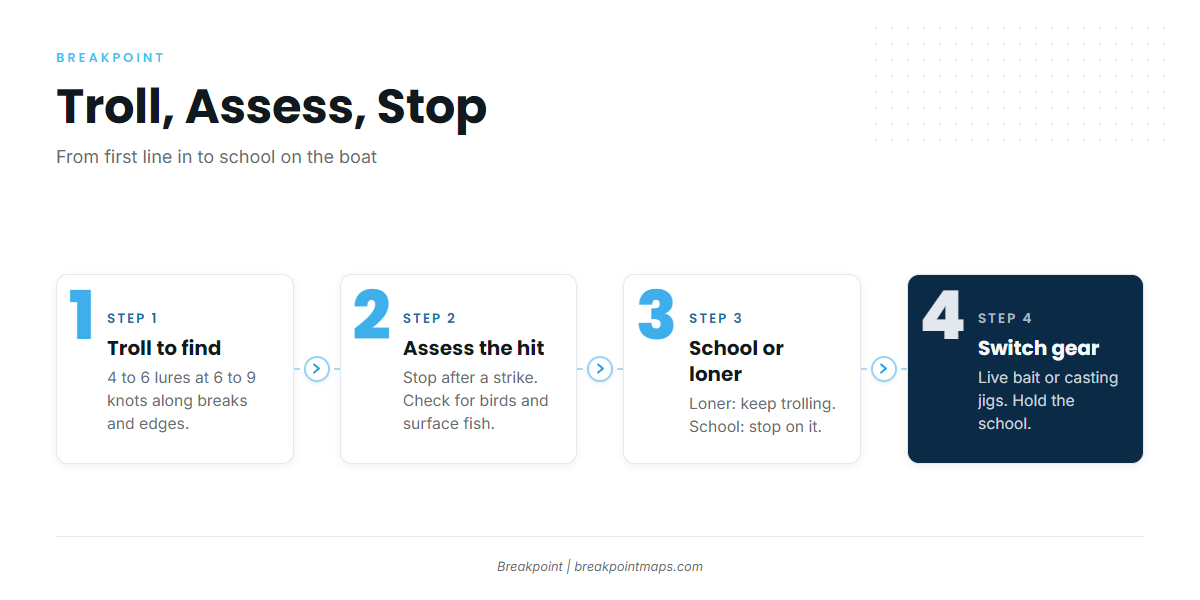
The sequence is to troll to find fish, assess the first hit, then either stop on a school or keep looking. Rod, reel and leader basics are in the species guide.
Troll speed depends on the source. The Tackle Room says roughly 6 to 9 knots, and Sport Fishing Mag says about 7 knots. An older Boats.com piece (2015) describes 2 to 3 knots while searching for boilers, but most current sources run much faster.
Trolling to find fish
A starter spread, per The Tackle Room and Sport Fishing Mag:
- 4 to 6 lures.
- 6 to 9 knots.
- Surface lines 20 to 50 ft back.
- Deep lines 80 to 100 ft back, using a heavier lure or a downrigger.
- Core lures: cedar plugs and feathers. The Tackle Room says cedar plugs have caught Pacific albacore for 80 years. Skirted lures and hard-body plugs also produce.
Troll along breaks, color changes and current edges.
The bait stop
After a hit, follow this sequence, per The Tackle Room:
- Stop and assess.
- If birds are working or fish are pushing to the surface, you have found a school. Switch to live bait or casting jigs.
- If it was a loner, keep trolling the area.
The school often follows a hooked fish to the boat, according to Sport Fishing Mag, which calls live anchovies the key. Its live-bait setup is 50 lb braid with a 30 lb top shot.
High Class Tackle describes another approach: experienced captains keep trolling after the first strike to pick up multiple fish, then throttle down and chum to hold the school.
Iron and swimbaits
Casting jigs are the alternative to bait once a school is up, per The Tackle Room. Treat it as a tool for keeping lines in the water when bait runs short.
Crowds and fleet etiquette
Fleets communicate, and captains share where fish are holding, according to All Rivers Guide Service. Give working boats room and never cross a trolling spread. These are courtesies rather than rules, and they keep a crowded bite safe.
Bring plenty of ice. Charters bleed fish at sea and pack them in salted ice, according to Sea Breeze Charters.
Frequently Asked Questions
When is albacore season in the Pacific Northwest?
August and September are the most popular months, according to WDFW. Sources report fish from late June to late October depending on the year, per Sport Fishing Mag. Plan for the peak and stay flexible on either side.
How far offshore are albacore off Washington and Oregon?
Usually 15 to 50 miles, according to Saltwater Sportsman. Some years fish come as close as about 22 miles off Ilwaco, per Sport Fishing Mag. The distance follows the water.
What water temperature do albacore like?
Usually 60 to 66°F, with 58 to 68°F possible, according to The Tackle Room. Look for a 2 to 5 degree break rather than a single number, because the fish key on the change.
Is there a bag limit on albacore in Washington?
WDFW lists no daily limit, no possession limit and no minimum size for albacore. Yellowfin, skipjack and northern bluefin carry a limit of 2 each. Verify before you fish.
Conclusion
Plan on August and September, and stay flexible on either side. Find the break and the color edge, then troll, assess, and stop on the school.
Before you leave the dock:
- Check the SST chart the night before.
- Check the bar and offshore forecasts.
- Verify the rules with WDFW, ODFW or NOAA Fisheries.
Breakpoint’s hotspots feature scores albacore in the Pacific Northwest each day from the ocean data, including sea-surface temperature, water color and seabed structure, and shows you why each pin is where it is. It points you to better water but can’t promise fish.
Chart layers are not for navigation.