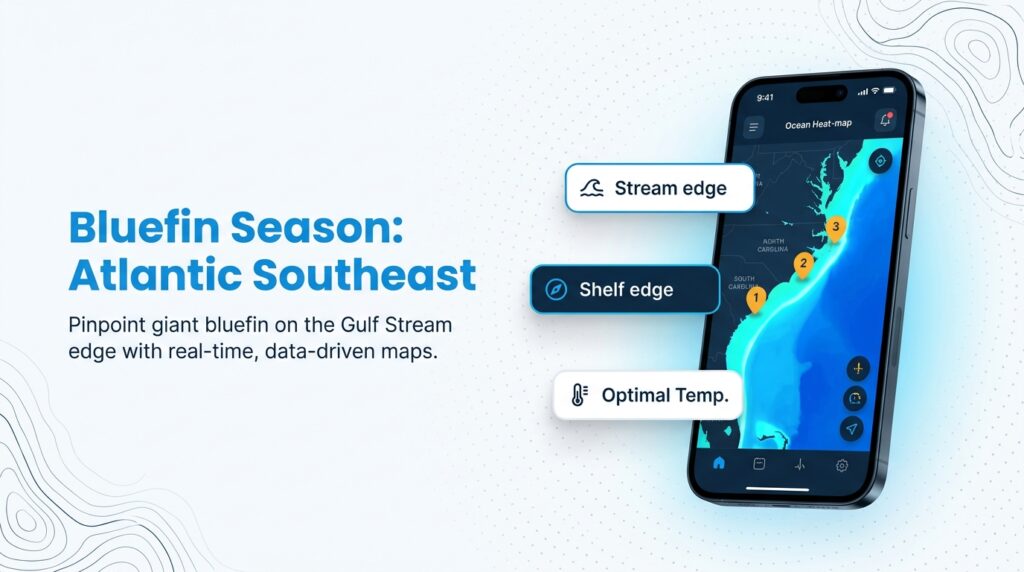
Atlantic bluefin tuna fishing in the Atlantic Southeast is a winter fishery, and most of it happens off North Carolina. Large fish move south along the Gulf Stream from roughly December through March, sometimes into April. Off Cape Hatteras the Gulf Stream swings closer to the beach than along most of the East Coast, which is a big part of why the fishery exists where it does.
For the fundamentals (biology, tackle basics, why bluefin are worth the effort), start with our Atlantic bluefin tuna fishing guide. This page covers when fish show, where they hold, what works locally, and what you can legally keep.
Arrival varies from year to year, and where the data runs out, we say so.
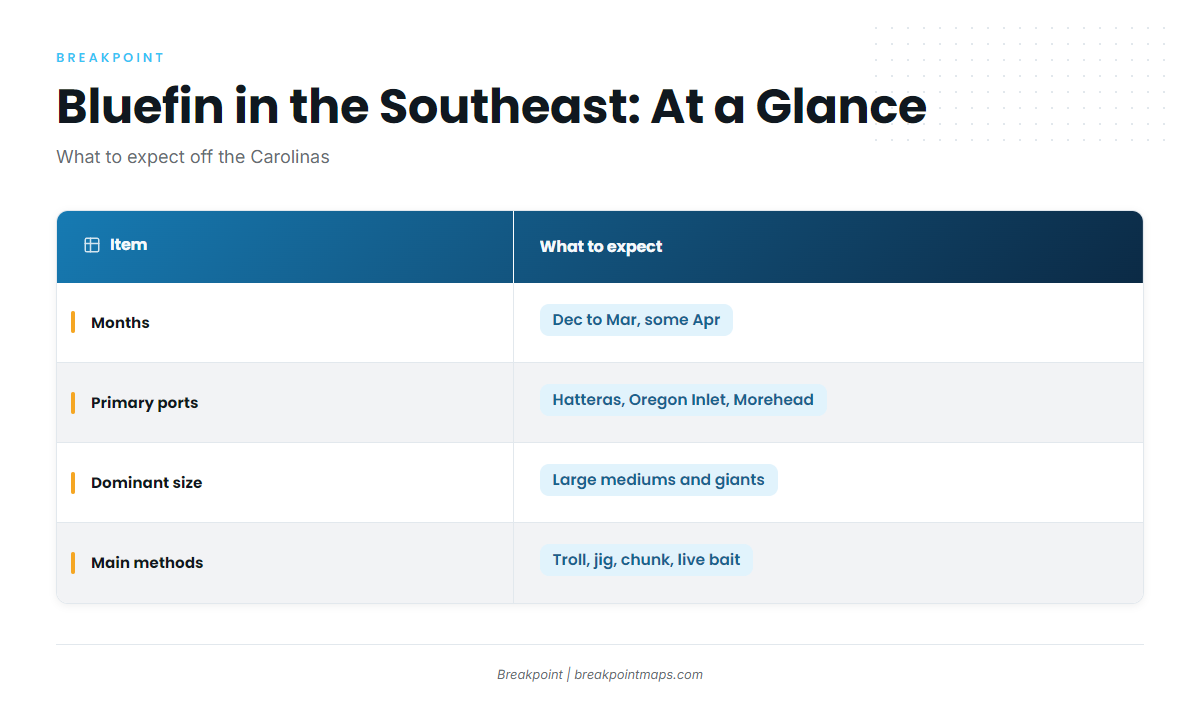
At a glance
| Item | What to expect |
|---|---|
| Months | Roughly December to March, sometimes into April. Arrival varies. |
| Primary ports | Hatteras, Oregon Inlet, Morehead City/Beaufort |
| Dominant size | Large mediums and giants (see Regulations for the 73-inch line) |
| Main methods | Heavy-tackle trolling to find fish, then jigging, chunking or slow-trolling live bait |
Regional Differences
Bluefin feed north through summer and fall. In winter they move south, and off the Carolinas they meet warm Gulf Stream water running close to the shelf. Everything else in this region follows from that pattern.
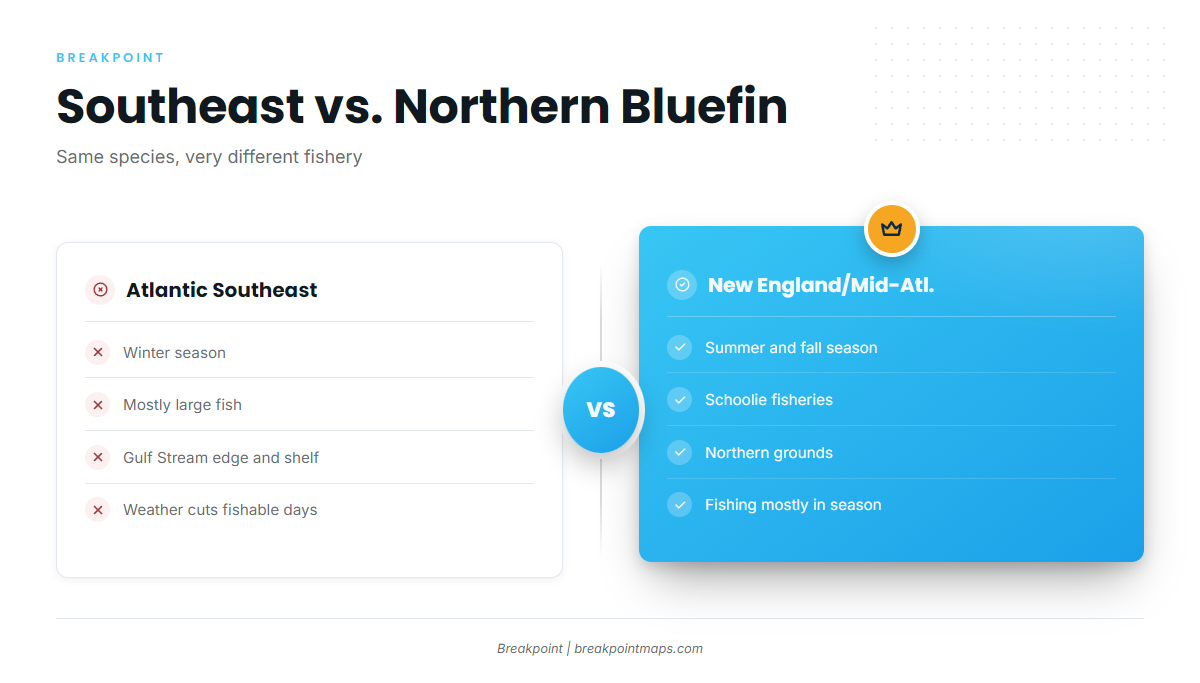
Here is how the Southeast fishery differs from the fisheries farther north:
| Atlantic Southeast | New England and Mid-Atlantic | |
|---|---|---|
| Season | Winter | Summer and fall |
| Fish size | Mostly large fish and giants | Includes the schoolie fisheries |
| Water | Gulf Stream edge and shelf | Northern grounds |
| Limiting factor | Weather, which cuts fishable days hard | Varies by ground |
Nobody can promise timing. Some seasons fish show before Christmas, and in others they hold off until February. There is no way to know in September which kind of year it will be.
Plan for release, too. Most fish here are larger than what many anglers can keep, so read the Regulations section before you book anything.
South of the Carolinas
The fishery concentrates off North Carolina. Encounters off South Carolina, Georgia and Florida’s Atlantic coast are less predictable and mostly incidental.
Some fish continue toward spawning grounds in the Gulf of America, where NOAA allows retention only of incidentally caught trophy fish while fishing for other highly migratory species. Federal rules apply anywhere you hook one. The Regulations section covers what to check before you keep a fish.
Habitat & Conditions in the Atlantic Southeast
Where fish hold here comes down to one mechanism: warm water meeting the shelf. This section covers the edge, the shoals, the bait, and the weather that decides whether you get to fish at all.
The Gulf Stream edge and the shelf
When the Gulf Stream pushes warm water over or against the shelf edge, it creates a current and temperature break. Bait and bluefin set up along it. Anglers fishing Cape Lookout report winter bluefin off North Carolina just off the current break, with prime time coming when the Stream pushes warm water over the shelf edge.
Shoals and ports
Three places anchor the fishery geographically:
- Diamond Shoals off Cape Hatteras
- Cape Lookout Shoals off Morehead City/Beaufort
- Oregon Inlet, the northern access point
Treat the shoals as orientation rather than a promise of fish. Port choice comes down to run length and geography. Hatteras and Morehead City both draw anglers from far away, and Oregon Inlet puts you at the north end of the fishery.
Bait
Bluefish are the one bait with a source behind it. Anglers slow-troll live bluefish, and some find big schools of bluefish on the bottom and jig them up to use as bait. Other baitfish likely matter too, so watch what the birds and the sounder show you.
What the data can and can’t see
A clean edge on the chart is a place to start, and it doesn’t confirm fish. Winter cloud blocks satellite sea-surface temperature passes, so the picture may be days old. Bluefin can also hold well below anything a surface signal shows. Read the chart, then check it against what you see on the water.
Weather
Weather decides this fishery more than any chart layer does. Northeast winds, cold fronts, inlet bars and cold water all cut into your days on the water.
North Carolina bluefin inlet conditions are demanding. Carolina inlets are challenging in good conditions, and cold weather adds danger. Many traveling anglers book a veteran local crew that knows the water for that reason.
If the inlet looks wrong, stay in. The fish may be there another day.
If you are traveling, build buffer days into the trip. A single good weather window is worth more than a tight itinerary.
Tactics for the Atlantic Southeast
Rig construction is covered in the species guide. What follows is what changes off the Carolinas.
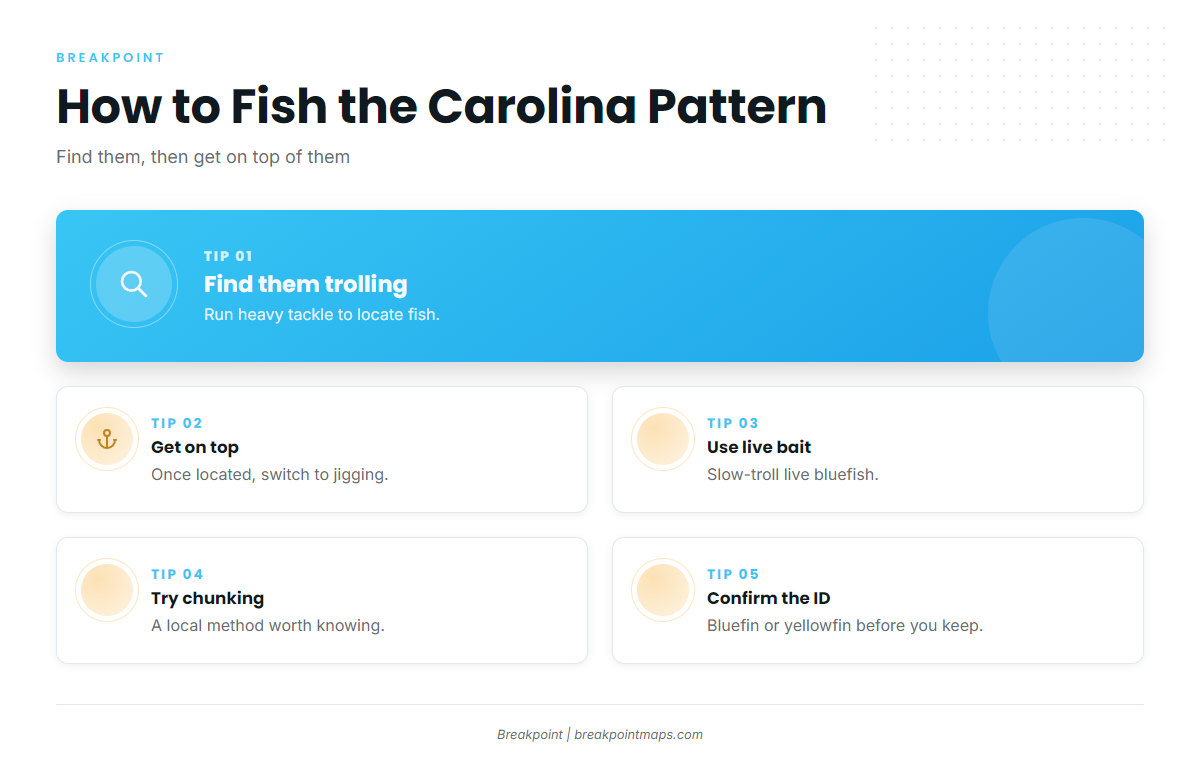
The local sequence looks like this:
- Find them trolling. Many local captains troll heavy gear as the default. Trolling covers water, and covering water is how you find fish on a moving edge.
- Get on top of them. Once you have located fish, switching to jigging is a common way to hook up.
- Use live bait. Slow-troll live bluefish, or jig up bluefish from bottom schools and put them back out.
- Chunk. Anglers chunk when fish are holding on a bait school.
If you fish yellowfin and wahoo out of the Carolinas, expect giants to demand heavier gear than most Gulf Stream yellowfin setups. Start with the species guide and talk to a local tackle shop.
Federal highly migratory species rules may require circle hooks when you fish natural bait. Confirm the current scope in the Regulations section below before you leave the dock.
Handle every fish you plan to release with care. Keep it in the water as much as possible, keep the fight short, and follow NOAA release guidance.
Confirm bluefin versus yellowfin before any retention decision. NOAA publishes identification resources for this.
Frequently Asked Questions
When is bluefin season in North Carolina?
Generally December through March, sometimes into April. Arrival varies year to year, and weather decides how many days you actually fish.
Can you keep a giant bluefin in North Carolina?
Only if the Southern Area trophy subquota is open and you hold the right HMS permit. The status changes, so check NOAA’s bag-limit page the day you fish.
Do I need a permit to fish for bluefin on a charter?
The vessel needs an HMS Charter/Headboat permit. Ask the captain to confirm it before booking.
Are there bluefin off South Carolina, Georgia or Florida?
Occasionally, and mostly incidentally. The directed fishery concentrates off North Carolina. Federal HMS rules apply throughout.
Before you run
Watch the Stream edge, respect the weather, and verify the rules on the day.
Before you leave the dock:
- Check NOAA’s bag-limit page for current limits and trophy subquota status.
- Confirm your HMS permit.
- Watch the marine forecast and the inlet.
Breakpoint’s hotspots feature scores Atlantic bluefin tuna across the Atlantic Southeast using the same inputs covered above: sea-surface temperature, the Gulf Stream edge and bathymetry. It is a starting point for where to look and does not guarantee fish. It also cannot see through cloud.
Chart layers are not for navigation.