


Swordfish spend the daylight hours in near-darkness, often 1,200 feet down or deeper, and rise toward the surface after sunset. Anglers run 20 to 100+ miles for a fish they may never see until it is boatside. This swordfish fishing guide covers what the fish is, where it lives, how to decide whether your boat is ready, baseline tactics and where to confirm the rules.
Two methods dominate. Daytime deep-drop puts baits near bottom in 1,200 to 2,000 feet, the range most crews report. Night drifting uses lights, floats and baits staggered at several depths. Both follow from one behavior, explained below.
Find your region: our Gulf of Mexico swordfish guide · swordfishing the Florida Straits and Southeast · Northeast canyon swordfishing · Southern California swordfish
Overview
The swordfish, Xiphias gladius, also called the broadbill, is a large, solitary, migratory predator found in oceans worldwide. Most of what makes it hard to catch comes from one habit: it commutes between deep water and the surface every day. That commute, called diel vertical migration, underlies everything in the Tactics section.
How to identify a swordfish
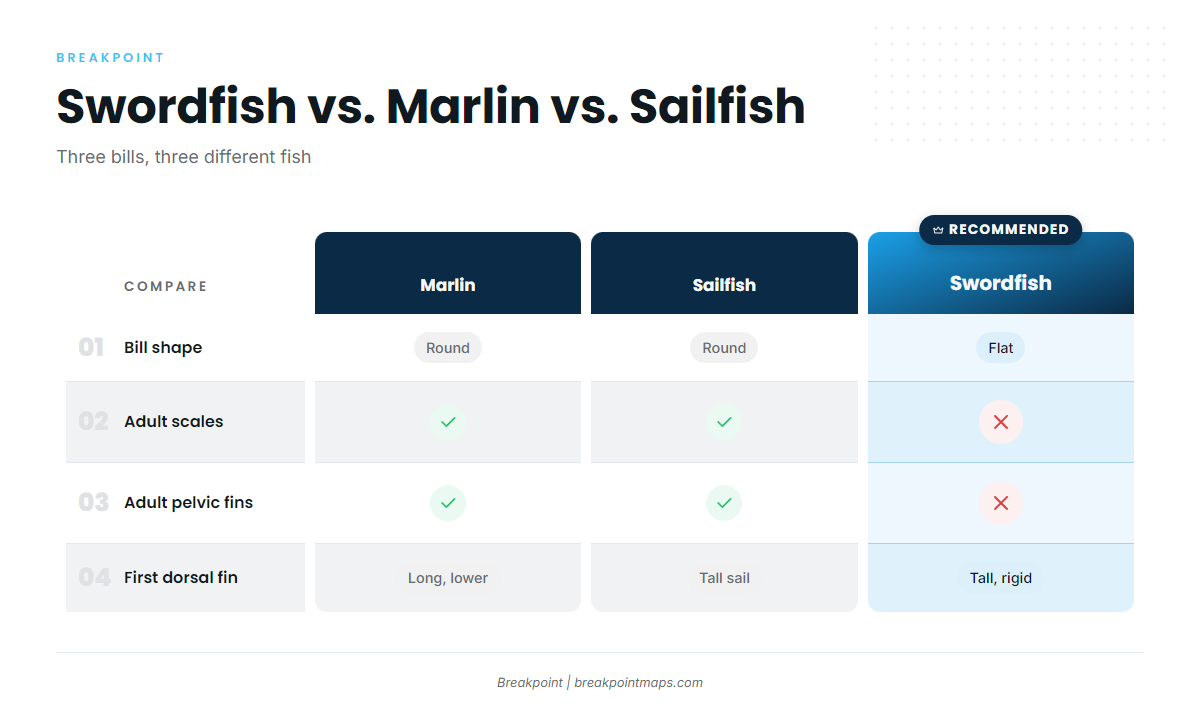
Adult swordfish have no scales, no pelvic fins and no teeth. The most obvious feature is the long, flat bill, which Britannica’s swordfish entry describes and which is the quickest way to rule out other billfish.
Bill shape is the cleanest field mark. The NSW fisheries species profile notes the sword is flat rather than rounded as it is in marlin, and relatively long and wide.
| Feature | Swordfish | Marlin | Sailfish |
|---|---|---|---|
| Bill cross-section | Flat and wide | Round | Round |
| Scales as an adult | None | Present | Present |
| Pelvic fins as an adult | None | Present | Present |
| First dorsal fin | Tall, rigid, crescent-shaped peak | Long fin running down the back | Tall sail running most of the back |
How big do swordfish get?
Swordfish reach a maximum of about 15 feet and about 1,000 lb (about 450 kg), according to Britannica. Females grow larger and live longer than males, which are rarely seen above about 200 lb (90 kg), per the NSW fisheries profile. Most fish you meet are far smaller, and record figures vary, so treat the top end as a ceiling rather than a target.
Day deep, night shallow: diel vertical migration
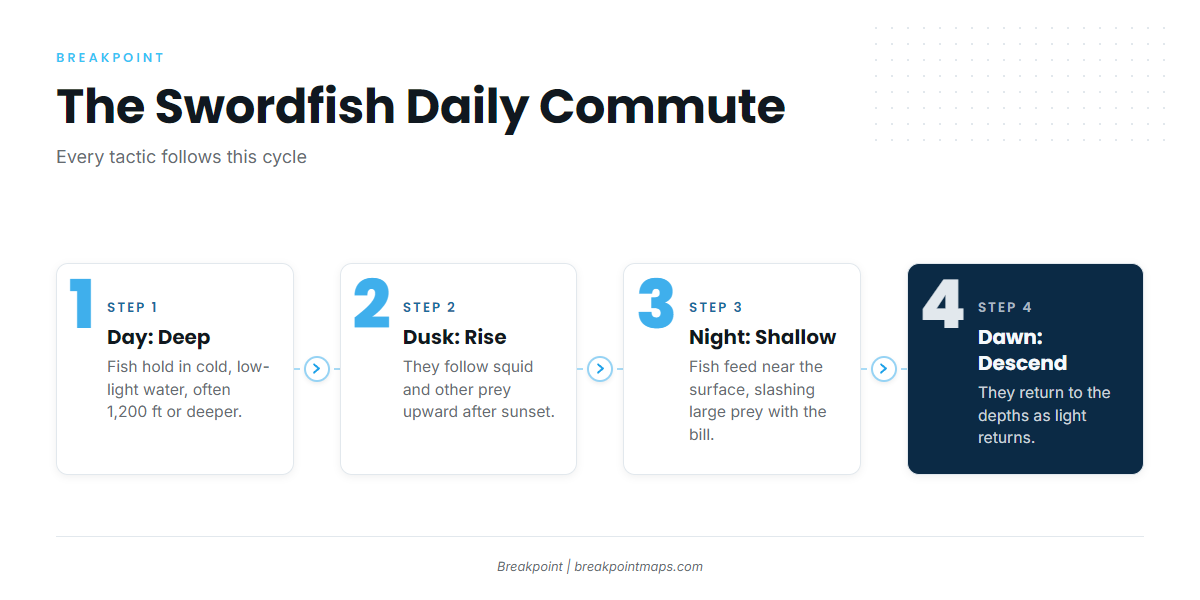
By day, swordfish hold deep in low light. At night they follow squid and other prey toward the surface. The NSW fisheries profile states that these vertical movements may be rapid and span a broad range of temperatures.
The physiology explains how. Woods Hole research on swordfish reports the fish are comfortable at depths of about 2,600 feet (800 m). A heat-producing organ warms the eyes and brain, so the fish can hunt in cold, dark water that slows its prey.
Per WHOI, swordfish slash larger prey with the bill and swallow smaller prey whole, so rigging matters: a bait that falls apart on the first strike will not last. Every tactic below responds to this daily commute.
Habitat & Range
Swordfish live worldwide, from tropical water to near-freezing water. They spawn in the upper ocean, in water above 73°F (23°C), according to WHOI. Outside spawning, they are mostly solitary.
Terms used in this section:
- Thermocline: the temperature boundary the fish cross on their daily commute.
- Deep scattering layer: the band of squid and small fish that rises and falls with light.
- SST break: a line where surface temperature changes sharply, often where forage gathers.
Where they sit in the water column
The deep scattering layer is the food the fish follow. Sounders sometimes paint it, which is one reason a capable sounder matters offshore.
Daytime depth is not the same everywhere. A 2023 Scientific Reports tagging study found shallower, more variable daytime behavior in some regions, with a mean daytime depth of 234 m, and documented occasional daytime "basking" near the surface. Treat 1,200 to 2,000 feet as a common working range rather than a rule.
Structure and fronts
Most anglers report that canyons, ledges, seamounts and steep bottom concentrate prey, and that swordfish follow. Temperature fronts and upwelling gather forage at the surface in a similar way. Neither guarantees a bite, but both narrow the search.
Regional differences at a glance
| Region | Typical structure | Season (hedged) | Method emphasis | Deeper guide |
|---|---|---|---|---|
| Gulf of Mexico | DeSoto Canyon, Mississippi Canyon | Varies by crew | Long runs, deep-drop and night | Gulf of Mexico swordfish guide |
| Atlantic Southeast | Florida Straits, Gulf Stream edge | Most crews report year-round effort | Daytime deep-drop | Florida Straits and Southeast |
| Atlantic Northeast | Hudson, Baltimore and Norfolk canyons | Most crews report summer to fall | Night drifting, growing daytime deep-drop | Northeast canyon swordfishing |
| Pacific Southwest | Southern California Bight | Varies by crew | Newer daytime deep-drop fishery | Southern California swordfish |
Swipe the table sideways to see every column.
Gulf of Mexico
DeSoto Canyon and the Mississippi Canyon anchor Gulf swordfishing. Runs are long, and anglers report operations beyond 100 miles are common, so fuel and weather windows dominate planning. Start with our Gulf of Mexico swordfish guide.
Atlantic Southeast
The Florida Straits and the Gulf Stream edge are widely credited as the birthplace of recreational daytime deep-dropping. Runs from Miami and the Keys are shorter than in most regions, and Keys crews commonly report fishing 25 to 50 miles out. See swordfishing the Florida Straits and Southeast.
Atlantic Northeast
Hudson, Baltimore and Norfolk canyons anchor a summer-to-fall fishery. Night drifting is traditional here, and daytime deep-dropping is growing. Details are in Northeast canyon swordfishing.
Pacific Southwest
The Southern California Bight has a harpoon heritage, and the daytime basking documented in the tagging study helps explain it. Daytime deep-drop is a newer fishery here. Pacific swordfish sit under a separate rules framework, with international management through two regional fishery management organizations, as described in NOAA’s North Pacific swordfish profile. See Southern California swordfish.
Tactics
Because the fish sit deep by day and rise at night, there are two ways in. This section covers daytime deep-drop, night drifting and how to decide whether your boat is ready.
Is swordfishing realistic for your boat?
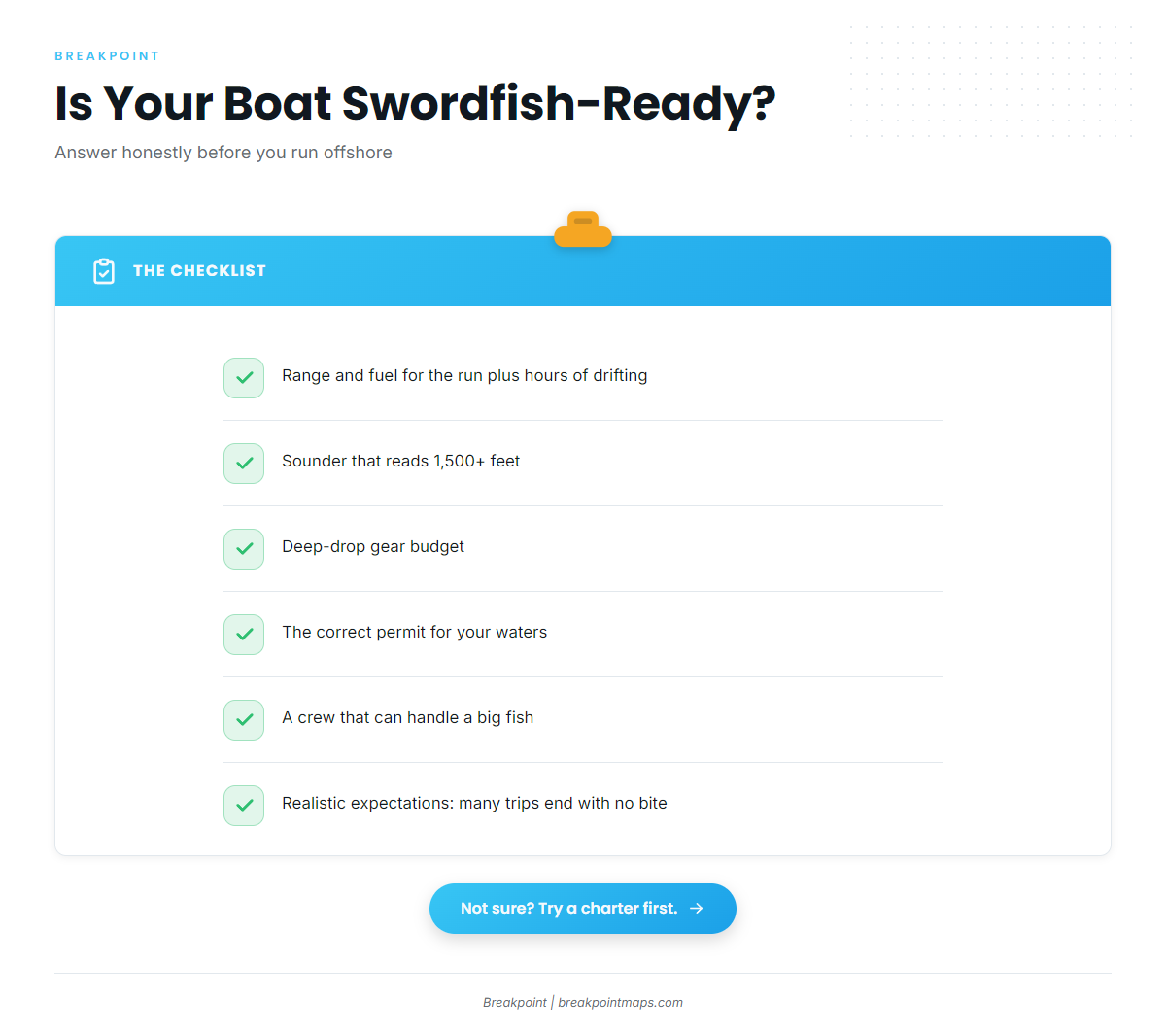
Work through these questions before you buy gear:
- Range and fuel: Can you cover the run out, hours of drifting and the run home with a reserve?
- Sounder: Crews commonly recommend a 1 kW-class transducer to read bottom and the deep scattering layer past 1,500 feet. Setups vary.
- Deep-drop gear budget: Electric reel, braid, leads, lights and leader add up.
- Permit: Confirm the right permit before you keep a fish (see Regulations).
- Crew: Can your crew handle a large, powerful fish and a dangerous bill?
- Expectations: Many trips end with no bite.
If you are unsure, book a charter first to see the method up close.
Daytime deep-drop, step by step
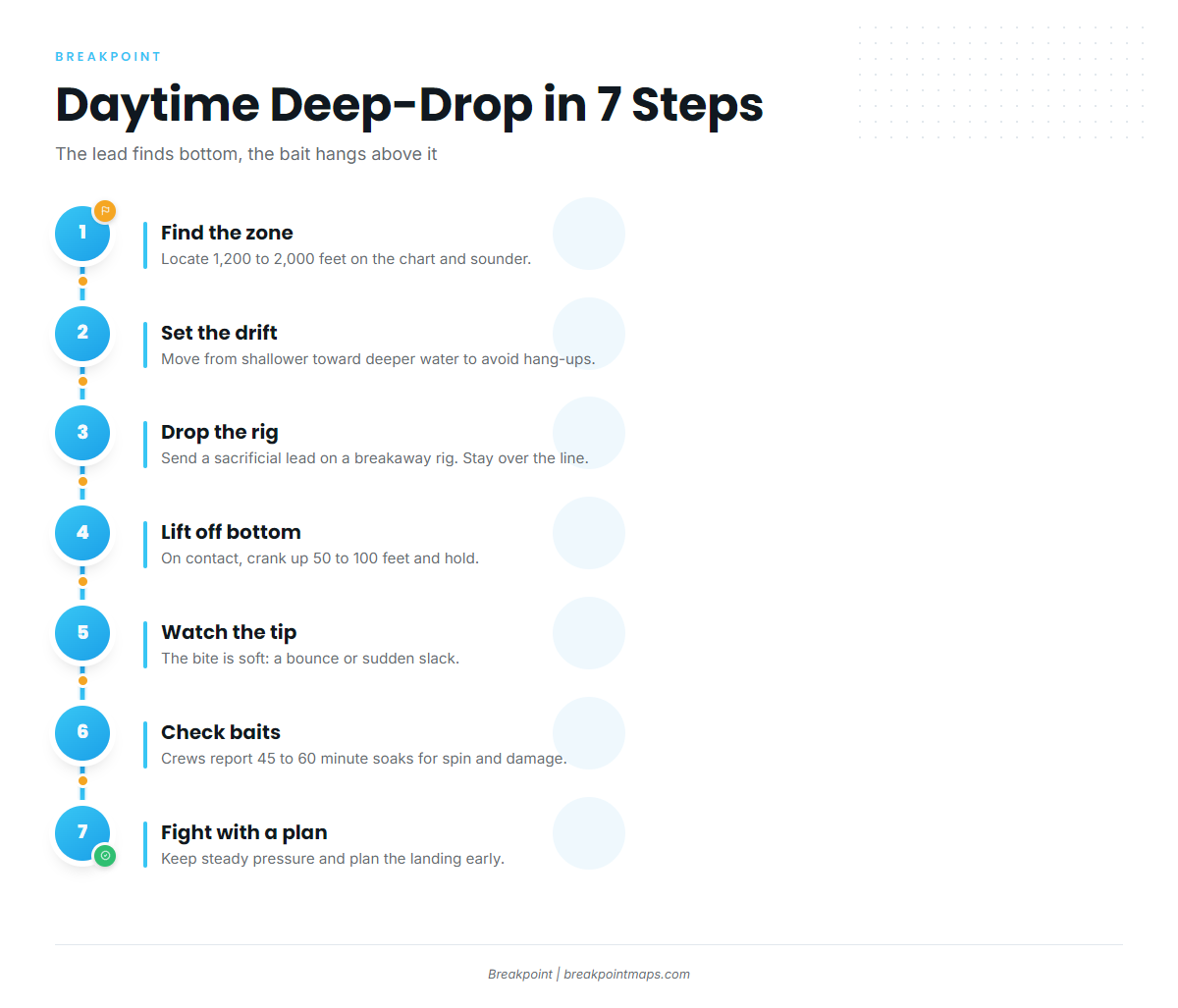
The lead finds bottom, and the bait hangs above it. Most crews describe the same sequence:
- Find the depth zone on the chart and sounder. The commonly reported range is 1,200 to 2,000 feet.
- Set the drift so the boat moves from shallower toward deeper water, not the reverse. Drifting up from deep water can hang gear on bottom.
- Drop a sacrificial lead on a breakaway rig and keep the boat in gear so you stay over the line.
- Crank up 50 to 100 feet after bottom contact and hold, so the bait hangs just above the bottom.
- Watch the rod tip. The bite is soft with that much line out. Look for a bounce or sudden slack.
- Check baits on a regular interval. Crews report leaving a bait down 45 to 60 minutes before checking for spin or damage.
- Plan the fight and landing before the fish is visible. Keep steady pressure.
The method works because the bait sits in the fish’s deep daytime zone, in the low light where it hunts, close to where prey holds.
Night drifting
Night drifting is the traditional method. Lights go under or beside the boat, floats carry light sticks, and baits are staggered at several depths as the fish rise to feed. The boat becomes a small patch of light in dark water, and prey gathers around it.
How well it compares with daytime fishing shifts by region, so check the regional guides above before you commit.
Bait, rigging and gear
Setups vary. Common ranges are:
- Reel: Electric reel or heavy conventional reel.
- Main line: Braid.
- Leader: Mono, roughly 150 to 300 lb. Lengths vary widely by crew.
- Lead: Breakaway weight that scales with current. Crews report up to about 20 lb in strong current.
- Light: An LED deep-drop light above the leader.
- Hooks: J hooks, circle hooks or a combination.
For baits, squid, bonito belly and other durable strip baits are common, along with whole fish such as mackerel or eel. Stitch them tight. Swordfish slash at prey first, as WHOI describes, and loose baits fall apart.
Reading the water: SST, chlorophyll and bathymetry
Three data layers narrow the search:
- SST breaks and eddies mark boundaries where forage can gather.
- Chlorophyll edges show productive water and clean-water boundaries.
- Bathymetry puts that surface picture over the right depth and structure.
Each has limits. Cloud cover blocks satellite passes, and surface data does not show what is happening at 1,500 feet. Use these layers to choose where to start, not to promise a bite.
Regional adjustments
Most crews report these differences:
- Gulf Stream: Strong current calls for heavier leads and active boat control.
- Canyons: Drift behavior and wall structure change how you set up. See Northeast canyon swordfishing.
- Pacific: Drift and sea state differ from the Atlantic. See Southern California swordfish.
Handling, release and safety
The bill is dangerous on deck. Keep crew clear of the head, decide early whether you will keep or release the fish, and control it at the boat. For catch and release, keep time out of the water short.
Offshore safety matters as much as technique:
- Heavy leads can swing overhead in a sea.
- Long offshore range raises the stakes on weather windows.
- File a float plan.
- Watch fatigue on long runs.
What We Still Don’t Know
Bite windows vary, and no one reliably predicts them. You can do everything right and still get a quiet drift. How well day and night methods work also shifts by region and season.
Deep-water behavior is still being learned through tagging. Daytime basking is documented in the 2023 tagging study but not fully explained.
Frequently Asked Questions
How deep do you fish for swordfish during the day?
Anglers commonly report 1,200 to 2,000 feet, with the bait held 50 to 100 feet off bottom. WHOI notes swordfish are comfortable at about 2,600 feet, and the 2023 tagging study found daytime depth varies by region, so use these as working ranges.
Do I need a permit to keep a swordfish?
In Atlantic and Gulf federal waters, you need an HMS Angling or Charter/Headboat permit from NOAA Fisheries, and state rules may add to that. Verify current requirements with the agency before you fish.
What is the minimum size for swordfish?
The federal minimum is 47 inches lower jaw fork length or 25 inches cleithrum to keel, and Florida uses the same figures. For California waters, check CDFW’s current ocean sport fishing regulations.
How do you tell a swordfish from a marlin?
Look at the bill first. A swordfish bill is flat and wide, and a marlin bill is round. Adult swordfish have no scales or pelvic fins, and the first dorsal is a tall, rigid peak rather than a long fin running down the back.
Day or night swordfishing?
Both work. Daytime deep-drop targets the fish’s deep daytime zone, and night drifting meets them as they rise. Which method dominates depends on region and season, so this swordfish fishing guide points to the regional pages for local detail.
How big do swordfish get?
Britannica gives a maximum of about 15 feet and about 1,000 lb. Females grow larger than males, and males are rarely seen above about 200 lb. Most fish you hook will be well under the maximum.
Are swordfish good to eat?
Swordfish is widely eaten. It carries a mercury advisory, so follow the fish consumption advice from the FDA and EPA, especially if you are pregnant or feeding young children.
Closing: Where to Start the Drift
The fish’s daily commute drives both methods, and structure and fronts narrow the search. The rules come from NOAA HMS and your state, so confirm them before you leave the dock.
Breakpoint’s hotspots and Fish Intel, including the OBS SST, Chlorophyll and Chart Contours layers, help narrow where to start a drift. Clouds block satellite passes, and Breakpoint can’t promise fish, only a better decision about where to look. Chart layers are not for navigation.
Keep this swordfish fishing guide handy, then follow the link for your water: Gulf of Mexico, Southeast, Northeast or Southern California.