


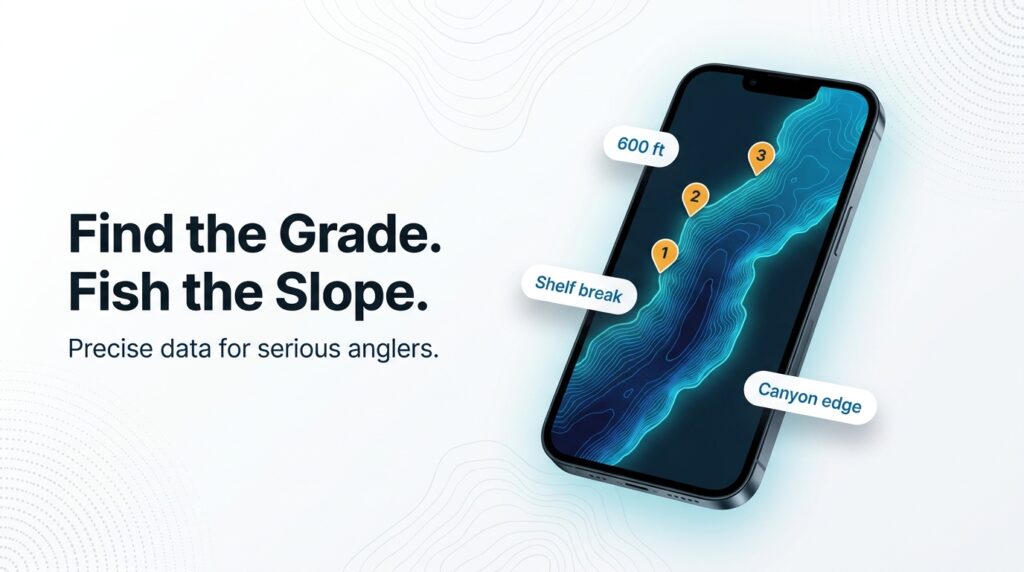
Sablefish, sold and fished as blackcod or black cod, is one of the best-eating fish on the Pacific coast. It lives deep on the slope past the shelf break, but electric reels and braided line now put it within reach of a well-equipped private boat. It is also a managed groundfish, and the rules vary by state.
Sablefish fishing has long belonged to commercial longliners and potters. Island Fisherman notes that sablefish are often overlooked by recreational anglers on the West Coast, mainly because they live in deep water along the continental shelf. Electric reels have changed that. This guide is the reference our regional pages point back to, pulling agency science, council management, and seafloor data into one place.
Expect long drops, bait-robbing hagfish and sharks, days lost to weather, and no guaranteed marks on the sounder.
This page covers four things in order:
- How to identify the fish.
- Where it lives.
- How anglers rig and fish for it.
- How to check current rules before you go.
If you already deep-drop for blackcod elsewhere, each section includes a "How it differs here" note.
Overview
Sablefish (Anoplopoma fimbria) is a deep-water Pacific groundfish, sold and fished as blackcod, black cod, or butterfish. NOAA Fisheries says it looks much like cod and is often called black cod, but it is not actually a true cod. It belongs to its own family.
Quick Facts
| Row | Detail |
|---|---|
| Names | sablefish, blackcod, black cod, butterfish |
| Scientific name | Anoplopoma fimbria |
| Adult depth band | Roughly 600 ft and deeper, on the continental slope |
| Range | North Pacific, from Baja California to Alaska |
| Lifespan | Among the longest-lived fish on the coast (NOAA Fisheries) |
| Diet | Opportunistic, fish and invertebrates (ADF&G) |
| Spawning | Winter to spring, timing depends on location (ADF&G) |
How to Identify Sablefish
Identification is straightforward on deck:
- Color: slate-gray to black on the back, fading lighter below.
- Body: long and tapered.
- Fins: 2 dorsal fins, well separated.
- Flesh: soft, oily, and white.
The fish often comes up limp from depth. That is normal and not a sign of a problem.
Sablefish vs Lingcod vs Rockfish
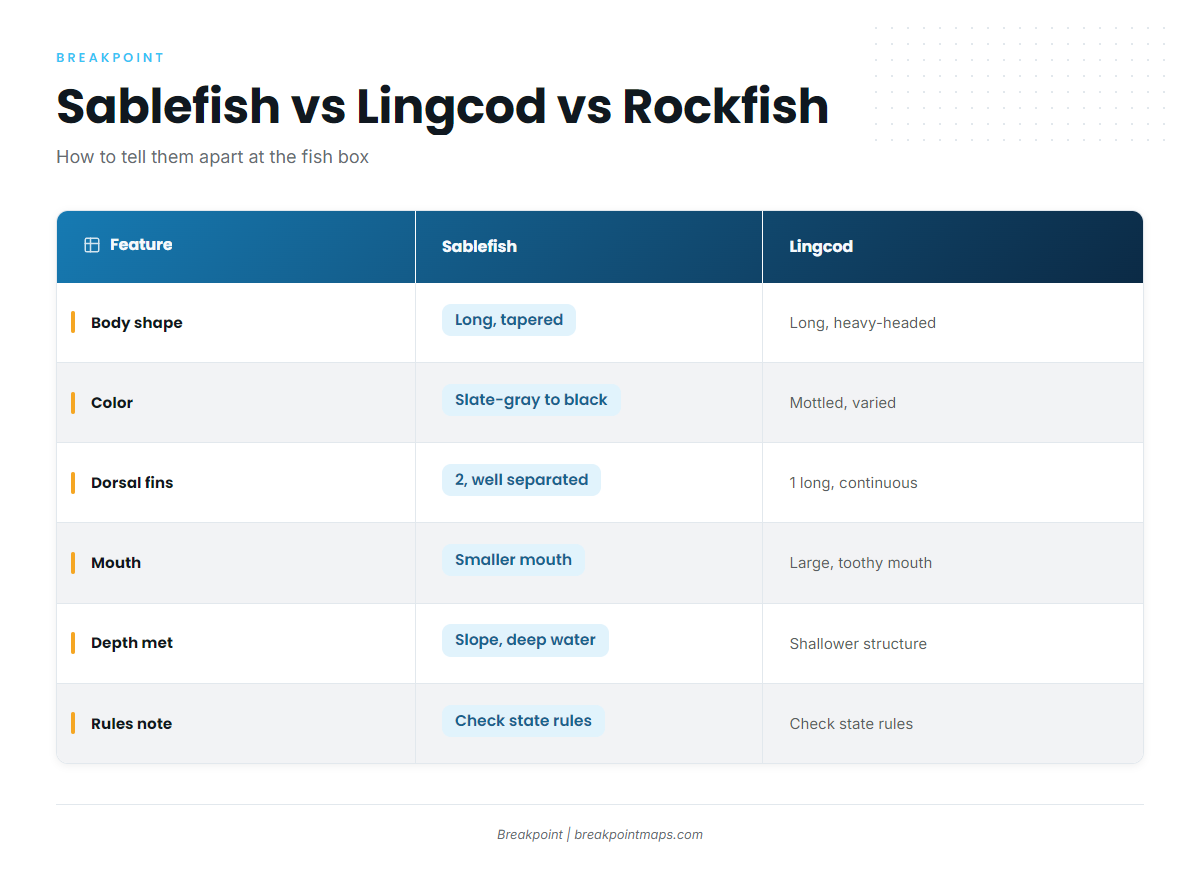
Anglers deep-dropping the slope may see all three on the same trip, so telling sablefish from lingcod comes up fast. This table sorts them out.
| Feature | Sablefish | Lingcod | Rockfish |
|---|---|---|---|
| Body shape | Long, tapered | Long, heavy-headed | Stout, deep-bodied |
| Color | Slate-gray to black | Mottled, often brownish or greenish | Varies widely by species |
| Dorsal fins | 2, well separated | 1 long, continuous | Spiny, one dorsal with a notch |
| Mouth and teeth | Smaller mouth | Large, toothy mouth | Spiny head and fins |
| Typical depth where anglers meet it | Slope, past the shelf break | Rocky bottom, shallower | Reefs, pinnacles, and slope |
| Rules note | Managed under the groundfish plan | Separate rules | Descending device may be required for release |
The rockfish note matters. See the Regulations section for the descending-device rule.
Behavior and Table Quality
ADF&G describes sablefish as opportunistic feeders. They are slow-growing and long-lived, which is why careful management matters.
Is sablefish good to eat? Yes. The flesh is rich and oily, which is where the name butterfish comes from, and Island Fisherman notes it is prized for its high Omega-3 content. Gentle preparations work best: baking, steaming, smoking, or miso-marinating.
If you already fish blackcod in Alaska or BC, it is the same fish. What changes in the Pacific Northwest is access, rules, and how the slope sits relative to port. Details follow.
Habitat & Range
Adult sablefish live on the continental slope, from the shelf break at roughly 100 fathoms (600 ft) down well past 1,500 ft. They favor mud bottom and canyon edges, while juveniles use shallower nearshore water. This biology is drawn from NOAA Fisheries and ADF&G.
Depth reports vary by region. In Alaska, one Sitka charter operator reports black cod caught from 700 to 3,000 ft. That is a local observation and not a universal range.
| Zone | What it means for you |
|---|---|
| Shelf | Gently sloping bottom off the beach. Not where adults live. |
| Shelf break | Around the 100-fathom line (600 ft). The bottom starts falling away hard. |
| Slope | Everything below the shelf break, grading into deeper mud. Where you fish. |
| Canyon heads | Cut into the shelf and pull slope depths closer to port. |
The Shelf Break, in Fisherman Terms
The shelf break is where the bottom that has been sloping gently off the beach starts falling away hard, around the 100-fathom line. Everything below it is the slope. Submarine canyons off Washington and Oregon cut into the shelf and bring slope depths closer to port.
Your first job is reading bathymetry and contour maps to find those edges. Spot-level detail belongs on our regional pages.
Juveniles Nearshore, Adults Deep
Younger fish show up in shallower water, but the fish most anglers target sit on the slope. Plan for depth rather than nearshore encounters.
What the Data Can’t Tell You
Adult sablefish sit in water few anglers ever see, and the quality of slope bathymetry varies by survey. Some areas are densely mapped, while others rely on older, sparser soundings.
At 1,000 ft, the sounder often won’t mark sablefish the way it marks rockfish stacked on a pinnacle. You are fishing the grade and the bottom type instead of a mark. Contour lines show where to look, and they can’t show where the fish are.
Chart layers are not for navigation.
How It Differs Here
Pacific Northwest conditions add their own demands:
- Bottom: mud slope.
- Current: strong, and it shapes your gear.
- Distance: long runs to the grade from many ports.
SoCal deep-droppers are often targeting a different species mix, and Alaska anglers may find deep water closer to port.
Regional pages: Washington coast, Oregon coast.
Tactics
Most anglers fish sablefish with an electric reel spooled with braided line. The rig is a heavy weight and a circle-hook dropper rig baited with squid, herring, or octopus, and the boat drifts the slope near bottom. It resembles halibut drifting, but in water 3 to 5 times deeper with far more line out. Anglers in BC and Southeast Alaska commonly run this style of deep drop fishing.
Finding the Grade
Find the 100-fathom contour and the canyon heads first, then work down the slope into mud bottom.
Why Depth Changes Your Gear
At 1,000 ft plus scope, you need a lot of line on the reel. Thin braid cuts drag in current and keeps you closer to vertical. It also transmits bottom feel and bites that mono stretch would hide.
Weights need to be far heavier than your halibut weights, scaled to current. Island Fisherman points out that reeling up to 800 ft of line for a bait check is hard work, and electric reels make it efficient and accessible.
Gear Table
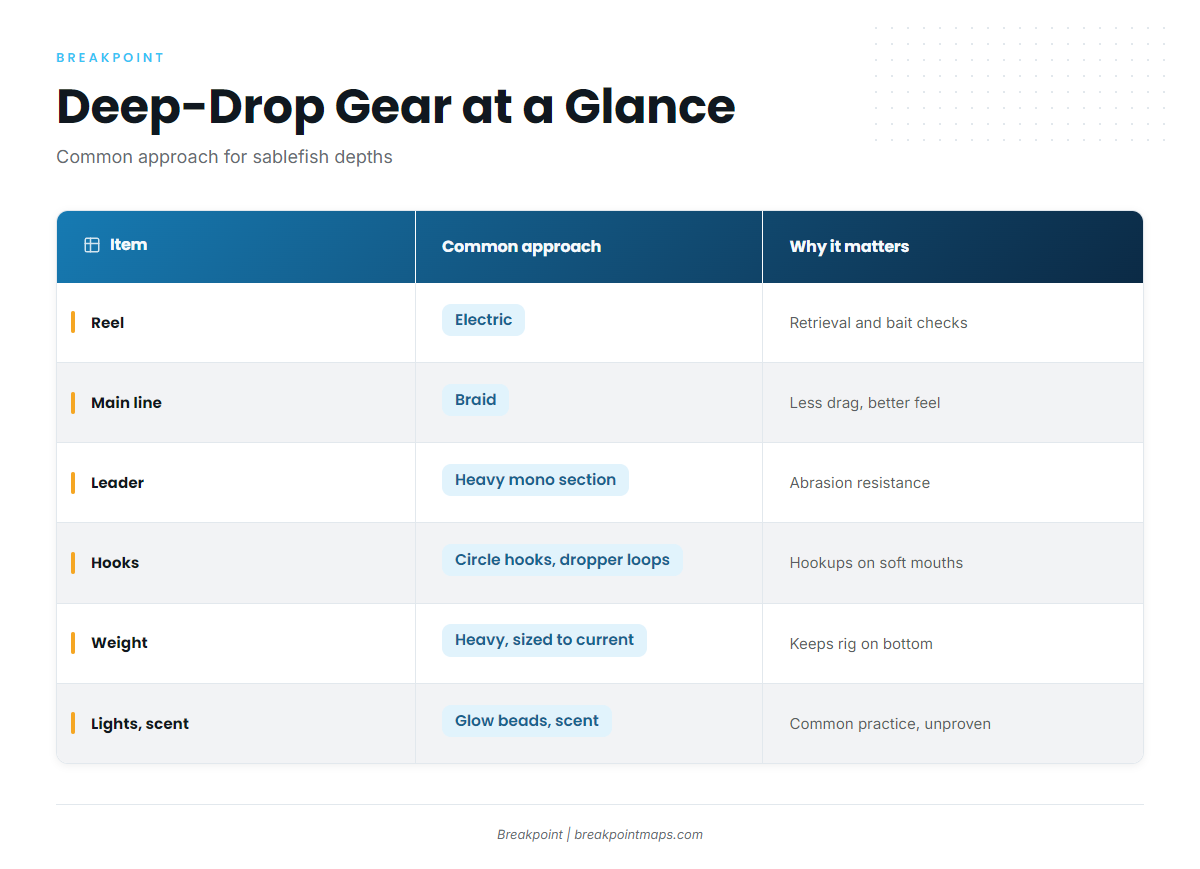
| Item | Common approach | Why it matters |
|---|---|---|
| Reel | Electric | Line retrieval and bait checks at depth |
| Main line | Braid | Small diameter, less drag in current, better bottom feel |
| Leader | Heavy mono section | Abrasion resistance and shock absorption |
| Hooks | Circle hooks on dropper loops | Hookups on soft-mouthed fish |
| Weight | Heavy, sized to current | Keeps the rig on bottom |
| Lights and scent | Glow beads or lights, scent | Attraction in dark water. Common practice, not proven. |
Scale line capacity, leader, and weight to your depth and current.
Rigs
A common baseline is a dropper loop rig with 2 to 3 circle hooks above the weight. Island Fisherman describes one proven BC setup: a 5/0 treble hook with a 7/0 J-hook trailer on 100-lb mono. It is not the Pacific Northwest standard, but it shows how anglers stack hooks.
Bait
Common baits are squid, herring, and mackerel. A first-hand account from USFWS Alaska says octopus holds up to robbers. It is tougher and other fish don’t strip it as easily, while herring gets picked apart.
Drift Control
The goal is a near-vertical line. Anglers use several methods:
- Drift socks and sea anchors.
- Spot-lock on trolling motors, where it can hold.
- Positioning up-current of the target contour.
The Sitka operator notes they need relatively calm seas and light winds to drift and search. Over the Pacific Northwest slope, current strength often dictates weight more than depth does.
The Fight
Island Fisherman calls the biggest mistake bringing the fish up at full throttle. Full speed is for bait checks. Slow down once a fish is on, because sablefish have soft mouths.
Bycatch Realities
Hagfish and shark bycatch strip baits and foul gear. Tougher baits, frequent bait checks, and patience are the standard answers. Rockfish may come up on the drop too, so see Regulations for the descending-device rule.
Handling Checklist
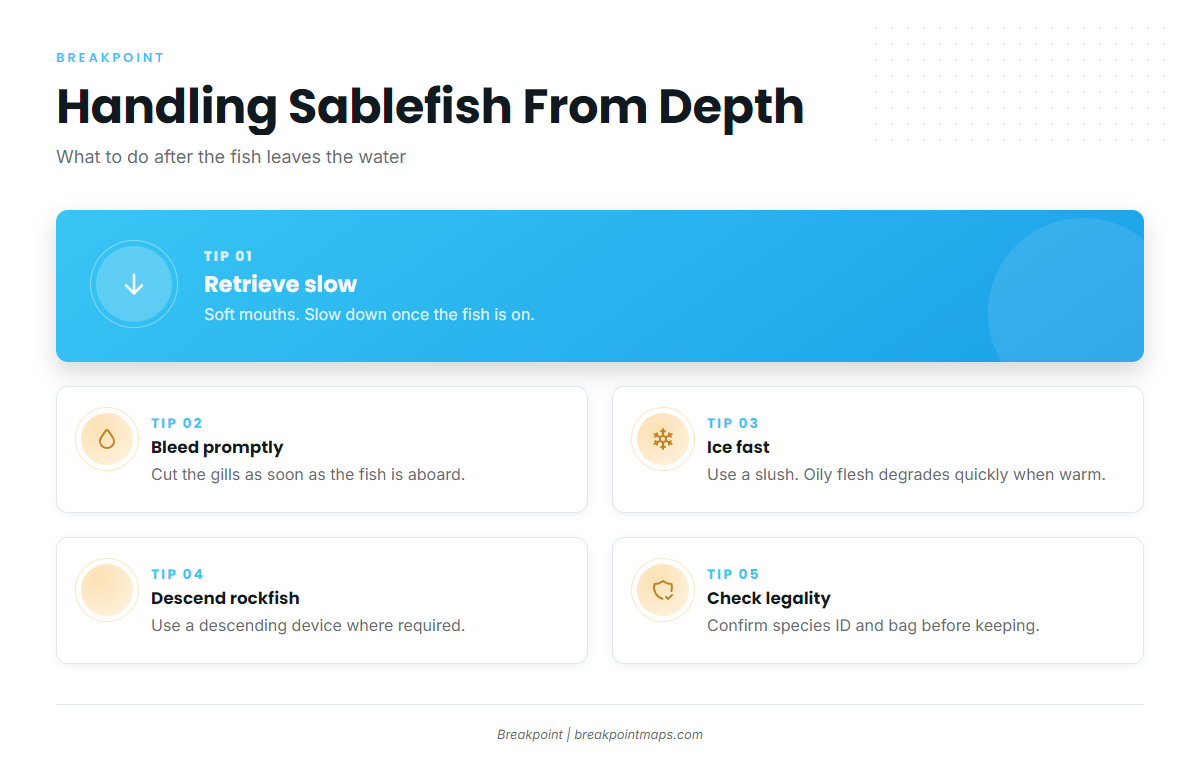
Sablefish flesh is oily and degrades fast when warm. Work through this list on deck:
- Retrieve slowly on the fight. Soft mouths.
- Bleed promptly by cutting the gills. Bleeding sablefish keeps the flesh clean.
- Ice fast in a slush.
- Descend rockfish with a descending device where required. Barotrauma shows up as a swollen swim bladder and bulging eyes from rapid ascent.
- Check legality before you keep anything. Confirm species ID and bag.
Safety
Offshore runs for black cod need the right weather window, a capable boat, and proper safety gear. Island Fisherman recommends a buddy-boat system, and so do we. Chart layers are not for navigation.
Frequently Asked Questions
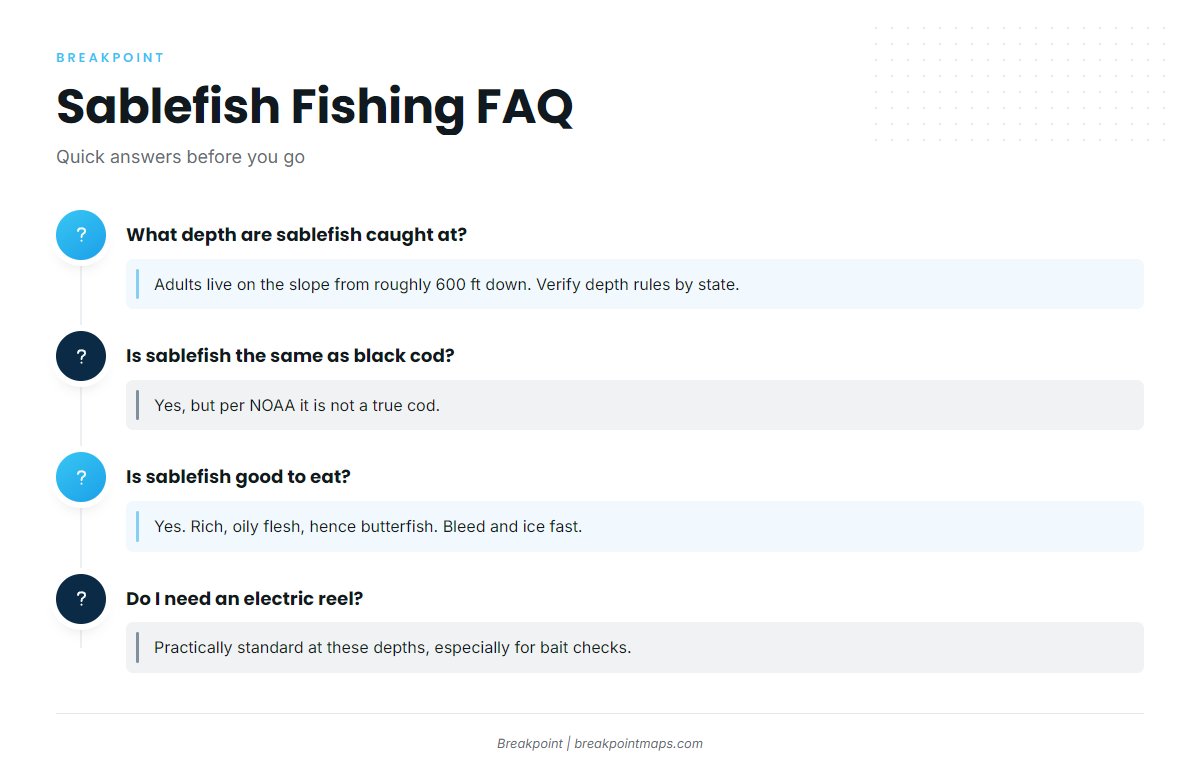
What depth are sablefish caught at?
Adults live on the slope from roughly 600 ft down. One Sitka, Alaska charter operator reports black cod at 700 to 3,000 ft. Verify depth rules by state before you fish, since restrictions can change what is open.
Is sablefish the same as black cod?
Yes. Blackcod and black cod are common names for sablefish. Per NOAA Fisheries, it is not a true cod. The fish belongs to its own family, though it looks much like cod.
Is sablefish good to eat?
Yes. The flesh is rich and oily, hence the name butterfish. Island Fisherman notes it is high in Omega-3. Bleed it promptly and ice it fast to protect the flesh. Gentle cooking works best.
Sablefish vs lingcod: how do you tell them apart?
Sablefish have 2 separated dorsal fins and a smaller mouth. Lingcod have a large, toothy mouth and a long, continuous dorsal fin. Color helps too: sablefish run slate-gray to black.
Do I need an electric reel?
It is practically standard for these depths. Island Fisherman notes that reeling up to 800 ft of line for a bait check is hard work, and electric reels make the fishery efficient and accessible.
What is the Oregon sablefish bag limit?
Per ODFW, the sablefish limit is 10 fish daily, separate from the general marine bag. Rules change, so verify with ODFW before you fish.
Conclusion
Sablefish is worth targeting for the table. Plan for depth, gear, and weather, and check the rules first.
In short:
- Confirm your state’s current rules.
- Pick a weather window and a buddy boat.
- Find the grade.
Finding the grade is where we can help. Breakpoint’s hotspots and Fish Intel view show where sablefish habitat sets up. The Chart Contours layer shows the shelf break and canyon edges in the 600 to 1,500 ft band. Survey density varies, and where the seabed hasn’t been surveyed, the app says so. Chart layers are not for navigation. We can promise a better decision about where to look, though not a guarantee of fish.
The slope keeps some of its secrets whatever you bring. Good luck out there.