


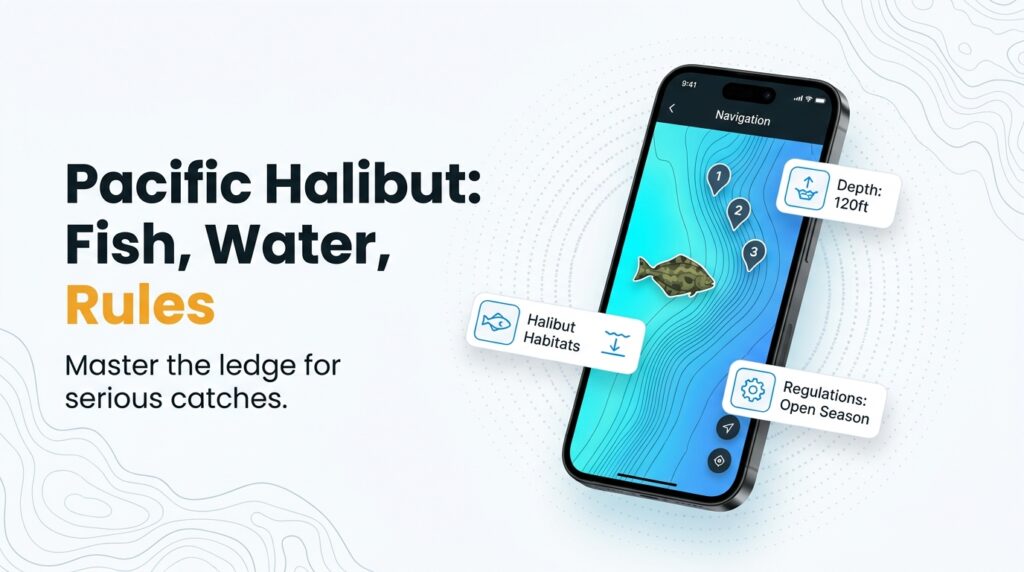
The Pacific halibut (Hippoglossus stenolepis) is the largest flatfish on this coast. It is a bottom-dweller fished on the edges of structure, and it is some of the best eating in the North Pacific.
This guide covers how to identify the fish, where it lives, how to present bait to it and who sets the rules. It draws on the waters most PNW anglers fish or trailer to: the Strait of Juan de Fuca, the Oregon coast, British Columbia and Alaska.
Seasons in Washington, Oregon and California are short and set every year. The gear is heavy, and a big fish is a handling problem on a small boat. By the end you should know whether halibut fit your boat and your calendar, how to plan a tide and a drift, and where to check current rules. Most Area 2A openers are closed or closing, so treat this as planning for the 2027 season.
Overview
This section covers what a Pacific halibut looks like, how to separate it from its California cousin, and how it behaves on the bottom.
How to identify a Pacific halibut
A Pacific halibut is a right-eyed flatfish with a diamond-shaped body, a mottled gray-to-dark-brown top and a white underside. According to the NOAA Fisheries species profile, the upper side "helps them blend in with sandy or muddy bottoms," and males tend to be smaller than females.
Both eyes sit on the upper side of the body. The fish lies flat and swims sideways. It is an ambush predator, and the camouflage lets it look like the seafloor.
Pacific halibut vs. California halibut
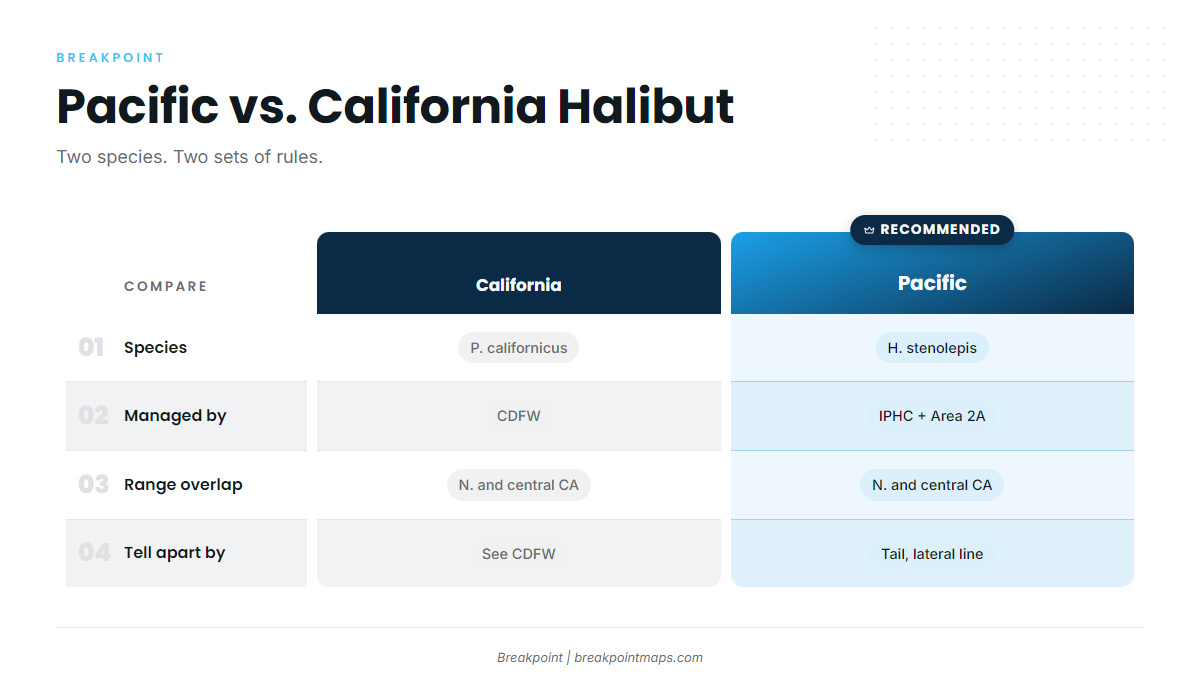
California halibut (Paralichthys californicus) is a different species. You can usually tell them apart by the tail, the lateral line and where you caught it.
Their ranges overlap off northern and central California, which is where identification and regulation mistakes happen. The two fish are managed by different bodies. The International Pacific Halibut Commission (IPHC) and the Area 2A framework manage Pacific halibut, and the California Department of Fish and Wildlife (CDFW) manages California halibut.
| Trait | Pacific halibut | California halibut |
|---|---|---|
| Scientific name | Hippoglossus stenolepis | Paralichthys californicus |
| Color | Mottled gray to dark brown on top, white below | See CDFW |
| Eye side | Right-eyed | See CDFW |
| Lateral line | Arches over the pectoral fin | See CDFW |
| Tail | Slightly concave | See CDFW |
| Typical water | Cold North Pacific, sand, mud and gravel bottoms | See CDFW |
| Range overlap | Bering Sea to about Santa Rosa Island, California | Overlaps off northern and central California |
| Managed by | IPHC and the Area 2A framework | CDFW |
Where a cell says "see CDFW,".
Chickens, barn doors and why size matters
"Chickens" are small halibut, and "barn doors" are fish over 100 lb. Most large fish are female, which matches NOAA’s note that males run smaller.
For planning, what matters is that size is also a handling and safety issue, covered under Tactics.
How halibut behave and feed
Halibut are ambush feeders that lie on the bottom and strike prey that passes over them. They sometimes rise into the water column to chase fish like herring. The diet is broad: fish, squid, crab and octopus.
Mature fish move to deep water along the edge of the continental shelf to spawn in winter. Halibut also move more than their lazy look suggests, and IPHC tagging studies only partly explain where and why. Because they ambush prey, scent and bait held near the bottom matter a great deal.
Habitat & Range
Halibut are a cold-water, bottom-oriented fish. Where they sit depends on bottom type, structure and season.
Where Pacific halibut live
Pacific halibut range from the Bering Sea south to about Santa Rosa Island, California, and west across the North Pacific to northern Japan, consistent with the cold-water, bottom-oriented habitat NOAA describes.
Most of the fishery is in Alaska and British Columbia. Washington, Oregon and California see much smaller catches.
Bottom types and structure that hold halibut
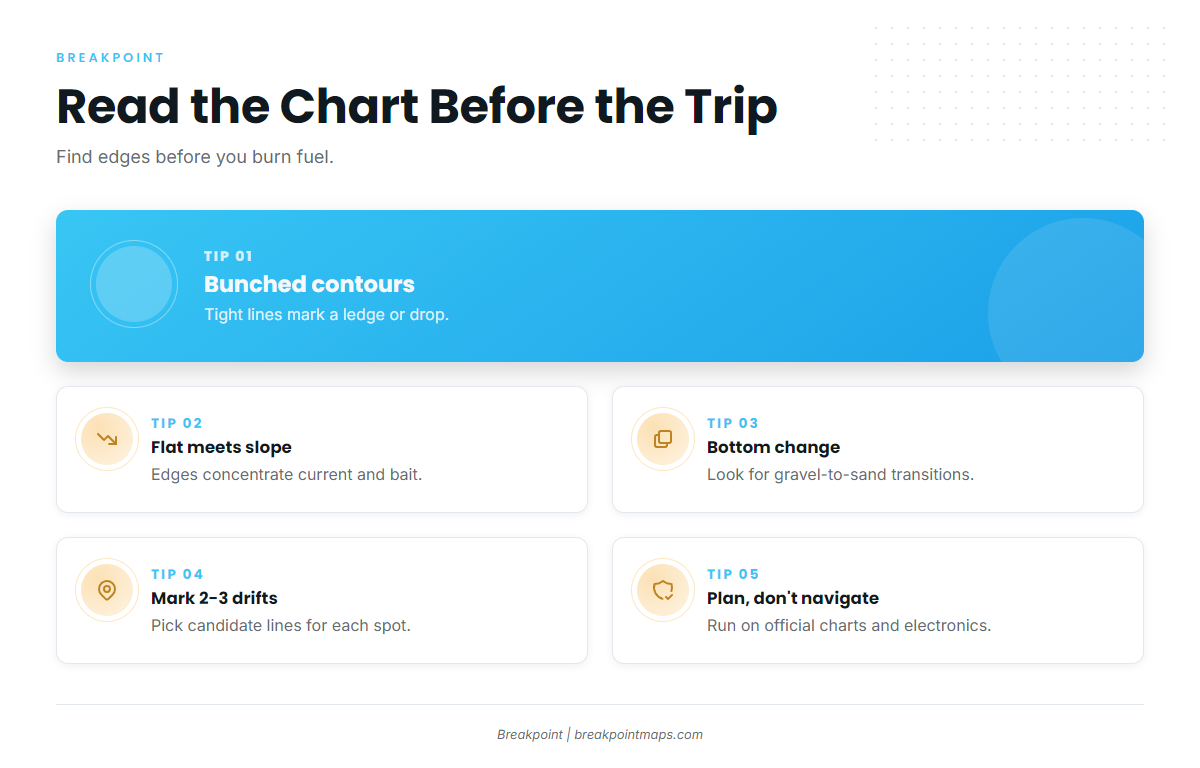
Halibut favor sand, mud and gravel bottoms, especially where those bottoms meet structure: a ledge, a drop-off, a gravel-to-sand transition or the edge of a bank. Edges concentrate current and bait, and a camouflaged ambush feeder sits where food comes to it.
You can read this on a chart before you leave the dock. On the Chart Contours layer:
- Look where contour lines bunch up, which marks a ledge or a drop.
- Look where a flat meets a slope.
- Check nautical chart bottom-type notes for a gravel-to-sand change.
- Mark 2 to 3 candidate drifts per spot, so you have somewhere to go if the first one is dead.
Chart layers are for planning, not navigation. Run on your official charts and electronics.
How halibut depth changes through the year
Halibut generally sit shallower in spring and summer to feed, and move deep to the shelf edge in winter to spawn.
Depth varies by area and by year. Use your local agency’s area maps and your sounder.
One depth line matters for planning in Oregon: the 40-fathom regulatory line, a depth-based management boundary. Forty fathoms is 240 ft. Details are under Regulations.
How Area 2A differs from Alaska and BC
Off Washington, Oregon and California you are fishing the southern edge of the range. Expect fewer fish, generally smaller fish and much shorter openers than in British Columbia or Alaska.
If you fish Alaska or BC.
- Expect less time on the water, so pick your days carefully.
- Expect more competition for good drift lines on open days.
- Management areas and rules differ completely. See Regulations.
Tactics
Halibut tactics come down to heavy gear, bait held on the bottom, the right tide and a plan for the fish once it’s hooked.
Gear you need before you go
Halibut gear is heavy because you are lifting a big, flat fish from deep water and holding bait on the bottom in current.
| Component | What to look for | Why |
|---|---|---|
| Rod | Short, stout, heavy power | Leverage on a heavy fish |
| Reel | Conventional, high line capacity, strong drag | Deep water, long fights |
| Main line | Braid | Low stretch for bite detection, thin diameter so it cuts current |
| Leader | Heavy mono or fluoro | Abrasion near the bottom |
| Hooks | Large circle hooks | Hookups and release survival |
| Weight | Enough to hold bottom in the current you’ll fish | Changes with tide and depth |
| Landing | Gaff or harpoon, plus a way to secure the fish | Safety |
If your boat can’t safely handle a large fish thrashing on deck, plan to release big fish or consider a charter.
Best bait for halibut
Herring, octopus, squid and salmon bellies are the standard halibut baits because they are oily, scented or tough enough to stay on the hook.
- Herring gives you scent.
- Octopus is durable against small biters.
- Squid is tough and cheap.
- Salmon bellies add oil and a scent trail.
Jigs and soft plastics
Jigs and soft plastics cover water and trigger reaction bites, which suits drifting when halibut are active or spread out. Many anglers tip a jig with bait to add scent.
Drifting vs. anchoring
Anchor when you’ve found a specific spot and want a scent trail to work. Drift when you need to search a ledge or flat.
Anchoring. Bait scent streams down-current and draws fish to you. When the tide turns, the boat swings and the trail sets up in the other direction, which brings a second round of fish. Anchoring in deep water and current needs proper ground tackle and a plan to retrieve it.
Drifting. Drifting covers ground. A drift sock or light motor work can slow the drift enough to keep bait near the bottom. When current gets too swift to hold bait down, many anglers switch to drifting and jigging.
Spreader bar or single leader. A spreader bar keeps bait off the sinker and away from tangles, and helps when anchored in current. A single leader is simpler and works well for drifting and light current. Which to use is a judgment call.
Best tide for halibut
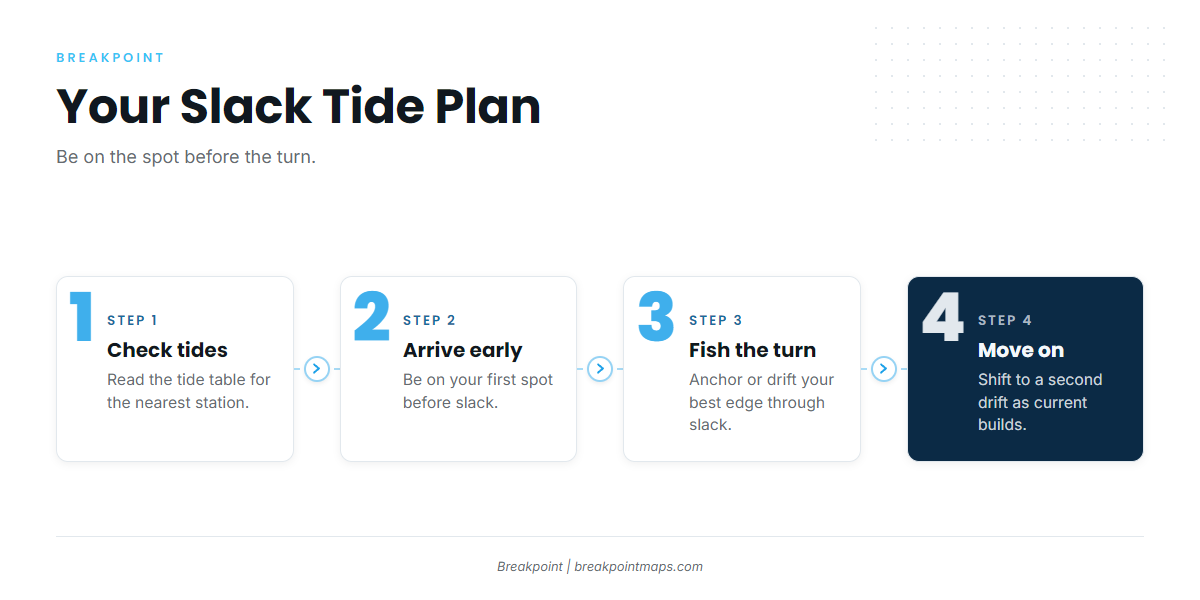
Halibut fishing is usually best around slack tide, because you need less weight to hold bottom and your bait stays put where fish can find it.
On a hard-running tide, the sinker needed to hold bottom gets heavy fast, your line bows and bite detection suffers. At slack, a lighter rig stays vertical and on the bottom. Moderate current on either side of slack spreads scent, so plan to be on your first spot before slack and fish through the turn. Big fish are also caught on moving water, so tide affects presentation but doesn’t guarantee anything.
A simple plan:
- Check the tide tables for the nearest station.
- Arrive before slack on your best edge.
- Anchor or drift through the turn.
- Move to a second drift as current builds.
Detecting the bite and setting circle hooks
With circle hooks you don’t swing. You let the fish load the rod and reel steadily, so the hook rolls into the corner of the jaw.
The hook shape slides out of the throat and catches the jaw hinge, which improves hookups and the survival of released fish. A halibut bite often starts as tapping or weight, so stay patient.
Landing, bleeding and caring for big fish
A large halibut is the most dangerous thing you’ll bring aboard, so decide how you’ll land it before you hook it.
A big halibut can break legs, gear and gunwales. Secure the fish in the water, typically with a harpoon or a gaff on a float line, before bringing it aboard. Keep crew clear of the tail. Check local rules on landing methods before using any firearm.
To bleed the fish, cut the gill arches, then get it cold quickly to protect meat quality. The effort pays off, since halibut is mild, flaky white table fare.
Releasing halibut
Released halibut survive best when caught on circle hooks, kept in the water and handled as little as possible.
- Use a dehooker.
- Support the body.
- Avoid lifting heavy fish by the jaw or gills.
Where size or slot limits apply, especially Alaska charter rules, release is part of the law. See Regulations.
Frequently Asked Questions
How do you tell Pacific from California halibut?
They are different species. Pacific halibut (Hippoglossus stenolepis) has a mottled gray-to-dark-brown top, a right-eyed body and an arched lateral line, and it is managed by the IPHC and the Area 2A framework. Their ranges overlap off California, where CDFW manages California halibut. Check both rulebooks.
When is halibut season?
In Washington, Oregon and California, halibut season generally runs in spring and summer on limited days, set yearly after the IPHC’s January meeting. British Columbia and Alaska run longer. With late September 2026 here, you are planning for 2027. Check WDFW, ODFW, CDFW, DFO or ADF&G.
What’s the best tide for halibut?
Around slack tide. You need less weight to hold bottom, your line stays vertical and your bait stays put where fish can find it. Get on your spot before slack and fish through the turn. Halibut also bite on moving water, so tide affects presentation but doesn’t guarantee a bite.
Who sets halibut limits?
The IPHC sets coastwide limits each year. NOAA Fisheries and the PFMC Catch Sharing Plan allocate Area 2A, and WDFW, ODFW and CDFW set state dates. DFO manages British Columbia. NOAA Alaska Region and ADF&G manage Alaska. Verify current rules with the agency before you fish.
Conclusion
Good halibut trips depend mostly on planning: reading the edges, timing the slack, rigging heavy and landing big fish safely. After that, check the rules with the agencies before you go.
Breakpoint’s hotspots and Fish Intel help you shortlist halibut ground, including depth breaks, edges and structure, before you burn fuel. They point you to where to look and say nothing about whether the fish will bite.