


Introduction
The gray triggerfish is a hard-bottom reef fish of the Gulf and the Atlantic Southeast, and people chase it for the table. According to the NOAA Fisheries species profile, the meat is "uniquely sweet" and tastes more like crab than fish. It is also tightly managed, and seasons can close early, so check the rules before you keep one.
This guide covers how to identify the fish, where it holds, a baseline rig, and where to confirm the season in your waters. Where the science is unsettled, the guide says so.
Overview
The gray triggerfish (Balistes capriscus) is a leathery, gray-olive reef fish with a locking dorsal spine and a small mouth full of strong teeth. Identification comes first, and the mouth shapes nearly everything about how you fish for it.
Identification
Gray triggerfish identification comes down to a short list of features:
- A gray or olive body, sometimes with faint, broad dark bands
- A blue rim on the upper eye
- A large first dorsal spine that locks upright
- A small, beak-like mouth with fleshy lips
- Tough, leathery skin
Females grow larger and live longer than males, reaching more than 22 inches, per the South Atlantic Council.
How the trigger works
The first of the three dorsal spines is large and tough. As angler guides describe it, the fish locks that spine upright by bracing it with the smaller second spine. The main spine won’t fold down until the second spine, the "trigger," is released. The fish uses this to wedge itself into rock and reef crevices. Keep it in mind when you handle one, because the spine can wound you.
Behavior and nesting
Triggerfish are hard to catch on hook and line because they nibble the bait, according to the North Carolina species profile. FishTalk adds that their tiny mouths are dominated by parrot-like teeth. The Tactics section is built around this.
NOAA reports that spawning runs from April to August. Males establish territories, build nests in the sand and entice females into the nest to spawn. The South Atlantic Council adds that eggs are demersal, laid in guarded nests, and that fish spawn at about 3 years old or 12 inches.
Captain’s detail: The nibbling is why small, strong hooks and tough bait matter. The teeth and the spine both matter when you handle the fish, and we cover that under Release and handling.
Similar species
Ocean and queen triggerfish share some waters with gray triggerfish, and the rules can differ by species. Confirm your identification against the agency species page before you keep a fish.
Habitat & Range
Gray triggerfish live over hard bottom across the Gulf and the Atlantic Southeast: reefs, ledges, rocky areas and artificial structure.
NOAA Fisheries uses the name Gulf of America for this water. We use “Gulf” from here on. From the Gulf up the Atlantic coast, the broad range runs from hard bottom in bays and lagoons to reefs out to roughly 180 feet (about 55 m), per Cast and Spear. That is an angler-guide figure, so treat it as a working range.
Triggers often sit on the same structure you fish for red snapper, and often turn up on the same trip. Look for:
- Natural ledges and rocky hard bottom
- Artificial reefs and wrecks
- Reef lines along the shelf
Related guide: red snapper fishing in the Gulf of Mexico.
Gulf vs. South Atlantic
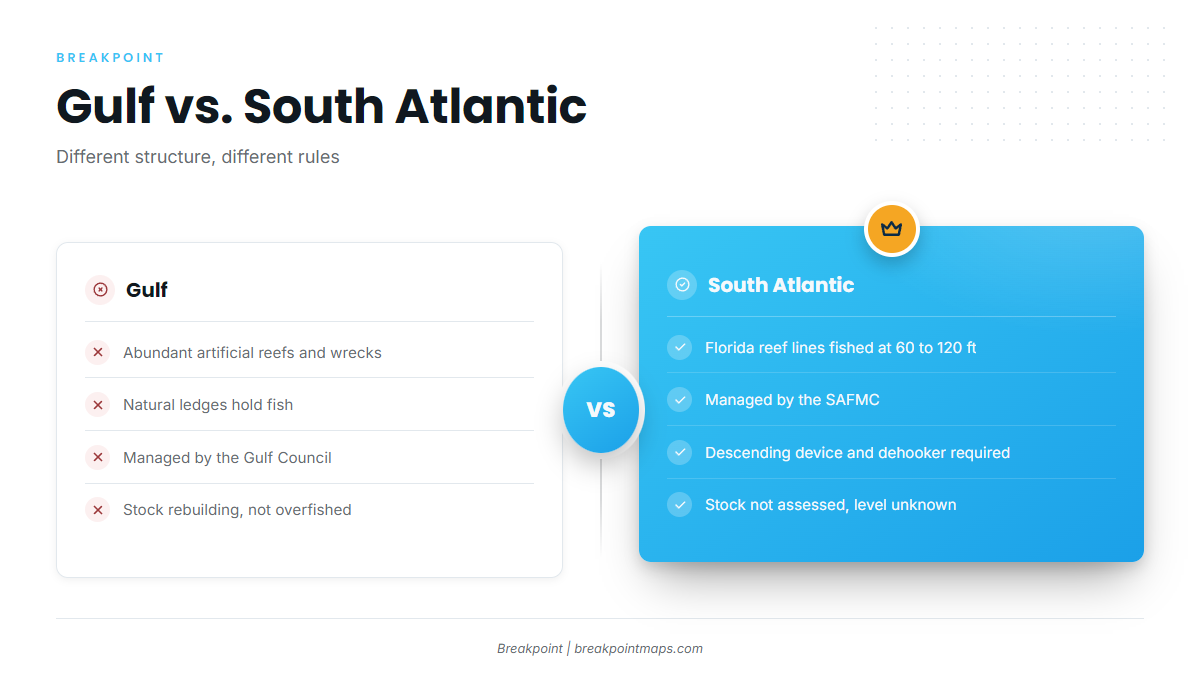
FishingBooker’s guide describes the Gulf as having abundant artificial reefs, wrecks and natural ledges. On the Atlantic side, it says anglers from Jacksonville to the Keys work reef line depths and hooks in 60 to 120 feet of water. That describes how anglers commonly fish it and isn’t a rule of biology.
Warmer months generally bring the best numbers, per the same guide.
What we don’t know
Nobody has a full count of these fish, and several questions remain open.
- South Atlantic: NOAA says the stock has not been assessed and the population level is unknown.
- Gulf: NOAA says the stock is not overfished but is still rebuilding to target levels, based on a 2015 stock assessment, and not subject to overfishing based on 2024 catch data. Why rebuilding has been slow is not settled.
- Habitat use: How these fish use habitat is still being studied.
Tactics: How to Approach Gray Triggerfish Fishing
For gray triggerfish fishing, use small, strong hooks with tough bait on a short, abrasion-resistant leader, and use braid so you can feel the nibble. What follows is common angler practice, not regulation or science.
Baseline rig
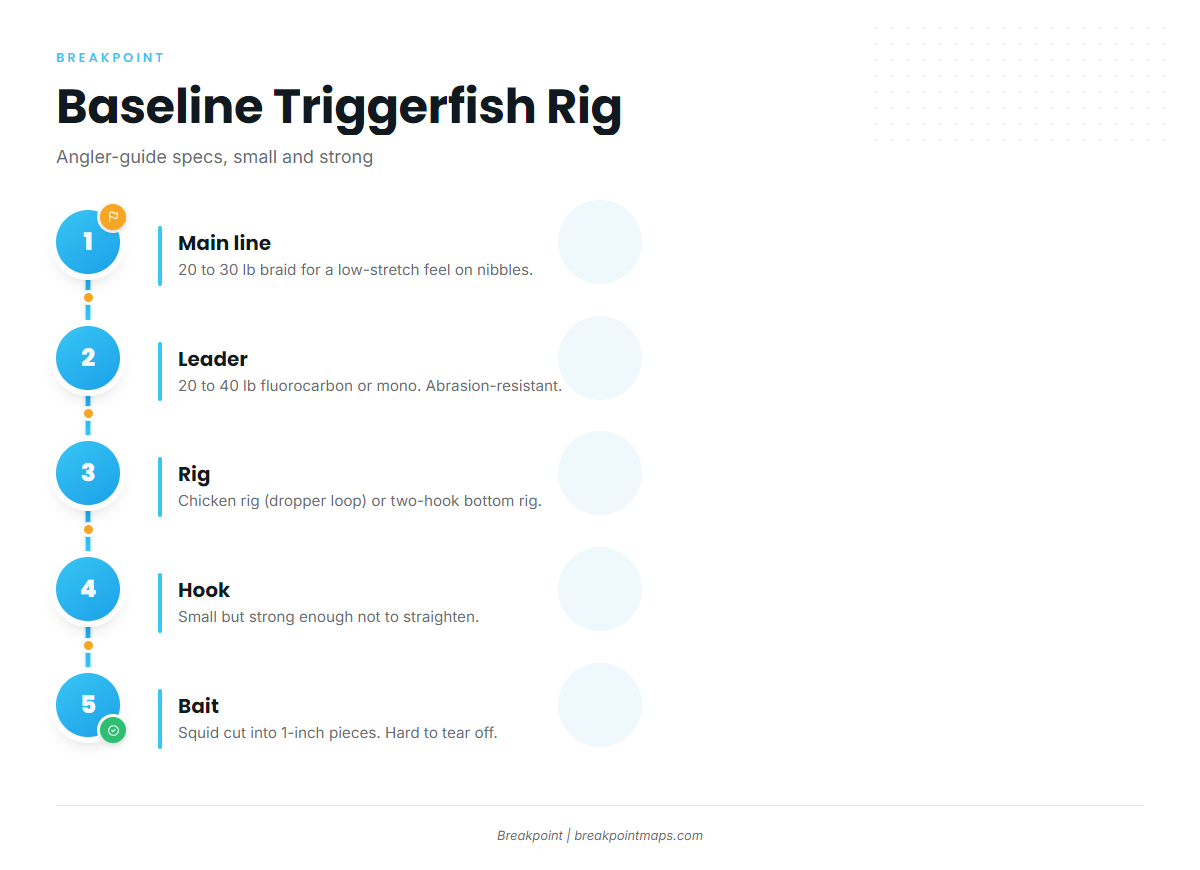
Many anglers start here:
- Main line: 20 to 30 lb braid
- Leader: 20 to 40 lb fluorocarbon or monofilament. FishingBooker suggests 20 to 30 lb fluorocarbon for abrasion resistance around reef.
- Rig: A chicken rig (dropper loop) or a two-hook bottom rig
- Hook: Small and strong, within the range below
- Bait: Squid cut into 1-inch pieces
Those main line and leader figures come from baseline triggerfish tackle specs published by Cast and Spear. FishingBooker suggests a medium-action spinning or conventional rod with a reel that handles 20 to 30 lb line.
Hooks
Published guides disagree on size:
| Source | Hook size |
|---|---|
| FishTalk | #6 to #4 |
| FishingBooker | #2 to 2/0, circle or J |
| Cast and Spear | 1/0 to 3/0 circles |
The small mouth argues for a small hook, and the tough jaw argues for a strong one. FishingBooker says small, strong hooks are key to penetrating the jaw, and FishTalk’s shockingly small hook advice makes the case for going down to #4 and #6.
Our read is to go as small as you can while keeping a hook strong enough not to straighten. We won’t name one correct size. Circle versus J is a real choice among anglers, and the sources recommend both.
Bait
Squid is the most popular bait, per Half Hitch. Cast and Spear recommends 1-inch pieces because they are hard to tear off. Cut fish or peeled shrimp are alternatives, and some anglers prefer squid strips as more durable. Triggerfish feed on small clams and crustaceans, according to Half Hitch. Some anglers also chum lightly before dropping lines.
Detecting the bite
Triggers rarely smash a bait. They peck until they get a hold, and braid’s low stretch helps you feel it. FishTalk also advises against dropping right on top of the fish, because the splash can spook them. Drop beside the fish instead.
Release and handling
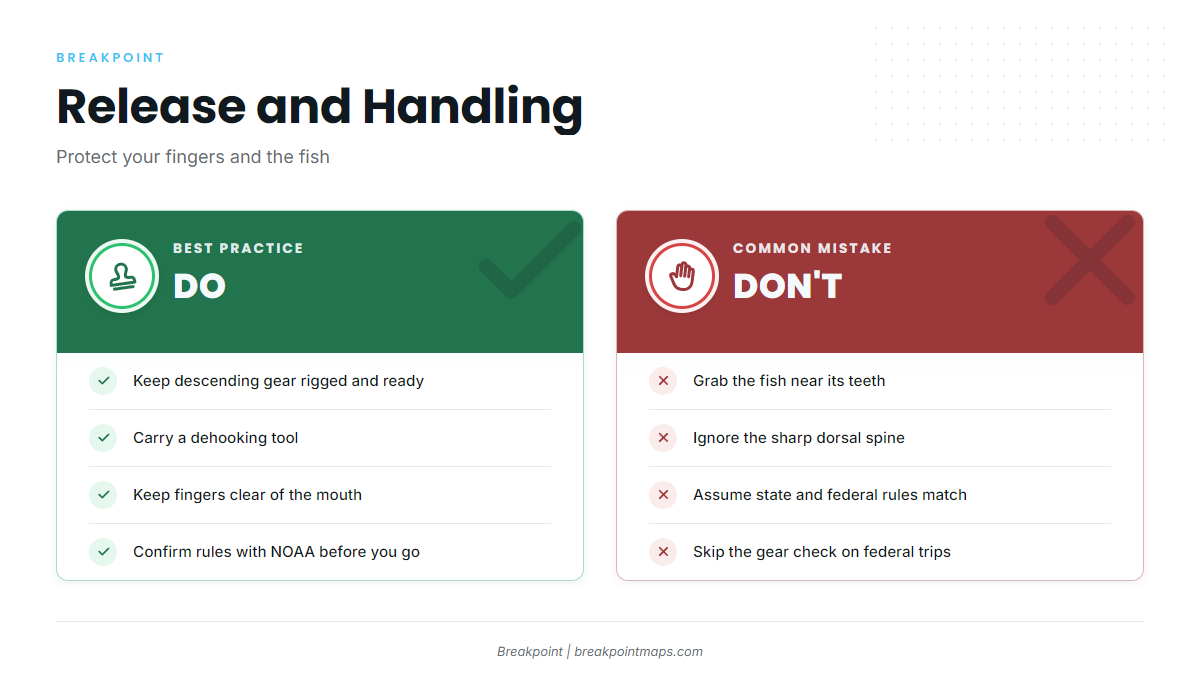
Cast and Spear describes the bite as deceptively powerful and the dorsal spine as able to cause a painful wound. Keep your fingers away from the mouth.
Release gear is a legal matter as well as a stewardship one:
- South Atlantic federal waters: Per the South Atlantic Council, a descending device must be on board, attached to at least 16 oz of weight and 60 ft of line, and a dehooking tool is required.
- Gulf federal waters: Federal DESCEND Act rules call for a descending device or venting tool rigged and ready. Confirm the exact current wording with NOAA before you go.
Reef fish brought up from depth can suffer barotrauma, which is why these gear rules exist. On the cleaning table, the skin is thick and leathery, and The Fisherman notes the meat is thickest along the dorsal side.
Frequently Asked Questions
Are gray triggerfish good to eat?
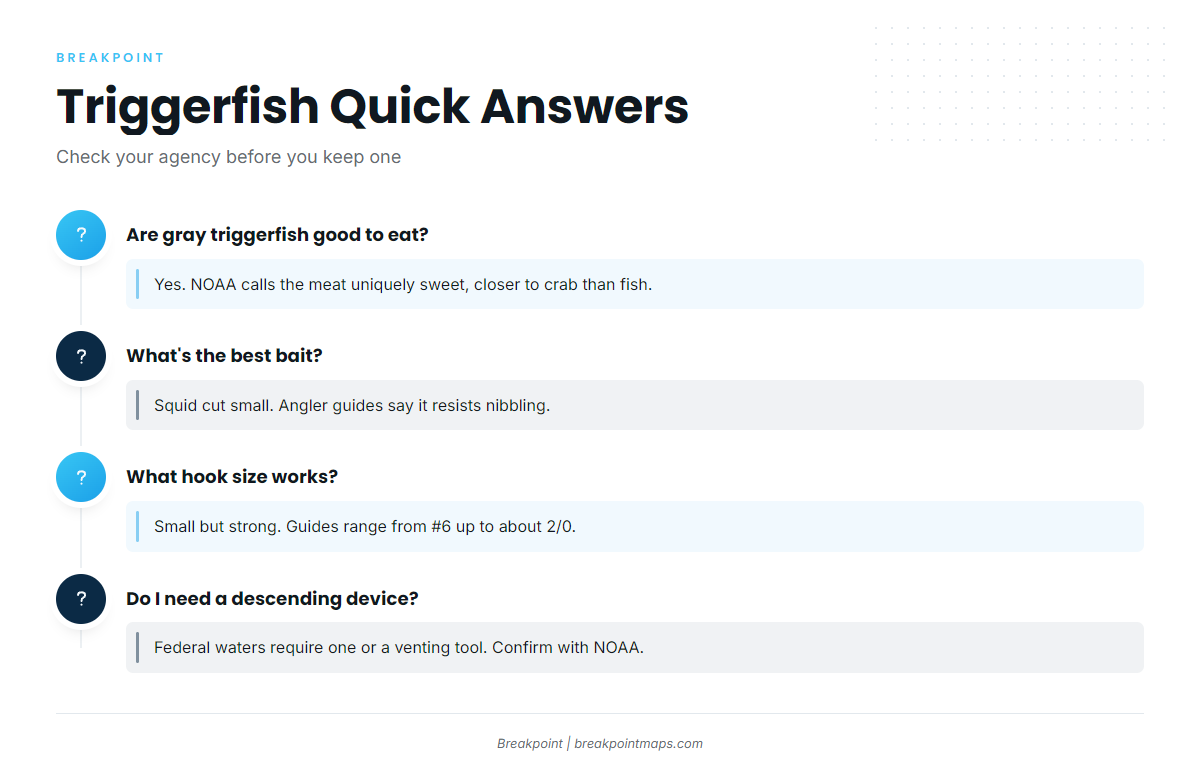
Yes. NOAA describes the meat as "uniquely sweet," closer to crab than fish. The skin is thick and leathery, so plan to skin the fish before cooking.
What size do gray triggerfish have to be?
Limits are measured in fork length and differ between the Gulf and South Atlantic. The South Atlantic Council lists 12 inches for federal waters. The Gulf minimum is 15 inches fork length. Check your state agency for state-water rules.
When is gray triggerfish season?
Seasons differ by region and can close early when the catch limit is projected to be met. Check NOAA Fishery Bulletins, the councils and your state agency for current dates.
What’s the best bait for gray triggerfish?
Squid is the most common choice, cut into small pieces so it resists nibbling. Cut fish and peeled shrimp also work, per angler guides.
What hook size works for triggerfish?
Published guides range from #6 up to about 3/0. Go small but strong. The mouth is small and the jaw is tough, so the hook has to fit one and hold up against the other.
Do I need a descending device?
In South Atlantic federal waters, yes, per the South Atlantic Council, with at least 16 oz of weight and 60 ft of line, plus a dehooking tool. In the Gulf, the DESCEND Act requires a descending device or venting tool ready to use. Confirm with NOAA.
Where to Look Next
Triggers live on hard bottom, ledges and reefs. A small mouth calls for small, strong hooks and tough bait, and the season in your waters should be confirmed before you keep one.
Breakpoint’s hotspots and Fish Intel can help you shortlist that structure before you run. Chart layers are not for navigation, and regulations change, so verify before you fish.