


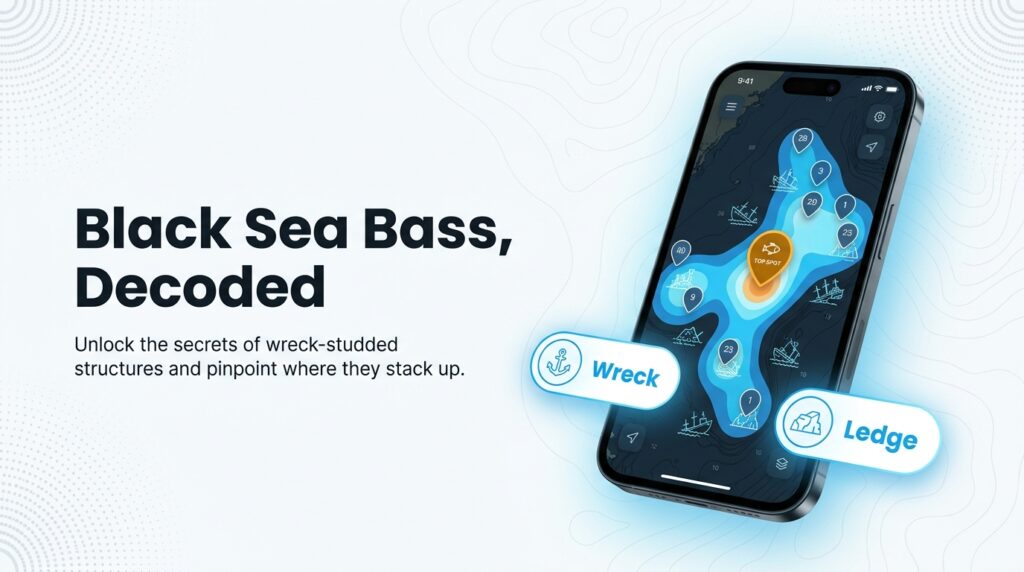
Black sea bass are plentiful, usually willing to bite, and good on the table. On The Water describes the fillets as delicate and white, and FishTalk points to their large numbers and willingness to take a bait as what makes them dependable. If you want a bottom fish that fills the cooler and rewards a short run, this is a good one to target.
The fish is Centropristis striata, family Serranidae. The NOAA Fisheries species profile says the fishery operates from Maine to Florida, that the fish are found in association with structured habitats, and that there are 2 stocks, Mid-Atlantic and South Atlantic. Cape Hatteras roughly separates a migratory northern population from a resident southern one, and that same line divides who writes the rules.
This guide covers identification, habitat, tactics and how the rules work.
By the end, you should be able to identify the fish, pick a depth for the season, tie a hi-lo rig, and know which agency page to open before you keep one.
In this guide:
Overview: Identifying Black Sea Bass
Black sea bass belong to the sea bass and grouper family (Serranidae) and live on structure. Identification comes first, since the habitat, tactics and rules all depend on knowing what you have on the line.
How do you identify a black sea bass?
A black sea bass is a gray, brown or blue-black fish with a paler belly, a netted scale pattern, and a rounded tail with one elongated upper ray. The dorsal fin carries a dark spot near its rear and trailing filaments. Breeding males grow a hump behind the head and can turn bright blue.
Check these marks, in order:
- Color: Gray, brown or blue-black on the upper body, paler below. Scales give a netted look.
- Dorsal fin: White spots and stripes, filaments trailing from the spines, and a dark spot on the last dorsal spine.
- Tail: Rounded, with an elongated top ray. The bigger the fish, the longer the ray.
- Breeding males: A nuchal hump (the bump behind the head) and bright blue coloring during spawning. Anglers call these fish humpbacks or knobheads.
Behavior and the sex change
Black sea bass school on and around structure, which fits the structured habitat NOAA describes. Expect them tight to the bottom, stacked near relief.
Are they good to eat?
Yes. On The Water calls them delicate, white fillets that work in a range of recipes and whole preparations. Keep only legal fish, covered below.
Not striped bass, not Chilean sea bass
Black sea bass are not striped bass, which belong to a different family. "Chilean sea bass" is a market name for Patagonian toothfish, which is unrelated.
Black Sea Bass Habitat & Range
Structure and the stock split explain where to fish and why the rules differ.
NOAA gives the range as Maine to Florida.
| Habitat feature | Why it matters |
|---|---|
| Wrecks and artificial reefs | Hold crabs, shrimp and baitfish |
| Rock piles and ledges | Vertical relief that breaks current |
| Irregular hard bottom | Primary southern habitat |
| Bays and coastal areas | Spring and summer movement in the north |
Two stocks and the Cape Hatteras line
Researchers describe two distinct Atlantic populations separated at Cape Hatteras, based on growth and behavioral differences. The northern population migrates seasonally, and the southern population does not. That biological line is also roughly the management line.
What structure holds black sea bass, and why
The Tackle Room describes shipwrecks as sea bass condominiums. Metal and wood hold small crabs, shrimp and baitfish, and vertical relief creates current breaks where fish can ambush food without fighting the flow.
Look for these structure types:
- Wrecks
- Artificial reefs
- Rock piles
- Natural ledges
- In the south, irregular hard bottom, which SAFMC describes as core habitat
On sonar, that shows up as vertical relief with bait marks tight to it.
Water temperature, migration and season
Per NOAA, fish move offshore and south in fall, then return north and inshore to coastal areas and bays in spring. Southern fish stay largely resident.
On The Water describes the southern New England pattern: fish move inshore to spawn in spring and finish spawning in 20 to 40 feet of water in June. In fall they head south and west to winter in deep water off the Mid-Atlantic. Depths shift with year, water temperature and location.
The northward shift, and what nobody knows yet
The northern stock has expanded into the Gulf of Maine and increased in number, while the southern stock has declined. After strict regulations in 2010, the population began declining again in 2013, which suggests other factors, such as the environment, may be at play. How this plays out over the next decade is not settled.
Companion species
In the north, scup and tautog share structure with black sea bass. In the south, anglers commonly catch black sea bass while bottom fishing for grouper or snapper, according to the Florida FWC species profile.
Northeast vs. Southeast at a glance
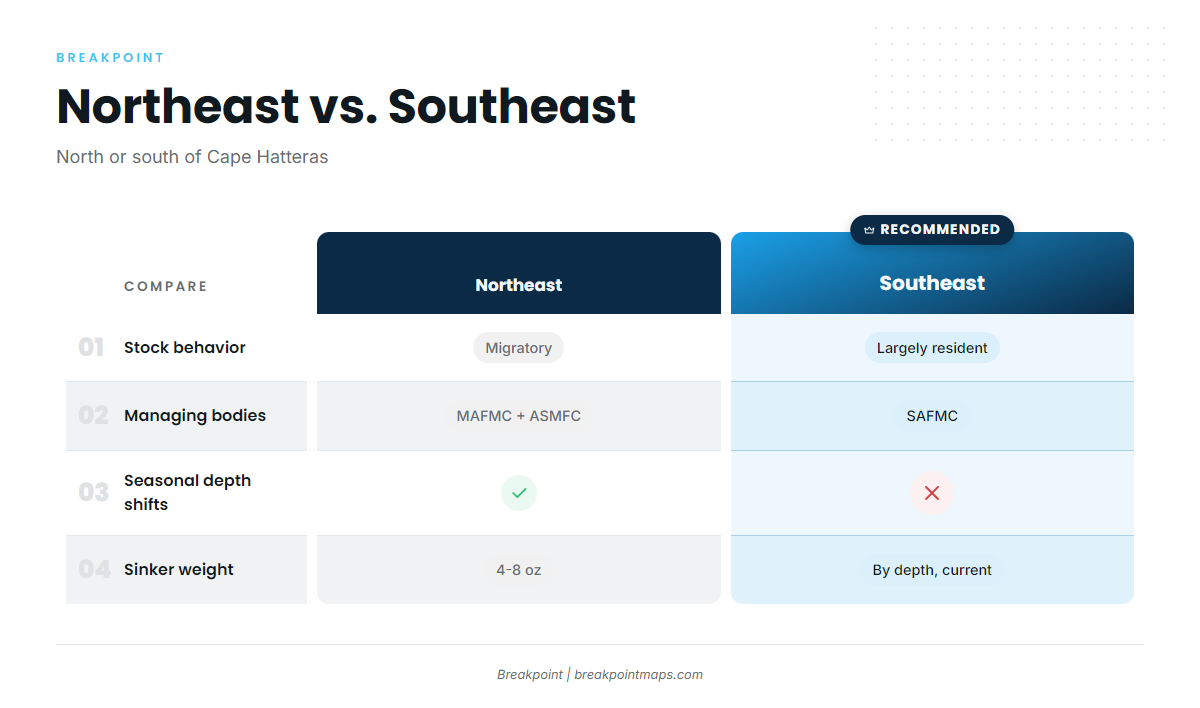
| Factor | Northeast (north of Cape Hatteras) | Southeast (south of Cape Hatteras) |
|---|---|---|
| Stock behavior | Migratory | Largely resident |
| Typical depths by season | Spring: inshore to water less than 120 ft once bottom water exceeds 7°C. Fall: offshore to wintering areas at 240 to 540 ft. | Year-round on hard bottom. The South Atlantic council lists a general depth range of 2 to 130 meters (about 7 to 427 feet), with a mean of 20 to 35 meters. |
| Typical size | Winter jumbos of 5 to 6 lb targeted on party boats November to January (On The Water) | No sourced size figure |
| Managing bodies | MAFMC and ASMFC, implemented by NOAA Fisheries | SAFMC, implemented by NOAA Fisheries |
| Gear weight | 4 to 8 oz sinkers by current and depth (FishTalk) | Adjust for depth and current. FWC’s light-to-medium guidance applies to shallower fish. |
Use these figures as starting points, not rules.
Northeast
North of Cape Hatteras, the fish move. They come inshore in spring, go deeper through summer, and head back offshore in fall. Winter party boat trips target the biggest fish in deep water.
[Regional page link goes here when published.]
Southeast
South of Cape Hatteras, the fish are resident on hard bottom and often mixed with snapper and grouper. The task there is finding the right structure rather than following a migration.
[Regional page link goes here when published.]
How to Catch Black Sea Bass: Tactics
Finding structure on charts and sonar
Look for irregular bottom contours and marked artificial reef sites on your chart plotter, per The Tackle Room. Take Me Fishing notes that unmarked spots often hold more promise than marked reefs. On sonar, look for vertical relief with bait tight to it. Chart layers are not for navigation.
Anchoring vs. drifting
Anchoring holds you over a tight wreck, while drifting covers scattered hard bottom and ledges. Wind and current decide which works on a given day.
How to tie a hi-lo rig for black sea bass
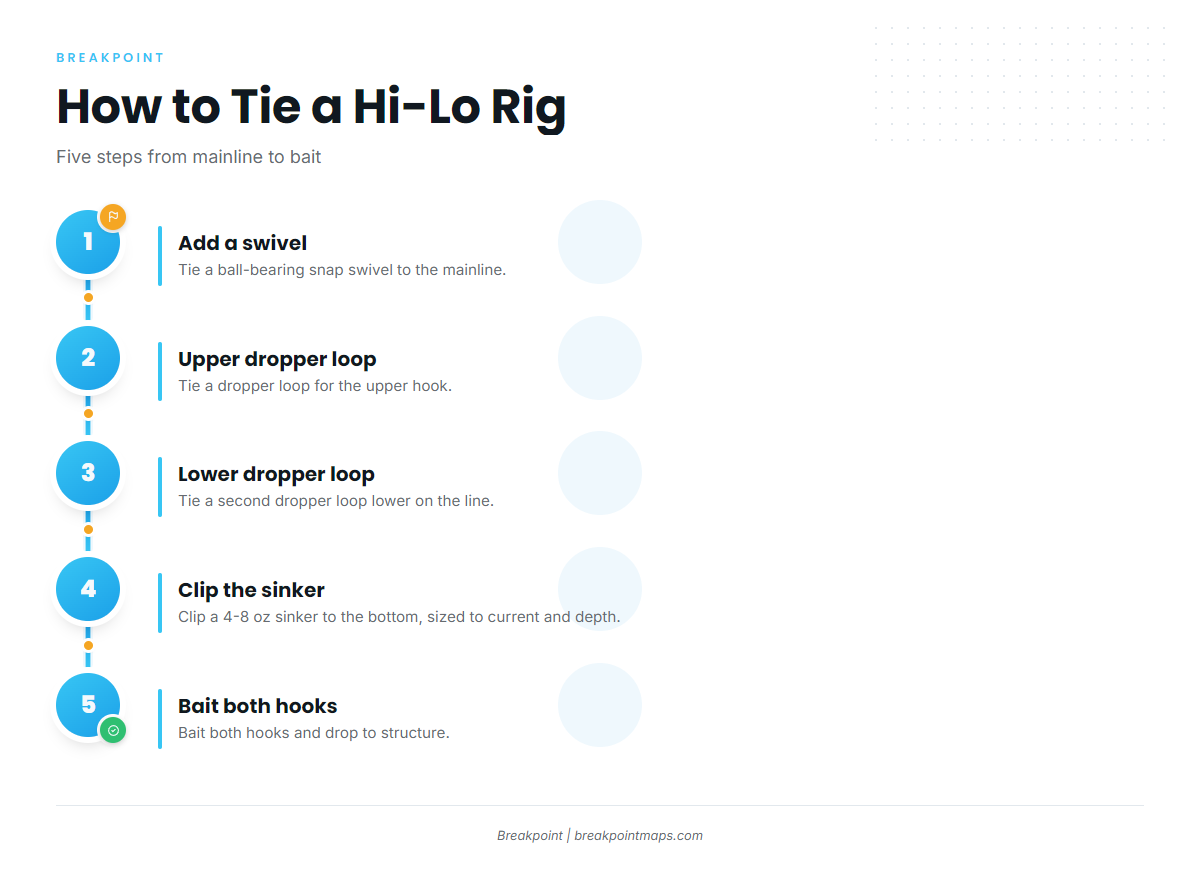
The basic build:
- Tie a ball-bearing snap swivel to the mainline.
- Tie a dropper loop for the upper hook.
- Tie a second dropper loop lower on the rig.
- Clip a sinker to the bottom. FishTalk suggests 4 to 8 oz depending on current and depth.
- Bait both hooks.
A common variant puts a bucktail or diamond jig at the bottom with a single teaser hook on a dropper loop about 18 inches above, per The Tackle Room. The jig brings fish in with flash and vibration, and the teaser catches the followers.
Starter gear list
- A 7 ft medium rod and a reel with 20 to 30 lb line for deeper water (FishTalk)
- Light to medium spinning or baitcasting tackle with 10 to 20 lb test line for shallower fish (Florida FWC)
- 4 to 8 oz sinkers
- Ball-bearing snap swivels
- A measuring board
Best bait, and when jigs win
| Option | What anglers use |
|---|---|
| Bait | Squid strips, clam, cut bait |
| Jigs | Leadhead or bucktail jigs tipped with bait, soft-plastic trailers or Gulp |
Both bait and jigs catch black sea bass. Some anglers also use slow-pitch jigging for bigger fish.
Stop line twist
The Tackle Room calls line twist the number one rig killer on sea bass trips. A ball-bearing snap swivel between the mainline and the top of the rig prevents it.
Regional adjustments
In the north, follow the migration and move deeper through summer. In the south, fish resident hard bottom, where sea bass often mix with snapper and grouper. Adjust sinker weight to depth and current, and use the table above as a reference.
If you don’t have a boat, party boats and charters run sea bass trips in both regions.
Black Sea Bass Regulations: Who Sets the Rules
Rules change often, so verify before you fish.
The management map
North of Cape Hatteras, ASMFC black sea bass management is shared with the Mid-Atlantic Fishery Management Council under the Summer Flounder, Scup and Black Sea Bass Fishery Management Plan. NOAA Fisheries implements the rules. ASMFC uses regional state groupings, so confirm your state’s grouping on the ASMFC page.
South of Cape Hatteras, the South Atlantic Council species page covers management, hard-bottom habitat and the size and measurement rule.
Stock status, per NOAA:
- Mid-Atlantic stock: Not overfished and not subject to overfishing.
- South Atlantic stock: Not overfished and not subject to overfishing.
Confirm the current northern harvest limits on the MAFMC or ASMFC pages.
Why the rules vary so much
The two stocks have separate councils. In the north, states set size, bag and season within regional targets, and limits get adjusted as assessments and harvest limits change.
Federal vs. state waters
Federal rules may not match state rules at a given moment. Delaware, for example, announced that Delaware’s 2026 rule update applies in both state and federal waters. Follow the rules for where you are fishing and where you land, and confirm the exact wording with the agencies.
How is a black sea bass measured?
Black sea bass are measured by total length, from the tip of the snout to the tip of the tail, excluding the filament at the end of the tail. Confirm the wording on the SAFMC page for south of Cape Hatteras, and check each northern state’s page separately, since they may not be identical.
Agencies and where to find their rules
| Agency | Jurisdiction | Where to find it |
|---|---|---|
| NOAA Fisheries | Federal implementation | Species page (linked above) |
| ASMFC | Atlantic coast, north of Cape Hatteras | Species page (linked above) |
| MAFMC | Mid-Atlantic federal waters | Search the council’s black sea bass page |
| SAFMC | South Atlantic federal waters | Species page (linked above) |
| Massachusetts DMF | Massachusetts | Search the agency’s recreational regulations page |
| NY DEC | New York | Search the agency’s recreational regulations page |
| NJDEP | New Jersey | Search the agency’s recreational regulations page |
| DNREC | Delaware | Search the agency’s recreational regulations page |
| NC DMF | North Carolina | Search the agency’s recreational regulations page |
| SCDNR | South Carolina | Search the agency’s recreational regulations page |
| GA DNR | Georgia | Search the agency’s recreational regulations page |
| FWC | Florida | Species profile (linked above) |
Release and barotrauma checklist
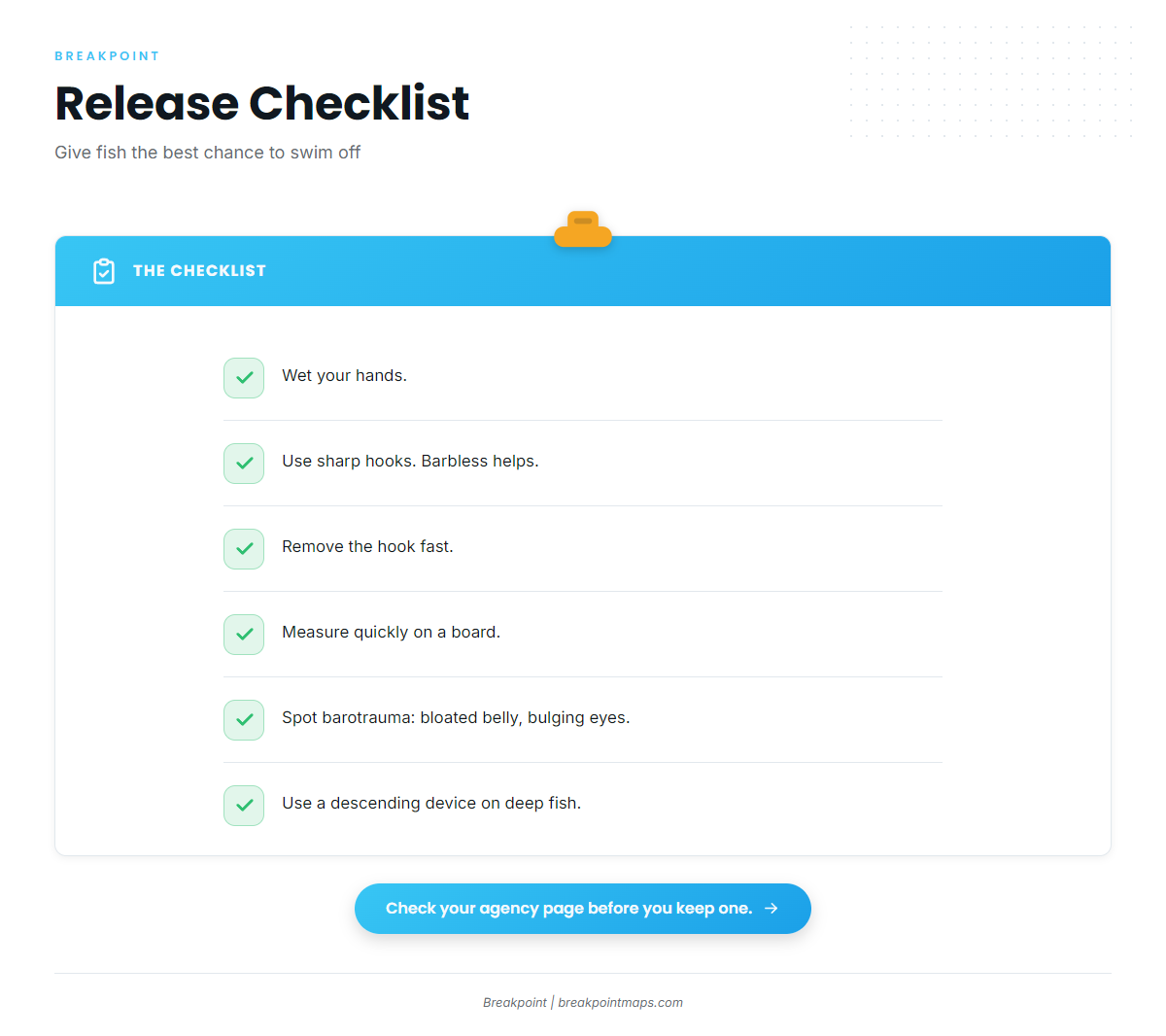
Use this before every release:
- Wet your hands before touching the fish.
- Use sharp hooks. Barbless hooks help, per Take Me Fishing.
- Remove the hook fast.
- Measure quickly on a board.
- Know the signs of barotrauma: a bloated belly, bulging eyes, stomach pushed from the mouth.
- Use a descending device to return deep fish to depth.
Check SAFMC for current descending device requirements in South Atlantic federal waters.
Frequently Asked Questions
Are black sea bass good to eat?
Yes. On The Water describes delicate, white fillets that work in a wide range of recipes. Keep only legal fish, and check the size, bag and season for where you land before you keep any.
What’s the best bait for black sea bass?
Squid strips, clam and cut bait are the classics. Jigs tipped with bait or scented soft plastics like Gulp also work.
How deep are black sea bass?
In spring, black sea bass move inshore to water less than 120 feet deep once bottom temperatures exceed 7°C. In fall, they move to offshore wintering areas at 240 to 540 feet. In the south, fish stay on hard bottom year-round. The South Atlantic council lists a general range of 2 to 130 meters (about 7 to 427 feet).
How is a black sea bass measured?
By total length, tip of the snout to tip of the tail, excluding the filament at the end of the tail, per the SAFMC wording. Check the rule for the state where you land, since northern states set their own details.
Who sets black sea bass regulations?
MAFMC and ASMFC manage the fishery north of Cape Hatteras, and SAFMC manages it south. NOAA Fisheries implements the rules, and states set their own details within those frameworks.
Should I use a descending device?
Yes, for fish showing barotrauma from deep water. A descending device returns them to depth. Check SAFMC for current requirements in South Atlantic federal waters.
Closing: Build Your Short List
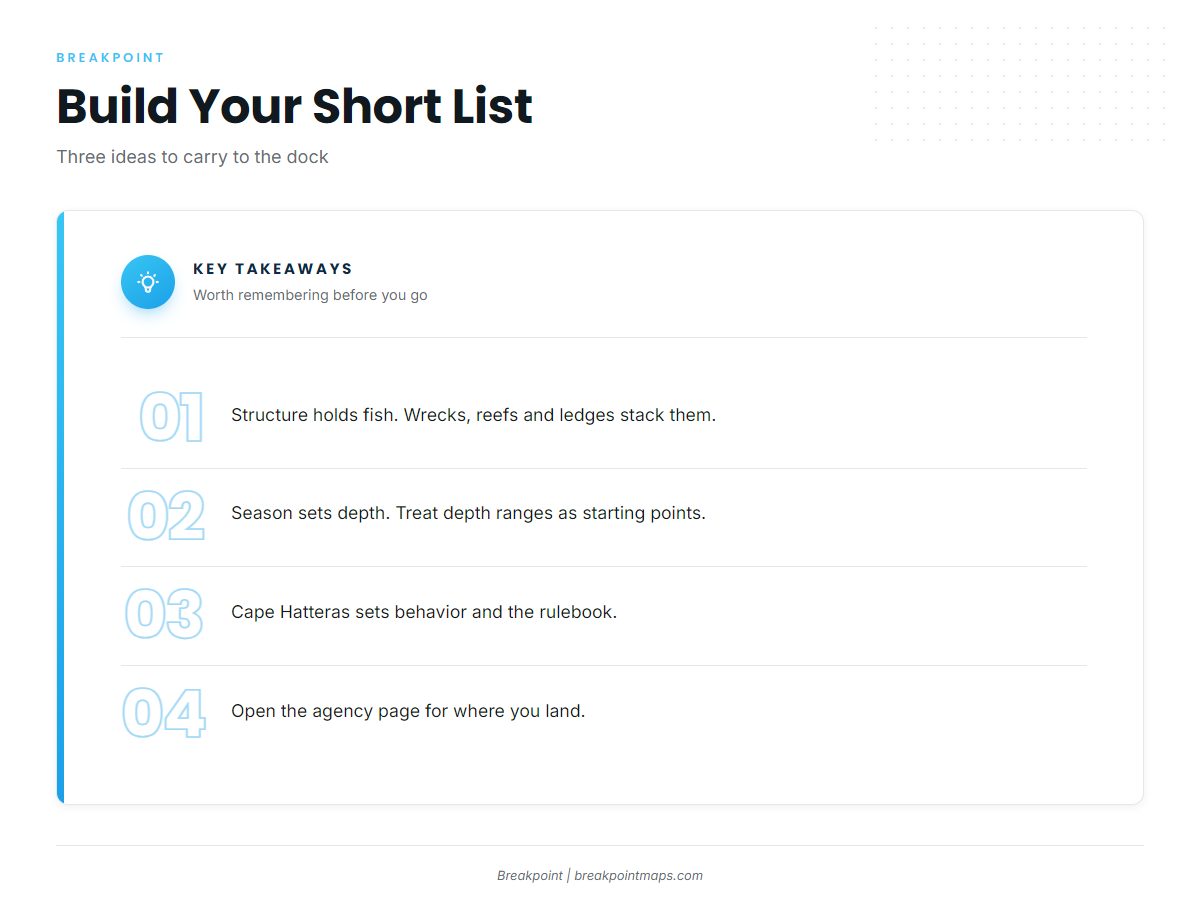
Structure holds fish, season sets depth, and Cape Hatteras marks the change in both behavior and rulebook.
Before your trip, work through this list:
- Pick 3 to 5 pieces of structure at the right seasonal depth.
- Rig a hi-lo with a ball-bearing swivel.
- Open the agency page for where you will land.
Breakpoint’s Hotspots and Fish Intel layers show where structure and bottom-fish activity have been reported, so you can build a short list of wrecks and ledges before you leave the dock. Chart layers are not for navigation.