


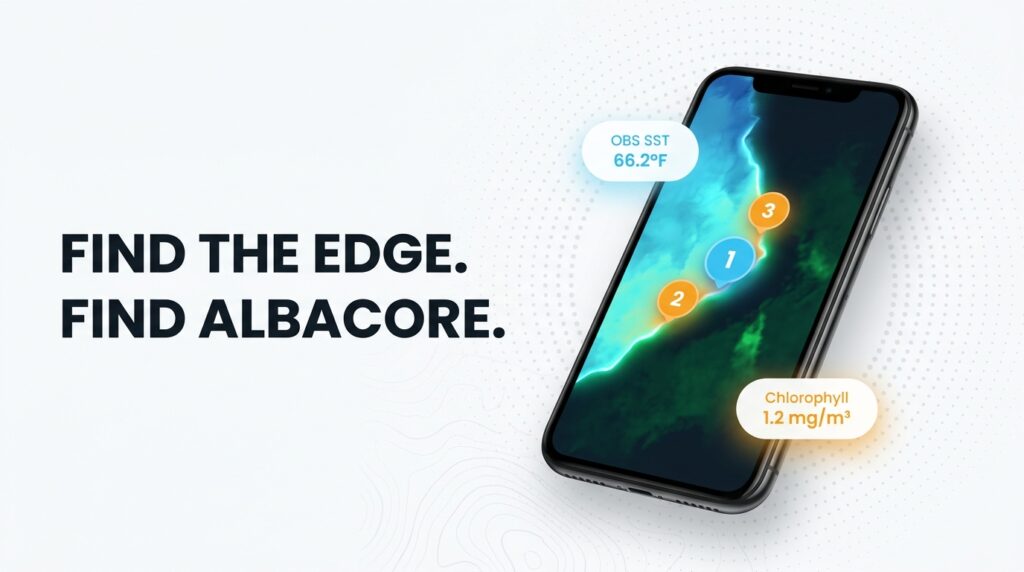
Pacific Northwest boats run 30 to 60 miles past their salmon grounds for albacore. Albacore (Thunnus alalunga) are the long-finned, white-meat tuna of the North Pacific. They bite eagerly, and NOAA Fisheries says they are the only tuna that can be labeled "white meat" when canned. The run is worth it for a capable boat and crew in a good weather window, and not worth forcing on a marginal day. This guide covers how to identify albacore, where they hold, how to find and keep a school, how to keep the meat in good condition, and where to check the rules.
Overview
Albacore are a highly migratory tuna found across the North Pacific. NOAA Fisheries manages them as two Pacific stocks, North and South. If you already fish tuna elsewhere and want the regional comparison first, see our Pacific Northwest albacore breakdown.
Identification
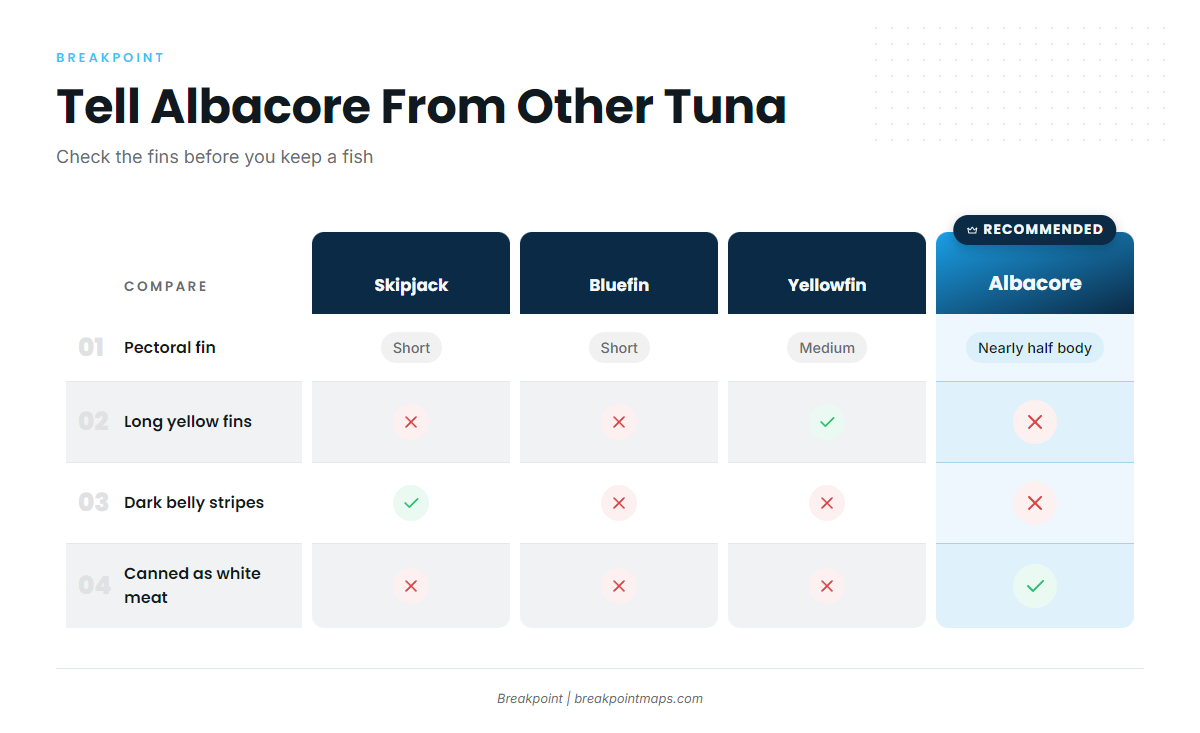
The pectoral fins are the giveaway. NOAA Fisheries describes them as exceptionally long, nearly half the length of the body. That description comes from NOAA’s page on the Atlantic population of the same species (Thunnus alalunga), so we use it here only for anatomy.
Size varies widely. NOAA lists a maximum of more than 4 feet and 88 pounds. Salt Water Sportsman describes a typical Pacific Northwest catch as anything from 5-pound "footballs" to fish in the 50 to 60 pound class.
Use this table to sort a mixed catch:
| Species | Pectoral fin | Other quick tell | Note |
|---|---|---|---|
| albacore | Very long, reaching past mid-body | Slim, torpedo-shaped body | The only tuna labeled "white meat" when canned |
| yellowfin tuna | Moderate length | Long yellow second dorsal and anal fins | Rare this far north |
| bluefin tuna | Short | Deep, barrel-shaped body | Confirm the ID before you keep anything |
| skipjack | Short | Dark horizontal stripes on the belly | Often smaller than albacore |
NOAA reports that albacore schools sometimes include skipjack, yellowfin and bluefin, so identify each fish before it goes in the box.
Albacore is low in fat and cholesterol, and NOAA says it has the most omega-3 fatty acids of any tuna species. That is the only food-value claim we make here.
Behavior
Albacore school, move fast and travel long distances. They follow warm, clear water and the forage that rides with it. Salt Water Sportsman describes fleet crews running and gunning, looking for birds and jumping fish. Guides add tuna boils and marine mammals as cues to slow down and start fishing. Those cues come from guide practice, not agency data.
Habitat & Range
Albacore follow warm, clear oceanic water. Off Washington and Oregon, that water arrives offshore in summer and pushes toward the coast in some years and not others.
Migration & Season
Albacore range across the North Pacific and move northeast toward the West Coast in summer and fall. They spend winters offshore in the central Pacific.
Pacific Northwest albacore effort typically runs from midsummer into fall. Salt Water Sportsman describes warm water off Washington and Oregon from mid-July until the October storms. Timing can shift by 4 to 6 weeks from year to year, depending on ocean conditions.
Charter and tackle sources commonly cite a rule of thumb:
- Warm El Niño years tend to bring fish earlier and closer.
- Cold La Niña years tend to push them later and farther out.
Treat that as a pattern, not a promise.
Westport, Washington is the largest charter and private boat port for albacore in the Northwest, according to Salt Water Sportsman. Ilwaco, Newport and Charleston also see steady effort. For port-by-port timing and runs, see our Pacific Northwest albacore breakdown.
Temperature and Color Breaks
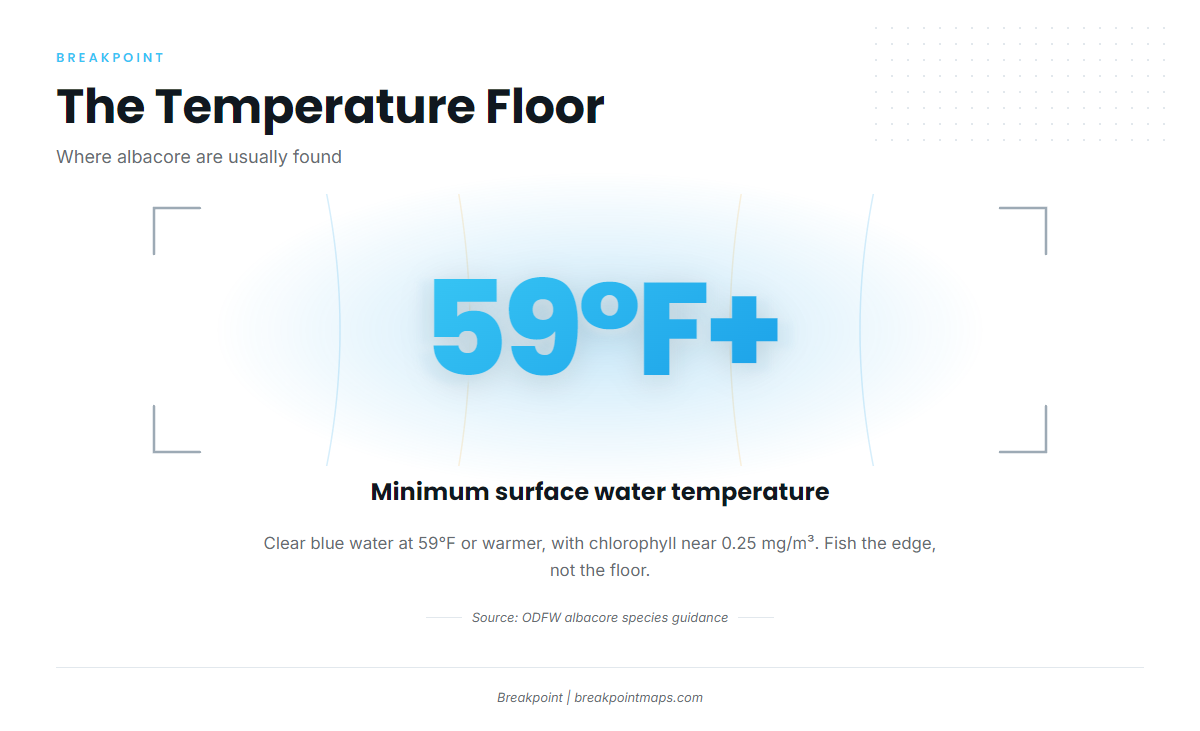
ODFW says albacore are usually found where surface water is at least 59°F and distinctly clear blue, with chlorophyll around 0.25 mg/m³. Many anglers target the low to mid 60s. Details are in ODFW’s albacore species guidance.
Sources differ slightly on the number. ODFW sets the floor at 59°F, while charter and tackle sources commonly cite 62 to 68°F as the preferred band. Use the agency figure to decide whether to look, and the wider band to decide where to fish.
The edge to look for is a sharp line where cold, dark green water meets warmer aqua blue water. Fronts like that stack forage along the break, and albacore work it. When an SST break and a chlorophyll break line up, the signal is stronger than either one alone. In the app, those are two views you compare: OBS SST and Chlorophyll.
Satellites cannot see through cloud. We watch the same SST passes you do, and when fog or cloud blocks them, the last clear image may be days old. Check its date before you trust it. A forecast model is a forecast, not an observation.
Distance from Port
There is no fixed distance. Charter and tackle sources commonly cite 40 to 60 miles offshore in warm years and 100 to 150 miles in cold years. Salt Water Sportsman notes that fast boats can reach fish in as little as 2 hours. The water decides.
The same port can be a 40-mile day one season and out of range the next. Match the run to your boat’s fuel range with reserve, and don’t plan around where the fish were last year.
Tactics
Most albacore fishing in the Northwest follows one pattern: troll to find them, then stop to keep them. Trolling covers water and finds a school. Stopping on the school keeps it near the boat.
Gear
This baseline is drawn from common tackle-source guidance. Adjust it to your boat and crew.
Core line and reel setup:
- Braided line of 30 to 50 pound test
- Fluorocarbon leaders of 20 to 30 pounds
- Reels with high line capacity for long, fast runs
Trolling lures:
- Cedar plugs, the long-standing classic
- Tuna feathers (skirted jigs)
Stopped-boat kit:
- Iron (flutter jigs)
- Lead-head swimbaits
- Live anchovy, if you carry it
Trolling Spread
ODFW says albacore anglers often troll cedar or diving plugs at 5 knots or faster. Charter and tackle sources commonly cite 6 to 9 knots. Start at the low end and speed up until the lures track cleanly.
Tackle sources describe a spread of 4 to 6 lures, with surface lines 20 to 50 feet back and deeper lines 80 to 100 feet back. Treat that as a rule of thumb. Work along temperature breaks and color changes, and watch for birds and jumpers.
Late in the season, tactics shift. Salt Water Sportsman’s PNW tactics describe swapping skirted lures for lead-head swimbaits trolled at 3 knots about 125 feet back.
After the Hookup
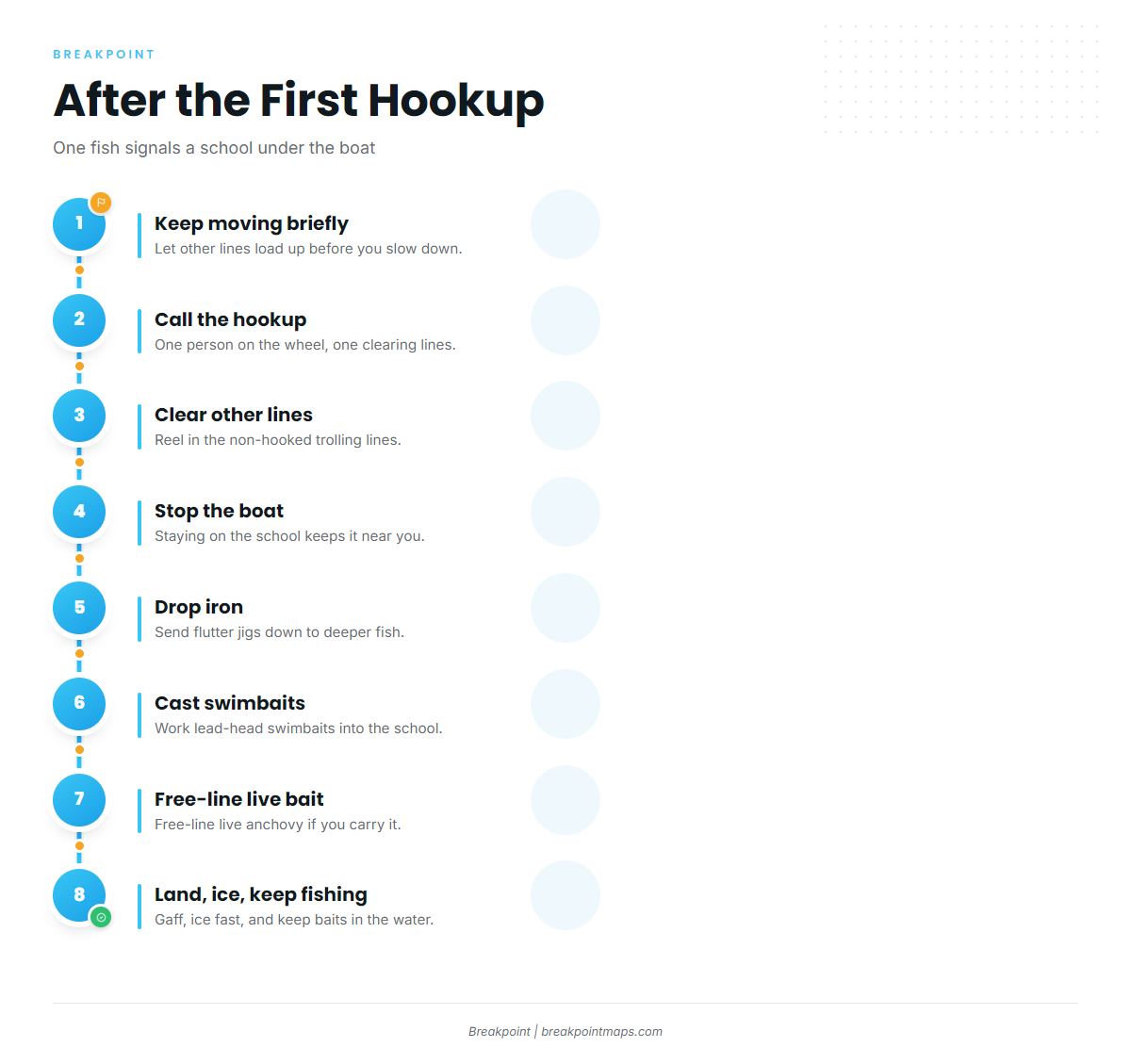
The first fish signals a school under you. Salt Water Sportsman describes this sequence:
- Keep the boat moving briefly so other lines can load up.
- Call the hookup and assign one person to the wheel and one to clearing lines.
- Clear the other trolling lines.
- Stop the boat.
- Drop iron to fish holding deeper.
- Cast swimbaits into the school.
- Free-line live anchovy if you carry it.
- Land the fish, ice it fast and keep baits in the water while the school holds.
For the iron and free-lined anchovy approach, the crew drops a flutter jig for fish holding 20 to 100 feet down. Late in the season, the same source describes sliding in next to the school, shutting down, chumming lightly, casting into the school and working the iron deep.
Handling & Bleeding
Handling determines meat quality and safety. Tuna held warm can form histamine, which causes scombroid poisoning. FDA guidance is to chill fish rapidly to 40°F after capture, as covered in this tuna handling and chilling guidance.
The general sequence:
- Stun the fish.
- Cut to bleed.
- Let it bleed out.
- Chill fast in ice or slush.
- Keep it cold to the dock and beyond.
For ice, brine and time-and-temperature detail, use the Albacore Vessel Quality Standards from the Oregon Albacore Commission.
Offshore Safety
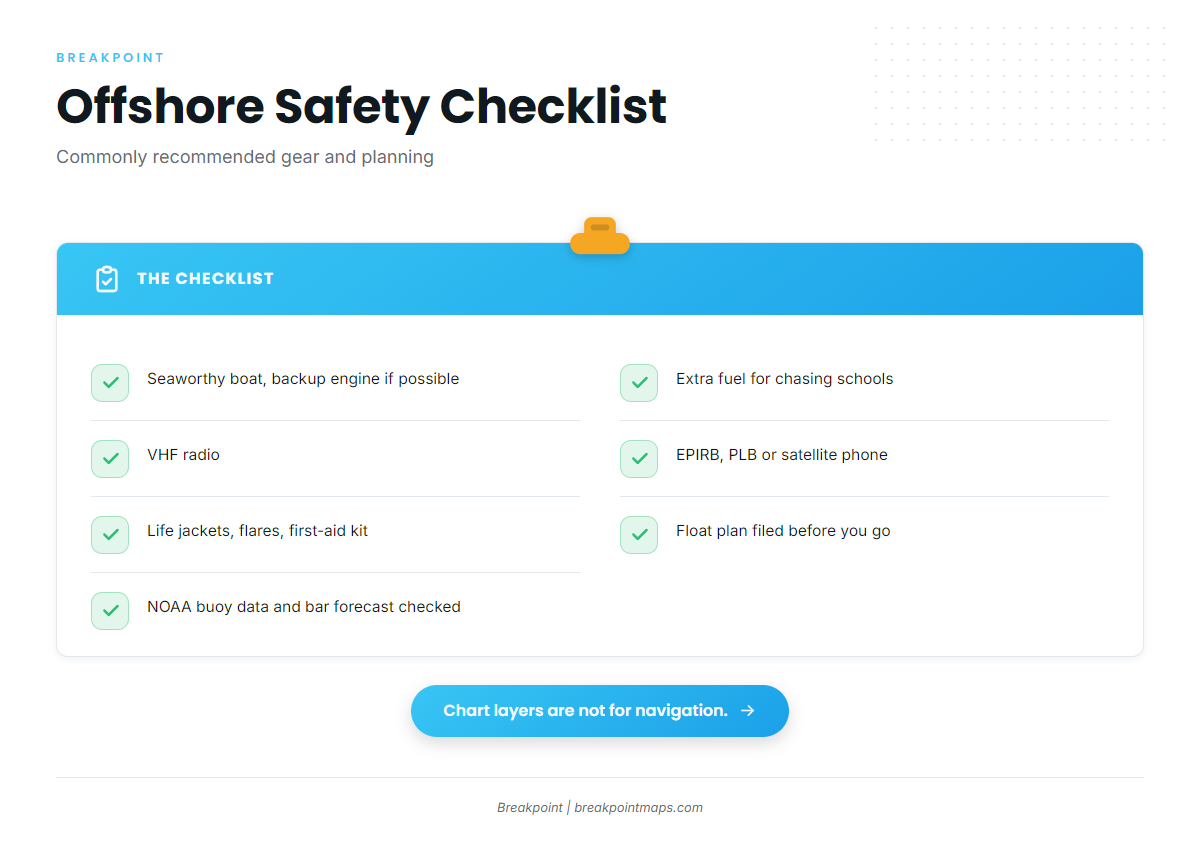
The distance demands preparation. Commonly recommended gear for a run this far offshore:
- A seaworthy boat, with twin engines or a backup if possible
- Extra fuel, because chasing schools burns it
- VHF radio
- An EPIRB or PLB, or a satellite phone
- Life jackets, flares and a first-aid kit
File a float plan, and check the NOAA National Data Buoy Center before you go. Pacific Northwest bars can close or turn dangerous faster than a forecast updates. The weather window you need covers the run home and the bar crossing, not just the fishing. Chart layers, including ours, are not for navigation.
Frequently Asked Questions
When is albacore season in Washington and Oregon?
Typically midsummer into fall. Salt Water Sportsman describes warm water off Washington and Oregon from mid-July until the October storms. Timing can shift 4 to 6 weeks with ocean conditions, so follow the water rather than the calendar.
How far offshore are albacore?
It varies. Charter and tackle sources cite 40 to 60 miles in warm years and 100 to 150 miles in cold years. The same port can be an easy day trip one season and out of range the next.
What water temperature do albacore like?
ODFW says at least 59°F in clear blue water. Anglers commonly target the low to mid 60s. Treat 59°F as the floor and fish the edge where warm blue water meets cooler green.
How do you tell albacore from yellowfin?
Albacore have pectoral fins that reach nearly half the body length. Yellowfin have long yellow second dorsal and anal fins. The identification table above lays out the differences for each species you might see.
Do you need a license to fish for albacore?
State licensing applies, and the details vary by state. Check WDFW, ODFW or CDFW for the state where you fish and land. Verify before each trip, because rules change.
How do you bleed albacore?
Stun the fish, cut to bleed and chill it fast toward 40°F to limit histamine. For time-and-temperature detail, use the Oregon Albacore Commission’s Albacore Vessel Quality Standards.
Conclusion
Look for the long pectoral fins. Find warm, clear blue water at 59°F or above, next to green water. Troll to find fish, then stop to keep them. Chill the catch fast, and check the rules and the weather window before you leave.
Before each trip, check the date on the last clear SST pass, the bar and marine forecast, and the agency rules. Breakpoint’s Fish Intel and hotspots layer OBS SST and Chlorophyll so you can see where the 60-degree edge sat on the last clear pass, and when it was last clear. It helps you decide where to look and does not promise fish.