Blackfin tuna fishing in the Atlantic Southeast depends on how far the Gulf Stream sits from your inlet. That distance sets when fish show up, how far you run and what you throw at them, from Cape Hatteras to the Atlantic side of the Keys. For biology, identification and general tackle, start with our blackfin tuna species guide. This page covers what changes in this region.
It covers when fish show up by sub-area, where the water concentrates them, how locals fish them and the rules you need to follow.
Regional Differences
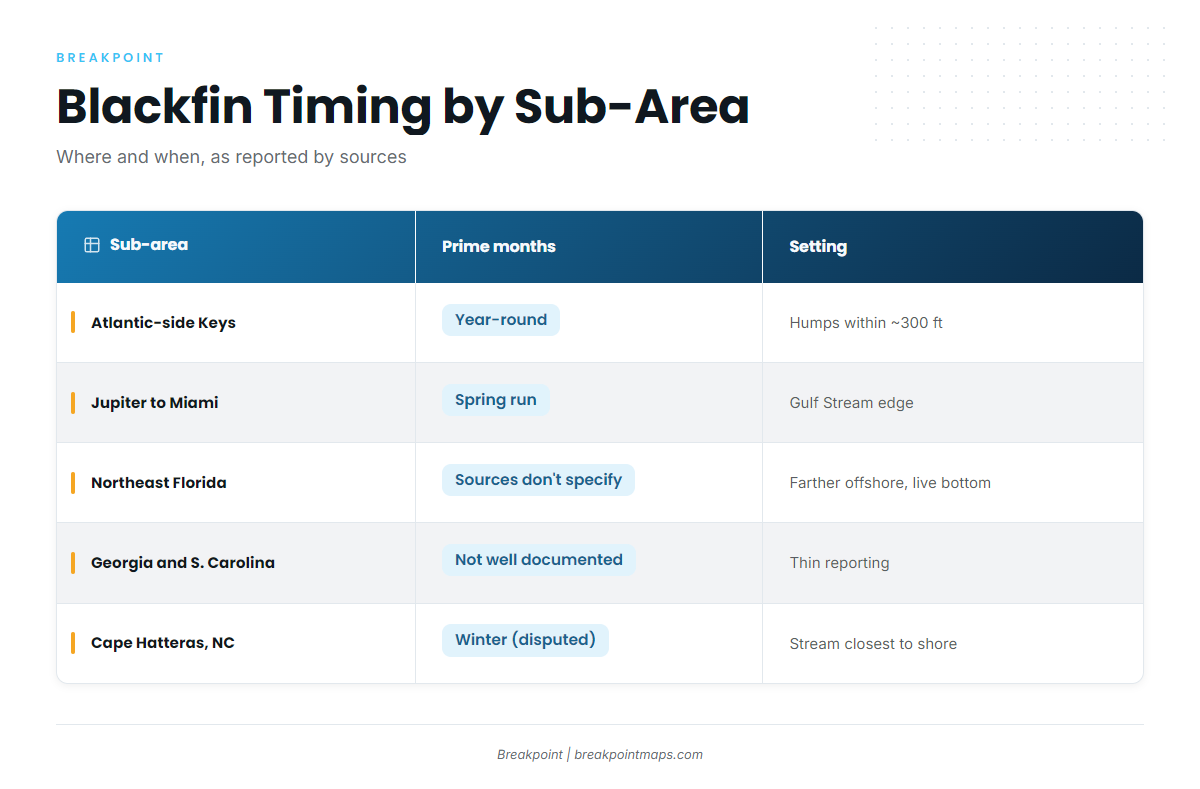
Timing follows the Gulf Stream. The Keys humps produce most of the year. Larger fish run from Jupiter to Miami in spring. Northeast Florida fish sit farther offshore. Cape Hatteras fishes best in winter, when the Stream comes closest to shore.
Sport Fishing Magazine reported on May 18, 2026 that blackfin flood South Florida waters in May, from the Keys up the coast to Palm Beach, and usually stay a few months. The table compares the sub-areas:
| Sub-area | Prime months | Typical setting | Source |
|---|---|---|---|
| Atlantic-side Keys | Year-round, most abundant spring through fall | Humps rising to within about 300 ft of the surface | Sport Fishing Magazine; Florida Sportfishing |
| Southeast Florida (Jupiter to Miami) | Spring run of larger fish, moving toward Palm Beach in May | Gulf Stream edge | Sport Fishing Magazine; Florida Sportfishing |
| Northeast Florida (First Coast) | Sources don’t specify | Farther offshore over live bottom, temperature breaks and current rips | Florida Sportfishing |
| Georgia and South Carolina | Not well documented | Not well documented | None |
| North Carolina (Cape Hatteras) | Winter, disputed | Where the Gulf Stream comes closest to shore | Sport Fishing Magazine |
Atlantic-Side Keys: A Year-Round Hump Fishery
Florida Sportfishing reports that blackfin can be caught year-round around the Keys humps, on virtually any day of the year. The Islamorada Hump is the best-known example. Sport Fishing Magazine notes that the bottom there rises to within about 300 ft of the surface. The rise creates upwellings that draw bait, and the bait draws fish.
Southeast Florida: The Spring Run, Jupiter to Miami
Florida Sportfishing reports that jumbo blackfin move through the southeast coast from Jupiter to Miami every spring. Sport Fishing Magazine puts the larger fish at 20 to 35 lb during the spring migration off Miami. The run builds toward Palm Beach in May.
Northeast Florida and Georgia: Farther Offshore
Off Florida’s First Coast, Florida Sportfishing says the action is much farther offshore, near live bottom, temperature breaks and current rips. Georgia-specific reporting is thin.
The Carolinas: Winter at Hatteras
Sport Fishing Magazine reports that blackfin move into the waters off Hatteras in winter. The western wall of the Gulf Stream runs closer to shore here than anywhere else in the region, which puts warm blue water within reach of a day boat. A retailer blog puts the 100-fathom curve about 30 miles out. Confirm that figure on a chart before you plan around it.
Sources disagree on North Carolina’s best months. Some point to summer, when warm water pushes north, but the strongest reporting points to winter. South Carolina is not well documented, so we print no months for it.
Habitat & Conditions in the Atlantic Southeast
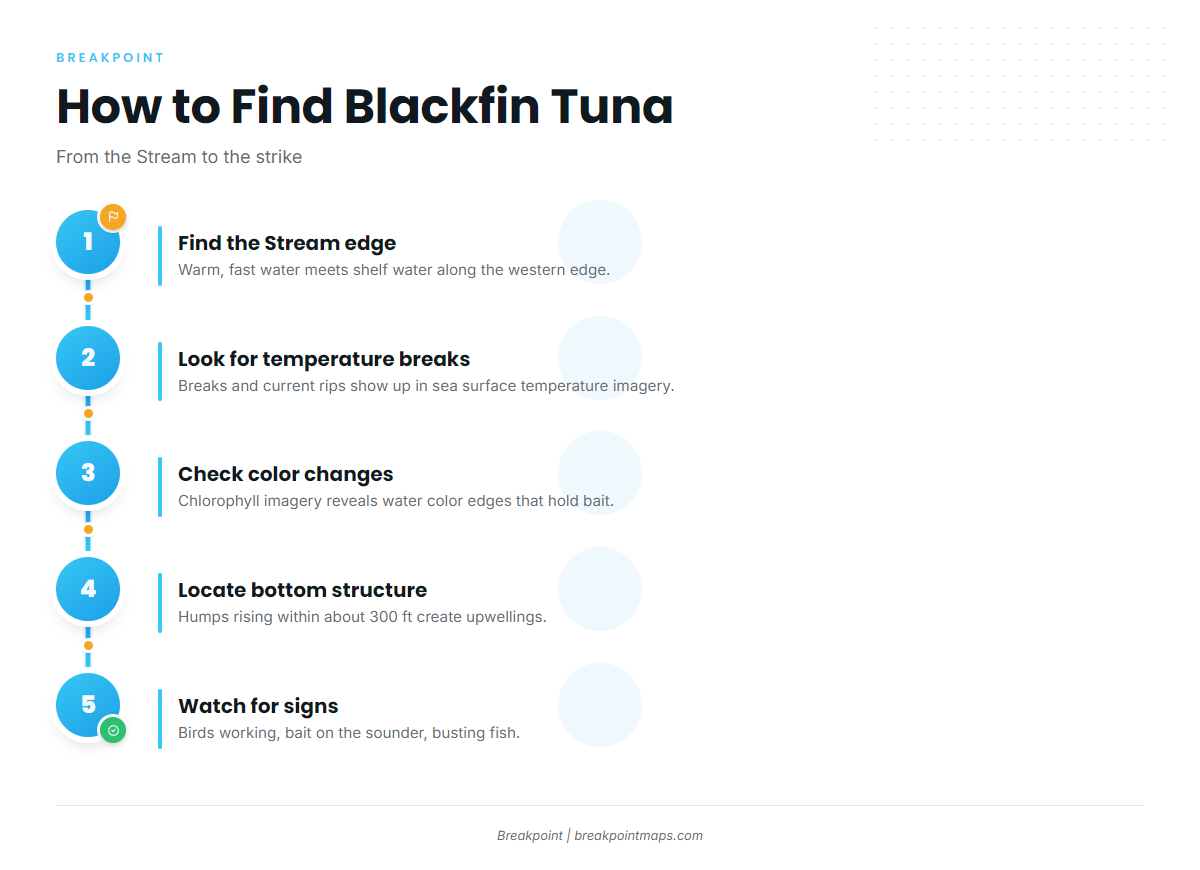
Fish sit where the Stream, the bottom and the bait line up. The sections below take those in order, from the biggest feature to the smallest sign on the water.
The Gulf Stream’s Western Edge
The Stream’s distance from shore explains most of the regional pattern, including why Hatteras fishes in winter and the Keys fish year-round. The western edge is where warm, fast water meets cooler shelf water, and that seam concentrates bait and the fish that feed on it. Sources give no dependable temperature ranges for blackfin here.
Temperature Breaks and Current Rips
Blackfin often school near the surface around temperature breaks, humps and current edges in spring and fall. Treat that as a tendency, not a rule.
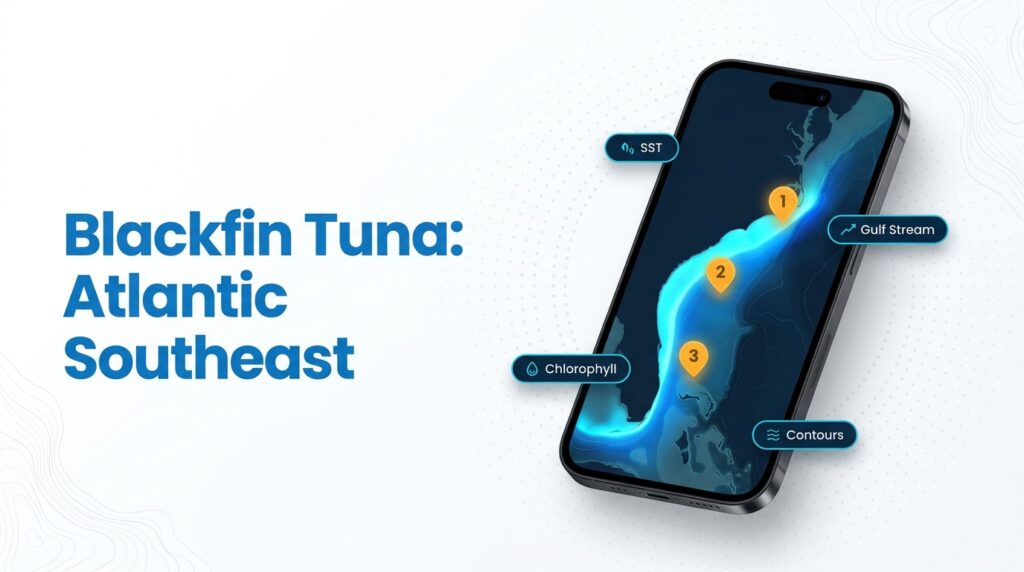
You can see much of this before you leave the dock. Temperature breaks show up in OBS SST, color changes in Chlorophyll, and bottom rises in Chart Contours. Cloud cover blocks satellite passes, so some days will have gaps in the imagery.
Humps and Upwelling
In the Keys, humps rise to within about 300 ft of the surface and create upwellings that attract bait and fish. The Islamorada Hump is the example most anglers know.
Bait
South Florida anglers lean on pilchards. In the Sport Fishing Magazine piece, Capt. Scott Stanczyk of Catch 22 in Islamorada is reported to head offshore only with about 1,000 pilchards in the livewell. Goggle eyes and ballyhoo are also common bait choices in the region.
Signs to Look For
Watch for these on the way out:
- Birds working: they mark bait pushed to the surface.
- Bait on the sounder or surface: no bait usually means no tuna.
- Busting fish: blackfin feeding on top are catchable on poppers and stick baits.
- Temperature and color edges: these line up bait along a seam.
Tactics for the Atlantic Southeast
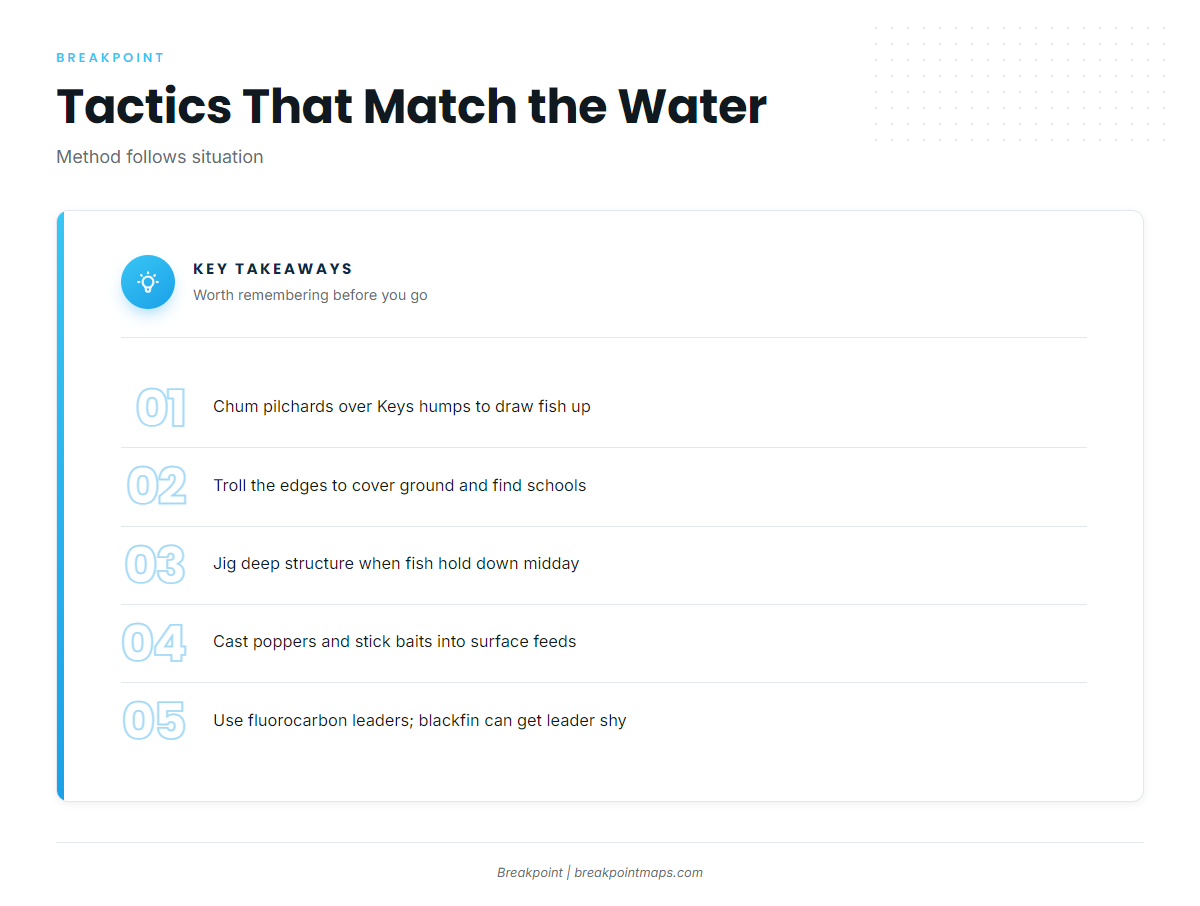
Most local methods share one approach: find bait, then draw the tuna to it. Pick the method that fits your sub-area and the day’s conditions.
Chumming Pilchards on the Keys Humps
Why it works here: Upwelling over the humps holds bait, and chum draws fish up from the water column.
Sport Fishing Magazine’s guidance is to chum, preferably with live pilchards, though dead chunks work fine. The rig it describes is a spinning rod with straight 30 lb monofilament and a No. 1 hook through the pilchard’s nose. Cut bonito or little tunny also makes a good chunk bait and scent trail.
Trolling the Edge
Why it works here: Trolling covers ground along breaks and helps you find the schools.
Small cedar plugs and feathers are standard. Blackfin often turn up as bycatch while trolling for other species, so a dedicated troll along a temperature edge is a reasonable way to locate fish before you stop and chum.
Vertical Jigging
Why it works here: It reaches fish holding deep over structure, including midday when they may sit below 200 ft.
Drop metal jigs over marks on the sounder and work them up through the water column.
Casting to Busting Fish
When blackfin blow up on bait at the surface, throw poppers and stick baits into the school. The action is fast and visual, and it works best when the fish are actively feeding.
Leaders and Terminal Tackle
Blackfin can get leader shy. Use fluorocarbon leaders, skip the wire and choose single hooks over trebles. Baseline tackle is covered in the species guide.
Bleeding and Icing the Catch
Bleed fish immediately and ice them heavily. Blackfin meat is lean and best eaten fresh.
A Note on Crossing the Gulf Stream
Wind against current stacks up steep seas. Watch the forecast, and turn back early if it builds.
Frequently Asked Questions
Do I need an HMS permit for blackfin tuna?
No. According to NOAA Fisheries permit guidance, blackfin tuna are exempt from the HMS Angling permit requirement that applies to other Atlantic tunas. Other tunas on the same trip may still require the permit, so check before you fish.
What is the blackfin tuna bag limit in Florida?
The limit is 2 fish per person or 10 per vessel, whichever is greater, in state and federal waters, according to the Florida Fish and Wildlife Conservation Commission. Rules change, so verify on the FWC site before you fish.
When is blackfin season off North Carolina?
The strongest reporting points to winter at Hatteras, where the Gulf Stream runs closest to shore. Some sources point to summer instead, so treat the timing as unsettled and check recent local reports before you commit to a trip.
Putting It Together
The same chain applies in every sub-area. The Gulf Stream’s distance sets the season, structure and upwelling hold the bait, and the bait holds the tuna. Your method follows from what the water is doing that day.
Breakpoint’s hotspots feature scores blackfin tuna in the Atlantic Southeast and sits alongside the OBS SST, Chlorophyll and Chart Contours layers. It helps you decide where to look and does not promise fish. Chart layers are not for navigation.