


Overview
Blue marlin fishing in the Atlantic Northeast happens at the cold edge of the species’ range. The window is short, and the fishery depends on warm eddies that spin off the Gulf Stream and push into the canyons.
For biology, tackle basics and the case for chasing blues at all, start with our blue marlin species guide. This page assumes you’ve already decided to go. It covers the Northeast specifics, roughly Virginia and Maryland north through New Jersey, New York and southern New England.
Below you’ll find when the window opens, which canyons to watch and from which ports, how local crews rig their spreads, and the federal rules, with sources and a check date. We can’t promise fish, but we can help you decide where to look.
Regional Differences
In the Atlantic Northeast, the blue marlin window runs from mid-July through the end of September. Sport Fishing Magazine calls it the optimum 10-week period to target blues in both near and offshore canyon waters.
Big fish do show up this far north. On Aug. 19, 2026, Capt. Damon Sacco and angler Walter Chapman landed what CBS Boston reported as the largest blue marlin off Massachusetts waters in living memory. The fish came from Atlantis Canyon, about 100 miles off Cape Cod. It measured more than 11 feet and weighed 1,260 lb, only 142 lb shy of the Atlantic world record. Its head went to the University of Maine, where scientists estimate the fish was 25 to 30 years old.
That catch is an outlier. Walt Golet, director of the University of Maine Pelagic Fisheries Lab, told CBS Boston: "I don’t suspect there will be a whole lot of blue marlin caught in the Atlantic in general that are going to top 1,200 pounds for the next several years." The water here is too cold for the species most of the year, so one giant fish shows what is possible rather than what is typical.
A few things follow for planning:
- You are fishing visitors, not residents. Numbers are smaller than in the Southeast or the Caribbean.
- Depth matters. Blue marlin are rarely found inside 100 fathoms, according to On The Water.
- You will share the water. White marlin and yellowfin tuna often dominate catch reports, while blue marlin encounters stay steady, per Southern Boating. Expect to fish a mixed spread in mixed water.
- The runs are long. More on fuel and range in the tactics section.
Water temperatures are shifting. Soundings reports that anglers once saw 77 to 78°F as the warmest water and now catch fish in 80°F water. The Outdoor Wire asks whether there are more fish or better anglers and answers "some of both." Range expansion is not settled science.
The region also hosts two big billfish events. The MidAtlantic tournament out of Cape May has produced numerous grander-class blue marlin, according to Southern Boating. The White Marlin Open in Ocean City is the region’s other major billfish draw.
Habitat & Conditions in the Atlantic Northeast
In spring, summer and fall, the Gulf Stream throws off warm-core eddies. They drift into canyon structure and meet colder shelf water and Labrador Current water, creating temperature breaks and bait concentrations. Blues follow both, according to BD Outdoors.
Canyons from South to North
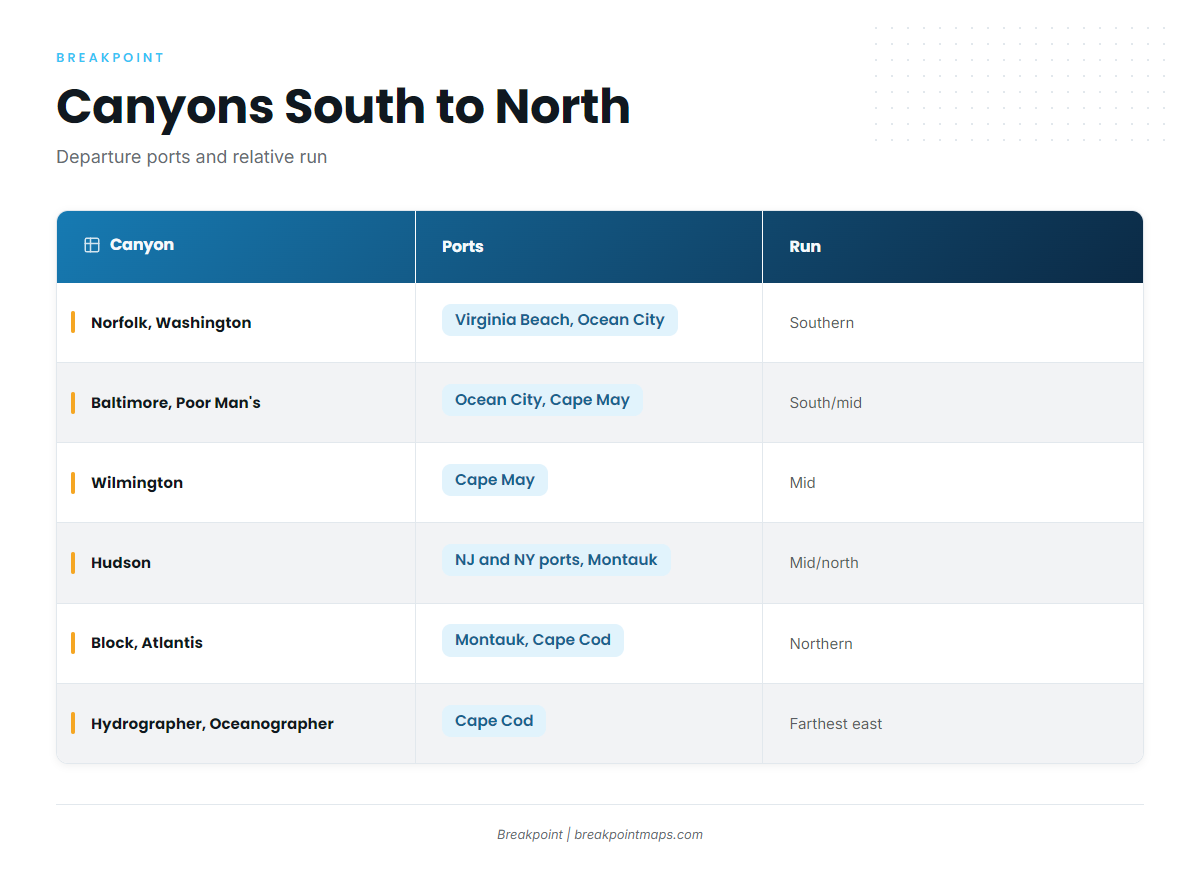
The table runs roughly south to north. We’ve listed only sourced details.
| Canyon | Typical departure ports | Relative run | Notes |
|---|---|---|---|
| Norfolk, Washington | Virginia Beach, Ocean City | Southern group | A Marlin Magazine trip report describes sulfur lines and rips in 320 feet of water at Norfolk |
| Baltimore, Poor Man’s | Ocean City, Cape May | Southern to mid group | Mid-Atlantic tuna and white marlin grounds |
| Wilmington Canyon off Cape May | Cape May | Mid group | Fed by Gulf Stream eddies that create the breaks and structure blues favor |
| Hudson | NJ and NY ports, Montauk | Mid to northern | Named as marlin water south of New York City (On The Water) |
| Block, Atlantis | Montauk, Cape Cod | Northern | Atlantis produced the 1,260 lb fish, about 100 miles off Cape Cod |
| Hydrographer, Oceanographer | Cape Cod | Farthest east | Hydrographer is at least a 250-mile round trip and troll from most Cape Cod ports (Fisherman’s Outfitter, 2015) |
The choice between southern and northern canyons comes down to access and pressure. The southern canyons are easier to reach from Mid-Atlantic ports. The eastern canyons see fewer boats because fewer can make the run, and Marlin Magazine puts the distant canyons at 120 to 160 miles out. A 2015 Fisherman’s Outfitter post says canyons from the Hudson to Oceanographer usually hold marlin when temperatures are favorable, but that is one angler’s observation, not current data. In any given year the water decides where the fish are, more than the calendar does.
Temperature Thresholds
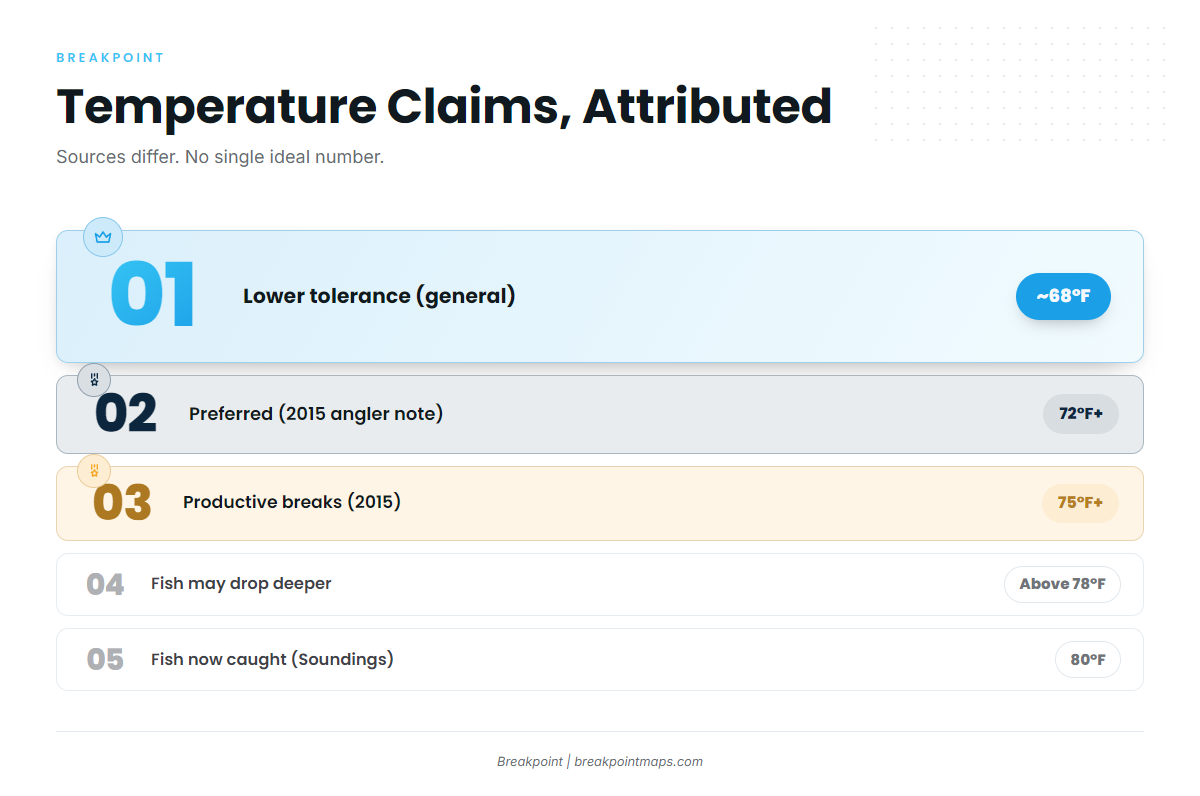
Sources disagree on numbers, so each is listed with its source rather than blended into a single "ideal" figure:
- About 68°F (20°C): Thought to be the lower tolerance limit, though individual fish have been caught in cooler water. This is general species biology from North Carolina’s marine fisheries agency, not Northeast-specific.
- 72°F and up: A Northeast angler writing in 2015 says blues prefer at least 72°F, with breaks on the warmer side of 75°F and higher seeming most productive.
- Above 78°F: Sport Fishing Magazine says fish may drop deeper toward the thermocline.
- 80°F: Soundings reports anglers now catch fish in water this warm.
- Tagging data: A 2022 blue marlin tagging study found tagged fish spent roughly 70% of their time shallower than 17 feet, mostly in 68.0 to 78.8°F water. The study was off Madeira, not the Northeast, so treat it as general behavior only.
Structure and Surface Signs
Several local sources point to the same features:
- The 500 curve. Fisherman’s Outfitter reports that temperature breaks along the 500 curve seem most productive for big blues.
- The 30 to 60 fathom lines. Southern Boating says crews working these lines along the canyon walls put real fish in the spread.
- Sulfur lines and rips. A single Marlin Magazine trip report describes them in 320 feet of water at Norfolk Canyon. One report doesn’t make a pattern, but it is worth knowing about.
Our read is to look for a clean temperature break that crosses the curve, rather than warm water sitting in open ocean. That is editorial judgment, not a catch claim. Before the run, sea surface temperature and chlorophyll charts can show where the blue-to-green edge and the break sit.
What the Data Can’t Tell You
Charts get you to the right neighborhood, but they have limits:
- Eddies shift overnight.
- Cloud blocks satellite SST passes, so a clear-looking chart can be days old.
- Surface temperature says nothing about what is happening near the thermocline.
- Range expansion is still an open question.
On the day, the water itself has the final say.
Tactics for the Atlantic Northeast
Northeast crews fish mixed spreads because blues share the water with tuna and white marlin. Targeting blues means tilting that spread, not replacing it. For general spread fundamentals, see the species guide. What follows is what changes locally.
Spread and Lures
A mix of spreader bars, ballyhoo and skirted lures catches marlin consistently in the canyons, according to On The Water. Beyond that baseline:
- Dredges. BD Outdoors calls the dredge the most important component of the Northeast canyon mixed trolling spread, with a canyon preference for a 36" or 40" single-tier artificial dredge.
- Big-fish lures. The Big Tuna Titan 45 and Titan 60 are slanted-face lures that imitate a tuna or skipjack already swimming in the spread. They draw tuna and, typically, big blue marlin.
- Tuna-heavy water. When tuna outnumber marlin, bullet-style lures are the usual call.
Natural Baits
Sport Fishing Magazine lists the favorite Northeast forage baits as squid, small mahi, tinker mackerel, skipjack and other small tunas. Soundings describes small ballyhoo pulled around dredges and teasers. Match lure and bait size to what is actually in the eddy.
Speed
Published speed figures are thin. A general reference gives a range of 4 to 8 knots with up to 8 lines out. One Marlin Magazine account from Norfolk Canyon has a crew trolling at 10 knots. That is a single trip report and not a recommendation.
Range and Fuel Planning
The runs shape the whole trip. The sources say:
- Hydrographer is at least a 250-mile round trip and troll from most Cape Cod ports.
- Marlin Magazine puts the more distant canyons at 120 to 160 miles offshore.
- Soundings reports one captain running as far as 225 miles, calling it "not a day trip but an excursion."
- Marlin Magazine notes that weather "can be horrible" 130 miles out.
Set your fuel reserve, weather window and float plan before you pick a canyon. If you are pricing a charter, Captain Experiences lists a full-day Massachusetts blue marlin trip at around $9,000, within a $7,000 to $10,000 range. That is a single-market figure, so confirm with captains directly.
Where the Water Lines Up
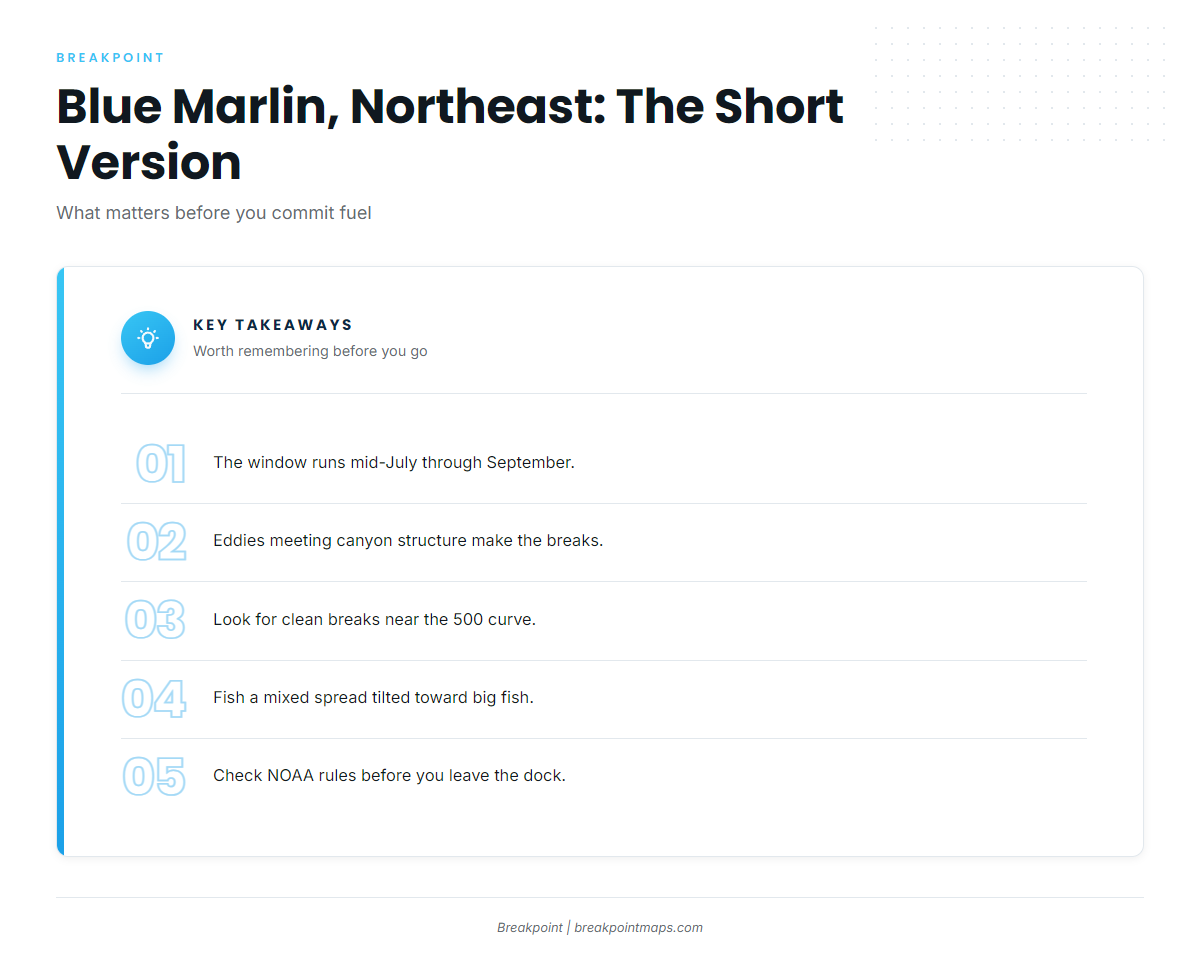
The pieces are mid-July through September, eddies against canyon structure, breaks near the curve, a mixed spread tilted toward big fish, and the rules checked before you leave the dock.
If you want a second look before committing fuel to a canyon run, Breakpoint’s hotspots feature scores blue marlin in the Atlantic Northeast. Chart layers are not for navigation, and it won’t promise a bite, but it should help you pick the right edge.
Frequently Asked Questions
When is blue marlin season in the Northeast?
Mid-July through the end of September. Sport Fishing Magazine calls it the optimum 10-week period. Eddy timing shifts the window from year to year, so watch the water as well as the calendar.
Which canyons hold blue marlin?
Anglers work canyons from Norfolk north to Oceanographer. Southern Boating cites Wilmington Canyon off Cape May, and the 2026 Massachusetts fish came from Atlantis. Water conditions on the day matter more than the canyon name.
What water temperature do blue marlin need?
Sources differ. General biology puts the lower limit near 68°F. A 2015 Northeast angler prefers 72°F and up, with breaks at 75°F and above. Soundings reports fish now caught in 80°F water. There is no single ideal number.
What permit do I need to fish for blue marlin?
NOAA Fisheries requires an HMS Angling permit, or an HMS Charter/Headboat permit on charter vessels. Verify the current requirement with NOAA before every trip.
Can I sell a blue marlin?
No. NOAA prohibits the sale or purchase of billfish, and all landings must be reported.