Jump to: Regional Differences · Habitat & Conditions · Tactics · Regulations
Overview
California yellowtail fishing in the Pacific Southwest covers the Southern California Bight from Point Conception to the U.S.-Mexico border, the Channel Islands, and the Coronado Islands and northern Baja waters that San Diego boats fish. Yellowtail (Seriola dorsalis) are most common south of Point Conception, according to CDFW’s Enhanced Status Report, dated 2022.
For biology, gear basics, and why they’re worth chasing, start with our California yellowtail species guide. This page covers the Pacific Southwest specifically.
The fishery here runs on water temperature and bait, and runs swing from year to year. We can’t promise fish, but we can help you decide where to look.
Regional Differences
Pacific Southwest yellowtail fall into two broad groups: resident fish around the islands and summer school fish that arrive when the water warms. How far north they push, and how long they stay, depends on the year’s temperature and bait.
CDFW reports that warm-water years typically raise landings and cooler years lower them, which is the El Niño and La Niña effect in plain terms. Check the current ENSO status with NOAA’s Climate Prediction Center. We are not calling the current phase here.
Bait explains most of the rest. CDFW lists the main prey as:
- Northern anchovy
- Pacific sardine
- Pacific mackerel
- Market squid
- Pelagic red crab
Where the bait is, yellowtail have a reason to be. Market squid are a major prey item.
Size classes vary by season. Channel Islands operators describe two groups: "mossback" or "home-guard" fish caught year-round, reaching 30 to 40 lb, and school fish of about 12 to 20 lb that are more common in summer. That is one operator’s description, not a survey. CDFW puts most fish in the fishery at 20 to 48 inches fork length.
Catalina
Salt Water Sportsman reports that in recent years Catalina has hosted the most consistent year-round fishing of any yellowtail water in the region. Many attribute that to El Niño, though that is an attribution and not a settled fact. The north shore gets much of the summer attention.
San Clemente
Large fish are often described on deeper, steep structure such as walls and pinnacles. The best fishing tends to be where the bottom drops off hard. Timing varies by year.
Coronados and San Diego nearshore
Catalina and the Coronado Islands are widely described as the traditional yellowtail grounds. Closer in, the kelp off Point Loma and La Jolla holds fish in summer and into fall, as long as the water stays warm.
What we don’t know
Northward movement in summer is believed, not established. How much fish move between Mexico and Southern California versus staying resident is not settled, and bait-dependent years can break any pattern. Treat seasonal windows as starting points, not schedules.
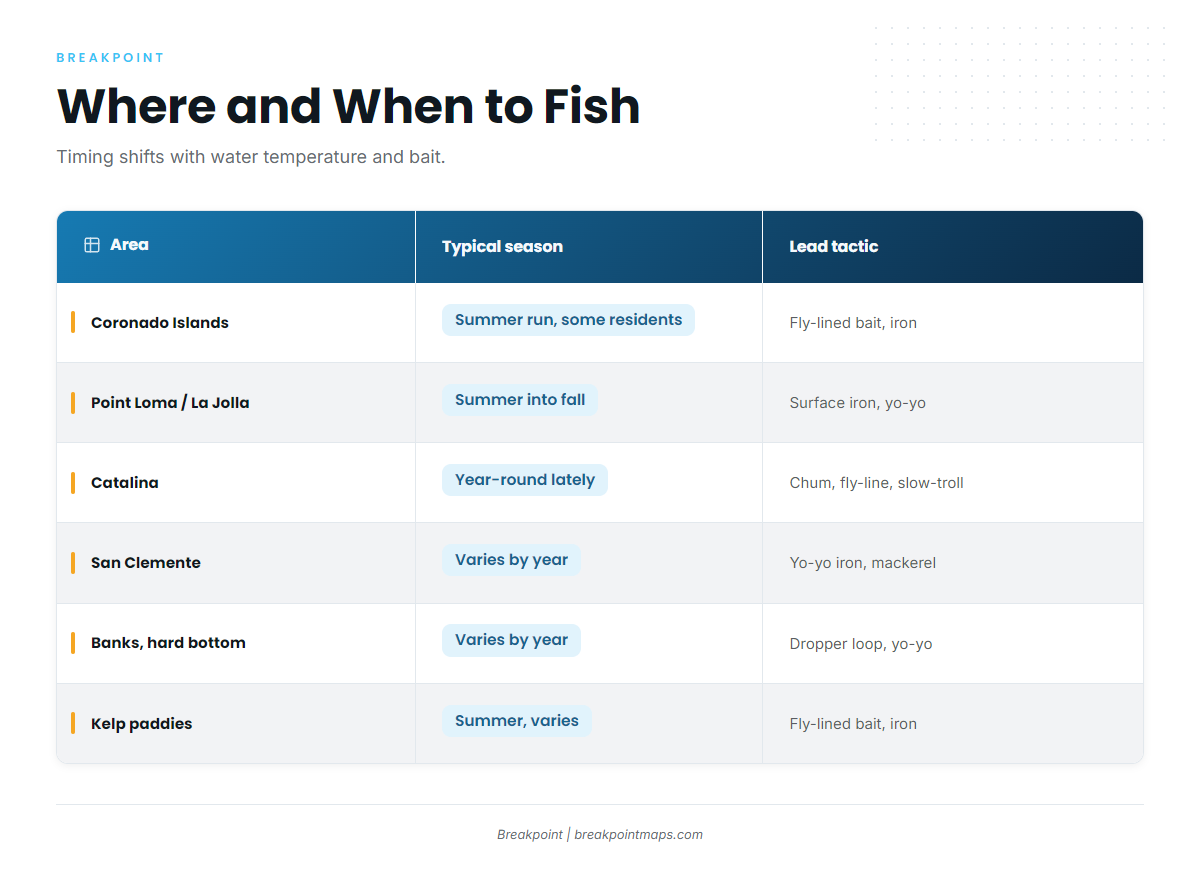
| Area | Typical season | Main structure | Lead tactic |
|---|---|---|---|
| Coronado Islands | Summer run (commonly described June to October window); some residents year-round | Island edges, kelp | Fly-lined bait, iron |
| Point Loma / La Jolla kelp | Summer into fall while water stays warm | Kelp beds | Surface iron, yo-yo, fly-line |
| Catalina | Year-round in recent years (per Salt Water Sportsman) | North shore, kelp, structure | Chum line with fly-line or slow-troll |
| San Clemente | Varies by year | Steep walls, pinnacles | Yo-yo iron, mackerel |
| Banks (e.g. 9-Mile Bank), deep hard bottom | Varies by year | Hard bottom and ridges at 180 to 300 feet | Dropper loop, yo-yo |
| Kelp paddies | Summer, varies by year | Floating kelp | Fly-lined bait, surface iron |
Timing shifts with water temperature and bait.
Habitat & Conditions in the Pacific Southwest
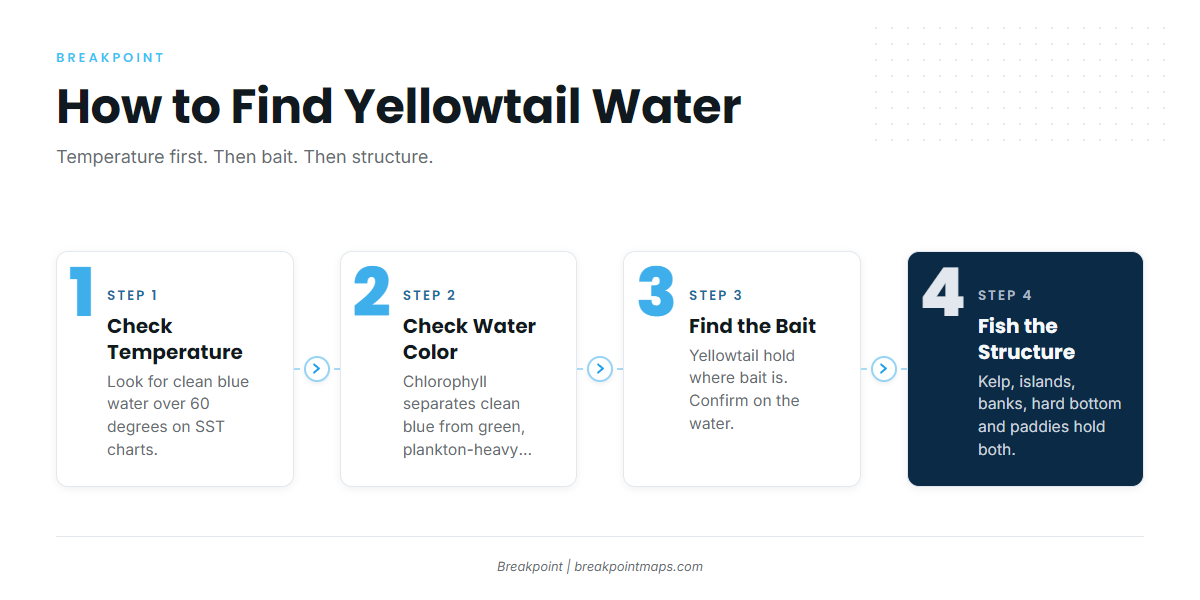
Yellowtail here hold where warm, clean water, bait, and structure line up: kelp beds, island edges, banks, hard bottom, and summer kelp paddies. Start with temperature and water color, then look for bait, then fish the structure that holds both.
CDFW gives a depth range of surface to 1,023 feet, so fish can be almost anywhere in the water column. The useful numbers are narrower. Anglers describe looking for water over 60 degrees and clean blue color. One writer on deep-water yellowtail from private boats reports that 63-degree, clean, blue water matched what the sea surface temperature and chlorophyll charts showed.
To use charts effectively:
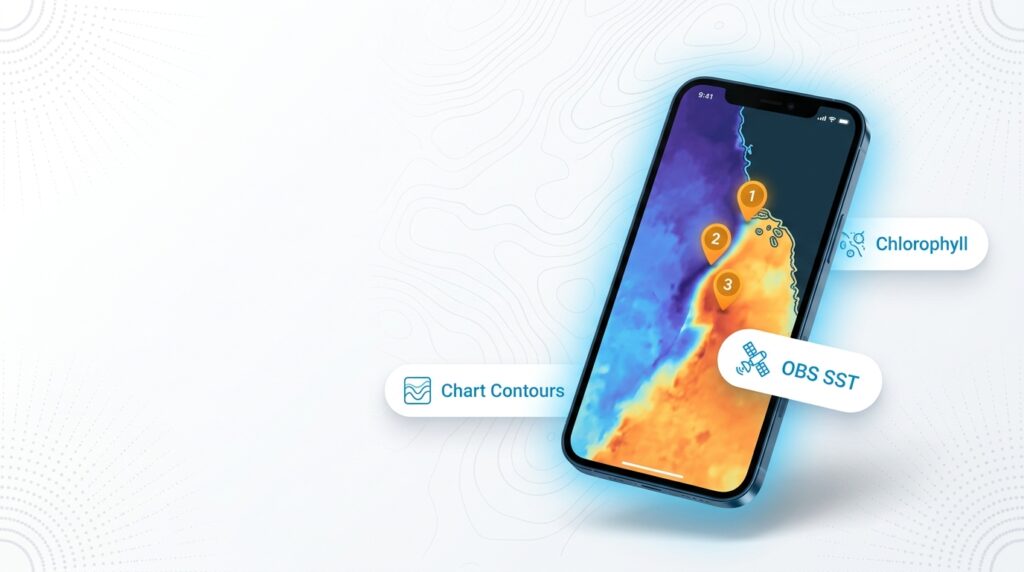
- OBS SST shows where the warm water sits and where the breaks are.
- Chlorophyll separates clean blue water from green, plankton-heavy water.
- Cloud cover blocks satellite passes, so gaps happen.
- Confirm on the water. A chart shows water, not fish or bait.
Structure that holds fish:
- Kelp beds: La Jolla and Point Loma. Salt Water Sportsman notes that yellowtail favor structure such as wrecks, reefs and kelp.
- Islands: The Coronados, Catalina and San Clemente.
- Banks and high spots: The 9-Mile Bank is a well-known example.
- Deep hard bottom: Schools have been reported foraging at 30 to 50 fathoms (180 to 300 feet) on hard bottom with structure.
- Kelp paddies: A paddy in clean 63-degree water with bait under it is worth a stop. A bare one in green water usually isn’t.
If you’re on a private boat: Check the SST and chlorophyll from the previous night before leaving the harbor, then confirm temperature and color when you arrive.
Tactics for the Pacific Southwest
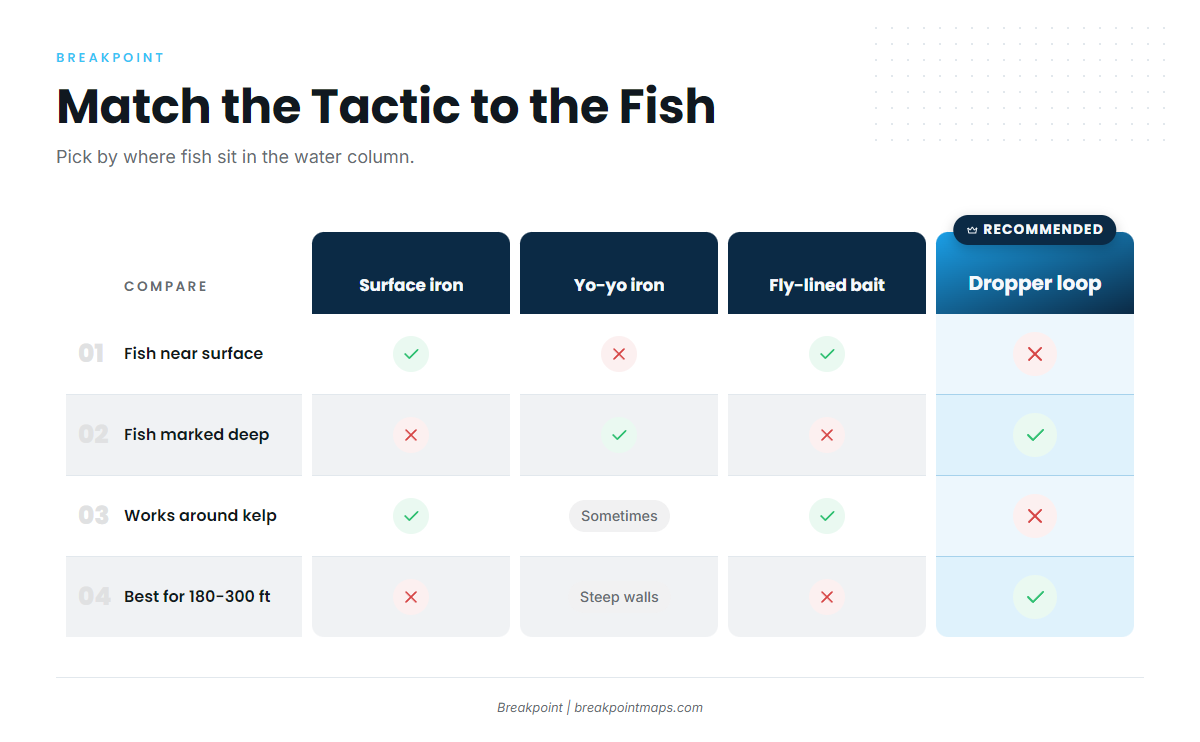
Pick the tactic based on where the fish are in the water column. Surface iron and fly-lined bait suit fish up top, yo-yo iron and dropper loops suit fish on deep marks, and slow-trolled mackerel suits bigger fish. Chum holds them once you’ve found them.
The tactic follows the fish, not the calendar. We won’t repeat knots and basic setups here; see the general rigging covered in the species guide.
Surface iron and yo-yo iron. Surface iron is for fish showing near the top, and yo-yo is for fish marked deeper. Channel Islands operators recommend high-ratio reels for both.
Fly-lined sardine, anchovy or squid. This is the default when fish are near the surface or around kelp. One operator describes a 1/8 to 1/4 oz sliding sinker, or no sinker at all.
Slow-trolled mackerel. Use it for bigger fish around the islands.
Dropper loop. Use it on deep hard-bottom marks at 180 to 300 feet.
Chum lines. A steady chum line attracts yellowtail whether you’re slow-trolling, drifting or anchored. Sport Fishing Mag says the approach works across Southern California, including Santa Monica Bay, Catalina and Dana Point.
The bait-burn mistake. Many private-boat trips fail because other species bite too readily. Anglers end up burning bait on other species: calicos, bonito and barracuda. If the ratio is wrong, move.
Bycatch. H&M Landing posted one full-day Coronados count: 91 yellowtail alongside 47 calico bass, 52 rockfish, 43 whitefish, 15 bonito and others. That is one boat on one day, not a norm.
If you’re in a kayak: La Jolla kayak anglers commonly carry a surface iron setup and a yo-yo setup. Know the La Jolla MPA boundary before you launch (see Regulations), and know your limits, since a hooked yellowtail will tow you.
If you’re on a sportboat: Full-day and Coronados trips give the most time on yellowtail water. Bait and rental tackle are usually available, but confirm with your landing.
| Tactic | When it works | Typical setup |
|---|---|---|
| Surface iron | Fish showing near the surface | High-ratio reel (operator-described) |
| Yo-yo iron | Fish marked deep, steep structure | High-ratio reel (operator-described) |
| Fly-lined live bait | Near-surface fish, kelp, paddies | No sinker or 1/8 to 1/4 oz sliding sinker (operator-described) |
| Slow-trolled mackerel | Bigger fish around islands | Varies by boat |
| Dropper loop | Deep hard bottom, 180 to 300 feet | See species guide |
| Chum line | Holding fish once found | Steady chum, anchored or drifting |
Frequently Asked Questions
When is yellowtail season in San Diego?
The summer run commonly starts once water passes about 60 degrees and runs roughly June through fall. Some fish stay around the islands year-round. Timing shifts with warm and cool years, and CDFW notes that warm-water years typically raise landings.
Do I need a Mexican permit for the Coronado Islands?
Yes. A Mexican sport fishing permit is required through CONAPESCA, and you should carry your passport. Rules and processes change, so verify with your landing and the official sources before the trip.
What’s the California yellowtail size limit?
Check the size rule and bag limit on CDFW’s Ocean Sport Fishing Regulations before you fish, and verify the date on whatever you read.
Where do yellowtail hold in Southern California?
They hold on kelp beds, island edges, banks, deep hard bottom at 180 to 300 feet, and summer kelp paddies. Look for clean water over 60 degrees with bait present. Structure matters, but bait and temperature decide whether fish are there.
Closing
Temperature sets the stage, bait gives the fish a reason to stay, and structure concentrates both. Tactic follows where the fish are in the water. Years differ, and reports and charts narrow the search without making the decision for you.
Breakpoint’s hotspots feature scores California yellowtail across the Pacific Southwest by reading layers like OBS SST, Chlorophyll and Chart Contours. It points you at water worth checking. It doesn’t see bait, and it doesn’t promise fish. Chart layers are not for navigation.