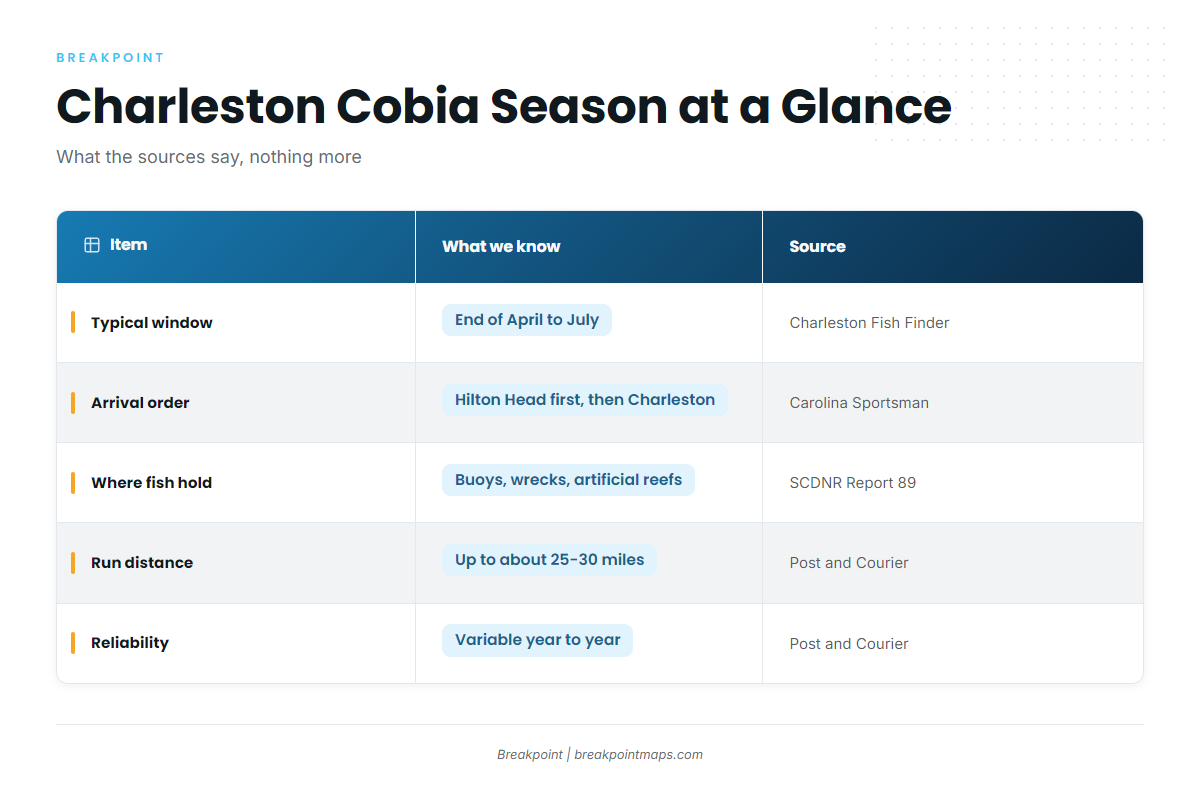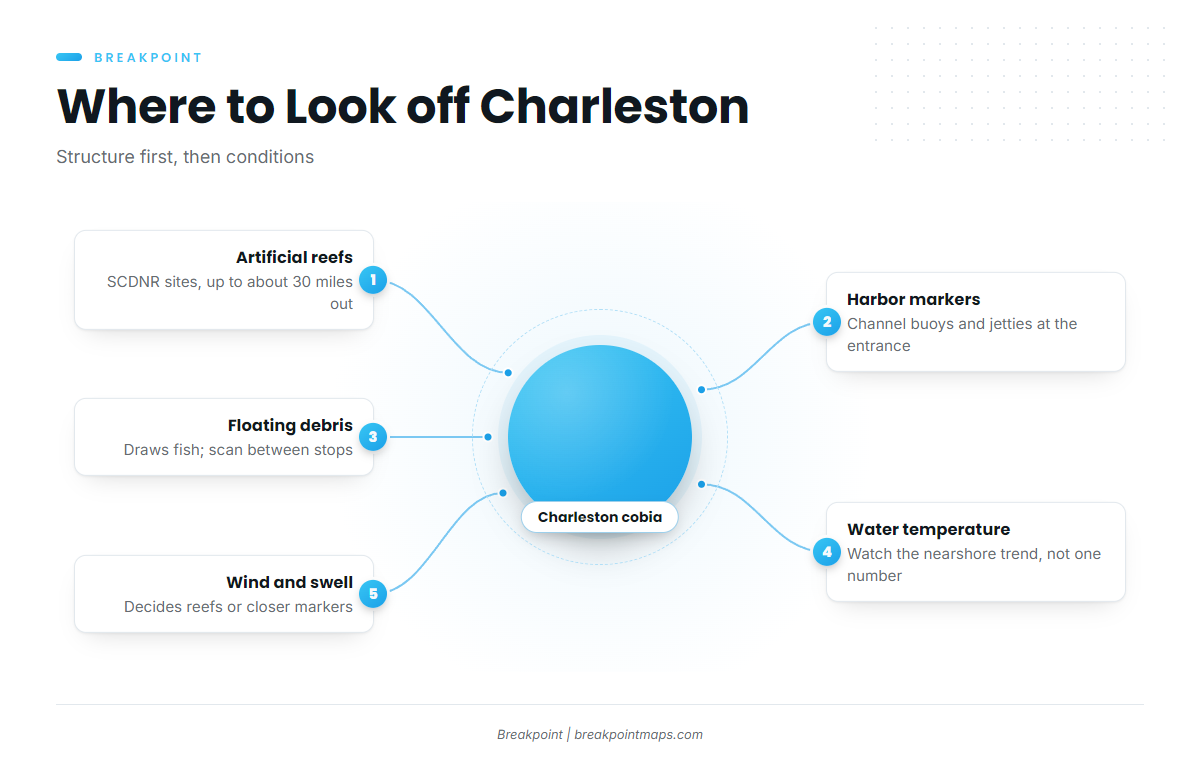
Cobia fishing off Charleston is a structure and buoy fishery. Fish show up on reefs, harbor-approach markers and floating debris, mostly from the end of April through July, according to Charleston charter season notes. This page covers the local specifics for cobia fishing in Charleston, South Carolina. Biology, identification and rigging basics are in our cobia species guide, and the run from Florida to Virginia is in our Atlantic Southeast regional guide. What follows is what changes at Charleston.
Cobia are close to a cultural institution here. SCDNR’s Jason Broach told Live 5 News at the 2025 Charleston Cobia Cup at Shem Creek, "Cobia fishing is kind of a cultural thing here."
Results vary a lot. Some seasons are lean, with cobia found only infrequently around Charleston. The Post and Courier describes days when fish sit on buoys and days when they are "nowhere to be seen," and it also describes limits being caught. We can’t promise fish, but we can help you decide where to look.
Treat this as a planning guide, not a forecast.
| Item | Detail | Source |
|---|---|---|
| Typical window | End of April through July | Charleston Fish Finder |
| Arrival order | Hilton Head first (late March to early April), then Charleston, Myrtle Beach, Southport and Morehead City every few weeks | Carolina Sportsman |
| Where fish hold | Buoys, wrecks, artificial reefs | SCDNR Technical Report 89 |
| Run distance | Up to about 25 to 30 miles for some reef trips | Post and Courier; Live 5 News |
| Reliability | Variable year to year | Post and Courier |
Regional Differences
Our regional guide covers the migration from Florida to Virginia. This section covers what differs at Charleston.
The management line comes first. According to the Post and Courier zone breakdown, state waters south of Jeremy Inlet, near Edisto Beach, form the Southern Cobia Management Zone. Charleston Harbor lies north of that line. A trip toward Edisto can cross into the Southern Zone, and the rules change when it does.
Charleston vs Port Royal Sound
SCDNR’s cobia technical report says adult cobia are regularly found inshore only in Port Royal Sound, and to a lesser extent in Calibogue and St. Helena Sounds. That inshore run begins in April and can last into July. Elsewhere, anglers fish buoys at bay mouths, coastal shipwrecks and artificial reefs, which describes the Charleston fishery.
The Live 5 News story on the Cobia Cup describes a genetically distinct cobia population found in South Carolina’s estuaries. It is concentrated to the south, which is why the Southern Zone carries stricter protection. The same SCDNR report notes that broodstock for stocking came from Port Royal Sound and was spawned at the Marine Resources Research Institute in Charleston and the Waddell Mariculture Center.
Charleston vs NC and VA
Fish move north through the Carolinas over several weeks. Per the spring arrival sequence northward, Hilton Head sees them first, then Charleston, Myrtle Beach, Southport and Morehead City. Northern runs come later than Charleston’s.
Who Manages Atlantic Cobia
The federal plan removal took effect March 21, 2019, and ASMFC approved Amendment 1 in August 2019, according to the NOAA Fisheries management history. Management moved to ASMFC because most landings come from state waters. The South Atlantic Fishery Management Council managed cobia before that change.
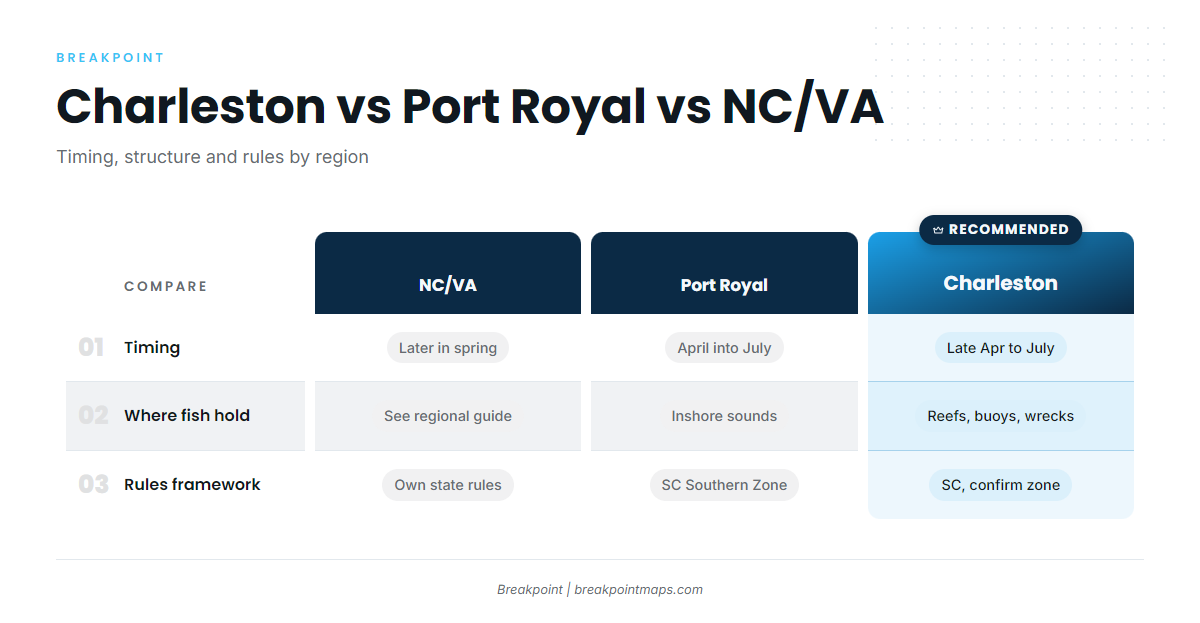
| Charleston | Port Royal Sound | NC/VA | |
|---|---|---|---|
| Timing | End of April through July | April into July, inshore | Later in the spring, per the arrival sequence |
| Where fish hold | Reefs, buoys, wrecks, debris | Inshore sounds (spawning) | Defer to regional guide |
| Rules framework | SC, north of Jeremy Inlet | SC Southern Zone | Own state rules under ASMFC |
Habitat & Conditions at Charleston, South Carolina
Charleston’s cobia water has three parts: offshore reef structure, harbor-approach markers and jetties, and the conditions that decide which of those you can reach.
SCDNR Artificial Reefs
SCDNR maintains a network of publicly charted artificial reef sites across the shelf off Charleston. The Post and Courier described a run of about 25 miles out of Dewees Inlet to the Y-72 reef area, and Live 5 News reported Cobia Cup boats fishing up to 30 miles offshore.
That is a long run in a small boat. A reef on the chart shows where structure is, but says nothing about whether a fish is on it today.
Harbor-Approach Buoys, Markers and Jetties
Buoys at bay mouths are a classic cobia pattern, per SCDNR Technical Report 89. At Charleston, that points to the harbor entrance channel markers and the jetties. Floating debris also draws fish, according to Charleston Fish Finder.
- Channel markers and buoys: Fish the structure, then look for fish holding near it.
- Jetties: Closer to port, and a workable option when the outer reefs are out of reach.
- Floating debris: Worth a look on any run.
The harbor entrance is a shipping channel. Stay clear of traffic and follow the rules of the road.
Water Temperature
Fish arrival tracks nearshore warming each spring. Watch the trend in nearshore surface temperature rather than a single threshold. The OBS SST layer shows that trend. It has limits: cloud cover can block a satellite pass, and a blocked pass is a gap in the picture, not a reading of zero change.
Wind, Swell and "If It Blows"
The wind and swell forecast decides whether you can run to reefs 25 miles out. On rough days, the jetties and harbor-approach markers are the closer options.
Tactics for Charleston, South Carolina
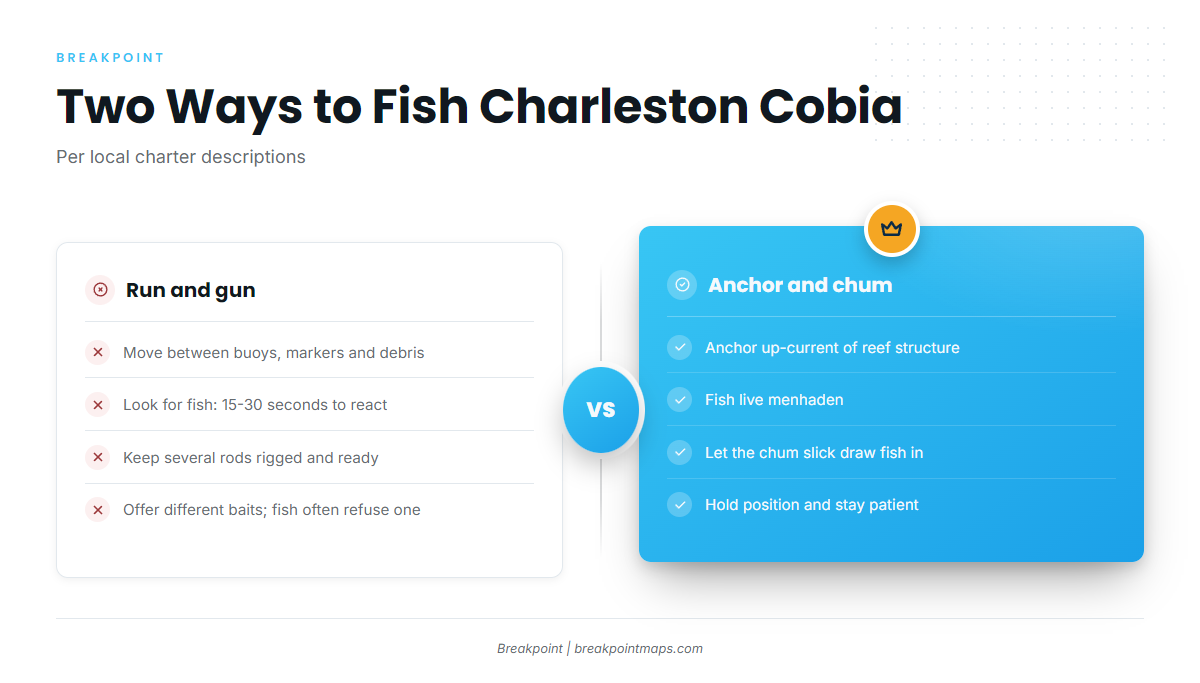
Local charters describe two approaches: "the run and gun and the anchor and chum." Nearly every Charleston cobia trip is one or the other.
Run-and-Gun Sight Casting
Move between buoys, markers and debris, and look. A cobia may approach the boat and give you a window of 15 to 30 seconds to cast, so have the rod rigged before you see the fish.
Keep several rods rigged with different baits, since fish often reject one offering and take another. The Post and Courier notes more center consoles are running spot-lock trolling motors to hold position offshore. You do not need a tower to try this.
Anchor and Chum
Anchor up-current of structure and set a chum line. Live menhaden are the standard bait. As Coastal Angler puts it, "cobia love the menhaden." Fish the bait near the structure and keep your other rods ready for a fish that shows up in the slick.
Rigs
Tackle specs from Lowcountry rig and tackle specs for Charleston jetties and reefs:
- Carolina rig with a 3 to 4 oz egg sinker, a bead and a swivel, plus a 100 lb mono leader
- 1/2 to 1 oz bucktails for casting
- 7’6" to 8′ medium rods, 4000 to 5000 reels, 20 to 30 lb braid
If you are stepping up from redfish and trout gear, see our cobia species guide for rigging fundamentals.
Baits
Live menhaden and eels are the baits to have aboard.
Landing Responsibly
- Veteran anglers play the fish out thoroughly before bringing it aboard, per Charleston Fish Finder.
- Measure before deciding to keep, and release legally short fish quickly.
- SCDNR collected fin clips from Cobia Cup catches for genetic research, one reason careful handling and reporting matter.
Frequently Asked Questions
When do cobia show up off Charleston?
Fishing is typically best from the end of April through July, according to Charleston Fish Finder. Fish arrive after Hilton Head and before the NC coast, per Carolina Sportsman. Timing varies year to year, so plan for a window rather than a date.
Is Charleston in the Southern Cobia Management Zone?
The zone covers state waters south of Jeremy Inlet, near Edisto Beach. Charleston lies north of that line. If you fish toward Edisto, you can cross the line into different rules.
What license do nonresidents need?
Nonresidents fishing SC saltwater need the SC Saltwater Recreational Fisheries License issued by SCDNR. Check SCDNR for the current price and license options before you go.
Is May closed off Charleston?
The May closure applies only to state waters south of Jeremy Inlet. Waters north of the inlet, including Charleston, have no closed season in state waters. Rules change often, so verify the current season with SCDNR before you plan a May trip.
Plan the Trip
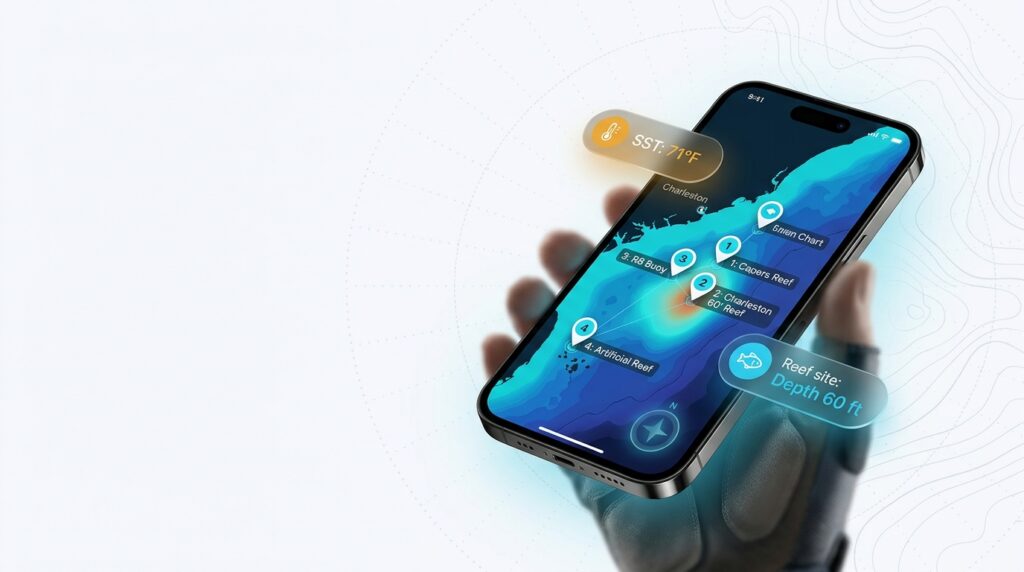
Charleston cobia are structure and buoy fish. The zone line matters, and the run varies from year to year. Breakpoint can help you plan a Charleston trip by marking SCDNR reef sites and harbor-approach markers and showing OBS SST as nearshore water warms. It will not tell you a fish is there, but it can help you decide where to look first. Chart layers are not for navigation.