Cobia fishing off Destin, Florida, is mostly a spring sight-casting fishery. Local reports put the peak from late March through mid-April, with fish cruising clear water along the beaches a short run from East Pass.
For biology, identification and general tackle, see our cobia species guide. For the Gulf-wide migration picture, see our Gulf cobia guide. This page covers only Destin specifics.
Several things set Destin apart:
- Green, clear water over white sand makes fish visible before you cast.
- The first and second sand bars act as travel lanes along the beach.
- Tower boats are the signature method.
- Local operators describe fish within minutes of the harbor.
Destin is also among the recognized cobia record destinations tied to multiple line-class records, alongside places like Pensacola Beach and Orange Beach.
Fish behavior is the main limit: a beach full of fish on Tuesday can be empty on Wednesday, and nobody predicts that.
Regional Differences
Destin sits in the middle of the Panhandle spring migration, so fish commonly show up here after the Big Bend and before Alabama and Mississippi. These are commonly reported patterns, not fixed dates.
- Big Bend: Fish are reported to arrive earlier.
- Alabama and Mississippi: Fish are reported to arrive later, as the westward push continues toward Mobile Bay.
- Texas and Louisiana: This is a rig and platform fishery, with a different method and structure and far less beach sight-casting.
- Atlantic run: A separate stock with separate management.
One local operator describes most cobia in the northern Gulf of Mexico from March into October. (Some federal sources now use "Gulf of America" for the same water.) For rigs and the Big Bend, the Gulf cobia guide goes deeper.
Habitat & Conditions at Destin, Florida
Cobia usually show on the Destin beaches from late March through April, with a smaller fall window in September and October. The conditions below decide whether that window is fishable.
When the fish are here
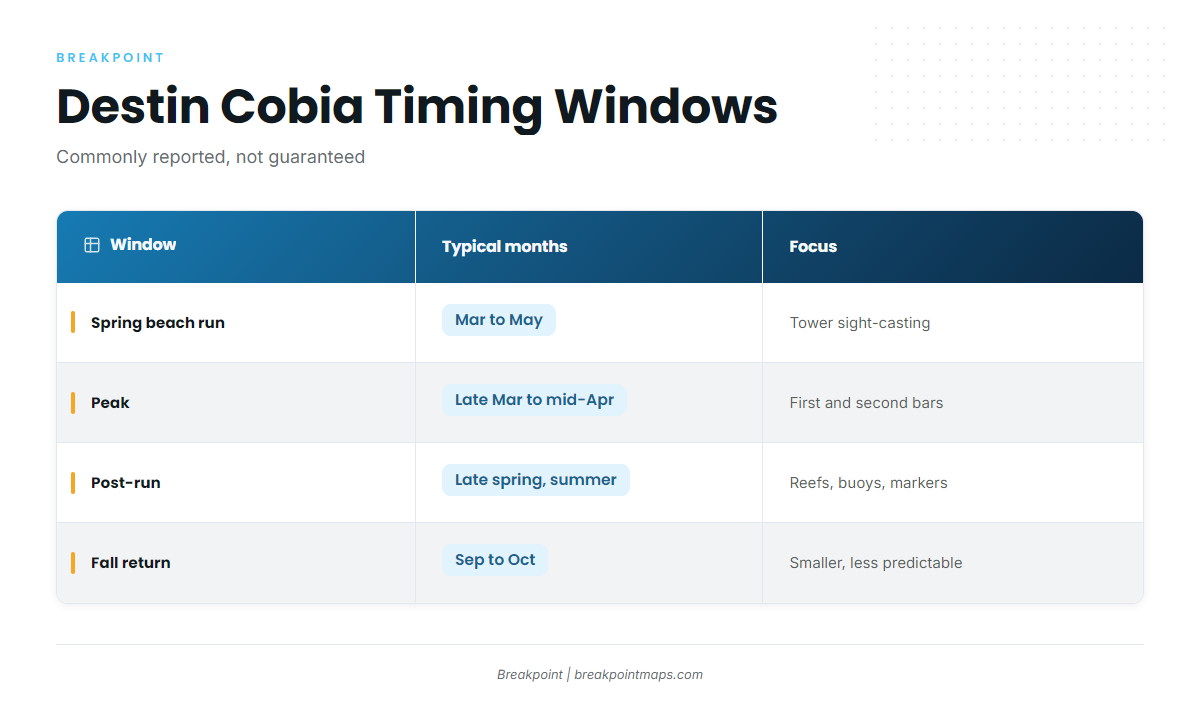
The table below summarizes the commonly reported windows. Treat every date as approximate.
| Window | Typical months (hedged) | What you’re doing |
|---|---|---|
| Spring beach run | Roughly March to May. Most reports peak late March to mid-April | Tower sight-casting along the bars |
| Post-run | Late spring into summer, variable | Working reef perimeters, buoys and markers |
| Fall return | Commonly reported September to October | Smaller, less predictable window as fish move back |
Reported start dates range from early March to April, and local sources disagree on whether the run ends in May or June. One regional resource describes the local window as mid-March through late April.
Warming water is the commonly cited trigger. One local charter source says cobia prefer water warmer than 70°F, and 68 to 70°F is often quoted. Use that as a guide rather than a switch, since the year’s weather shifts everything.
The Cobia World Championships, hosted by Harbor Docks, signals when the run peaks and when ramps and the beach get crowded.
Where they travel: the bars
Fish commonly travel along the first and second sand bar lines, parallel to the beach. Exact lane behavior varies by day, light and sea. Scan the Destin and Okaloosa Island beaches, east and west of East Pass.
East Pass
East Pass is the main exit for Destin boats, and it can stack up fast. Wind against an outgoing tide builds steep, short seas in the pass, so check tide and wind before you commit.
Buoys, markers and reefs
Cobia hold on buoys, channel markers and floating debris, so check each one on the run. A secondary tactics source describes cobia cruising nearshore structure within about 3 miles of shore in 30 to 60 feet of water. That is a general pattern, not Destin-measured data.
The Okaloosa County artificial reefs are another option. The Florida Fish and Wildlife Conservation Commission (FWC) runs the Florida Artificial Reef Program, the public source for reef coordinates. We print none here.
Go/no-go: wind, sea, clarity, sun
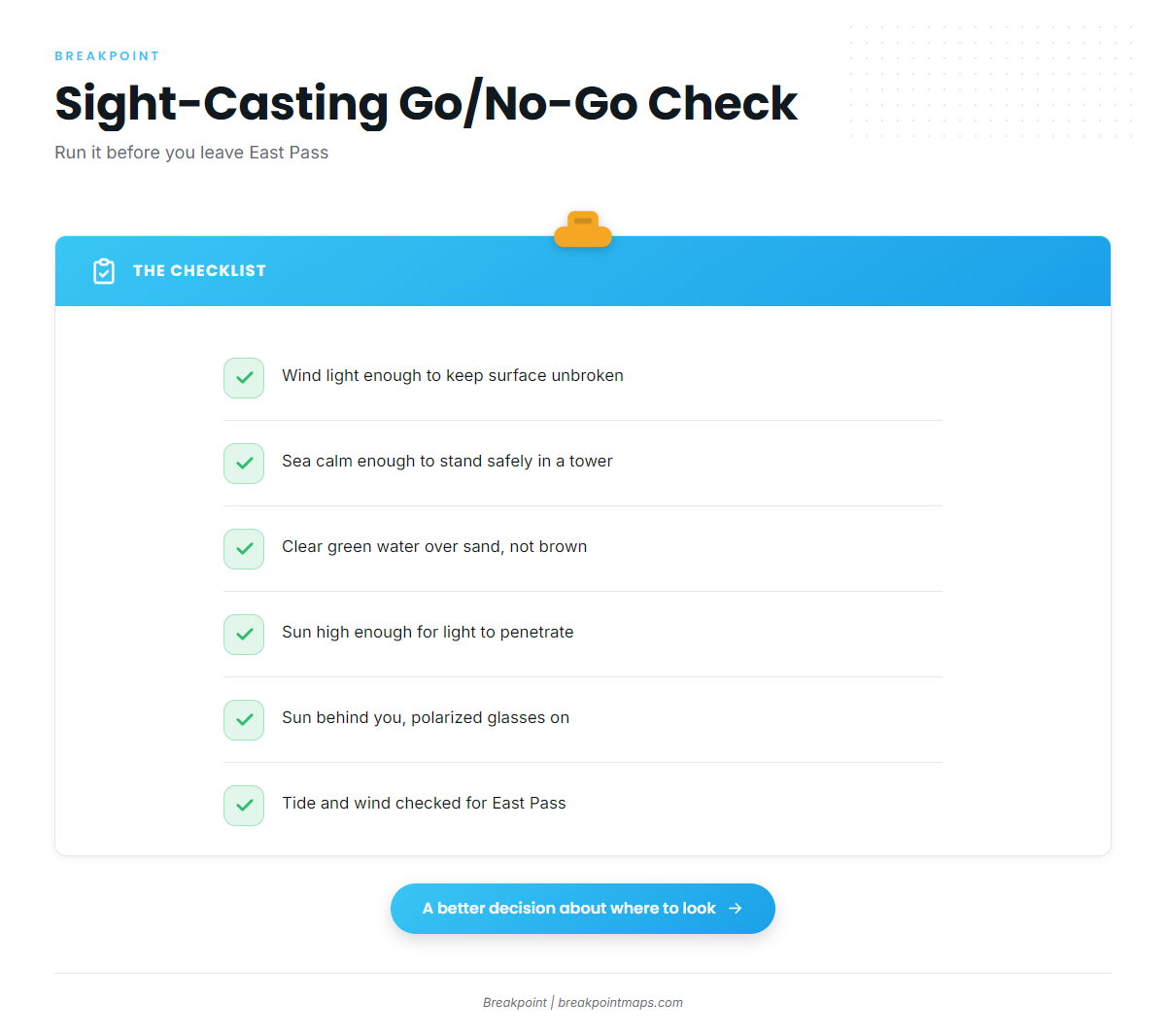
Wind and sea state decide whether sight-casting is possible at all. We use qualitative checks rather than invented thresholds:
- Wind: Light enough that the surface isn’t broken up.
- Sea: Calm enough to stand safely in a tower.
- Clarity: Clear green water over sand, not stirred-up brown water.
- Sun: High enough for light to penetrate, and behind you.
Satellite sea-surface temperature reads only the surface skin and can be blocked by cloud. On blown-out days, Choctawhatchee Bay or nearshore reefs are the usual alternative.
Tactics for Destin, Florida
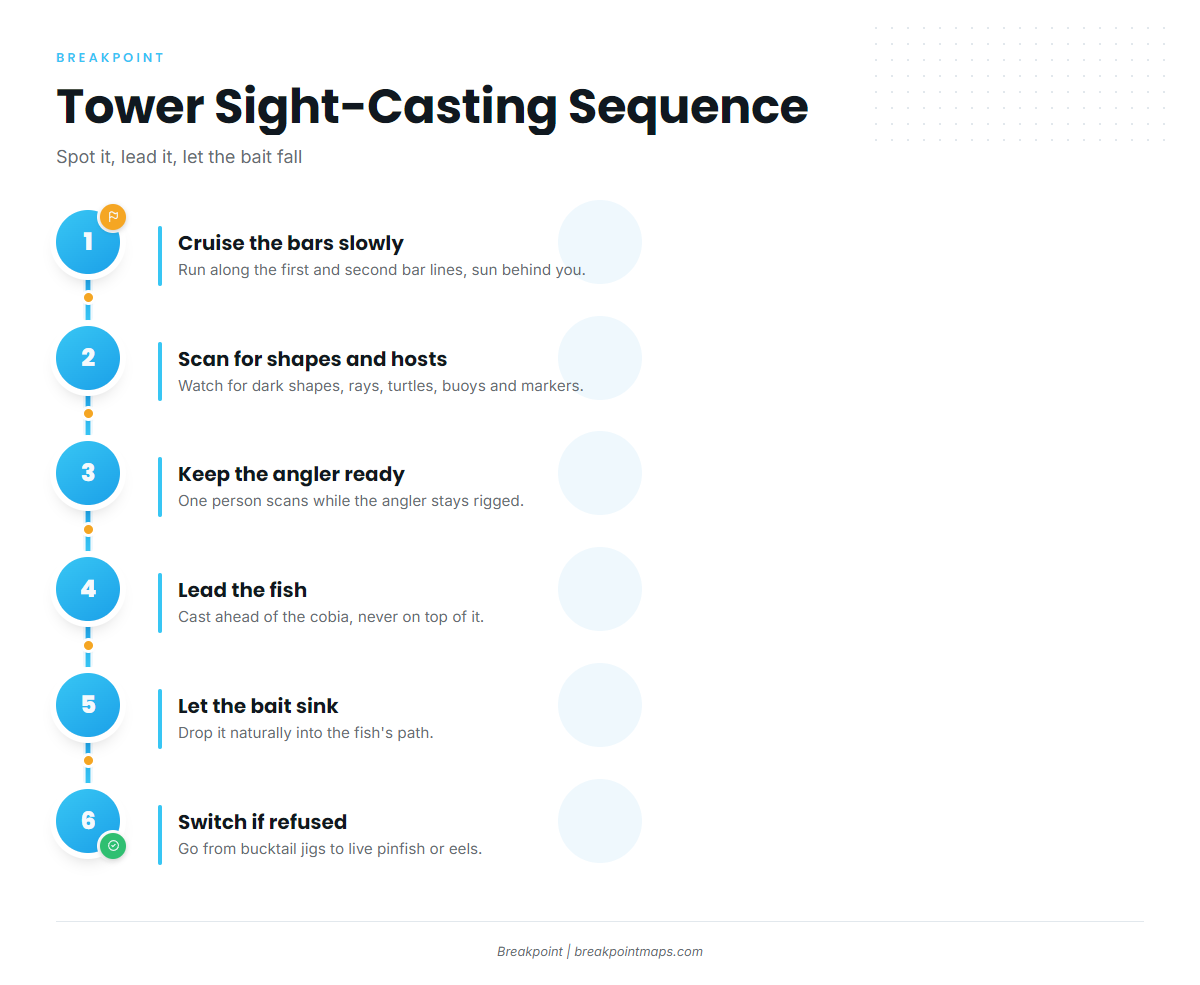
Most cobia fishing off Destin is tower sight-casting. You cruise the bars slowly, spot a dark shape, lead it and let the bait fall into its path.
Running the tower
Wear polarized glasses and keep the sun behind you. Go slow along the bar lines, with one person scanning while the angler stays rigged and ready.
A tower helps a lot, but anglers do spot fish from the deck around structure. If you lack a tower boat, a charter is sensible.
Read the host animals
Cobia often ride with other animals, so look for the host before you look for the fish. Manta and cownose rays carry cobia that ride the disturbance as the ray feeds, and rays carrying cobia in tow is a classic tell. The same source says one ray can tow a dozen fish. Turtles and large sharks serve the same purpose, and floating objects count too.
The cast and presentation
Lead the fish, casting ahead of it rather than on top of it, and let the bait sink naturally into its path. Avoid lining the fish or slapping the jig near its head.
Bait order matters:
- Start with bucktail jigs.
- When fish follow and refuse, switch to live pinfish or live eels.
- Local operators commonly name pinfish as the top bait.
Rod, line and leader choices are in the species guide.
After the run: reefs and chum
Once fish leave the beach, they commonly patrol the perimeter of nearshore reefs and wrecks. Local sources describe setting up in the sand, upcurrent or off to the side of the structure, rather than directly on top of it.
Chumming is the common post-run approach. Keep a pitch bait ready, because fish often rise to the boat.
The fall window
Local sources describe a smaller secondary window in September and October as fish move back. It is less concentrated and less predictable than spring.
Frequently Asked Questions
When do cobia run off Destin? Roughly March to May, with the peak commonly late March to mid-April. Start dates vary each year, and a smaller window is reported in September and October.
What size cobia can you keep in Florida Gulf waters? The rules have tightened and sources disagree, so check the fork-length minimum with FWC and NOAA Fisheries before you fish.
Do you need a tower to catch cobia at Destin? A tower helps greatly for beach sight fishing. Without one, a charter is sensible, or you can work structure and spot fish from the deck.
What bait works for cobia off Destin? Bucktail jigs first, then live pinfish or eels for fish that follow and refuse.
Is there a fall cobia run in Destin? A smaller, commonly reported window in September and October as fish move back.
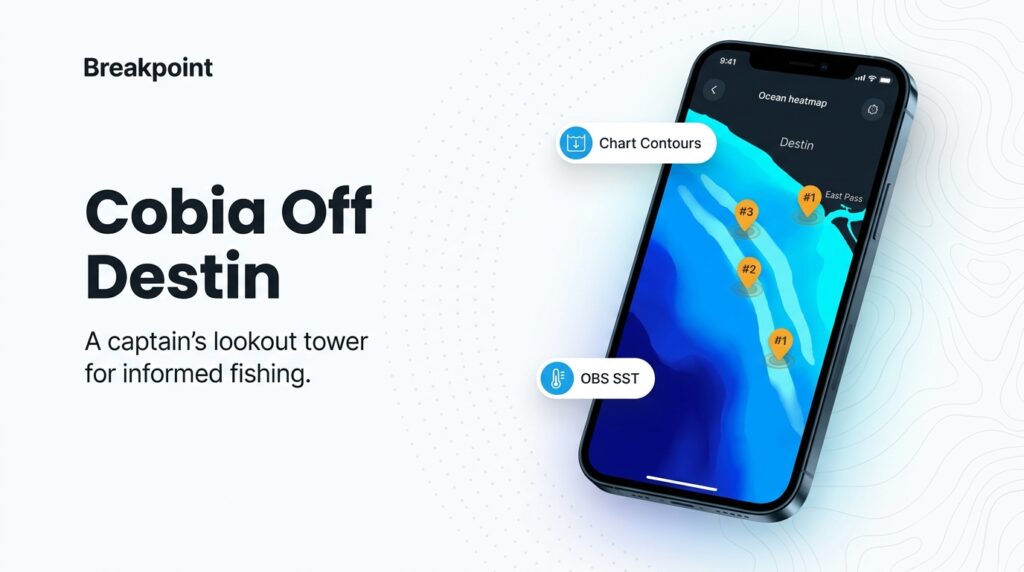
Breakpoint can help with the planning side of a Destin trip. Chart Contours shows the bar and nearshore depth breaks and the reef edges. OBS SST shows when nearshore water crosses the commonly cited warm range, cloud permitting. Chlorophyll helps you judge whether you’ll have the clarity to sight-cast. Chart layers are not for navigation, but they help you decide where to look.