Overview
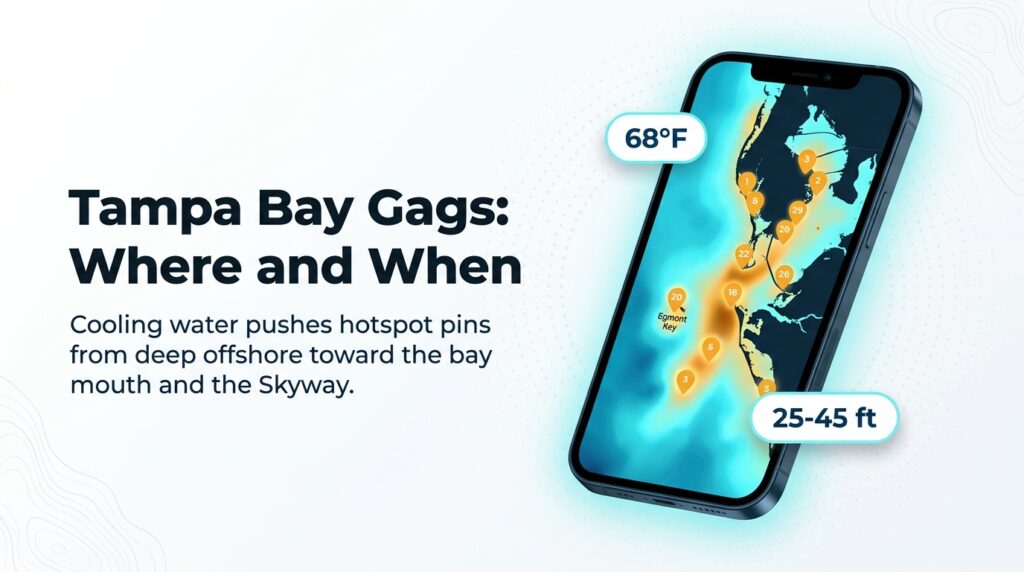
As the Gulf cools, local guides report gags following structure inshore toward the mouth of Tampa Bay, the shipping channels and the Sunshine Skyway. A Tampa charter guide ties that move to water below roughly 68°F, when fish leave deeper water and work the channels, passes and nearshore reefs. For biology, identification and general rigging, see our gag grouper species guide. This page covers Tampa Bay only: temperature, structure and timing.
The 2026 recreational gag season in Gulf state and federal waters ran Sept 1 to 30. The limit is 2 gags per person per day, 24 inches minimum total length, within the 4-grouper aggregate. After Sept 30, release every gag. Local guides expect the inshore push with October cold fronts, so the fish may be closer than the calendar suggests, but none can be kept until the season reopens.
At a glance
- Season status: Closed after Sept 30, 2026. The 2027 dates are not set. Check FWC and the NOAA Fishery Bulletins.
- Legal before you go: A Florida saltwater license (non-residents should check FWC for current requirements). From a private boat, you also need the free, annual State Reef Fish Angler Designation.
- Nearshore vs. offshore: In fall and winter, look at channel edges, bridges, the 3- and 7-mile reefs, and Egmont Key. In summer, gags sit in deeper offshore water. The Middle Grounds is a long, weather-dependent run.
- Charter or trailer: Local charters typically include the license, tackle and bait, which matters if you are visiting without a boat.
We can’t promise fish. We can help you decide where to look and when you can keep one.
Regional Differences
Tampa Bay has its own gag fishery. A Tampa-area charter guide describes the local advantage as nearshore and inshore gag fishing in late fall and winter. As the water drops, large gags follow structure into the passes, shipping channels and bridges inside the bay. Most gag water elsewhere on the Gulf coast is a long run offshore, so part of the season comes to Tampa anglers.
Local guides report gags holding at these spots:
- The 3- and 7-mile reefs
- The Sunshine Skyway shipping channel
- Egmont Key, at the bay mouth, where strong tidal currents concentrate bait
Structure and timing differ up the coast in the Big Bend and Panhandle.
The Middle Grounds is the long-run option: an offshore trip dictated by weather, best saved for a calm-forecast day.
| Area | What local guides report | Notes |
|---|---|---|
| Inside Tampa Bay (channels, Skyway) | Gags follow structure in as water cools | Timing follows water temperature and fronts, not a set date. |
| Nearshore reefs (3- and 7-mile) | Gags hold here in fall | Fish counts |
| Egmont Key | Strong tidal current at the bay mouth | Fishes best in late fall and winter, as the water cools. |
| Middle Grounds | Long, weather-dependent offshore run | Long run. Plan around the weather forecast. |
Habitat & Conditions at Tampa Bay, Florida
Temperature drives location here, and structure decides where you drop.
Where Tampa Bay Gags Hold
Channel edges. Key inshore spots include deep channel edges in 25 to 45 feet of water. Grouper are structure-oriented and sit along the vertical walls of the shipping channels.
Bridge pilings and rock. Look at the Sunshine Skyway and along the shipping lanes.
Artificial reefs. Hillsborough and Pinellas counties maintain nearshore reef systems with public GPS coordinates. Local sources report gag, red grouper, mangrove snapper and hogfish on them. Pinellas County publishes reef coordinates on its artificial reef GPS page, and the Hillsborough County Water Atlas lists reef positions in latitude and longitude.
Nearshore ledges. Local reports put big gags in as little as 30 feet of water in fall. Use sonar to find rock piles, ledges and other hard bottom. On sunny days in clear water, a patch of dark bottom usually means rock.
The Temperature Cue
In fall, gags push inshore as Gulf water drops below roughly 68°F. WFLA’s Reel Talk gag guide ties the move to October, when the first cold fronts arrive and groupers move shallower. In late spring and summer, gags go offshore to deeper, cooler water near the thermocline.
Spawning Context
Gags form spawning aggregations offshore in winter and early spring. To protect those aggregations, the Gulf Council created 2 marine reserves in Regulatory Amendment 9. The two sites together cover 219 square nautical miles near the 40-fathom contour off west central Florida. Fishing for all species under the Council’s jurisdiction is closed there year-round. Spawning helps explain where the big fish go in winter and spring.
Seasonal Pattern
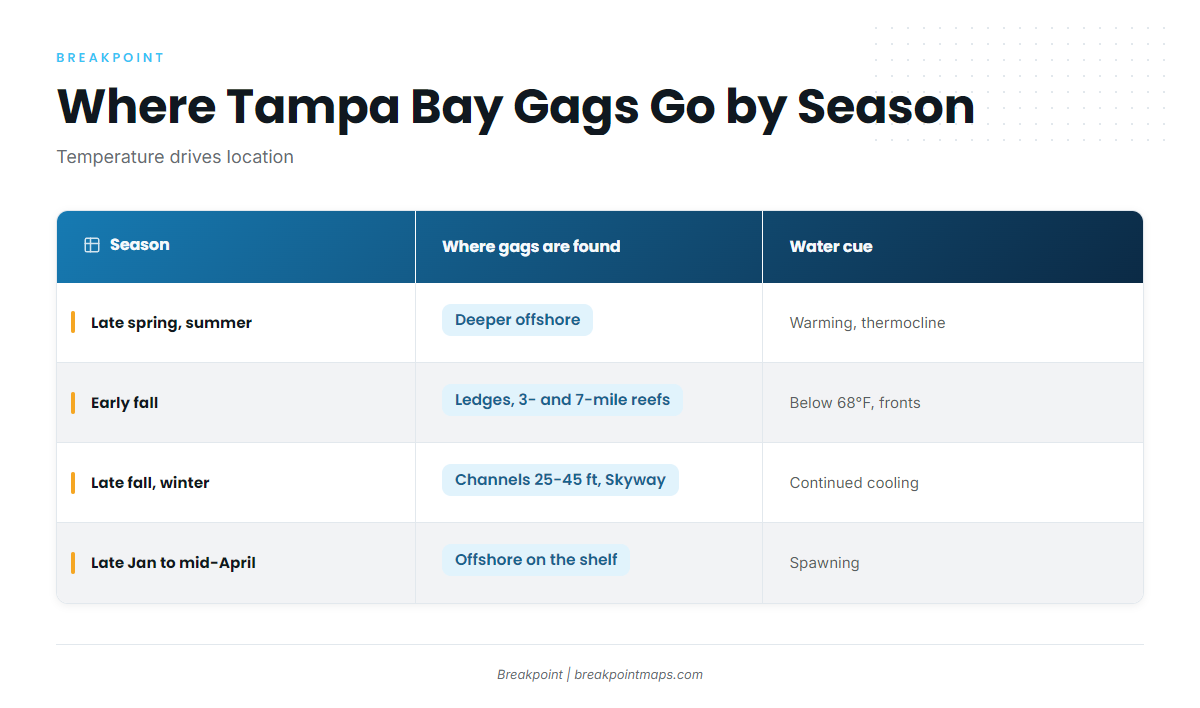
| Season | Water cue | Where local guides find gags | Tactic |
|---|---|---|---|
| Late spring and summer | Warming water, thermocline | Deeper offshore | — |
| Early fall | Gulf below ~68°F, first cold fronts in October | Shallower ledges, the 3- and 7-mile reefs | Frozen bait, then live pinfish |
| Late fall and winter | Continued cooling | Channel edges 25 to 45 ft, Skyway, passes, Egmont Key | Trolling deep divers, anchoring with live bait |
| Winter to early spring | Spawning | Offshore on the shelf | — |
What We Don’t Know
- Timing: The inshore push follows fronts and temperature, not a calendar date.
- Check FWC’s red tide status page before you run.
- Low-relief ledges: Use sonar to find them.
Tactics for Tampa Bay, Florida
Location sets tactics. Inside the bay, you troll the channel edges. On the reefs and ledges, you anchor and fish live bait.
Trolling the Channel Edges
Local guides call trolling one of the most popular ways to catch grouper here because so many shipping channels cross the bay. Run a big diving plug, such as a Mann’s Stretch 25, or a large soft plastic on a planer or downrigger. Work it along the channel edge or from rock pile to rock pile, letting the lure run just off the bottom. Local guides also report fish taking artificials in the shipping channel inside the bay.
Anchoring and Chumming
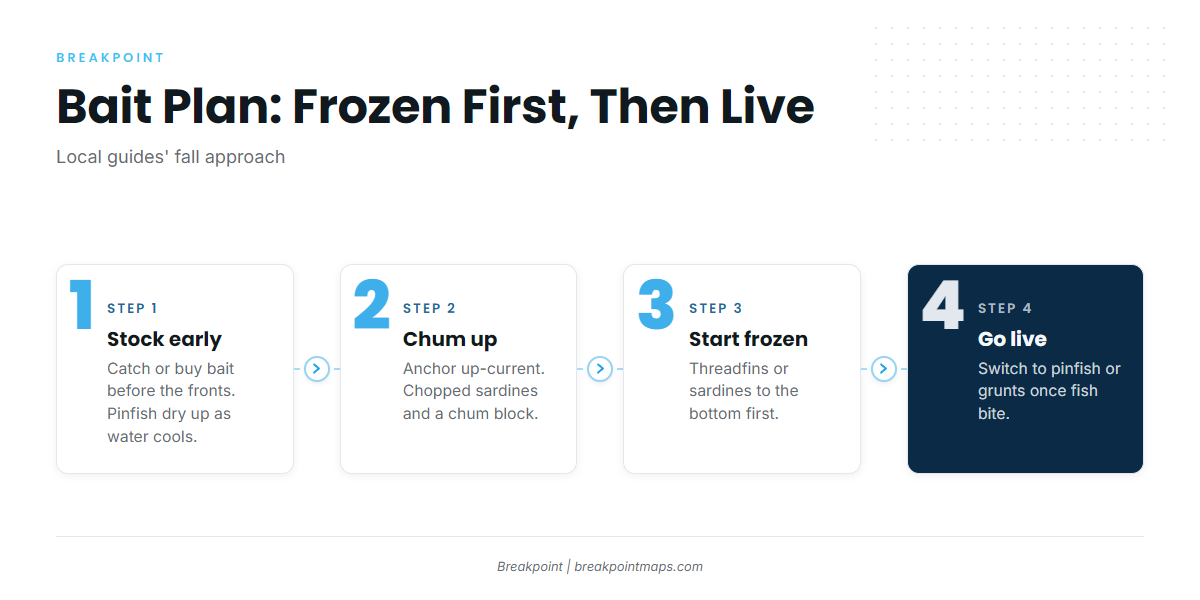
Anchor up-current of the structure so chum and baits drift back onto it. Chum with chopped sardines and a chum block, then drop a pinfish or frozen sardine to the bottom.
Bait: Frozen First, Then Live
Local guides start with frozen threadfins or sardines, then switch to live pinfish once fish are biting. Bigger gags are pickier. Pinfish and grunts are the main live baits.
Bait supply is the local wrinkle. Guides report traps that produced 20 to 30 pinfish a drop falling to 2 or 3 as inshore water cools, the local fall pinfish shortage. Catch or buy bait before the fronts arrive, and carry frozen as backup.
Rigging
- Line and leader: Use 60 to 80 lb braid with a heavy braid and fluorocarbon leader in the 60 to 80 lb range. The heavy leader protects against rocks and sharp bottom.
- Live-bait rig: A conventional rig: lead weight, swivel, leader, hook.
- Reel: Choose one with enough drag to stop a grouper before it reaches cover.
Turning the Fish
The first seconds decide the fight. Use heavy fluorocarbon and immediate, aggressive rod pumping to pull the fish away from vertical structure. Once a gag gets its head in the rocks, you are mostly negotiating.
Release Handling
Any gag caught after Sept 30, and any fish under 24 inches, goes back. NOAA’s Return ‘Em Right resources cover barotrauma and release handling. Federal and state rules require specific release gear for reef fish; check current requirements with NOAA Fisheries and FWC.
Frequently Asked Questions
When is the gag grouper fishing Tampa Bay, Florida season in 2026?
Sept 1 to 30 in state and federal waters, per FWC and NOAA Fisheries. It is closed after that. The 2027 dates are not set.
What is the size and bag limit?
24 inches total length minimum and 2 gags per person per day, within the 4-grouper aggregate, according to FWC.
Do I need the State Reef Fish Angler Designation?
Yes, if you fish from a private boat. It is free, renewed annually, and issued by FWC.
When do gags move inshore at Tampa Bay?
Local guides tie the move to October cold fronts and water below roughly 68°F. Fronts set the timing, not the calendar.
What bait works for gags in Tampa Bay?
Start with frozen threadfins or sardines, then switch to live pinfish or grunts. Stock bait early, because the pinfish supply drops as the water cools.
Can I keep a gag after Sept 30?
No. Release it. Watch FWC and the NOAA Fishery Bulletins for 2027 dates.
Conclusion
Before the next season, get the State Reef Fish Angler Designation, load the county reef coordinates, plan your bait, and watch for the first October fronts. Then verify the 2027 dates with FWC and NOAA before you leave the dock.
When the fronts start stacking up, we watch OBS SST for the roughly 68°F water local guides associate with the inshore move, and we use Chart Contours to plan ledge drops off Pinellas. Chart layers are not for navigation.