



Overview
Gulf king mackerel are managed as a separate stock, and in fall the population splits and migrates in two directions. For identification, general tackle and biology, start with our King Mackerel species guide. This page covers what changes in the Gulf.
On timing, Destin charter operators report that spring and fall are the most productive windows, and that kingfish can be found year round depending on location. Treat that as a starting point, since actual dates shift each year with water temperature, fronts and bait.
Federal agencies call this water the "Gulf of America (formerly Gulf of Mexico)," and you will see that name on NOAA Fisheries pages. We use "Gulf of Mexico" here because that is what most anglers search for.
This page covers:
- Where and when to fish, stretch of coast by stretch of coast
- The conditions and structure that hold kings
- The tactics that work in Gulf water
- Current rules
Regional Differences
Gulf king mackerel run north in spring and south in fall, in two separate groups. That split shapes the rest of this page, from which coast gets fish when to which rules apply off the Keys.
East vs. West: Two Fall Migrations
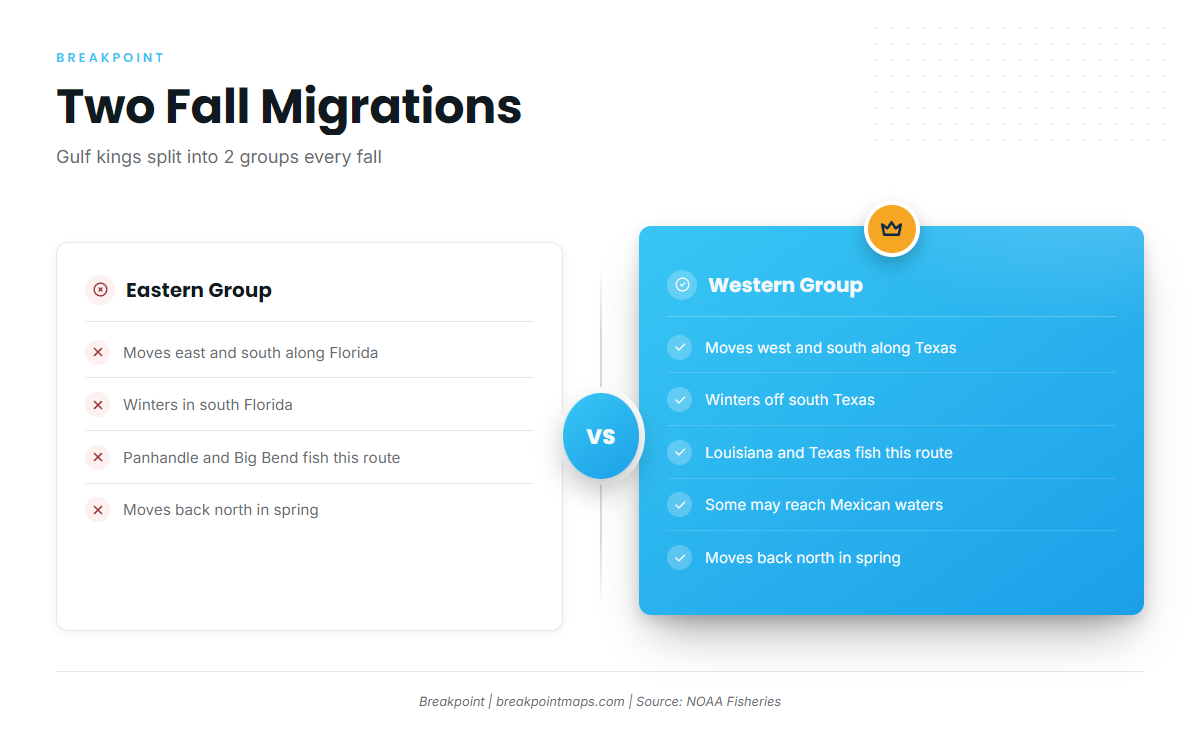
According to NOAA’s Making Sense of Mackerel, the Gulf stock moves in fall as two groups. One moves east and south along the Florida coast and winters in south Florida. The other moves west and south along the Texas coast and winters off southern Texas. Some portion may move into Mexican waters off the Yucatan. In spring, both groups head back north.
The Panhandle and Big Bend sit on the eastern group’s route, and Louisiana and Texas sit on the western one. Arrival on either route depends on the water, not the calendar.
The Florida Keys Mixing Zone
Getting this wrong can mean keeping an illegal fish. In winter, Gulf group and Atlantic group kings both show up in waters off Florida. NOAA Fisheries describes the winter mixing zone as primarily the waters off the Florida Keys, managed by the Gulf of Mexico Fishery Management Council (the Gulf Council) year round. Off the Keys, that means Gulf rules apply; the numbers are in the Regulations section.
The Gulf Council and the South Atlantic Council manage king mackerel jointly under one fishery management plan, with the Gulf Council handling the Gulf group.
Where and When by Stretch of Coast
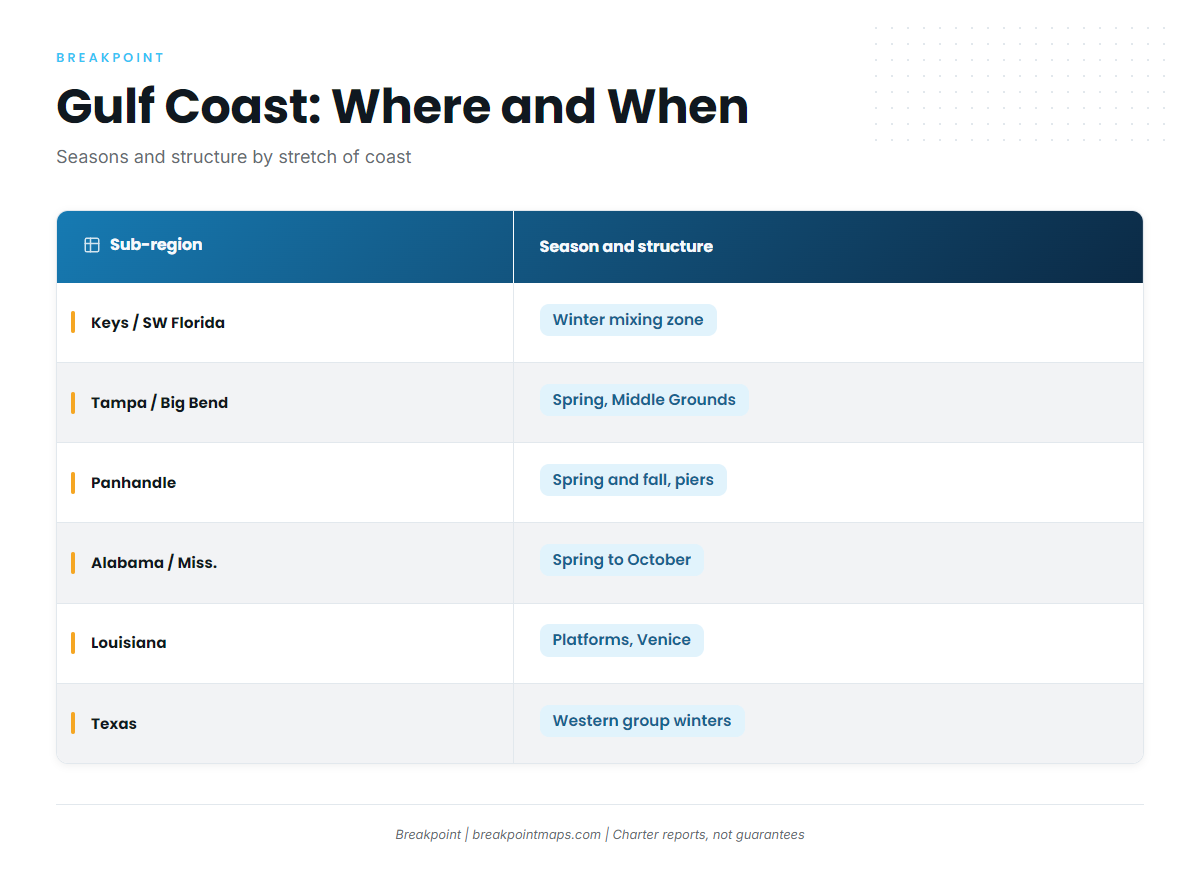
Timing varies by coast.
| Sub-region | Typical season | Key structure / notes | Source basis |
|---|---|---|---|
| Keys / SW Florida | Winter | Winter mixing zone, managed by the Gulf Council year round | NOAA Fisheries |
| Tampa Bay / Big Bend | Spring | Florida Middle Grounds is a named eastern Gulf area worth knowing | |
| Panhandle | Spring (April to June) and fall (September to November) | Piers are a real option here (see Tactics) | Charter report (Destin) |
| Alabama / Mississippi | Spring warm-up through October | Fall menhaden push out of Mississippi Sound and the Chandeleur and Breton Sounds | Alabama Gulf Coast mackerel season coverage; 2013 magazine account |
| Louisiana | Western route; arrival depends on the water | Oil and gas platforms, Venice as a named launch and staging place | Qualitative |
| Texas (to Port Aransas and South Padre) | Western group winters off south Texas | Minimum length 27 inches (see Regulations) | NOAA Fisheries; GCOOS |
In Alabama, kings start showing up as the weather warms in spring and stay until October. Farther west, a fall menhaden push into kings has been described off Mississippi. Menhaden spend summer along the shorelines of the Mississippi, Chandeleur and Breton Sounds, then move into the Gulf as fall water cools, and eventually into schools of kings.
Habitat & Conditions in the Gulf of Mexico
In the Gulf, kings follow bait, and bait follows water temperature. To decide where to fish king mackerel in the Gulf of Mexico on a given day, start with the water and the forage, then the structure.
Water Temperature Is the Trigger
Charter operators report that as water climbs past 68°F in spring, baitfish return and kings follow. One Gulf charter captain reports a preferred range of 68°F to 76°F and depths of 20 to 150 ft.
Bait Is the Real Target
Gulf kingfish key on the forage they can find. The names you will hear locally:
- Pogies (menhaden)
- Hardtails (blue runners)
- Cigar minnows
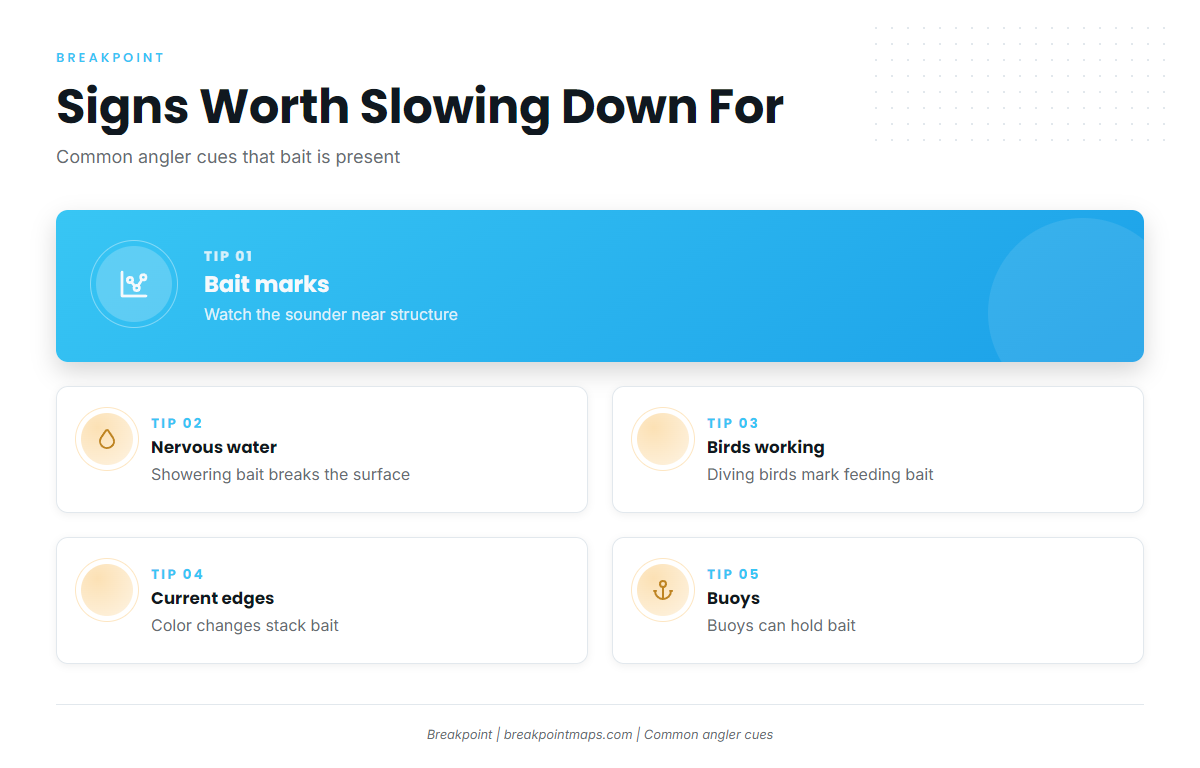
Signs worth slowing down for:
- Bait marks on the sounder near structure
- Nervous water or showering bait on the surface
- Birds working
- Color changes and current edges where bait stacks up
- Buoys holding bait
None of these guarantees fish. Anglers commonly rely on them because they show where bait is, and the day starts there.
Structure: Platforms, Reefs, Wrecks, Middle Grounds, Buoys
One Gulf charter captain reports kings nearshore and offshore, often around reefs, wrecks and buoys where baitfish concentrate. Off Louisiana and Texas, oil and gas platforms are the named structure. Platforms are being removed through decommissioning, so a structure on an older chart may be gone.
In the eastern Gulf, the Florida Middle Grounds is a name to know. Blue-water edges and the Loop Current also come up in Gulf fishing talk.
What Nobody Can Tell You
Arrival dates, front-driven bite shutdowns and bait movement all remain partly unpredictable. Center Console Life describes kings as unknowable quarry: "half predictable migratory species and half unknowable quarry." Anglers talk about warming water shifting the timing of the runs.
Tactics for the Gulf of Mexico
Slow-trolling live bait is the Gulf’s default for kings, and the bait you can keep alive decides the day.
Slow-Trolling Live Pogies, Hardtails and Cigar Minnows
Salt Water Sportsman’s trophy kingfish tactics list the live baits that work: mullet, menhaden, scaled sardines, threadfin herring, round scad, bigeye scad, redtail scad and blue runners. Livelier bait is better.
Fish the bait around the structure you have: platforms, wrecks, reefs and bait schools.
Stinger Rigs and Wire
Kings strike short and have teeth, so wire leaders and a stinger hook matter. The rig itself is covered in the species guide. On Gulf structure, the goal is keeping bait swimming naturally.
Spoons and Planers for Covering Water
When fish are scattered or bait is scarce, spoons and planers cover more water than a live-bait spread. Use them to search, then switch back to live bait once you find fish.
Smoker Kings and Keeping Bait Lively
Salt Water Sportsman describes giant "smoker" kings as wary, with keen eyesight. Its bait-keeping advice is practical:
- Pressurized livewells keep baits lively all day, which matters for late bites
- A hook-out tool gives a no-touch transfer from the bait rig to the livewell
If you fish tournaments, check the event rules on weigh-ins and fish condition before you go.
Pier Kings in the Panhandle
You can target kings from Gulf piers. Okaloosa Island and Navarre are Panhandle piers people name for this.
Quick ID Check Before You Keep a Fish
Check the lateral line. On a king mackerel it drops abruptly at midbody, while on Spanish mackerel and cero it slopes gradually from the gill to the tail. For full ID, see the species guide.
Frequently Asked Questions
When is the best time for king mackerel in the Gulf of Mexico?
Charter operators report spring (April to June) and fall (September to November) as the most productive windows, per a Destin charter source. Kings can be found year round depending on location. Actual timing shifts with water temperature, fronts and bait, so treat those months as a starting point.
What is the Gulf king mackerel bag and size limit?
Federal Gulf waters allow 3 per person per day, with a 24-inch fork length minimum. Florida’s Gulf waters and Monroe County allow 3 per harvester at 24 inches. Alabama allows 3 per person at 24 inches, Mississippi 3 fish at 24 inches, and Texas 3 per day at 27 inches. Check the agency for your state before you fish.
Which rules apply off the Florida Keys?
Gulf rules. According to NOAA Fisheries, the winter mixing zone, where Gulf and Atlantic group kings both occur, primarily includes waters off the Florida Keys and is managed by the Gulf Council year round.
Can you catch kings from Gulf piers?
Yes. Panhandle piers such as Okaloosa Island and Navarre are known for it. Check state fishing rules and each pier’s own rules before you go.
Is it the Gulf of America or the Gulf of Mexico in regulations?
Federal agencies use “Gulf of America (formerly Gulf of Mexico),” and NOAA Fisheries pages reflect that. The name change does not affect the fishing rules themselves. Search both names when you look up regulations.
Closing Nod
Breakpoint’s hotspots feature scores king mackerel across the Gulf, which can help narrow where to look before you run. A score improves the decision about where to look but does not promise fish. Chart layers are not for navigation.