



King mackerel fishing off Morehead City runs through Beaufort Inlet, which gets you to wrecks, reefs and the Cape Lookout Shoals quickly. In the fall, the big-fish conversation moves east toward Raleigh Bay. General biology is covered in our king mackerel species guide, and the Atlantic Southeast regional guide covers the coast around it. This page covers what is different about Morehead.
The fishery runs year-round, according to FishingBooker’s 2026 guide, which points trophy hunters to an April to November window for 20 to 50 lb "smoker" kings. Dated angler reports from 2011 put the fall bite from October through December. The main method is slow trolling live menhaden around structure and temperature edges, which PropTalk calls "hands down the best way to catch a big king mackerel."
Most local reports are seasonal and dated, so each one is labeled with its year. Below: where to run from Beaufort Inlet, when, where to get bait, how to fish it, and what the rules are. For Crystal Coast king mackerel timing at a glance, use the seasonal calendar table.
Regional Differences
The regional pattern holds here, with two local exceptions.
Cape Lookout Shoals and Raleigh Bay as fall big-fish ground. Carolina Sportsman’s 2021 "Fall for Kings" piece defines Raleigh Bay as the water east of Cape Lookout and Lookout Shoals and west of Diamond Shoals and Cape Hatteras. Big kings are reported to be prevalent there in the fall, and the shoals define the fall geography.
Gulf Stream proximity. The Stream sits close enough that offshore boats out of the same inlet target billfish and tuna.
Run distances matter more than they look. 2011 angler reports on Hull Truth put fall kings 15 to 20 miles out through November, with big fish on the east side 20 to 25 miles out in December. These are dated angler reports, not current conditions. For planning:
- Fuel: Budget for a 20-plus mile run each way in December.
- Sea state: Check the forecast for the whole day, not just the morning.
- Return trip: The ride home is where most people get caught out.
Habitat & Conditions at Morehead City, North Carolina
The water off Morehead City is a sequence: a tricky inlet, nearshore and offshore structure, and the temperature and color edges that concentrate bait around it.
Beaufort Inlet: The Way Out
Beaufort Inlet is the access point for Morehead City, Beaufort and Atlantic Beach boats, and it is the first hazard of the day. An ebb tide running against an easterly wind stacks the inlet up. Check conditions before you commit, and have a plan for the ride home.
Wrecks, Reefs and Live Bottom
Carolina Sportsman’s fall kings report names the Atlas Tanker and the Smell Wreck as "the two heralded locations" for big kings.
- Atlas Tanker: A shipwreck roughly 20 miles east of Cape Lookout, in two sections, with nearby wrecks, rocks and reefs.
- Smell Wreck: Roughly 55 miles east of Cape Lookout, a long run for a trailer boat.
That article is from 2021, so treat its bite reports as seasonal and dated. The NC Division of Marine Fisheries (NCDMF) runs the artificial reef program, and its reef maps are the place to get reef names and coordinates.
Live bottom and ledges offshore hold bait and kings. Reefs and live bottom, with seaweed, coral and sponges, are where kings are reported to congregate.
The edge next to a wreck often produces better than the wreck itself. Per the same 2021 article, bait and kings are often concentrated at nearby temperature breaks and color changes rather than directly over the wreck. PropTalk adds that wrecks, reefs, channel edges and tidelines attract bait, and bait attracts kings.
Temperature Breaks, Color Changes and Reading SST
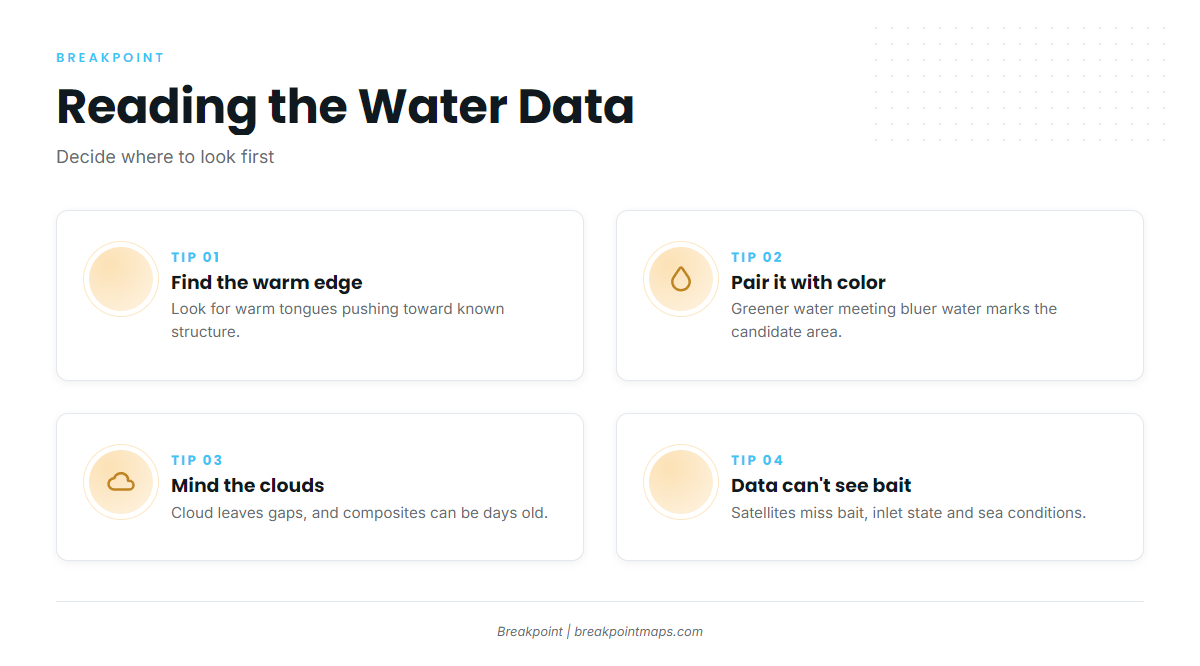
Look for a warm edge or tongue pushing toward known structure between Beaufort Inlet, Cape Lookout Shoals and Raleigh Bay. Pair it with a color change, where greener water meets bluer water. That pairing is your candidate area.
Satellite data has limits. It can’t see:
- Through cloud. A clouded pass leaves gaps, and a composite image may be days old.
- Bait moving.
- The state of the inlet on an ebb against an easterly.
- Forecast error.
Use the data to decide where to look first, then let the water tell you the rest.
Seasonal Calendar
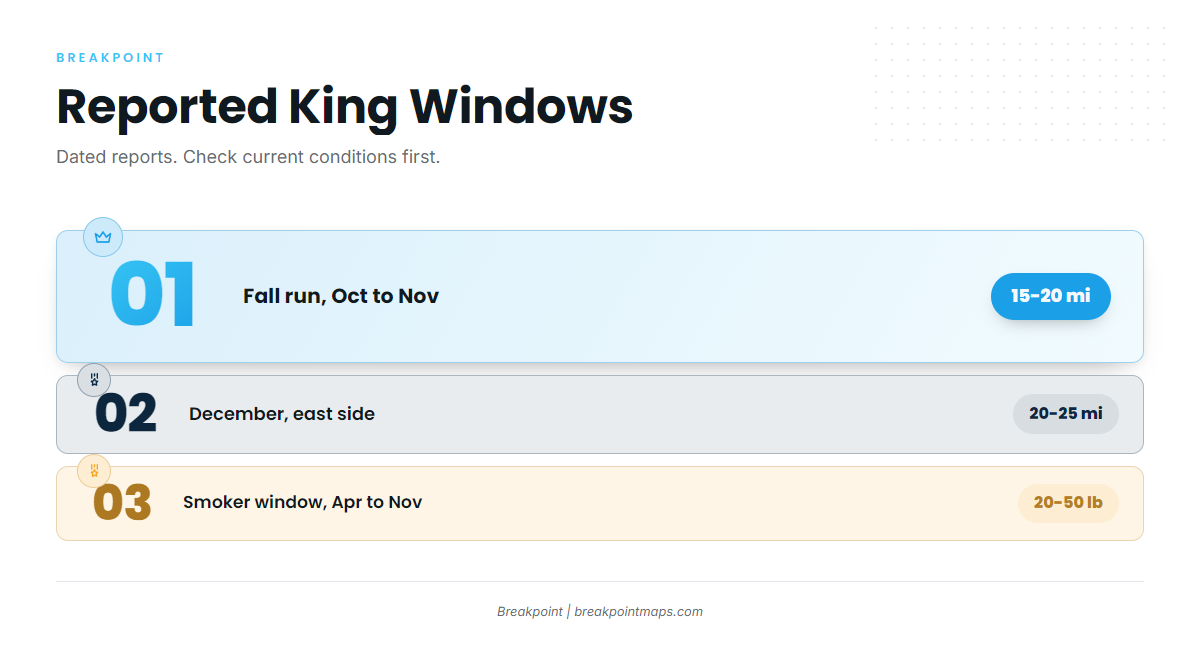
| Season | Where fish are reported | Typical cue | Source (year) |
|---|---|---|---|
| Year-round | Varies by season | Finding the fish is the challenge | FishingBooker (2026) |
| April to November | Smoker window, 20 to 50 lb | Bait on structure | FishingBooker (2026) |
| Fall (Oct to Nov) | 15 to 20 miles out; Raleigh Bay big fish | Temperature breaks, color changes near wrecks | Hull Truth (2011); Carolina Sportsman (2021) |
| December | East side, 20 to 25 miles out | Big fish reported | Hull Truth (2011) |
Treat these as starting points and check current reports before you go.
Tactics for Morehead City, North Carolina
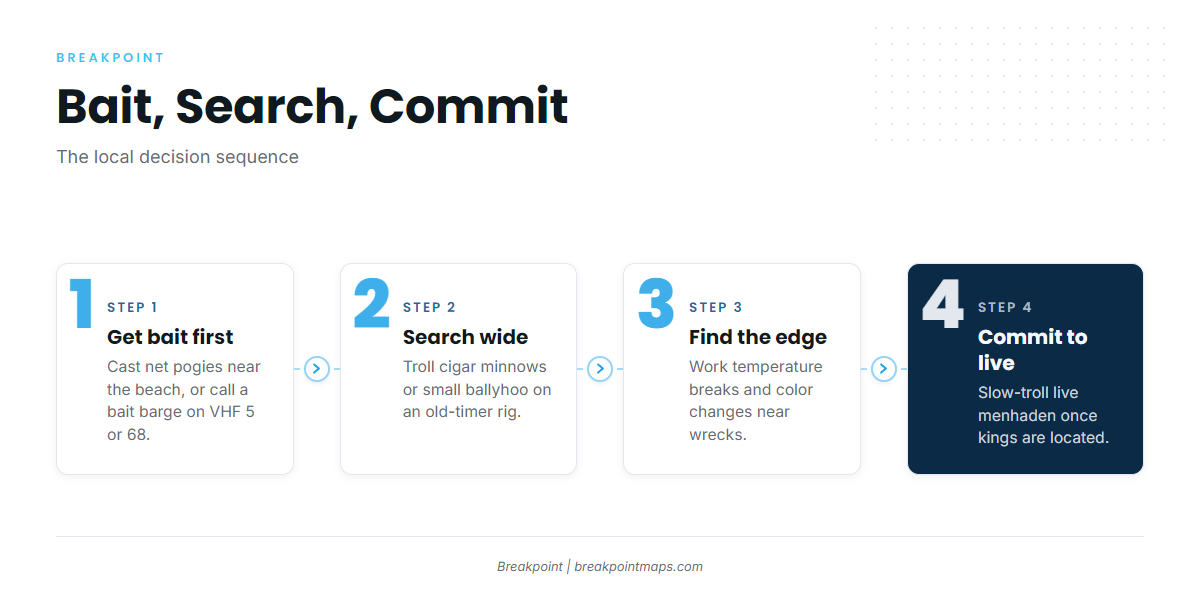
Bait comes first, then the choice between searching and committing, then tackle built for the short strikes kings are known for.
Get Bait First
Bait drives everything here. These are the reported sources:
- Near or on the beach: Cast net pogies (menhaden). Anglers report trolling 0 to 1 mile off the beach to find the schools (Hull Truth, 2011).
- Harkers Island, Spooners Creek, Town Creek Marina: Areas where anglers reported finding pogies (Hull Truth, 2011).
- Commercial bait: Call on VHF channel 5 or 68 to find a bait barge or commercial-bait operation (Carolina Sportsman, 2021).
Bait moves and these reports are dated, so ask at the dock.
Choose the Troll
The primary method is slow-trolling live menhaden around structure and edges. When you don’t know where the fish are, search wide first. Sport Fishing Magazine describes an old-timer rig then live bait sequence: troll cigar minnows or small ballyhoo on a jighead and trailer hook, then switch to live bait once kings are located. In practice, that means searching with dead bait until you find fish, then committing to live bait.
Tackle and Stingers
Capt. Matt Paylor told Coastal Review in 2022 how he sets up:
- A 7 ft live-bait trolling rod with a Shimano TLD reel and 20 lb line.
- Trolled spoons and frozen cigar minnows for school-size kings.
- Swimming plugs and topwaters on spinning gear for 10 to 20 lb fish around reefs, wrecks and ledges.
Carry stinger hooks for short strikes. A 2011 forum poster’s list was "4/0s, some wire, treble hooks."
Fall Pattern and Smoker Notes
- Big fall fish are reported east toward Raleigh Bay.
- Work the edges near wrecks rather than sitting directly over them.
- Search with dead bait, then switch to live.
- Sport Fishing Magazine reports that bluefish and blue runners have out-caught menhaden in fall events. That is one report, so don’t generalize it.
- Keep baits lively through long slow-troll days.
If you are fishing an event, check its current rules.