Overview
Pacific bluefin tuna fishing in the Pacific Northwest is sporadic and depends on conditions. According to Washington’s bluefin species page, "Pacific bluefin tuna are sporadically caught by anglers targeting albacore tuna off the Washington Coast, most often out of the ports of Ilwaco and Westport." Oregon anglers on albacore grounds see the same pattern, though.
For biology, general tackle, and range-wide behavior, start with our Pacific bluefin tuna species guide (Thunnus orientalis). This page covers what is different up here.
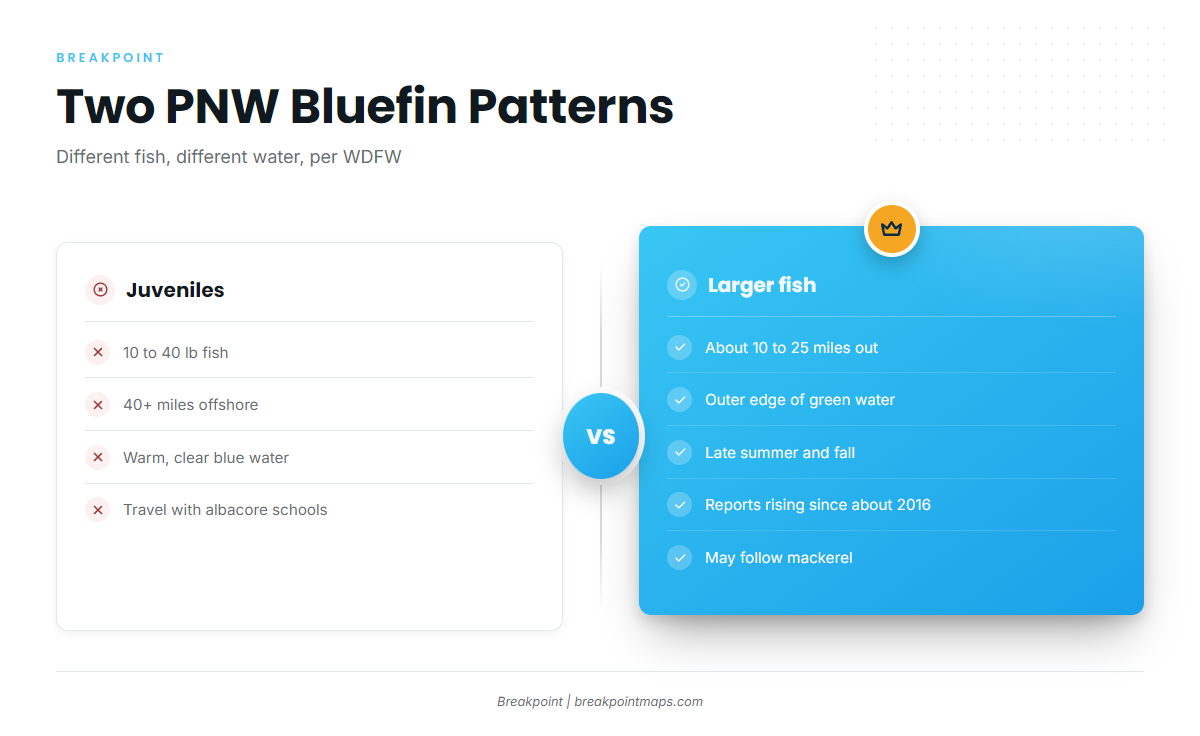
WDFW describes two patterns:
- Juveniles of 10 to 40 lb travel with albacore in warm, clear blue water 40 or more miles offshore.
- Larger fish have been reported since about 2016 in the outer green water, roughly 10 to 25 miles off southwest Washington, in late summer and fall.
We can’t promise fish, but we can help you decide where to look. On most trips, bluefin are a bonus on an albacore run rather than a targeted fishery like Southern California’s.
Regional Differences
The Pacific Northwest sits at the northern edge of the bluefin’s range, so encounters are irregular rather than seasonal. WDFW notes the region has likely always been the northern edge, citing archaeological evidence. It also raises a hedged possibility that more fish are expanding northward as bluefin populations recover from 20th-century overfishing. That is a possibility, not an established cause. Some anglers connect warm-water years to more encounters.
The fleet is noticing something. In a July 2025 Chinook Observer report, Colbach said the fleet was "definitely seeing a lot more bluefin than we’ve ever seen before." The albacore action was roughly 40 miles off the Washington-Oregon coast. Treat that as one season’s observation, not a trend line.
How the region compares:
- Southern California: An established, targeted fishery.
- Pacific Northwest: Sporadic, usually encountered on albacore trips.
- PNW sizes: Two size classes in two zones, per WDFW. The source does not say PNW fish run larger overall.
On timing, NOAA Fisheries says most U.S. bluefin are caught May to October. That figure is U.S.-wide, not regional. For the Pacific Northwest, WDFW points to late summer and fall for the larger fish.
Habitat & Conditions in the Pacific Northwest
Where you look depends on which bluefin you are after, since the two patterns live in different water.
Two PNW bluefin patterns
| Size class | Distance offshore | Water type | Season signal | Associated forage or school |
|---|---|---|---|---|
| Juveniles, 10 to 40 lb | 40+ miles | Warmer, clearer blue water | Travels with albacore | Large albacore schools |
| Larger fish | About 10 to 25 miles off southwest Washington | Outer edge of the green water | Late summer and fall, reports increasing since about 2016 | Possibly mackerel and other fish |
Swipe the table sideways to see every column.
Scouting Each Pattern
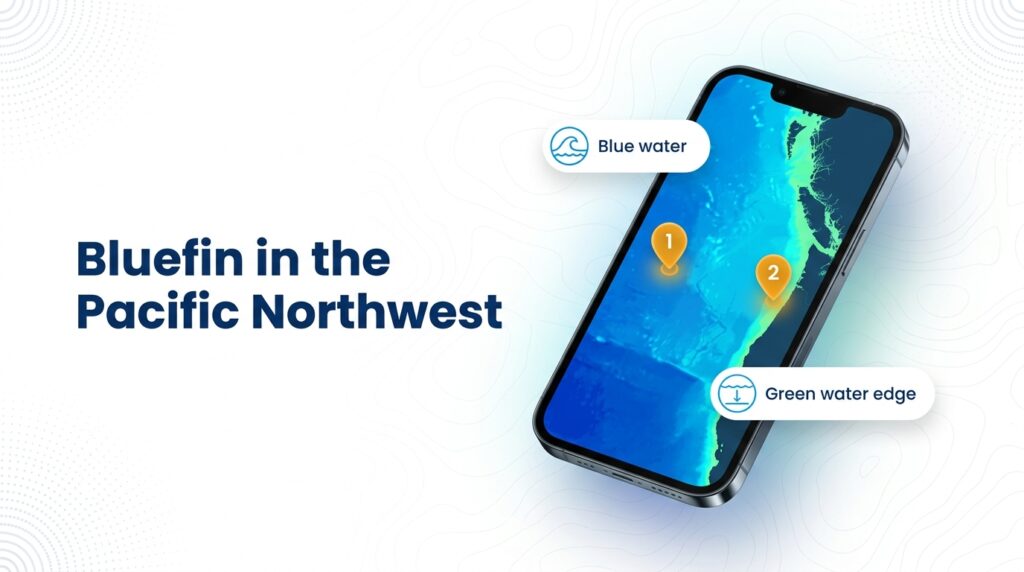
For juveniles, scout blue-water temperature breaks on the albacore grounds 40 or more miles out. For the larger fish, scout the outer green-water edge, where forage such as mackerel may hold. The run is shorter, and the water is different.
As a general principle, not specific to the PNW, bluefin are often associated with seamounts and ridges where upwelling occurs, and temperature and chlorophyll breaks are key indicators, according to a general bluefin habitat profile. Shelf-edge canyons and banks off Washington and Oregon are the kind of structure where upwelling and bait can concentrate.
Reading SST and Chlorophyll Together
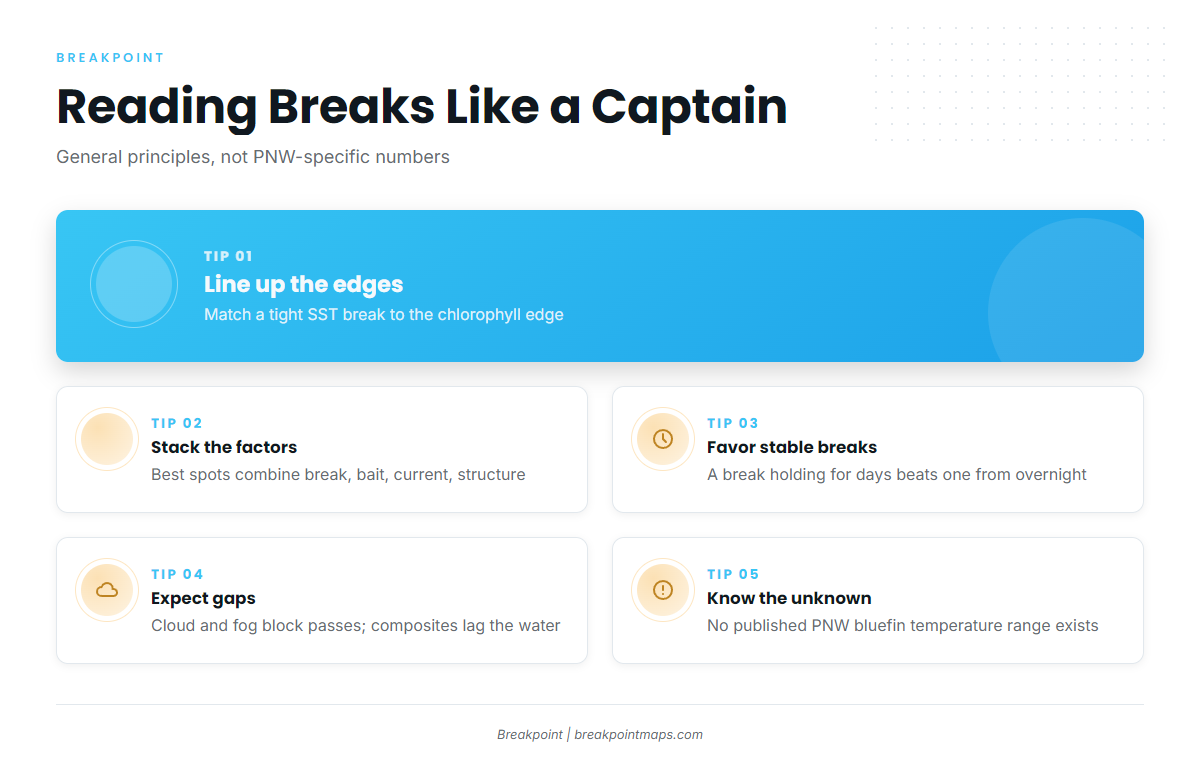
The useful step beyond finding a temperature break is stacking the layers: line up a tight SST break with the chlorophyll edge. The strongest spots combine break, bait, current, and structure in one place. Per general guidance on reading breaks, "a break that has stayed put for a few days is more trustworthy than one that appeared overnight."
Numbers quoted elsewhere mostly come from Southern California water and are not validated up here.
The data has blind spots:
- Cloud and fog regularly block SST satellite passes on this coast.
- Multi-day composites fill gaps but lag the water.
- Forecasts are forecasts.
Tactics for the Pacific Northwest
The gear already on most PNW albacore boats is what catches the juveniles.
On the Albacore Grounds
WDFW lists these methods for bluefin caught with albacore gear:
- Trolling plastic squid or plugs
- Vertical jigging
- Live anchovies or sardines
A 10 to 40 lb bluefin will test albacore tackle. General tackle and rigging fundamentals are in the bluefin species guide.
Targeting the Larger Nearshore Fish
The larger fish live in different water, so the approach shifts from a trolled albacore spread toward heavier tackle and bait that matches the forage WDFW mentions, mackerel and other fish.
Kite fishing and drifting a live bait such as a flyer or mackerel are Southern California methods for bigger or pickier fish. Treat them as borrowed ideas to test, not proven local tactics.
Runs, Bars, and Weather Windows
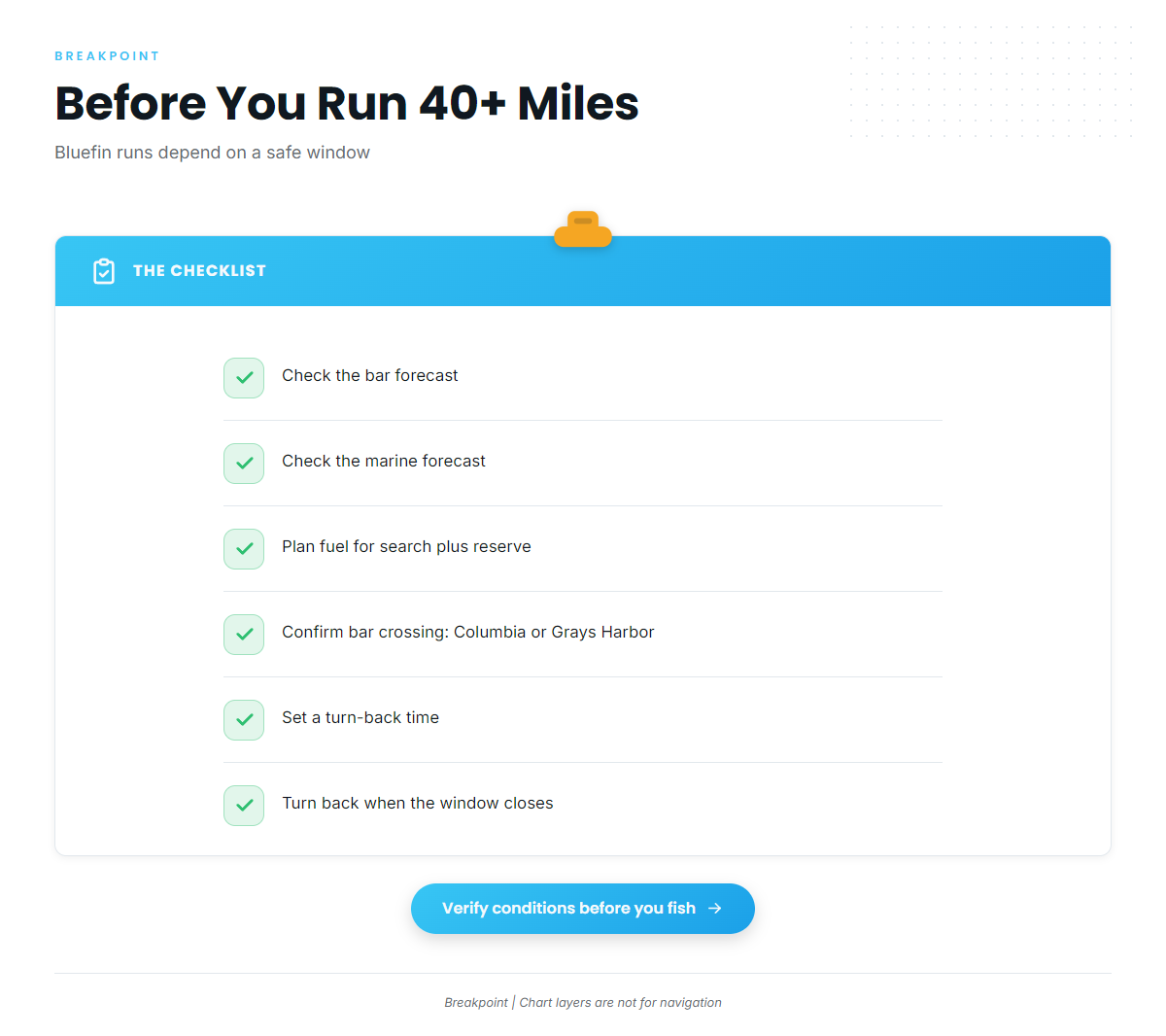
The juvenile pattern means runs of 40 or more miles each way. The larger-fish pattern is closer, roughly 10 to 25 miles. Both depend on a safe bar crossing: the Columbia River bar for Ilwaco and Grays Harbor for Westport.
Before you go:
- Check the bar and marine forecasts before committing.
- Plan fuel for the full search plus a reserve.
- Turn back when a window closes.
Chart layers are not for navigation.
Frequently Asked Questions
Are there bluefin tuna off Oregon and Washington?
Yes, sporadically. Per WDFW, they are mostly caught by anglers targeting albacore out of Ilwaco and Westport. WDFW also raises the possibility that recovering populations are expanding northward, though that is not an established cause.
How far offshore are bluefin caught in Washington?
Juveniles are caught 40 or more miles out in blue water, traveling with albacore. Larger fish have been reported about 10 to 25 miles off southwest Washington in late summer and fall, according to WDFW.
What size are Pacific Northwest bluefin?
Juveniles run 10 to 40 lb.
Where do I check bluefin regulations?
Check WDFW, ODFW, NOAA Fisheries West Coast Region, and the Pacific Fishery Management Council. Rules change, so verify each source before you fish.
Close
Juveniles run with albacore 40 or more miles out, and larger fish sit closer in over late summer and fall. Where you look and how you fish differ between the two, and the same regulations apply to both.
Breakpoint’s layers let you read temperature breaks, chlorophyll edges, and structure side by side. The layers show a read on the water, not a guarantee, and cloud can block satellite passes. Chart layers are not for navigation.