


Overview
Pacific bluefin are in Southern California waters most of the year, and most of the U.S. catch comes within 100 nautical miles of the coast. NOAA’s Pacific bluefin species page lists the fish as present year-round, with most catch from May through October. CDFW’s Marine Species Portal profile lists the species for California waters.
This guide covers the Southern California Bight, its offshore banks and the waters off northern Baja. For biology, gear fundamentals and trans-Pacific life history, start with our Pacific bluefin tuna species guide. This page covers only what changes in this region.
It is organized in three parts:
- Grounds by range. Which banks and islands fit your boat and your fuel.
- Tactics by behavior. Which method fits which kind of fish.
- Rules with check dates. What applies from the international level down to California.
Nothing here promises fish; the aim is a better decision about where to look.
Regional Differences
Bluefin here are young travelers from a single Pacific-wide stock, and many stay for years. That makes them present most months, but picky, boat-shy and hard to predict.
Why They’re Here: One Stock, Long-Stay Juveniles
According to CDFW, a portion of each cohort migrates from the western Pacific and stays up to several years as juveniles before returning west. In the eastern Pacific, fish are taken from Shelikof Strait, Alaska, to Magdalena Bay, Baja California. The Southern California Bight sits inside that much larger range, and local fish are part of a moving population, not a resident stock.
Season: Year-Round Presence, Variable Peak
NOAA says year-round presence, with most catch from May through October. Local charter and fishing sites cite April through November, or a July through September peak.
The peak moves with the year’s water and bait, so treat the calendar as a starting assumption rather than a plan. The best time is when temperature, bait and fish line up.
How They Show: Behavior Types
San Diego tuna-fishing sources describe several ways bluefin present. Each one maps to a tactic later in this guide.
- Breezers: fish on the surface with tails out of the water.
- Shiners: the school swimming just below the surface, making a shimmer.
- Foamers: fish busting bait white.
- Meatballs: bait balled tight, with fish working it.
- Deep marks: fish on the meter that will not come up.
Line-Shy, Boat-Shy and Keyed on Bait You Don’t Have
San Diego fleet sources report that bluefin here often focus on red crab or tiny baitfish that anglers don’t carry. Fish can be visible all day and still ignore everything aboard. Yellowfin tuna and yellowtail overlap on the same grounds, so a day targeting bluefin can turn into a different day.
What Nobody Knows
Nobody can say why a school vanishes from a bank overnight, what triggers movement between Baja and the Bight, or why fish that are present will not eat. Marine heatwaves and El Niño also shift where fish hold from year to year; they clearly matter, but how much is unclear. The data narrows the search without explaining the fish.
Habitat & Conditions in the Pacific Southwest
Bluefin in the Pacific Southwest hold on banks and islands where temperature breaks, chlorophyll edges and bait line up. How far you run depends on your boat. For Pacific bluefin off San Diego, the nearest ground is within private-boat range and the farthest is a multi-day commitment.
Grounds by Range
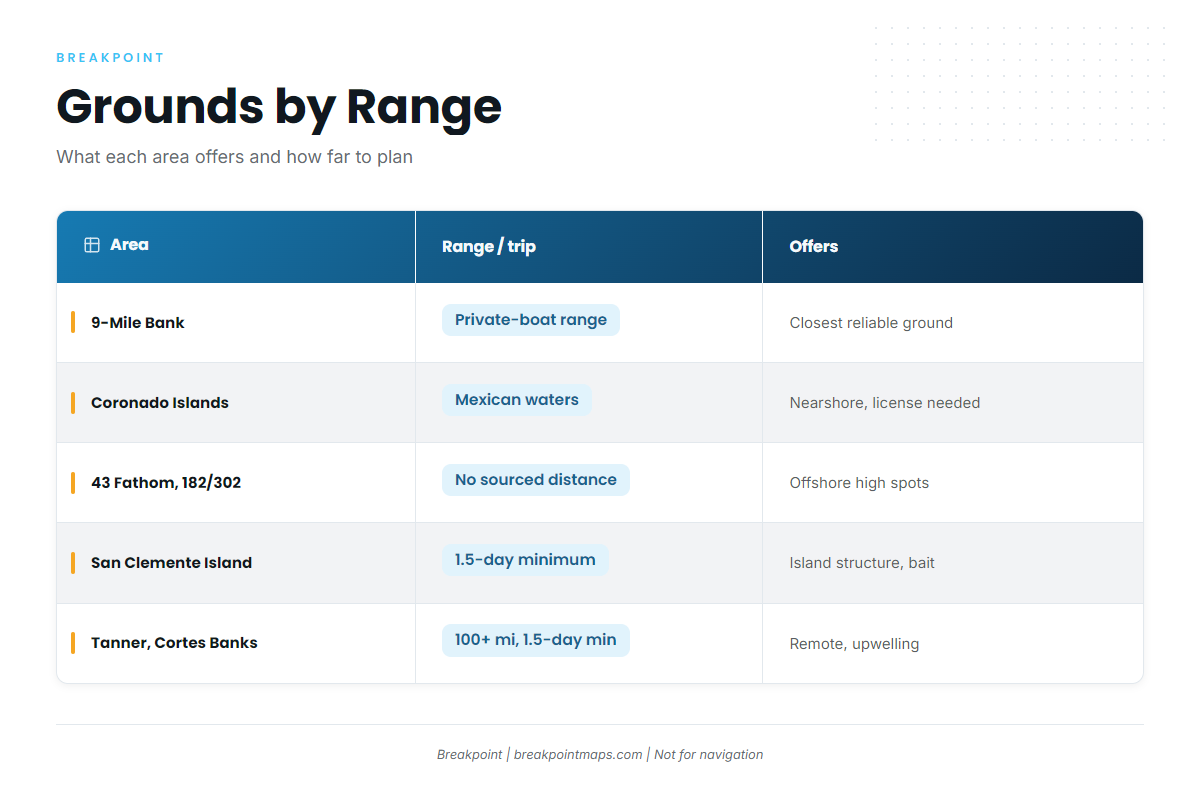
Your run decision comes down to fuel range, weather window and current intel.
| Area | Range / trip length | What it offers |
|---|---|---|
| 9-Mile Bank | Within private-boat range year-round | Closest reliable bluefin ground for trailer boats |
| Coronado Islands | Mexican waters; license required (see Regulations) | Nearshore option; cross-border paperwork |
| 43 Fathom Spot, 182/302 | Commonly fished SoCal offshore spots | Offshore high spots between the coast and the islands |
| San Clemente Island | 1.5-day minimum on the fleet | Island structure and bait |
| Tanner and Cortes Banks | 100+ miles offshore; 1.5-day minimum on the fleet | Remote banks with upwelling |
The 9-Mile Bank detail comes from one SoCal bluefin guide. The 1.5-day trip minimum is the fleet’s figure for reaching San Clemente and Tanner Banks, over 100 miles out. Chart layers are not for navigation.
What Concentrates Fish
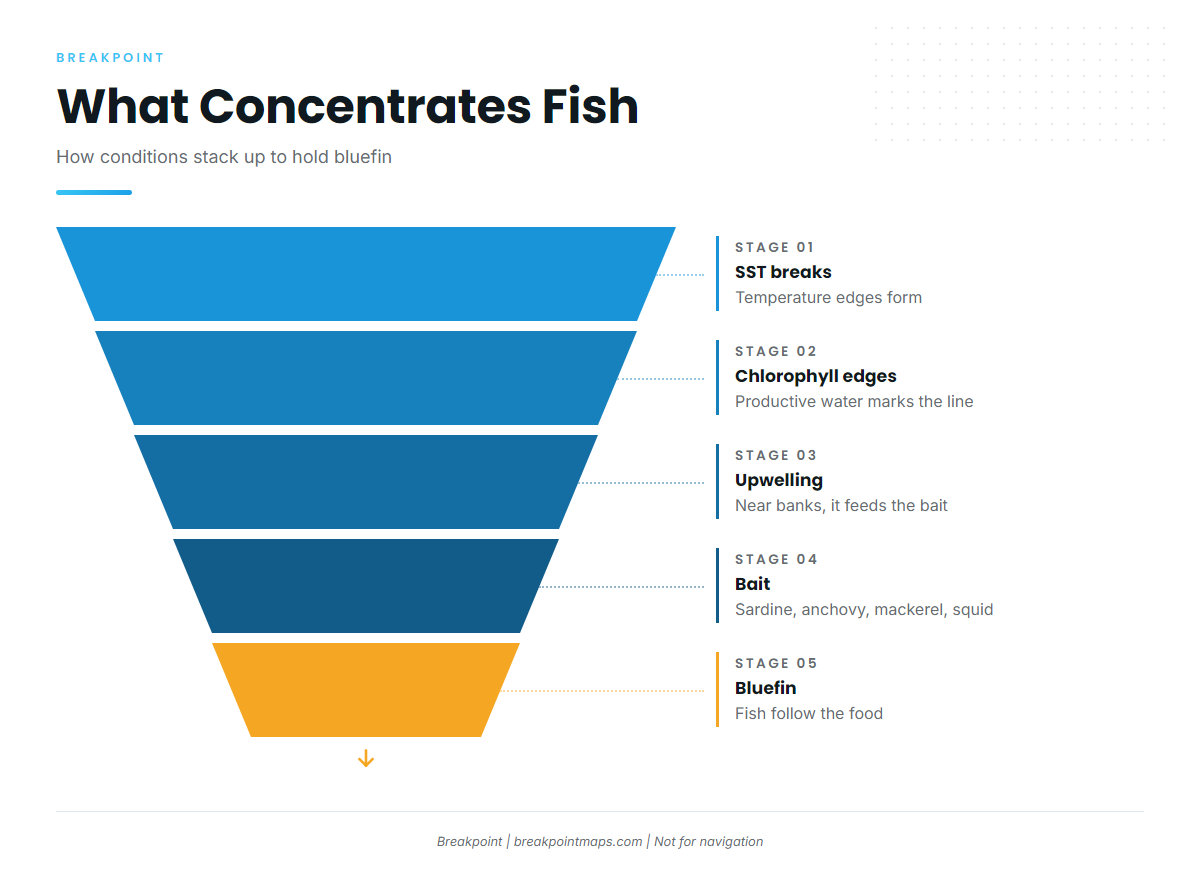
Temperature breaks form edges, chlorophyll edges mark productive water, and upwelling near banks feeds bait, which draws fish. NOAA lists squid, sardines, anchovies, saury, mackerel and hake among their prey.
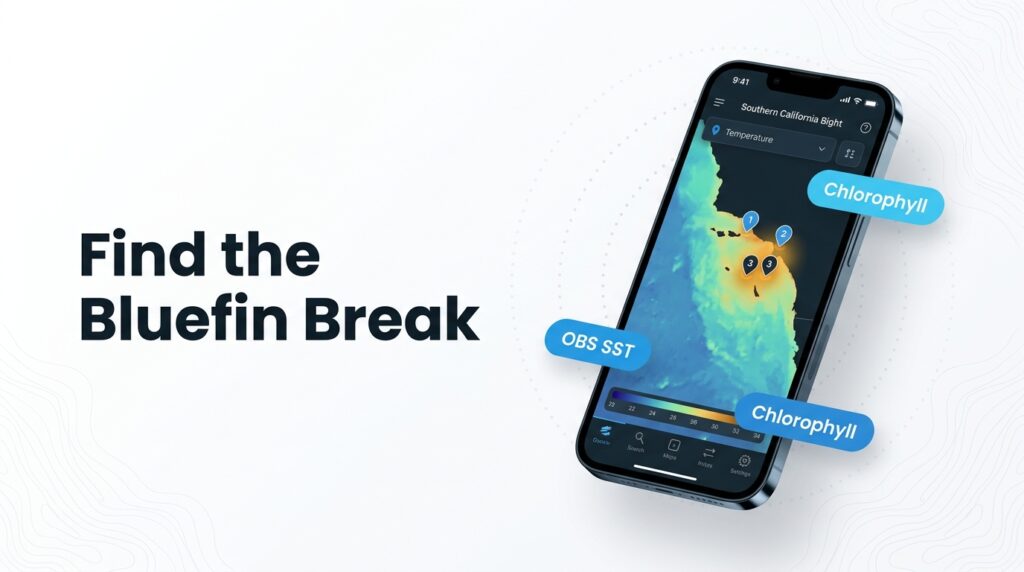
Anglers use these layers to cross-check reports. As a quiet-approach method from BD Outdoors suggests, gather reports from the area you plan to fish, then compare them against sea-surface temperature and chlorophyll charts. In our app, that means reading OBS SST and Chlorophyll side by side with the reports you trust.
What the Data Can’t See
- Cloud cover blocks a satellite pass. No pass means no fresh SST.
- SST shows the skin of the ocean, not the thermocline where deep fish hold.
- Chlorophyll marks productivity, not bait or bluefin.
- Reports age by the hour. A school can leave the bank you ran to.
Tactics for the Pacific Southwest
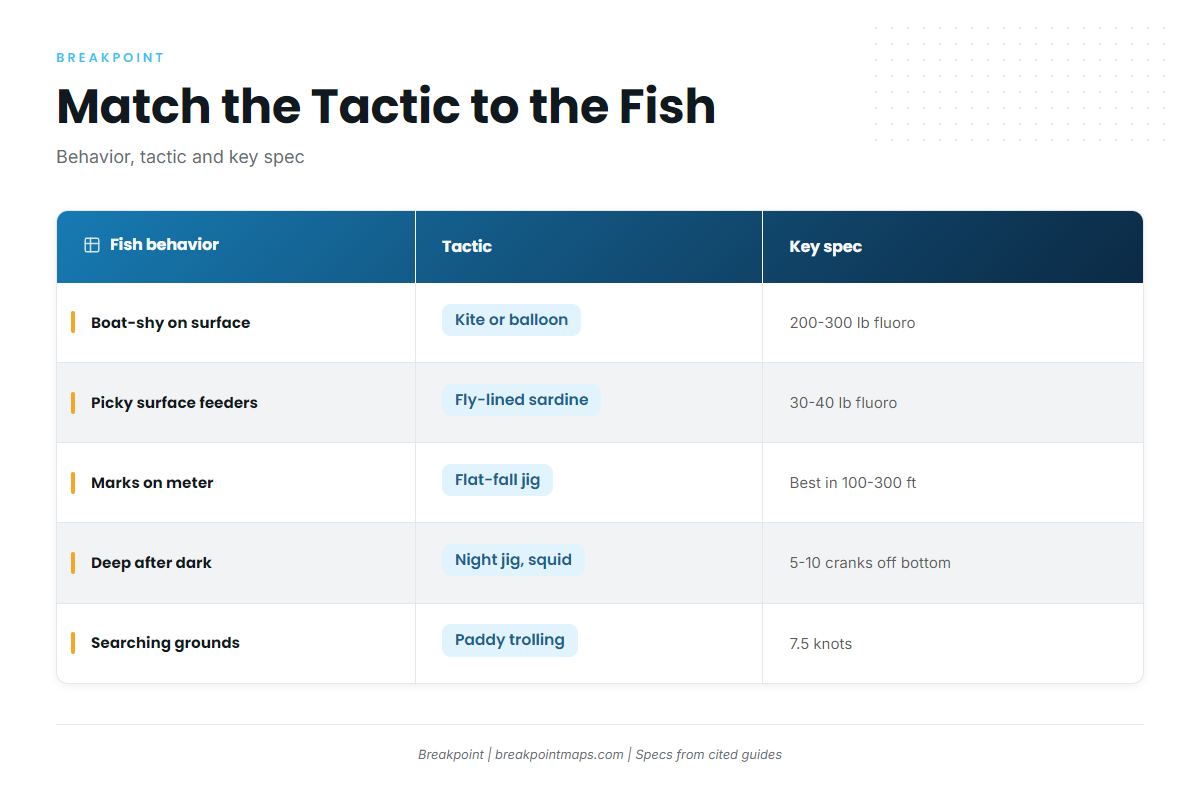
Match the tactic to what the fish are doing. Rig basics are in the species guide, so beginner rigging is skipped here. AFTCO notes that the right technique depends on fish behavior, boat type and angler ability.
| Fish behavior | Tactic | Key spec |
|---|---|---|
| Surface fish shying from the boat | Kite, or helium balloon on calm days | 100–200 lb braid, 200–300 lb fluoro; live mackerel, rigged flying fish or Yummy Flyer (In The Bite) |
| Picky surface feeders | Fly-lined live sardine, no weight | 30–40 lb fluoro, 6–8 ft leader |
| Marks on the meter | Flat-fall or knife jig, slow yo-yo | Works best in 100–300 ft |
| Deep after dark | Jig on the night drift; squid dropper loop | Squid 5–10 cranks off bottom (Sport Fishing Mag) |
| Searching / paddy grounds | Trolling kelp paddies | 7.5 knots (BD Outdoors) |
Kite and Balloon
A kite keeps the boat and line out of the fish’s view, which matters when bluefin shy from boats. San Diego sources note the helium balloon works the same way and suits calm days. Both lift the bait away from the boat and off the water.
Fly-Lining Sardines on Light Fluoro
Drift or anchor, chum live sardines or anchovies and fly-line a bait with no weight and no bobber, just a hook, a leader and a swimming sardine. It suits fish feeding near the surface that won’t hit lures.
Flat-Falls and Knife Jigs for Meter Marks
Drop to the depth the fish are marking and work a slow yo-yo. Flat-fall jigs earn their place when fish hold deep and won’t commit to surface baits. They work best in 100 to 300 ft of water.
Night Jigging and Squid Droppers
On the night drift, drop a fast-falling jig into the zone and work it back up. The fish eats on the fall, loads the rod and you crank. Live squid on a dropper loop, 5 to 10 cranks off the bottom, scores when fish feed deep.
Paddy Trolling
When searching, one BD Outdoors writer cruises at 7.5 knots and drags a cedar plug or Rapala in the shotgun position. Expect overlap with yellowtail and yellowfin around paddies.
Tackle Note
For lighter presentations, one guide recommends a 7 ft rod rated 30 to 80 lb and a 25- or 30-size two-speed lever drag reel. Larger fish call for heavier stand-up tackle.
When They’re Visible but Won’t Bite
Try these, in roughly this order:
- Approach quietly. Circle several hundred yards out, idle to within 75 to 100 yards and shut down.
- Turn off sonar. AFTCO reports that shutting down both up-and-down and side-scan units helped with boat-shy fish.
- Run lines farther back. Trolling guides say prop noise and engine vibration cost bites.
- Go lighter, and accept the tradeoff. Fish busting on the surface but refusing a 40 lb flyline may take 30 lb. Expect to lose some.
Some days nothing works, regardless of rig.
Frequently Asked Questions
When is bluefin season in Southern California?
NOAA lists bluefin as present year-round, with most catch from May through October. Local charter and fishing sites cite April through November or a July through September peak. Water temperature, bait and the year’s conditions matter more than the calendar.
How far offshore are bluefin off San Diego?
Most U.S. catch comes within 100 nautical miles of the California coast, per NOAA Fisheries. The 9-Mile Bank sits within private-boat range. San Clemente and Tanner Banks take a 1.5-day trip minimum on the fleet.
What is the California bag limit for bluefin?
California sets the recreational bag and possession limits. Check CDFW’s ocean sport fishing regulations directly for the current numbers. Verify before you fish.
Do I need a Mexican license at the Coronado Islands?
Yes. A CONAPESCA fishing license is required in Mexican waters, and the Coronado Islands are in Mexican waters. Confirm any vessel and FMM paperwork on official Mexican pages. Know where the maritime boundary sits before you fish near it.
Why won’t visible bluefin bite?
They may be keyed on red crab or tiny bait you don’t have. They are also boat-shy and line-shy. Approach quietly, shut down sonar, run lines farther back and go lighter on leader. Accept some break-offs; some days nothing works.
Close
Breakpoint’s hotspots feature scores Pacific bluefin conditions across the Pacific Southwest, reading layers like OBS SST and Chlorophyll the way a captain would, so you can decide where to look before you run. A score is a place to start looking, not a promise, and cloud cover can blind a satellite pass. Chart layers are not for navigation.