


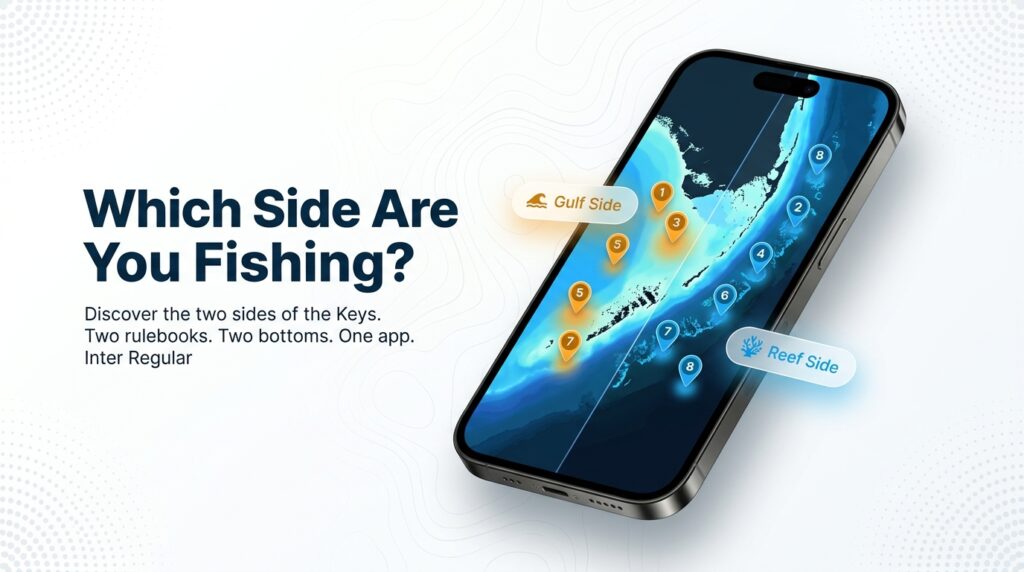
Red grouper fishing in the Florida Keys involves two management jurisdictions in one island chain, at the edge of the species’ core range, inside a national marine sanctuary. Biology, identification basics and general tactics are in our red grouper species guide. This page covers only the Keys.
Below you’ll find which side to fish, what bottom to look for, what weather window to wait for, and which rulebook applies. The Keys are not the heart of red grouper range, so a trip built around reds should expect mixed-grouper days.
Regional Differences
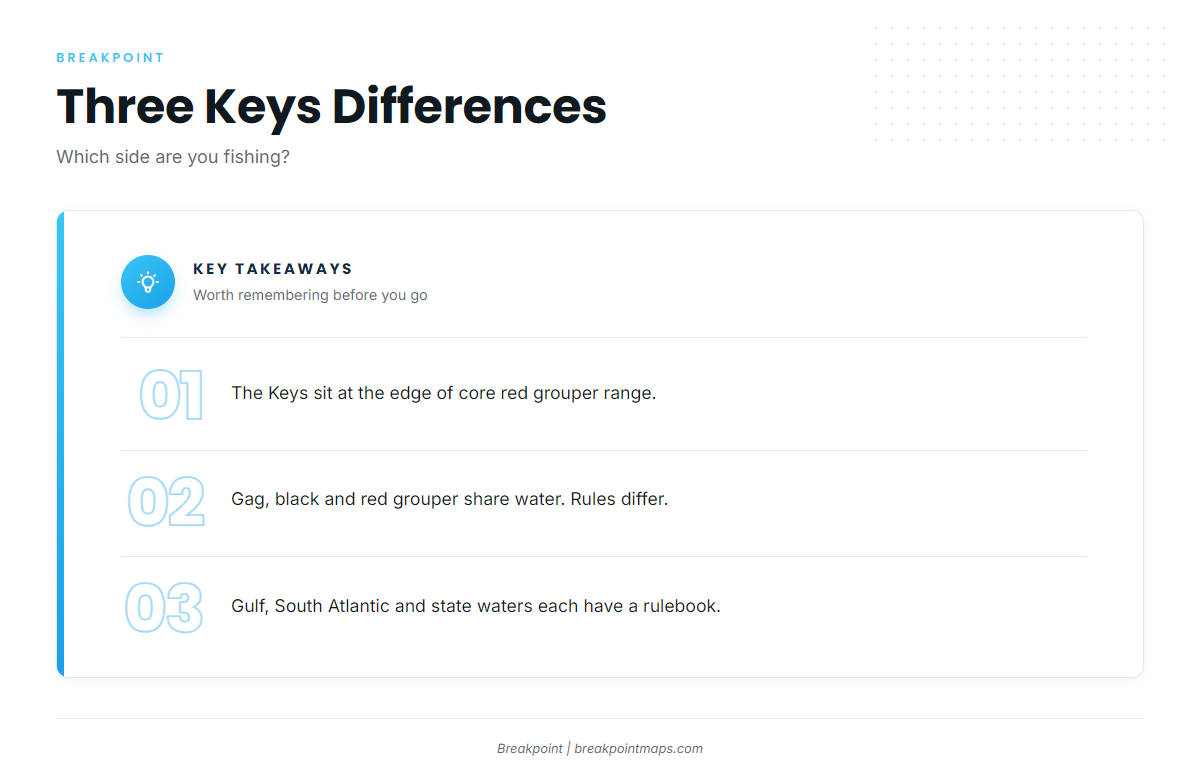
Fishing the Keys for red grouper differs from the Big Bend, southwest Florida and the Panhandle in three ways:
- Edge of range. The Keys sit at the southern and eastern edge of where red grouper are most abundant. The broad Gulf shelf farther north is the core, so reds here are one target among several.
- A mixed-grouper fishery. Gag, black grouper and red grouper share water here, and each carries different rules. That makes identification a compliance issue as well as a matter of curiosity (more in Tactics).
- Two management jurisdictions in one trip. Gulf waters are managed by the Gulf of Mexico Fishery Management Council (GMFMC) and NOAA Fisheries. South Atlantic waters are managed by the South Atlantic Fishery Management Council (SAFMC) and NOAA Fisheries. State waters fall under the Florida Fish and Wildlife Conservation Commission (FWC). A run from Marathon to the reef and a run to the Gulf side can fall under different rulebooks in the same week.
Marathon, Islamorada, Key West and the Dry Tortugas all put you within reach of this split. We make no claims here about which town produces more fish.
The first question on any Keys grouper trip is which side you are fishing. Bait comes after that.
Habitat & Conditions at the Florida Keys
The Gulf Council red grouper profile says red grouper prefer "offshore rocky flat bottom habitats or rocky ledges" at depths from 16 to 1,083 feet. In the Keys, that description points you toward Gulf-side hard bottom first. Red grouper fishing in the Florida Keys is largely a matter of finding that bottom and reading what surrounds it.
Read the contours yourself, and check any single number you hear at the dock before relying on it.
Gulf Side vs. Atlantic Side
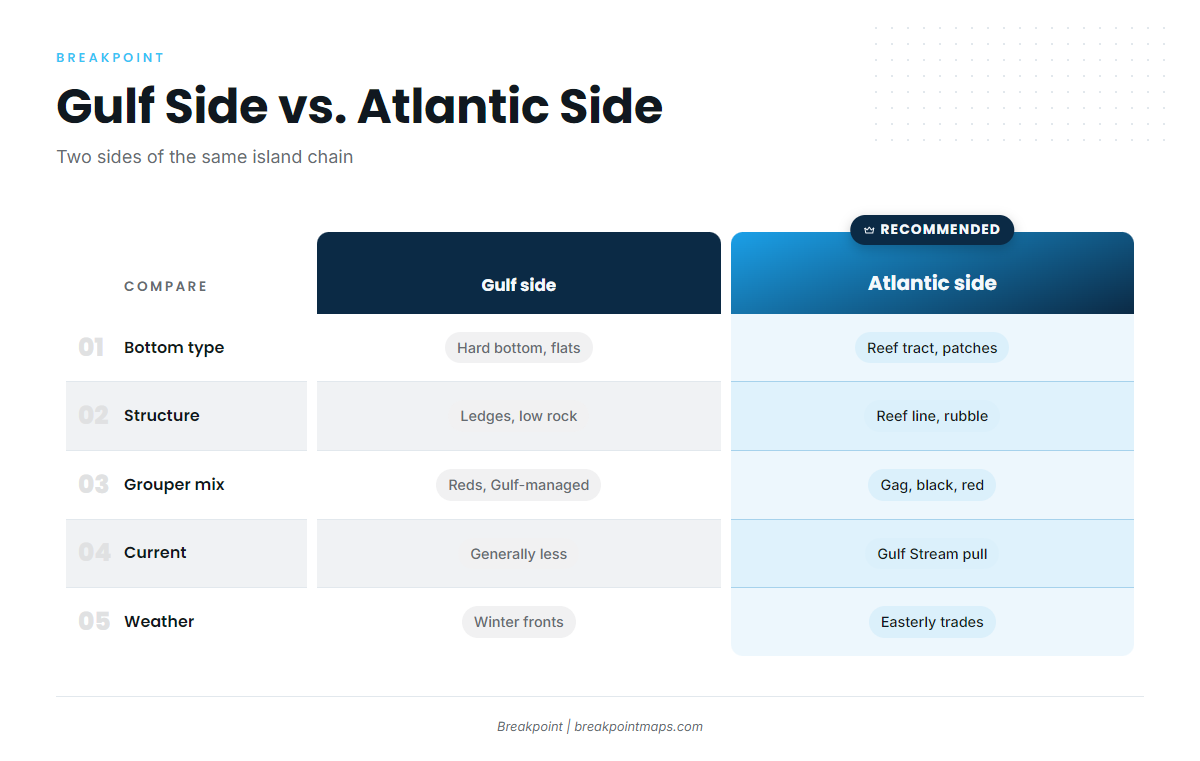
On the Gulf side, look for hard bottom and ledges. That matches the Gulf Council’s habitat description and is where the choice of side usually starts.
On the Atlantic side, you are working the reef tract and patch reefs. Red grouper share that structure with gag and black grouper, which is why identification and rules matter more there.
| Gulf side | Atlantic side | |
|---|---|---|
| Bottom type | Hard bottom, rocky flats (Gulf Council habitat description) | Coral reef tract, patch reefs, rubble |
| Typical structure | Ledges, low-relief rock | Reef line, patch reefs, deeper rubble seaward |
| Grouper mix | Reds within the Gulf-managed population | Mixed: gag, black, red |
| Current and anchoring | Generally less influenced by the Gulf Stream | Gulf Stream proximity can make holding bottom harder |
| Weather exposure | Exposed to winter fronts from the northwest and north | Exposed to easterly trade winds |
Where we have no data for a specific spot, the answer is the same: it varies, so read the contours.
Winter Fronts and Wind Windows
Fronts bring north and northwest wind that roughs up the Gulf side, and the days after a front often lay down. Easterly flow tends to give the Gulf side a lee and pushes sea state up on the Atlantic side.
That is judgment, not a rule. Check the marine forecast the morning you go and again before you leave the dock.
Current, the Gulf Stream and Water Clarity
On the Atlantic side, current strength decides whether you anchor or drift. If you can’t hold bottom without dragging, drifting the structure is often the better call. Clarity changes with the side and the weather, and it is best treated as a factor in presentation rather than a predictor of the bite.
What the Charts Can’t See
Survey coverage and resolution vary across the Keys, and some soundings are old. Low-relief hard bottom may not show on a chart at all, so a spot that looks empty on the chart may not be empty.
Red Tide and Lionfish
Red tide is an unknown on the Gulf side, so check current conditions before you commit to a run. Lionfish are present on Keys structure, so expect to see them.
Tactics for the Florida Keys
This section assumes you already know how to bottom fish. What differs in the Keys is the structure, the mix of species and the jurisdiction, and the notes below cover only those differences.
Rig and Bait
Use a live or cut bait bottom rig, with tackle heavy enough to turn a fish off reef or ledge. Circle hooks are required in Gulf federal reef fish waters. Verify the current rule, including whether it applies on the Atlantic side, before you leave the dock.
Turning the Fish in the First Seconds
A grouper that reaches structure is usually a lost fish. According to Florida Sportsman, you have roughly three seconds to give everything you have, and turning grouper off structure is the whole game. If the fish holes up, the article describes two recoveries: stay tight and "play the banjo" on the line, or back off the pressure entirely and wait a few minutes with slack line.
Reef and ledge structure is close at hand in the Keys, which raises the stakes on that first run.
Anchor or Drift
The same side-by-side logic applies. On the Atlantic side, current often drives the decision. On the Gulf side, conditions are often more forgiving. Keep the choice flexible and let the water tell you.
Identification Is Compliance
Gag, black and red grouper carry different rules, so misidentifying one is a violation. The Gulf Council’s ID cue is simple: "The red grouper’s mouth lining is a scarlet-orange color." For more help, check the FWC and NOAA Fisheries grouper identification resources.
Release and Barotrauma
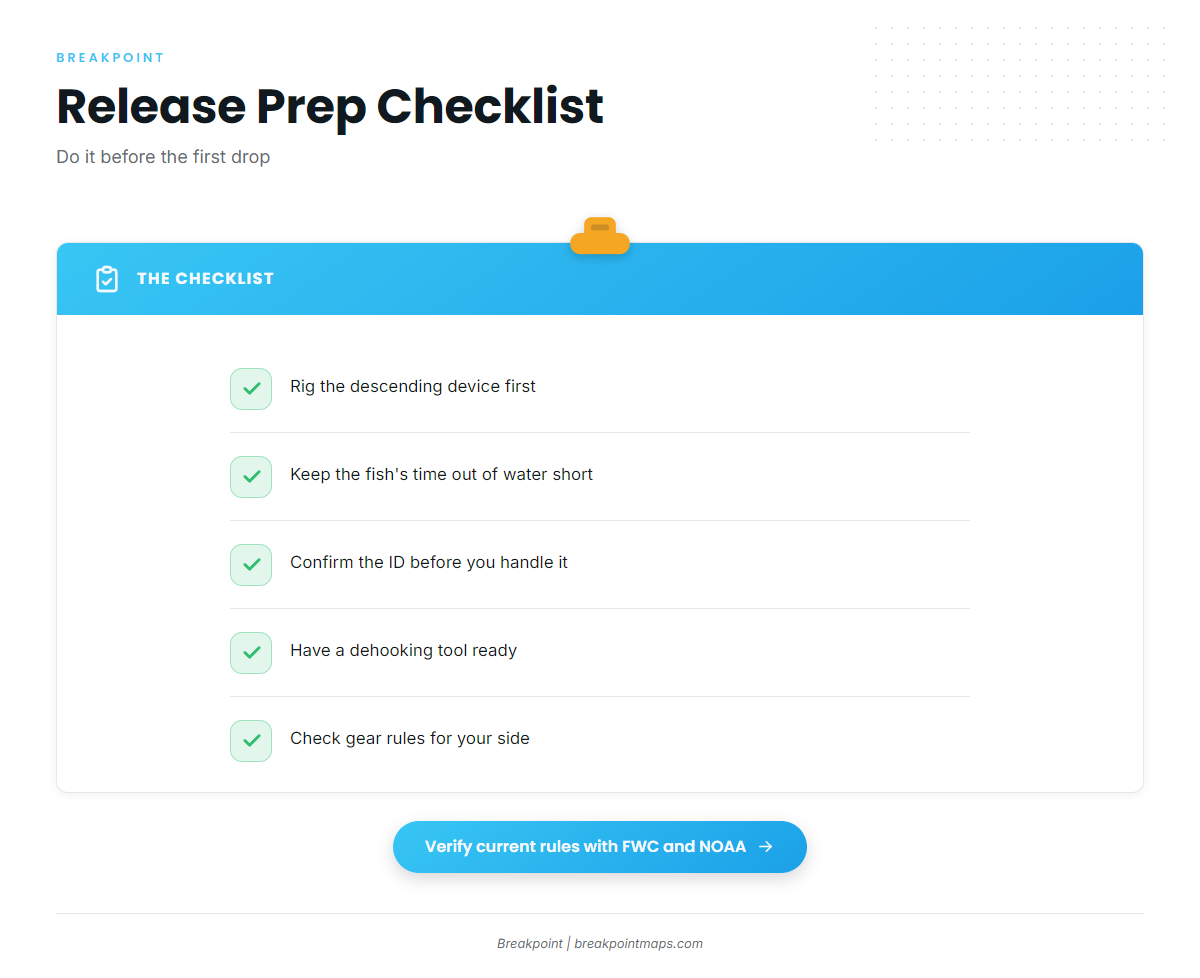
Deep-caught fish released at the surface can struggle, and a descending device returns them to depth. Gear requirements differ by side and are detailed in Regulations below.
Some handling notes:
- Rig the descending device before the first drop, not after the first fish.
- Keep time out of the water short.
- Have your dehooking tool within reach.
Frequently Asked Questions
Do Gulf or Atlantic rules apply in the Keys?
It depends on where you fish, not where you launched. The Keys straddle the Gulf and South Atlantic federal management boundary, and state waters fall under FWC. Check the FWC and NOAA boundary descriptions for the exact line before you run.
Is red grouper open in the Keys right now?
It depends on the side and the day. The Atlantic side has a shallow-water grouper spawning closure, historically Jan 1 through Apr 30, and the Gulf side is quota-managed and can close in-season.
Do I need the State Reef Fish Survey?
Per FWC, it applies to private-vessel anglers keeping reef fish. Verify the current requirement and any cost with FWC before your trip.
Do I need a descending device?
In Gulf federal waters, the Gulf Council requires a venting tool or descending device rigged and ready to use. The South Atlantic has its own descending-device rule under NOAA Fisheries. Check both, and carry a device either way.
Closing
Breakpoint puts Keys Chart Contours, OBS SST and forecasts on one screen, so you can pick Gulf side or reef side before you leave the dock. Chart layers are not for navigation, and regulations change, so verify before you fish.