Overview
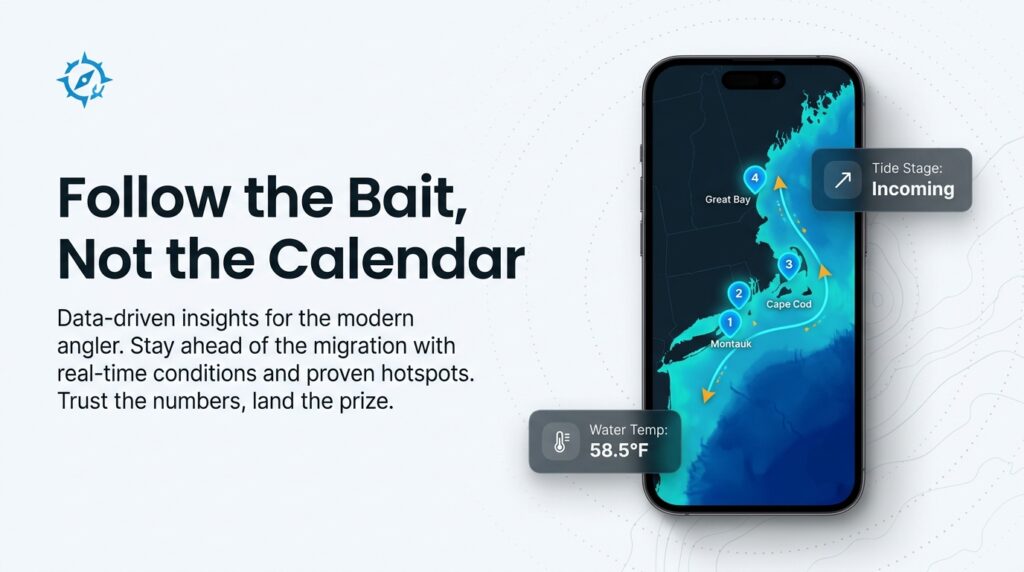
Striped bass fishing in the Atlantic Northeast follows two migrations, one north in spring and one south in fall. Bait and water temperature set the timing, and the calendar matters much less. If you want the fundamentals first (biology, tackle basics, how to handle a striped bass), start with our striped bass fishing guide. This page covers what’s different from Maine to New Jersey.
Striped bass are managed coastwide by the Atlantic States Marine Fisheries Commission (ASMFC) rather than a federal council. Federal waters from 3 to 200 miles offshore are closed to all commercial and recreational striped bass fishing. The 2024 stock assessment found the stock overfished but not subject to overfishing, according to NOAA Fisheries stock status. That status is why slot limits are tight. Circle hooks have been required with bait since 2020.
This page includes:
- A timing table by sub-region
- Where the structure and current sit, from New Jersey to Maine
- Tactics by platform: surf, boat, kayak and fly
- A regulations table with the agencies to check before you fish
What we can’t tell you. Run timing shifts from year to year with menhaden, sand eels, river herring and water temperature, and no map or forecast removes that uncertainty. The best advice we found is to time dates to water temperature rather than the calendar. Treat every window below as a starting point for where to look, not a promise of fish.
Regional Differences
Five things set the Northeast apart from the general picture.
Two spawning sources feed the region. The Chesapeake and Hudson spawning areas hold the major East Coast spawning and nursery grounds, with spawning in April and May in freshwater tributaries. Hudson fish explain early spring action in New York and New Jersey, while Chesapeake fish move through on their way north. The Delaware also contributes as a spawning river.
Two runs. Spring pushes north. In fall the fish move south, following bait out of cooling estuaries and down the coast. Many anglers call it the fall blitz.
Bait sets the schedule. Menhaden (bunker), sand eels and river herring each shape a season. River herring pull fish into places like Great Bay in spring, sand eels hold fish on shoals, and bunker drives much of the fall.
Big tidal current. The Cape Cod Canal and the rips off points and ledges such as Montauk, Block Island and Monomoy concentrate bait. Bass hold where current forces bait past structure.
Cold water north of Cape Cod. Gulf of Maine water delays arrival in New Hampshire and Maine. Fish reach the Gulf of Maine toward the beginning of June, and fishing improves through summer from south to north, according to On The Water.
Many of the fish you meet here are passing through on a long migration, so timing matters more than it does on a resident fishery.
Habitat & Conditions in the Atlantic Northeast
Work from south to north to follow the spring run, or reverse the direction to follow the fall run.
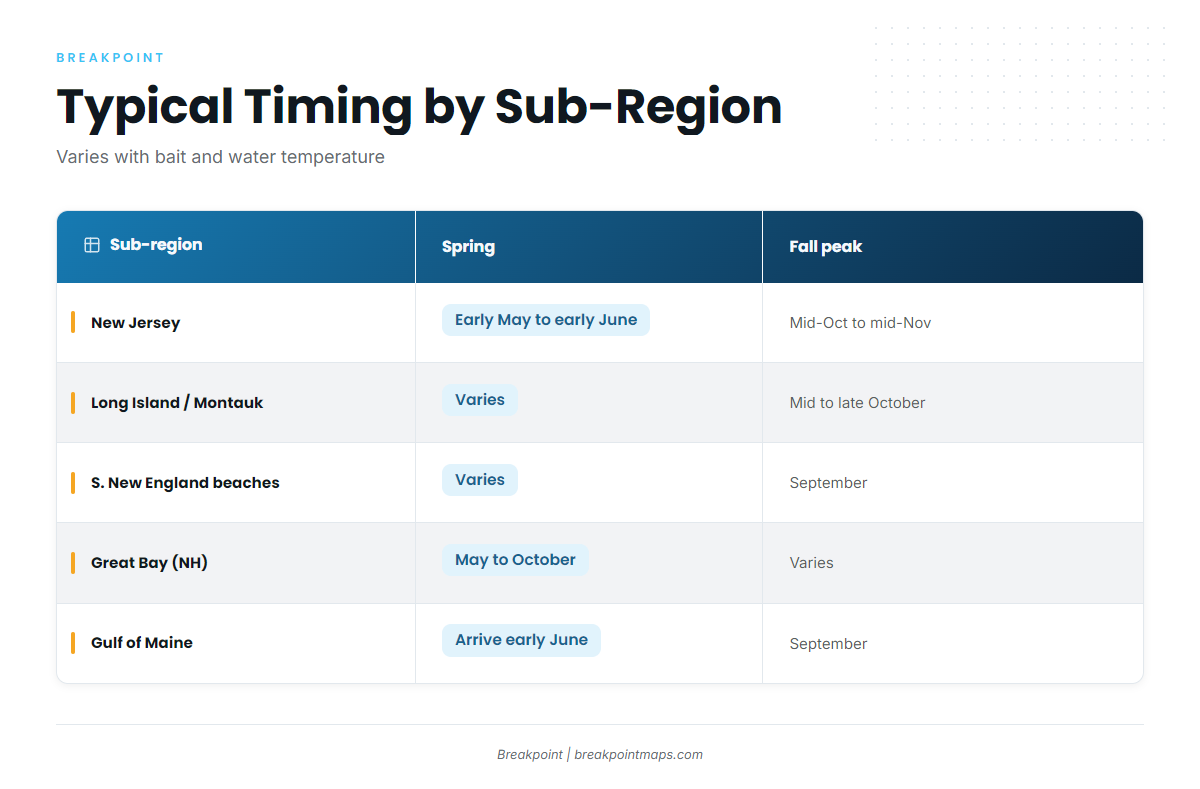
Table 1. Typical timing by sub-region. Varies with bait and water temperature.
| Sub-region | Typical spring arrival | Peak spring | Summer pattern | Fall peak |
|---|---|---|---|---|
| New Jersey | Early May | Early May to early June | Varies | Mid-October to mid-November |
| Long Island / Montauk | Varies | Varies | Varies | Mid-to-late October |
| Southern New England beaches | Varies | Varies | Varies | September |
| Great Bay (NH) | Roughly May | Varies | Feeding fish through the season | Runs roughly May through October |
| Gulf of Maine | Toward early June | Varies | Improves south to north | September on Maine beaches |
Swipe the table sideways to see every column.
The New Jersey windows come from New Jersey run windows. Cells marked "varies" are not backed by a source we trust, so we left them open.
When is the fall run in the Northeast? It typically rolls south from Maine and southern New England beaches in September, to Long Island in mid-to-late October, and to New Jersey from mid-October into November. The general pattern holds, but time it to water temperature, not the date.
New Jersey
Sandy Hook is the anchor. Stripers and bait moving in and out of Raritan Bay pass close to the beach at the Gateway National Recreation Area unit, and Highlands makes a practical base a short drive away. New Jersey gets early spring fish from the Hudson and is the last stop of the fall run.
New York and Long Island
Montauk Point is the fall run destination, where points and rips turn bait. The federal line sits offshore, closer than many boat anglers expect (see Regulations). Many Long Island anglers release fish voluntarily, which is common practice on that shore.
Connecticut and Rhode Island
The Rhode Island south-shore breachways (Charlestown, Weekapaug, Matunuck) offer walk-on access, and outflow current carries bait past the mouth. Offshore, Block Island’s Southwest Ledge is a boulder field covered in mussels. Strong tides and swirling currents disorient bait there, and squid and scup draw the bass.
Cape Cod and the Islands
The Cape Cod Canal has strong tidal current with walk-on and bike-on access. Monomoy offers rips and flats, and the open Cape beaches round out the options. Check Canal current tables before you go;.
New Hampshire and Maine
Great Bay and the Piscataqua hold slot-size fish following herring in spring. The Merrimack and Plum Island area works because the river supplies forage, current and structure. Maine’s rivers hold schoolies with some slot fish. Kayak launch areas include Saco Bay, Casco Bay, and the mouths of the Kennebec and Penobscot.
What Moves the Fish: Conditions
Use these as filters, not laws:
- Water temperature. Fall inshore water off Massachusetts and New Jersey sits around 55 to 65°F, according to fall inshore water temperatures reported by Saltwater Sportsman. Ranges vary, so treat any single number as a rough guide.
- Tide stage. In early spring, outgoing water carries warmer water out of back bays. On open beaches, moving water generally beats slack. Neither is a rule.
- Wind. Onshore wind often pushes bait into the surf.
- Light. Dawn, dusk and night are typically the most active periods.
- Bait. Find the bait and you find the fish. An eddy is the slack pocket down-current of a point, where bait gets turned and bass wait.
Tactics for the Atlantic Northeast
Rigging and knot basics are in our striped bass species guide. What follows is what works here.
Shore and Surf
- Live eels at night. Widely regarded as the big-fish tactic from the surf. Use circle hooks when fishing bait (see Regulations).
- Swimming plugs and needlefish at night. Best on darker beaches with little light pollution.
- Topwater at dawn and dusk. Work soft plastics around inlets, sod banks and pilings with a twitch-and-reel cadence.
- Cape Cod Canal. Fish the moving current and check the Canal current tables first.
- Reading the beach. Look for structure plus moving water: points, cuts and breachway outflows.
Boat
- Tube and worm. A New England favorite, trolled slowly near structure.
- Live-lining bunker. Find the menhaden schools and fish live bait under or near them, on circle hooks.
- Rips and ledges. Southwest Ledge and Montauk reward working the seams where current meets structure.
Mind the EEZ. Around Block Island and Montauk, the 3-mile line is close. See Regulations.
Kayak
- Rivers and estuaries give protected water and easy access. Keep moving until you find fish.
- Sit-on-top kayaks are more stable in current.
- Eddies behind points hold bass.
- Follow the kayak launch timing rule: at an unfamiliar site, avoid launching or landing from 2 hours before to 2 hours after low tide. Strong tides can be impossible to paddle against.
Fly
A 9-foot 9-weight with an intermediate line handles most fall-run beach fishing. Step up to a 10-weight for wind and bigger flies. Clouser Minnows in chartreuse over white and olive over white cover most bait. Flats and estuaries such as Monomoy and Maine suit the fly rod. Bluefish and false albacore share the fall-run water, so expect them.
Frequently Asked Questions
When is the fall run in the Northeast?
September on Maine and southern New England beaches, mid-to-late October on Long Island, and mid-October into November in New Jersey. Time it to water temperature, since timing shifts each year with bait.
What’s the striped bass slot limit?
The ASMFC ocean baseline is 1 fish per day, 28 to less than 31 inches. States may vary. Confirm with ASMFC and your state agency before fishing.
Can I fish for stripers beyond 3 miles?
No. Federal waters from 3 to 200 miles offshore are closed to all commercial and recreational striped bass fishing. Watch your position near Block Island and Montauk.
Do I need circle hooks?
Yes, when fishing with bait, under Addendum VI. Wording and exemptions vary by state, so verify with your state agency.
When do stripers arrive in Maine?
Fish reach the Gulf of Maine toward the beginning of June. Great Bay in New Hampshire runs roughly May through October, according to NH Fish & Game.
Before You Go
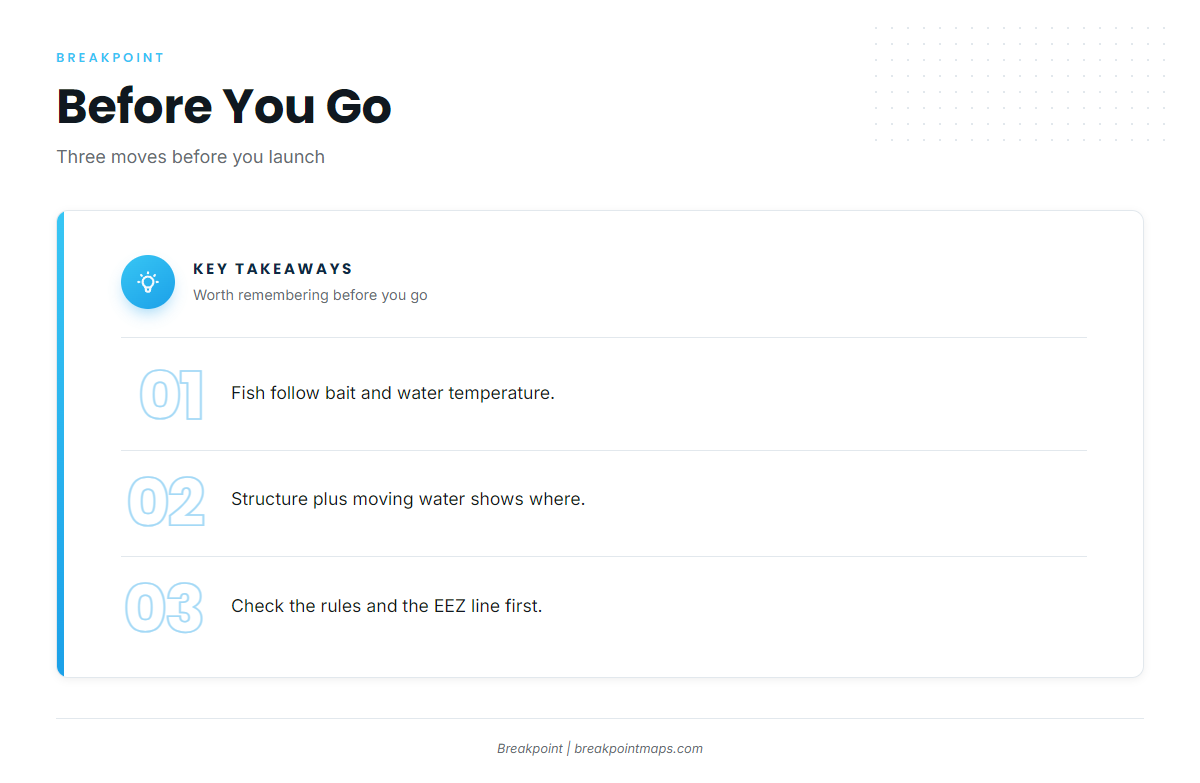
Fish follow bait and water temperature, structure plus current tells you where to look, and the rules tell you what you can keep and where you can fish.
Your checklist:
- Pick your window from Table 1.
- Pick structure with moving water.
- Check the rules and the EEZ line.
Breakpoint’s hotspots feature scores striped bass locations across the Atlantic Northeast. It helps you decide where to look, but it can’t tell you whether fish are there. It can’t see the bait that showed up this morning or the front that reshaped the beach overnight.
Chart layers are not for navigation. Verify regulations before you fish.