Overview
Striped bass in the Atlantic Southeast are mostly river fish, which shapes when, where and how you fish for them.
Each river runs on its own calendar rather than on a coastwide migration. The dependable fishery is in rivers and reservoirs. A winter sound and ocean fishery off North Carolina adds to it, but that one varies from year to year and may not show.
This guide covers North Carolina, South Carolina, Georgia and Florida’s Atlantic coast, north to south from the Roanoke to the St. Johns. For the fundamentals (biology, gear, general tactics), start with our striped bass species guide. This page covers what that guide doesn’t: how the fish behave here, where to look, and who sets the rules.
One piece of stock context applies before any planning. Per NOAA Fisheries stock status, the coastwide Atlantic stock is overfished but not subject to overfishing, based on the 2024 assessment, and it is managed under a rebuilding plan.
The sections below cover:
- Timing by river system, from the Roanoke to the St. Johns
- Where fish hold when the water gets hot
- Local tactics for rivers, reservoirs and the Outer Banks in winter
- A jurisdiction map that points you back to the agencies
We can’t promise fish, but we can help you decide where to look.
Regional Differences
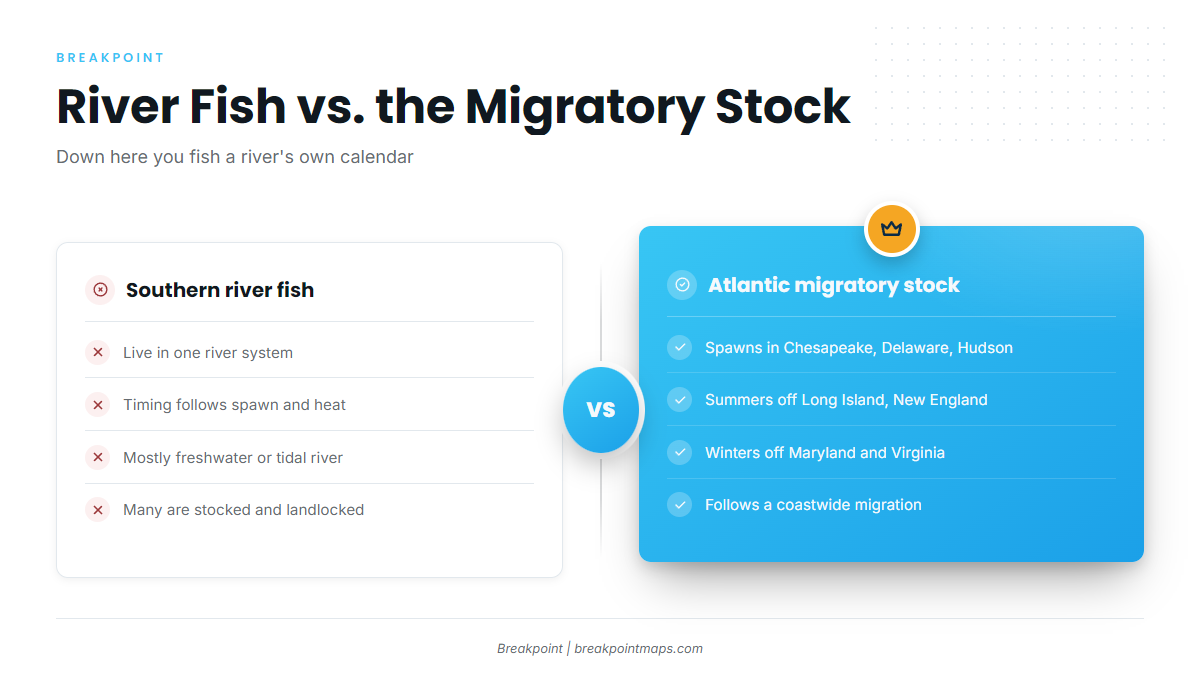
Population comes first, because timing, location, tactics and rules all follow from it. Many Southeast and Mid-Atlantic rivers hold resident striped bass, which are a separate matter from the large migratory stock. Per On The Water, the Atlantic migratory stock originates in the Chesapeake Bay tributaries and the Delaware and Hudson rivers, summers off eastern Long Island and New England, and winters off Maryland and Virginia.
Striped bass are anadromous: adults typically live in salt or brackish water and return to freshwater to spawn. They can also live their whole lives in freshwater, and in the Southeast many do.
River fish versus the migratory stock
Many southern fish never make the coastal run. They stay within one river system, moving from tidal estuary water in fall and winter to shoals and tailraces in spring and summer. This is a description of how the fish behave, not a claim about genetics.
The southern riverine populations, including the Roanoke River and Albemarle Sound stock, respond to local cues: water temperature, flow and the calendar of their own river. You are fishing a resident population, not intercepting a migration.
Stocked and landlocked fish
Many freshwater stripers in the region are there because state hatcheries stock them into systems of dams and reservoirs. Santee-Cooper is the special case: a landlocked population and a major destination. Details follow below.
Hybrid striped bass also show up in southern reservoirs and are managed separately. For identification and rules, go to the state agency.
The shifting winter ocean fishery
Winter fish off the Outer Banks have been less reliable in recent years, as wintering fish have tended to stay farther north. The ocean fishery is not something you can plan around with confidence.
The southern range limit
Sources disagree on where the Atlantic strain’s range ends. Some describe it as found mostly from Cape Hatteras north, while others list it as reaching Florida. The St. Johns sits at the southern edge, so check with FWC for current status.
If you’re coming from up north
Up north you intercept a migration. Down here you fish a river’s own population on its own calendar.
Timing follows each river’s spawn and heat, not a coastwide migration. Much of the fishery is freshwater or tidal river, and it falls under different agencies. Northeast rules don’t carry over either. New York’s circle hook rule under ASMFC Addendum VI is one example. Check each southern state instead of assuming.
Habitat & Conditions in the Atlantic Southeast
Population structure determines timing and location. The rest of this section covers heat, rivers and current.
Heat limits and thermal refuges
Biologists report that Atlantic-strain stripers prefer water between 55°F and 68°F and avoid water over 75°F, according to the preferred water temperature range published by Great Days Outdoors. That comes from biologists’ statements in a fishing-guide article, so treat it as practitioner-reported rather than as a primary study.
In summer, southern stripers seek cool refuges: deep holes, spring-fed reaches and tailrace outflow. They may still feed early and late in shallower water near channel ledges. In winter, once water drops into the 40s, fish feed deeper and less aggressively.
Heat is also why some fisheries close in summer. See Regulations.
Spring spawning runs, system by system
Timing varies with water temperature and flow.
Roanoke River and Albemarle Sound
Fish stage through winter in the shallow water of Albemarle Sound and in deep holes on the Lower Roanoke. In April and May, anglers head to Weldon for the spring run at Weldon, which Outer Banks Fishing calls the greatest striped bass spawning fishery on the Eastern Seaboard. Roanoke Rapids is the upstream tailrace.
The stock had declined seriously by the 1980s. Through the 1990s the state restricted harvest with reduced bag limits and strict size slots. Current rules are in Regulations.
Tar-Pamlico and Neuse
These runs are smaller.
Cape Fear
The Cape Fear holds a distinct southern riverine population. For harvest status, see Regulations.
Santee-Cooper (Lakes Marion and Moultrie)
Santee-Cooper is a landlocked destination. Winter is one of the best seasons on both lakes, with stripers often stacking at the lower end of Lake Moultrie near Pinopolis Dam. In spring, fish run up rivers such as the Congaree. Prime river fishing generally falls between March and May, with most fish back in the lakes by the end of May. For the summer closure, see Regulations.
Savannah and Ogeechee
These are shared Georgia and South Carolina waters. Rules differ by state and by river, so check GA DNR WRD and SC DNR before you go.
St. Johns
The St. Johns sits at the southern edge of the range. For anything current, check FWC.
System snapshot
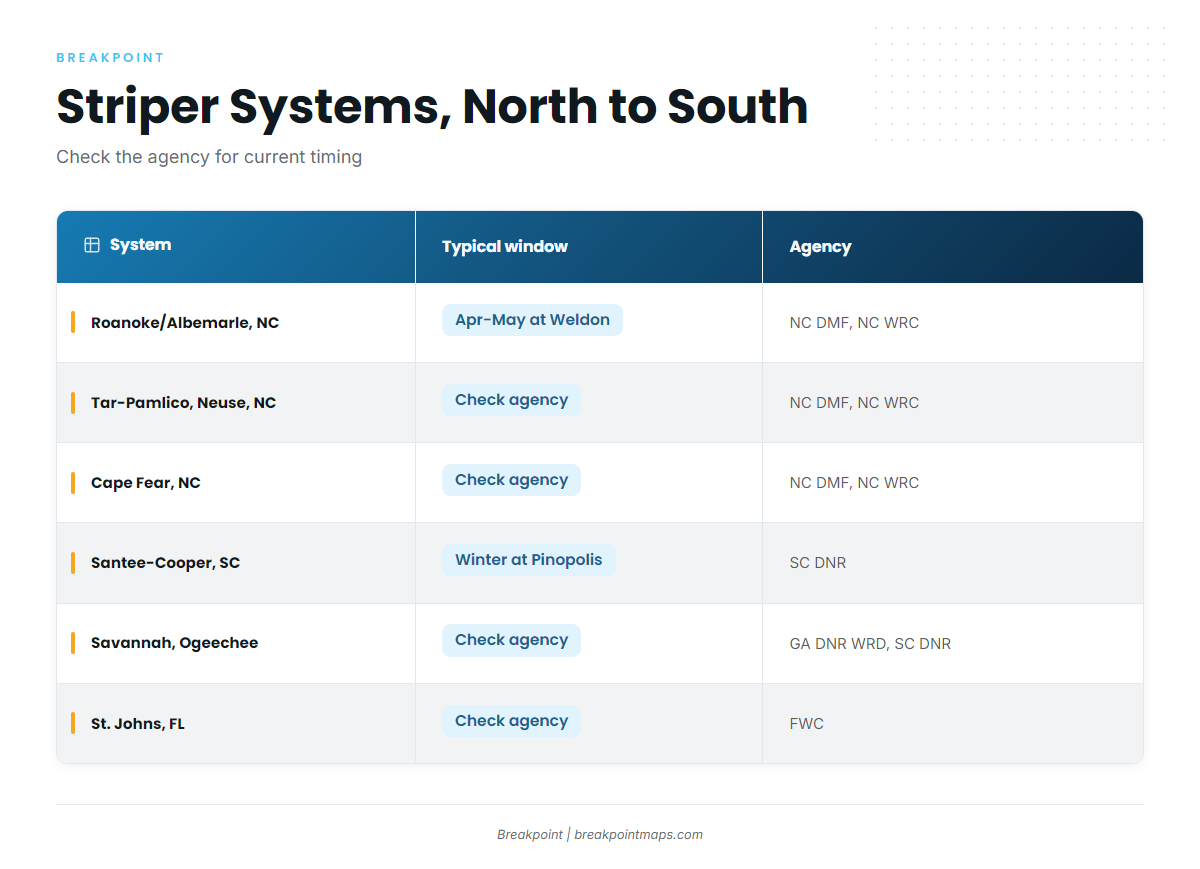
| System | State | Fishery type | Typical window | Managing agency |
|---|---|---|---|---|
| Roanoke/Albemarle | NC | Riverine and sound | Winter staging; April–May at Weldon | NC DMF, NC WRC |
| Tar-Pamlico, Neuse | NC | Riverine | Check agency | NC DMF, NC WRC |
| Cape Fear | NC | Riverine | Check agency | NC DMF, NC WRC |
| Santee-Cooper | SC | Landlocked reservoir | Winter at Pinopolis; spring upriver | SC DNR |
| Savannah, Ogeechee | GA/SC | Riverine | Check agency | GA DNR WRD, SC DNR |
| St. Johns | FL | Riverine, range edge | Check agency | FWC |
| Outer Banks ocean | NC | Winter migratory | Variable; not predictable | NC DMF, ASMFC; NOAA for the EEZ |
Swipe the table sideways to see every column.
Flow, rain and tide
Fish hold where moving water meets baitfish: river bends, submerged humps near current seams, and man-made currents at dam inflows and outflows. Rain and dam releases change where those seams set up. Tides matter in the lower tidal reaches.
Tailraces and night structure
Look for water deeper than 4 feet near structure such as rock walls, downed trees and boulder fields. Pools above and below major shoals are good places to start. At night, stripers work the edges of submerged or overhead lights near docks and piers, since they shun direct light.
A safety note on tailraces: generation schedules change water levels fast. Check the dam operator’s schedule before you fish or wade below any dam.
Tactics for the Atlantic Southeast
What works depends on the water you are fishing. The rigging basics are in the species guide; this section covers how they change by fishery.
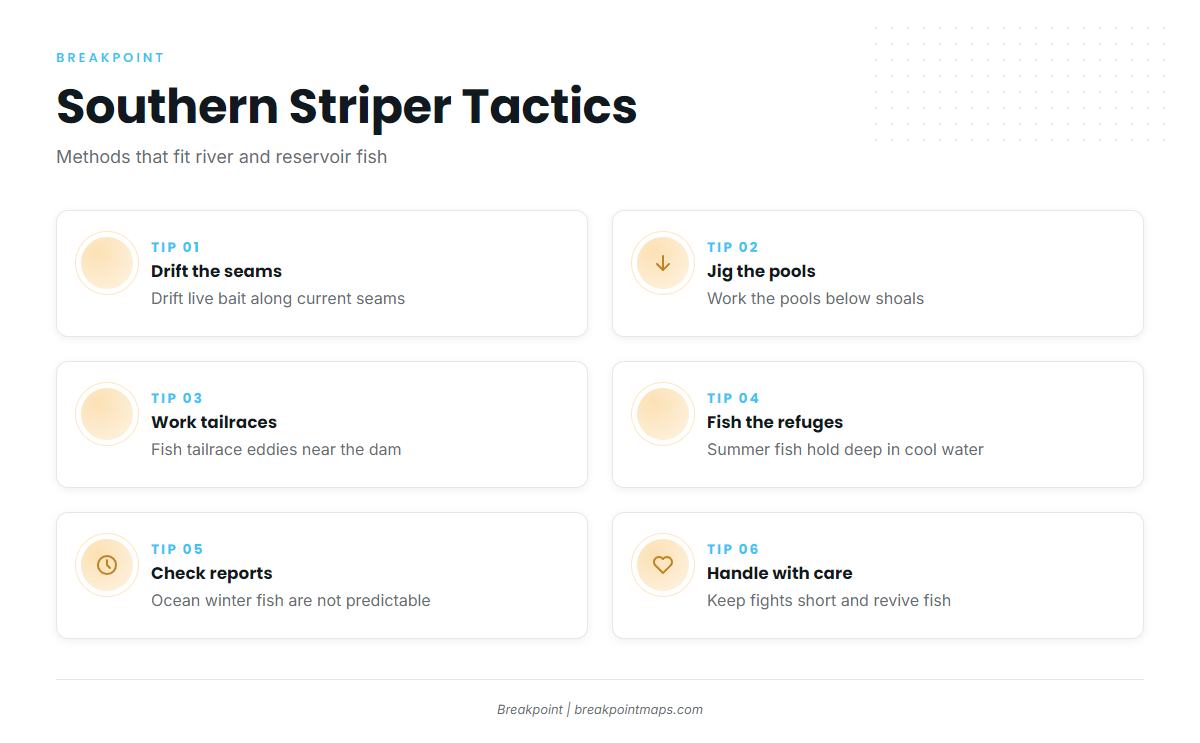
River runs: jigging, live-bait drifting, tailraces
Three approaches carry most of the river fishing:
- Live-bait drifting. Drift bait (herring, shad and similar, subject to local bait rules) along current seams.
- Jigging. Work the pools below shoals.
- Tailrace eddies. Fish the slack water beside the current below dams.
You don’t need a big boat. According to the Georgia Wildlife Resources Division’s blog, small jon boats, canoes and kayaks work for the rivers where stripers run, and wading is an option where there is walk-in access.
Reservoirs: Santee-Cooper
In winter, focus on the lower end of Lake Moultrie near Pinopolis Dam, where fish stack. In summer, fish hold deep in thermal refuges, which ties directly to the summer closure. See Regulations.
Outer Banks winter: sound and ocean
Local methods include trolling umbrella rigs and tube-and-worm, plus live bait and jigs near Oregon Inlet and Hatteras. These are methods, not a promise.
What we can’t tell you. Whether ocean fish show off the Outer Banks this winter can’t be known in advance, because wintering has shifted north in recent years. Check recent reports, tackle shops and charter captains before you commit, and keep a backup plan, such as the fish staged in Albemarle Sound.
Winter weather on the Outer Banks can turn hard. Nor’easters bring cold, powerful surf and high winds. Harvest status beyond 3 nautical miles is covered in Regulations.
Warm-water handling
Stripers stress easily in warm water. Keep fight time short and revive fish carefully before release. When water nears the heat limit covered in the Habitat section, stop targeting them.
Circle hooks are good practice with bait, but they are required only where the agency says so. See Regulations.
Frequently Asked Questions
Can you keep striped bass in federal waters?
Check NOAA Fisheries for the current answer before you go. Federal waters (the EEZ) start 3 nautical miles offshore, and the rule there differs from state-water rules. Confirm the status with NOAA Fisheries and ASMFC before planning a trip beyond state waters.
Who regulates striped bass in NC?
Two agencies, split by water type. NC DMF handles coastal and joint waters, and NC WRC handles inland waters. ASMFC sets the coastwide framework. Confirm which side of the line you are on before applying a rule.
When is the Roanoke run?
Weldon in April and May is typical, depending on water temperature and flow. Season status and limits are set by NC WRC and NC DMF, so check both before you go.
Are stripers still off the Outer Banks in winter?
Some years yes, but it isn’t predictable. Wintering fish have tended to stay farther north in recent years. Check recent reports, tackle shops and charter captains before you commit, and keep a backup plan.
Can you keep stripers in the St. Johns?
Check FWC. The St. Johns is the southern edge of the range. Confirm the rules with FWC before you fish.
Close
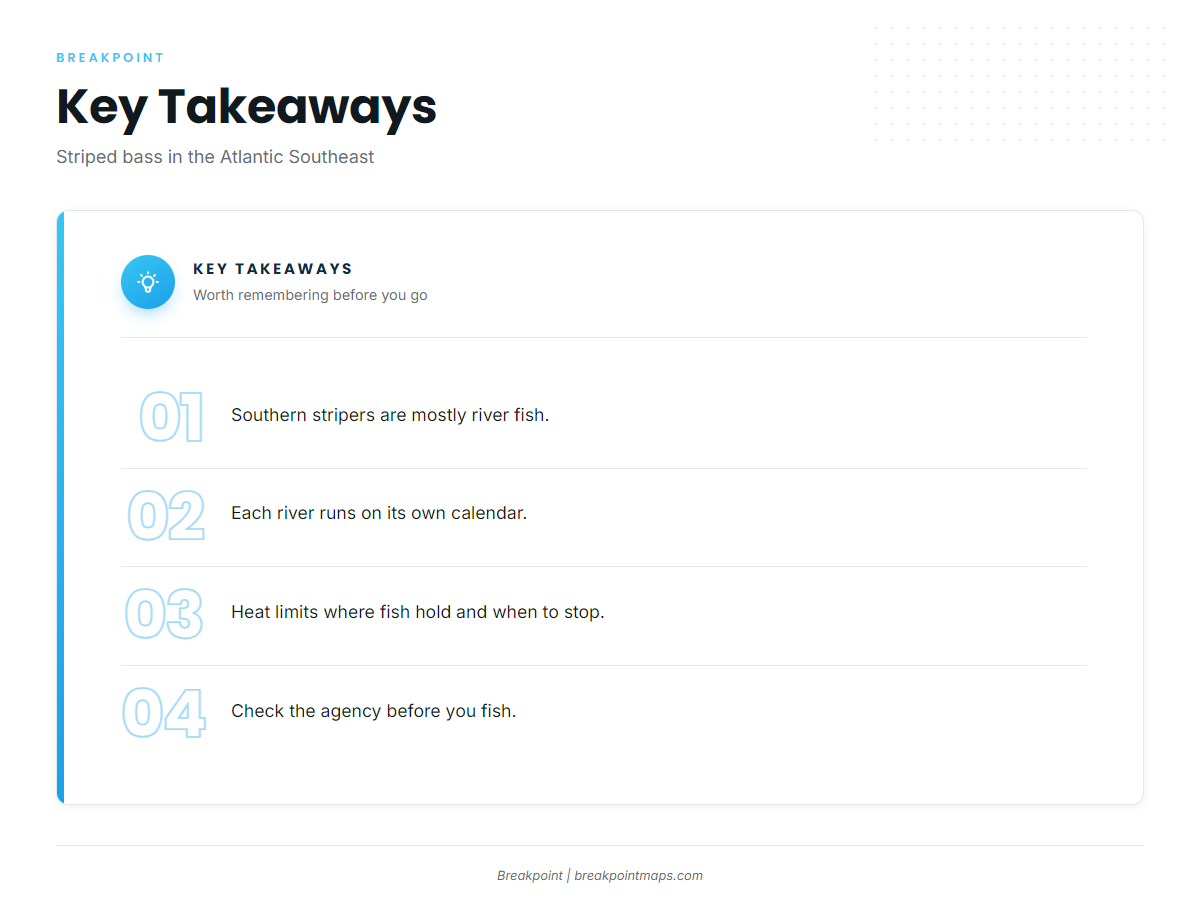
Stripers in the Atlantic Southeast are river fish first. They run on their own calendars, they are heat-limited in summer, and the rules change by water and by agency. Check the agency before every trip.
When you are planning, Breakpoint’s hotspots feature scores striped bass locations in the Atlantic Southeast. Use it alongside agency reports and your local tackle shop. Chart layers are not for navigation.