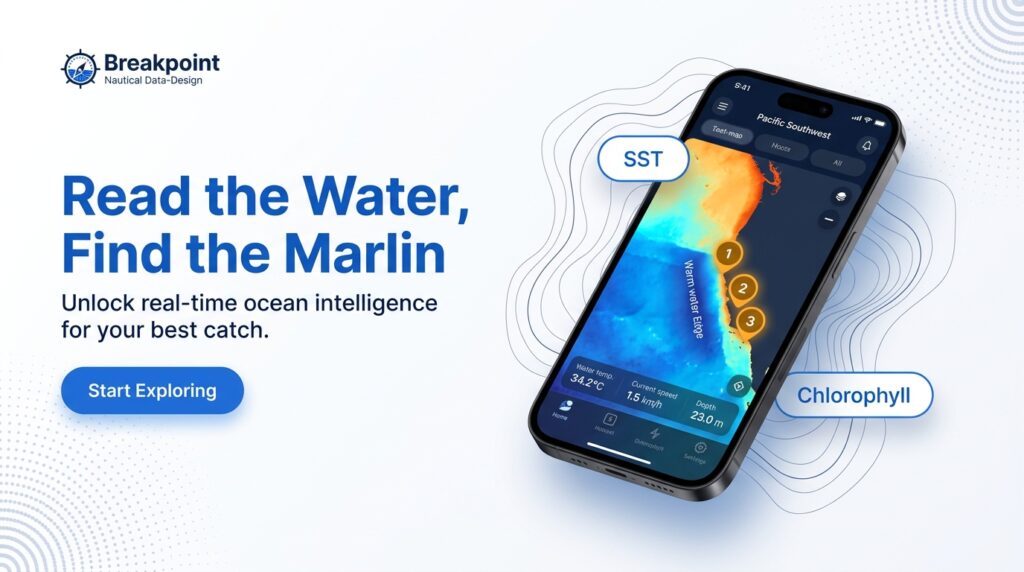
The Pacific Southwest striped marlin fishery runs from Point Conception to the Mexican border, plus the northern Baja waters San Diego boats commonly fish. For Southern California anglers, the season is short and unpredictable. CDFW’s striped marlin species profile says marlin usually appear off California in July and stay until late October, and it describes most of the effort as catch and release.
For biology, identification and general tackle, start with our striped marlin species guide. This page covers what differs here: when the fish tend to show, where the water sets up, how locals present baits, and which rules apply on each side of the border.
We read the same public water data you do, and we try to say plainly what it can and can’t show.
Regional Differences
Southern California sits at the edge of the striped marlin’s range. Fish arrive late in the year, timing shifts from season to season, and many fish are found on the surface. Those three facts shape everything else on this page.
Late, Variable Arrival
The fish that reach us come from the south and west. According to the NOAA Fisheries striped marlin page, spawning occurs in the central Pacific and off central Mexico, and juveniles are abundant around the tip of the Baja Peninsula.
The sources disagree a little on timing. CDFW gives July to late October. Marlin Magazine’s Southern California guide says the season can run from as early as late June through Thanksgiving, and longer in strong El Niño periods. Local charters commonly quote August through November. Treat that as a soft consensus rather than a fixed calendar, and book a window instead of a date.
Warm Years and Cool Years
Marlin Magazine credits warm-water El Niño years with tending to boost numbers. Cooler La Niña cycles are commonly reported to push fish farther offshore.
We can’t fully explain why a season fails. Water temperature accounts for a lot but not everything. We won’t guess at this year’s conditions here, and last year’s are not a reliable guide either.
Season Planning Table
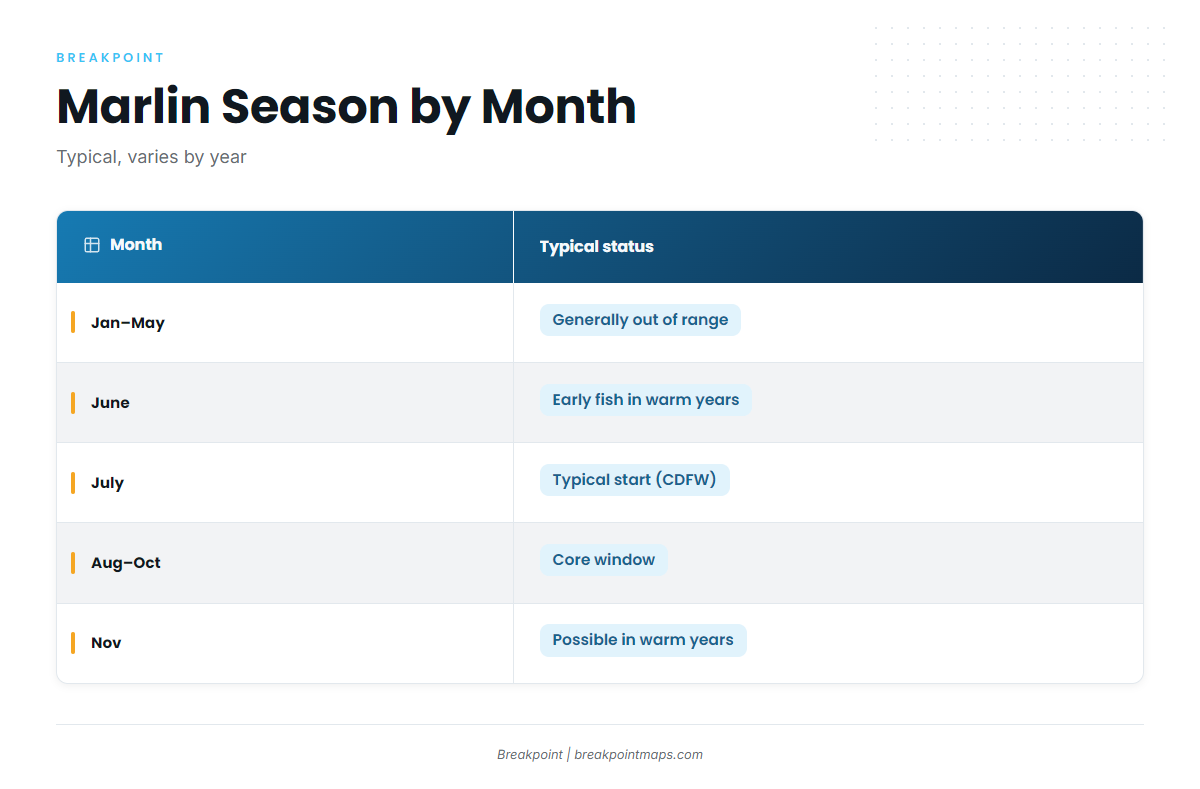
Use this as a rough frame. It is typical and varies by year.
| Month | Typical status |
|---|---|
| Jan–May | Generally out of range |
| June | Possible early fish in warm years |
| July | Typical start (CDFW) |
| Aug–Oct | Core window |
| Nov | Possible, especially in warm years (Marlin Magazine) |
Sources: CDFW and Marlin Magazine.
CDFW also notes that striped marlin are caught year-round and that there is no recreational season limit. The table shows when fish tend to be in range here, not when it is legal to fish.
Most boats fishing this water leave from San Diego, Dana Point, Newport or Avalon. Multi-day trips out of San Diego often fish Mexican waters, so read the Regulations section for licensing before you book. The broad approach below is the same for charters and private boats.
Surface Behavior
Many fish here are found and fished at the surface. Marlin Magazine sorts them into tailers, sleepers and feeders, and the tactics section below shows how each state changes your approach.
A Release Culture With Deep Roots
Catalina marlin fishing has a long history. At Avalon, Tuna Club members originally chased big schools of bluefin tuna. When those migrations tailed off in 1920, they turned to striped marlin and swordfish, according to Marlin Magazine.
That history sits under today’s habits. CDFW describes most effort as catch and release, and that is the local norm.
Habitat & Conditions in the Pacific Southwest
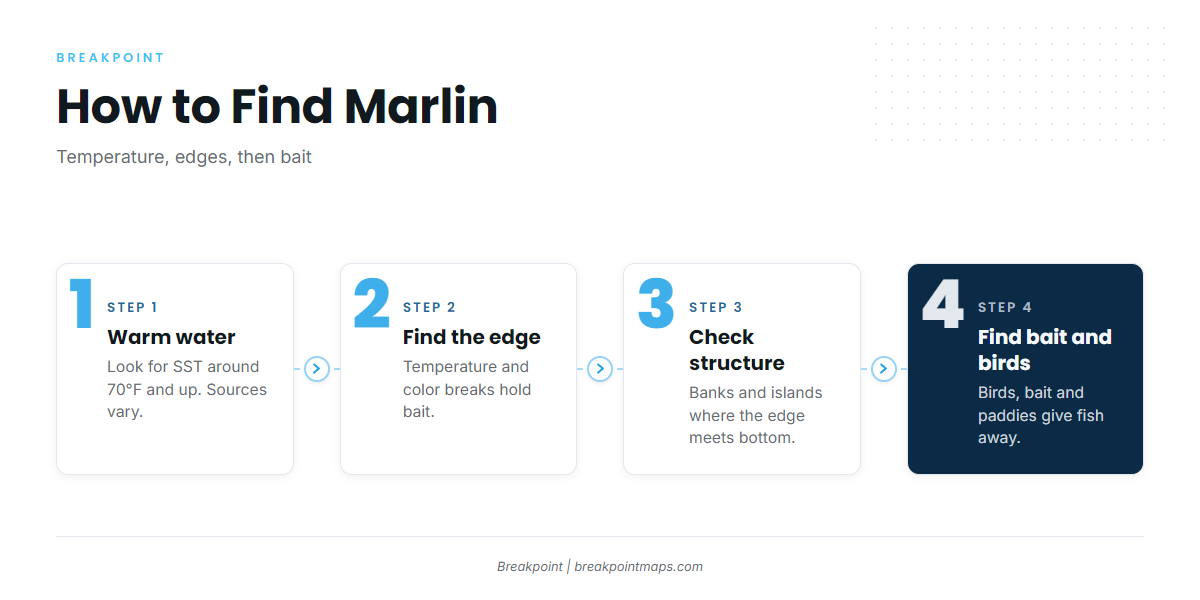
Marlin here tend to be found where warm offshore water meets structure and a temperature or color edge that holds bait. Temperature brings fish into range, breaks concentrate bait, and bait and birds give fish away.
The CDFW Corridor and the Banks
CDFW names the best California area as running from the east end of Santa Catalina Island offshore to San Clemente Island, then south toward the Los Coronados Islands.
Inside and beyond that corridor, anglers commonly fish these banks:
- 43 Fathom Bank
- 9 Mile Bank
- 60 Mile Bank
- 302
- Tanner Bank
- Cortes Bank
Offshore seamounts are also fished widely. We are not giving distances, depths or coordinates here. Pull those from your chart, and don’t treat any drawn contour as a survey.
Sea Surface Temperature
Anglers commonly cite around 70°F and up as marlin water. Sources disagree on the exact figure, so treat it as a range rather than a switch.
The edge matters more than the absolute number. If 70-degree water sits outside the islands and runs up against a bank, start there.
Chlorophyll and Color Edges
A green-to-blue break marks a productivity edge, and bait tends to stack there. Marlin work the blue side. That is interpretation, not a guarantee.
Marlin Magazine notes that captains combine temperature breaks, chlorophyll charts and structure to find bait and fish. Saltwater Sportsman makes the same point: by combining modern charting technology with a basic understanding of striped marlin behavior, they’ve never been easier to find.
Bait, Birds and Paddies
Forage here includes mackerel, squid and sardines. The old rule from Marlin Magazine still holds: find the birds and bait, and the marlin won’t be far behind. Kelp paddies are worth a look as common practice.
What the Data Can’t Tell You
A cloud-blocked satellite pass leaves a gap in the map. SST is a skin temperature, a reading of the surface only. Chlorophyll images lag behind what the water is doing now. A forecast is a forecast, and patterns that worked one year often don’t repeat the next. Use the chart to decide where to look, then confirm with what you see on the water.
Tactics for the Pacific Southwest
Most Southern California marlin fishing is a visual hunt. You troll to cover ground, but the shots usually come from fish you see first.
The Search Spread
Marlin Magazine describes SoCal stripey fishing as often starting with a five-lure spread to cover ground while you look for tailing or feeding fish. The spread is a search tool, not the whole plan.
Eyes Forward
Scan ahead rather than waiting for fish to show up in the spread. Marlin Magazine notes that some top crews favor gyrostabilized binoculars, which reflects an approach built on seeing the fish first and then catching it.
Behavior Table
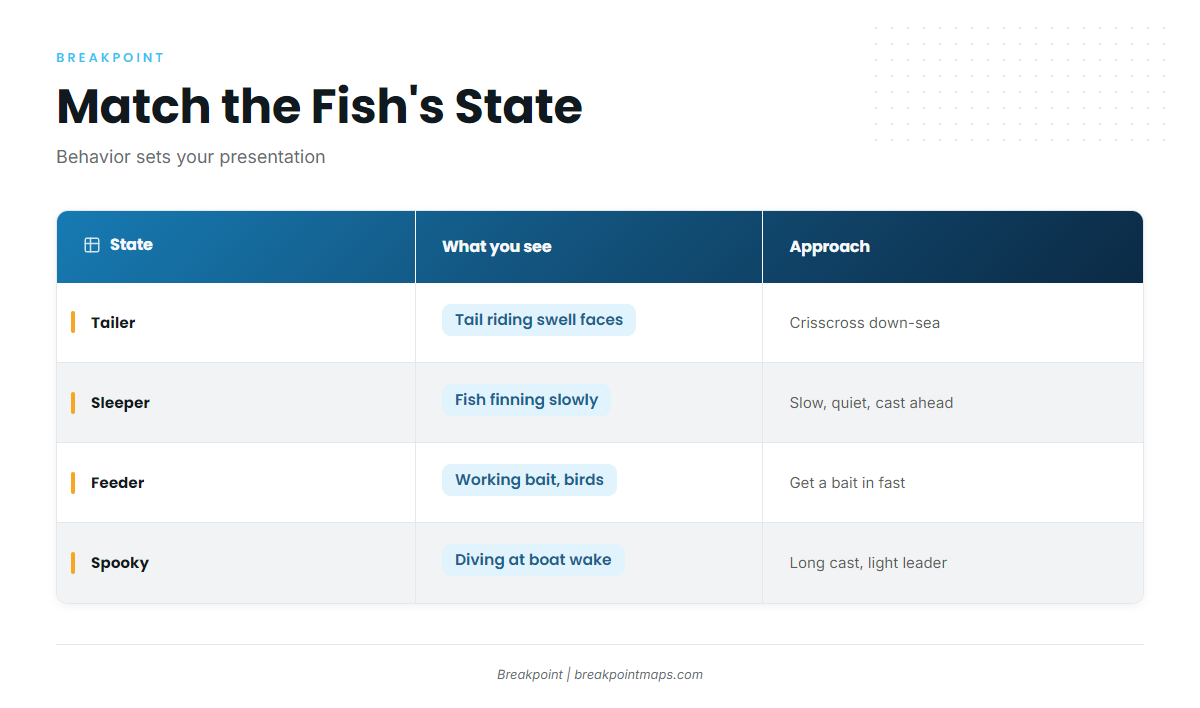
| State | What you see | How to approach |
|---|---|---|
| Tailer | Tail and fins riding swell faces | Crisscross down-sea, look down faces and troughs (Marlin Magazine) |
| Sleeper | Fish resting or finning slowly on top | Generally a slow, quiet approach with a cast ahead, without running over the fish |
| Feeder | Fish working bait, birds nearby | Get a bait into the zone quickly |
The sleeper and feeder approaches reflect general best practice rather than a sourced protocol, so adjust to what the fish are doing.
Bow-Casting Live Mackerel
The signature local technique is casting a live mackerel from the bow. Marlin Magazine dates the practice to the late 1960s. You run up on the fish, then put a bait ahead of its path.
Marlin Magazine describes one scene of marlin "traveling slowly in a chevron formation with dorsals folded down and tails exposed," with live mackerel cast from close range. The fish chased the baits and jumped.
Bait-and-Switch
Bait-and-switch is used when fish are raised on teasers. The species guide covers the mechanics. Off SoCal, most shots start from sight rather than from the spread.
Release Handling
Good release habits matter here because most fish go back:
- Keep the fish in the water.
- Revive it moving forward before you let go.
- Keep the fight short.
- Use circle hooks with live bait as best practice.
Check current federal and state rules before you go.
Frequently Asked Questions
When is striped marlin season in Southern California?
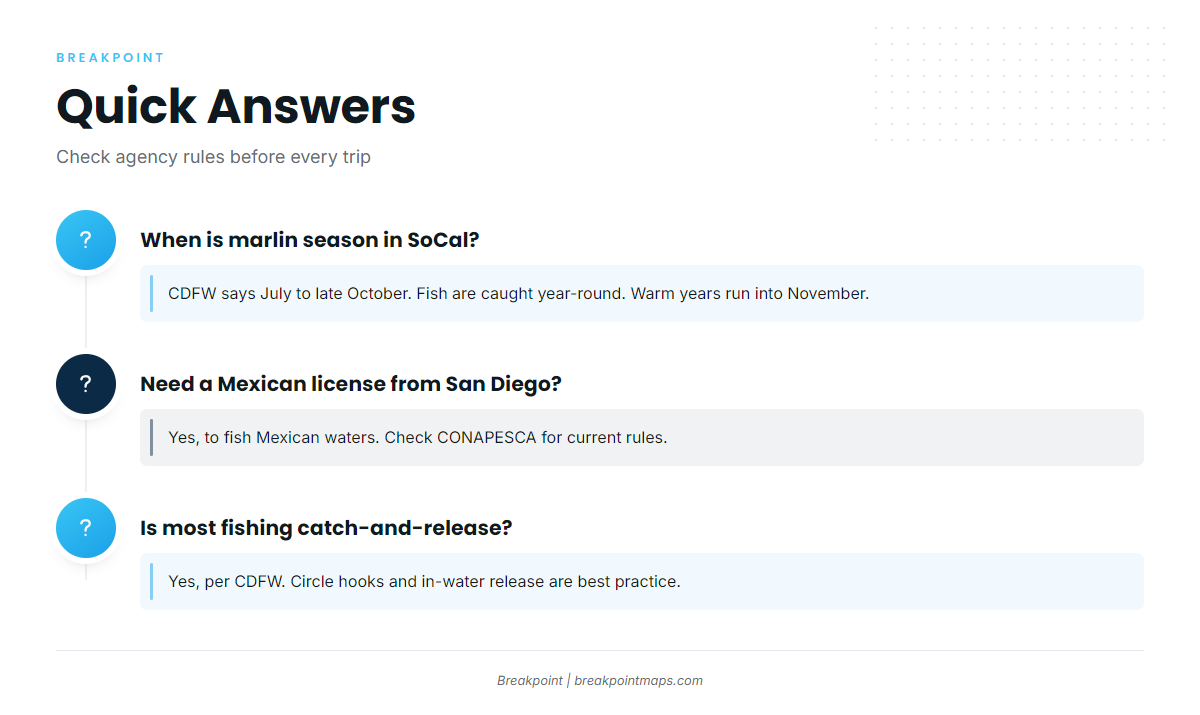
CDFW puts it at July to late October, and the fish are caught year-round. Marlin Magazine says warm years can run from late June through Thanksgiving. Expect the core window in August through October.
Do I need a Mexican license on a San Diego boat?
Yes, to fish Mexican waters. A Mexican fishing license from CONAPESCA is required. Check the agency for current rules and any billfish-specific requirements before you cross the border.
What is the California marlin limit?
Check the current CDFW ocean sport fishing regulations for the limit.
Is most fishing catch-and-release?
Yes. CDFW describes most striped marlin effort in California as catch and release. Keeping the fish in the water, reviving it and using circle hooks with live bait are best practice.
Closing: Where to Look
Start with temperature, then find the edges, then look for bait and birds, and let the fish’s behavior set your presentation. That sequence is how most Pacific Southwest striped marlin fishing gets organized, and it is better treated as a way to decide where to look than as a promise of fish.
Breakpoint’s hotspots feature scores striped marlin conditions across the Pacific Southwest each day, and it shows you why a spot ranks where it does, so you can weigh the reasoning yourself.
Chart layers are not for navigation.