


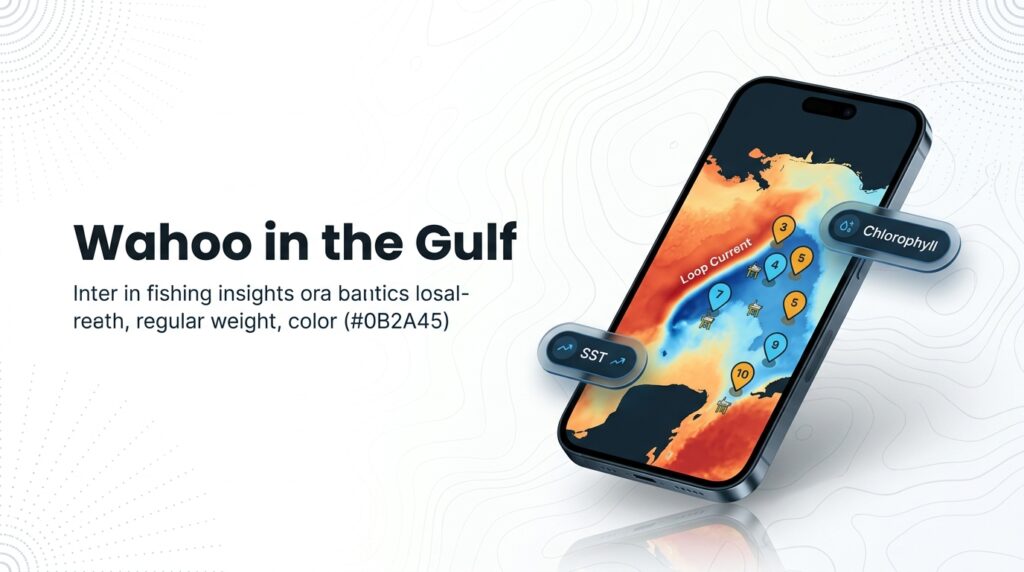
Wahoo fishing in the Gulf of Mexico depends on two things: where the blue water sits and where the fixed structure is. That means the Loop Current, the shelf edge and offshore platforms. The season varies with which stretch of coast you fish from.
For biology, gear basics and why wahoo are worth chasing, start with our wahoo species guide. This page covers what differs in the Gulf: how the water is set up, what the sources agree on, and where they don’t.
For wahoo (Acanthocybium solandri) in these waters, it covers:
- Where to look, by subregion
- When to go, from a sourced season table
- How to fish it, with speed, leader and depth choices
- Where to verify limits before you leave the dock
A naming note: federal agencies, including NOAA, now use "Gulf of America," so use that term when you search NOAA documents.
Regional Differences
The biggest difference is the Loop Current. In the Atlantic and Bahamas, the Gulf Stream runs as a fixed river along the coast. In the Gulf of Mexico, blue water arrives on a current that moves, and it moves differently every year. NOAA’s Ocean Service says the Loop Current sometimes barely enters the Gulf before heading for the Atlantic. At other times it travels nearly to the coast of Louisiana before swinging back toward the Florida Strait. How far the Loop Current reaches sets up the whole season.
The Loop Current also sheds warm-core eddies, which isolate pockets of warm Caribbean water inside the Gulf. A NOAA Marine Fisheries Review article noted decades ago that fishermen stationed their boats along the Loop Current’s eastern edge, a fast-moving "river" of tropical water that draws wahoo, dolphin and other gamefish. That is a historical account, not a current forecast.
Three more things separate the Gulf from the fisheries you may already know:
- Rigs are structure. Oil and gas platforms hold bait, especially off Louisiana and Texas. Charter sources such as MSC Fishing describe them as prime wahoo locations.
- Trolling style differs by crew. High-speed trolling was developed in the Bahamas fishery, according to Mossy Oak. Gulf crews borrow it, but many still run mixed spreads.
- The map keeps changing. Platforms get removed, and some become reefs through Rigs-to-Reefs programs. Last year’s productive structure may be gone.
What we don’t know
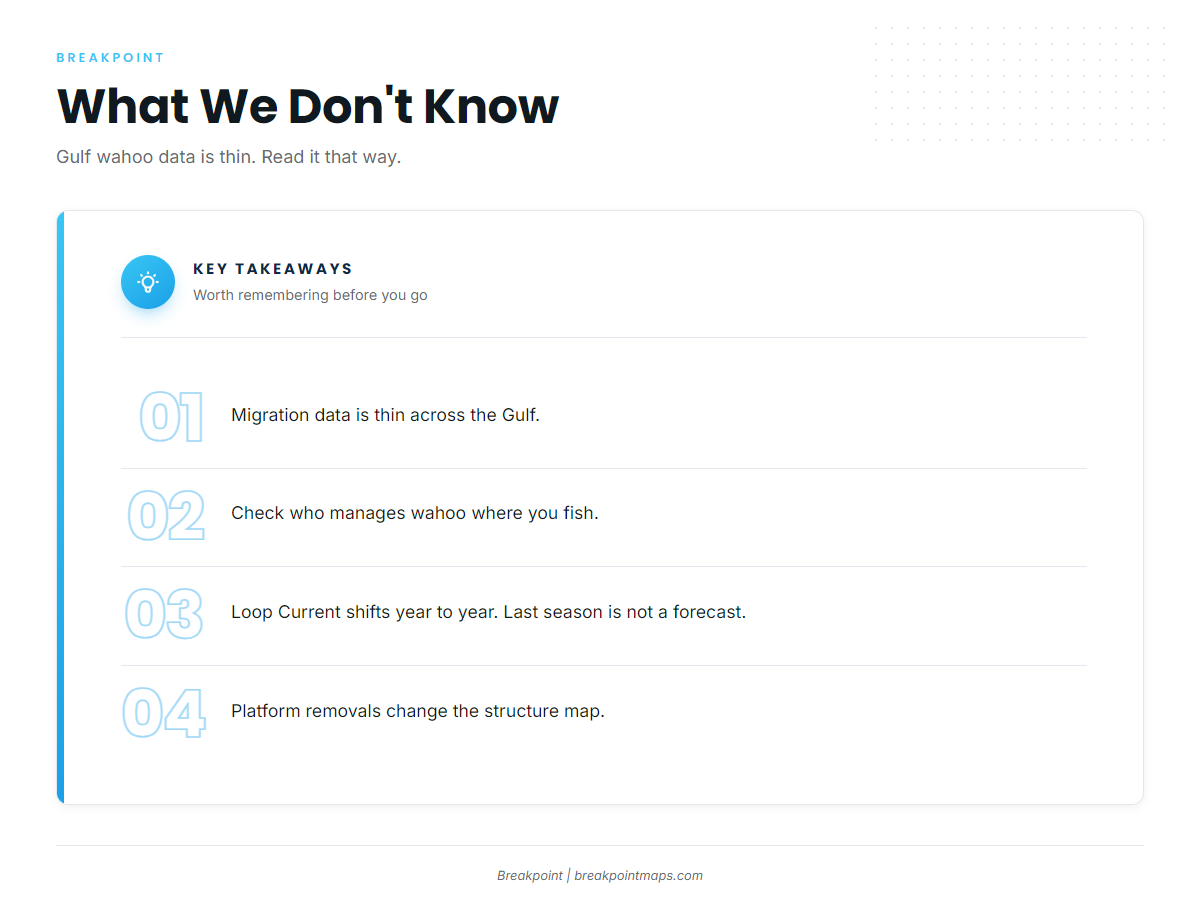
- Migration data is thin. Alex Fogg, Okaloosa County Natural Resources Chief, said, "There isn’t much scientific data on wahoo migrations in the Gulf of Mexico." That is not much migration data to plan a season around.
- Management is unclear. Check which agency manages wahoo where you fish. The Regulations section lists who to ask.
- The Loop Current moves. Its position shifts year to year, and structure changes with decommissioning, so last season’s pattern is not a forecast.
Habitat & Conditions in the Gulf of Mexico
The sections below cover fixed structure by subregion, then the calendar, then the conditions that move. Published detail is thin for some areas, and we say so rather than pad.
Florida Keys and Dry Tortugas
Gulf and Atlantic influences meet here, and Loop Current water exits toward the Florida Strait. Dry Tortugas wahoo fishing is real, but published, Tortugas-specific timing is scarce. Ask the captain for recent logs instead of trusting a calendar.
Florida Panhandle and Big Bend
According to a Panhandle small-boat source posted on The Hull Truth and the SORD blog, wahoo move into the northeastern Gulf in late spring and stay well past summer. Most fish there are caught 15 to 30 miles out, and some have been caught under a mile from shore.
For Destin wahoo depth, the SORD author’s personal preference is 150 to 250 feet, working ledges and natural bottom south of Destin between snapper holes. That is one angler’s approach, not a rule. Alex Fogg also placed 8 FADs off Destin, per Great Days Outdoors.
Published wahoo detail for the Big Bend is scarce.
Alabama, Mississippi and DeSoto Canyon
According to Gulf Shores tourism sources, trips out of Orange Beach and Gulf Shores often combine wahoo with tuna, mahi and billfish on high-speed or mixed trolling. MSC Fishing, an Alabama charter operator, gives May through September as peak season. DeSoto Canyon is a shelf-edge drop-off feature.
Louisiana (Venice) rigs and floaters
Venice wahoo season runs in winter. Sport Fishing reported big wahoo at rigs 15 to 30 miles off the coast in January and February, in clear, deep-blue water around 68°F at rigs farther out. Fishable weather windows were scarce. The full report on winter wahoo at Venice rigs is worth reading before you book.
On size, a Louisiana charter operator (MG Fishing) puts common fish at 30 to 50 pounds, with some reaching 90 to 100 and a Louisiana record of 139 pounds. Floaters are floating production platforms in deep water. They fish like rigs, with more depth under them.
Texas rigs and Flower Garden Banks
Great Days Outdoors says wahoo are known to aggregate at certain western Gulf rigs in winter. Port Aransas is the port name to search. Flower Garden Banks is a National Marine Sanctuary with its own rules, so check NOAA’s sanctuary page before you fish there. We have no habitat detail beyond this.
When to go: wahoo season in the Gulf by area
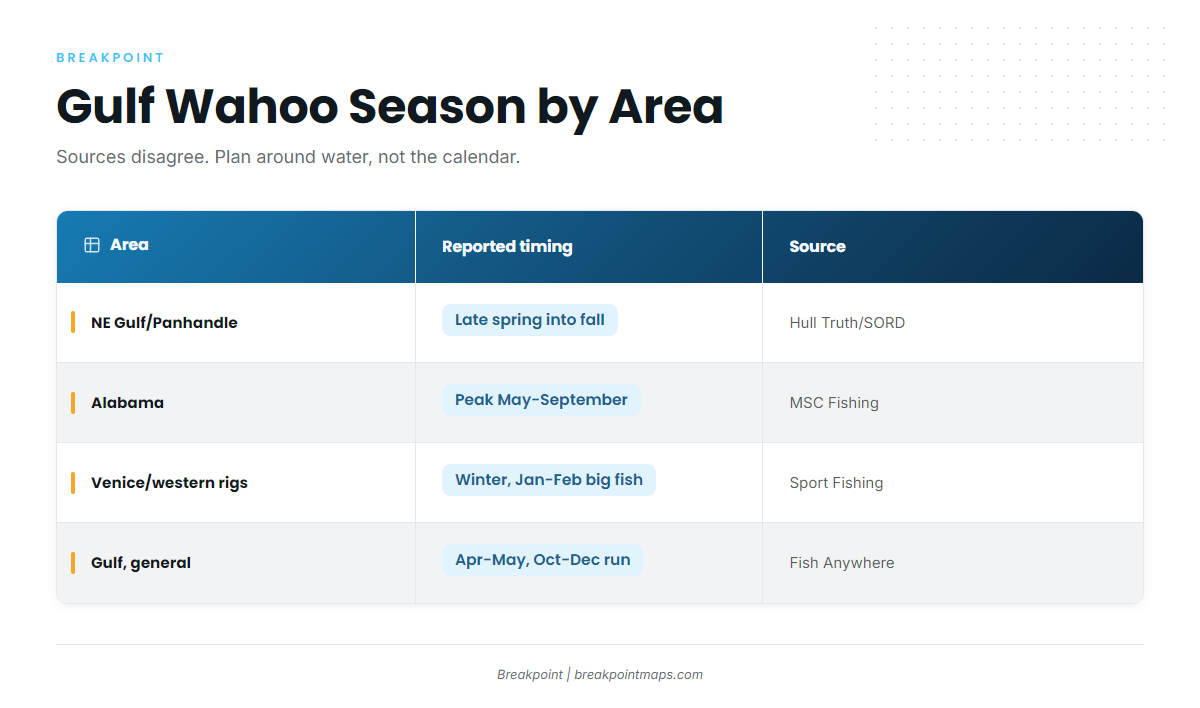
The sources disagree on timing, and the disagreement is informative.
| Area | Reported timing | Source type | Source |
|---|---|---|---|
| NE Gulf/Panhandle | Late spring into fall | Small-boat angler blog/forum | The Hull Truth, SORD |
| Alabama | Peak May through September | Charter operator | MSC Fishing |
| Venice/western Gulf rigs | Winter, January and February for big fish | Publication and county biologist quote | Sport Fishing, Great Days Outdoors |
| Gulf, general | April and May, second run October through December | Fishing blog | Fish Anywhere |
Our working rule is a winter rig bite in the north and west and a warm-season structure bite in the northeast. Fish are reported year-round at structure, so plan around water, not the calendar.
Weather is the other half of the plan:
- The Gulf can go from slick calm to 12 to 14 foot seas in an hour, per Great Days Outdoors.
- Winter fronts are frequent.
- Sport Fishing advises booking at least 3 days in Venice. Booking 4 improves the odds of 2 fishable days.
- The Panhandle small-boat source wants waves under 1 foot and wind and gusts under 10 mph.
Temperature, color and weed
The temperature numbers conflict. Great Days Outdoors says wahoo avoid water below 68°F and that 70°F and up is ideal. A tackle blog, Cast and Spear, says 72 to 80°F is ideal. Sport Fishing reported fish in about 68°F water at Venice.
Treat 68°F as a lower edge worth checking rather than a wall. Temperature breaks and clean blue water matter more than any single number.
Clean blue water, sargassum weed lines and current lines concentrate bait. Fogg notes that wahoo show up "seemingly at random" on weed lines and temperature breaks.
On moon phase, one source suggests logging moon, tide and time of day after each hookup. That is a record-keeping habit.
Reading the Loop Current and eddies
Fishermen have historically worked the eastern edge of the Loop Current and the edges of its warm-core eddies. Stack your data in this order:
- SST shows temperature breaks.
- Chlorophyll or water color shows the green-to-blue edge and bait potential.
- Sea surface height (altimetry) shows eddies and current edges when clouds block the other views.
In Breakpoint, that’s OBS SST, Chlorophyll and Chart Contours. Chart layers are not for navigation.
What the data can’t see:
- Cloud-blocked satellite passes leave gaps in SST and chlorophyll.
- Imagery can lag the water.
- Altimetry resolves big features, not fine edges.
- Models are forecasts.
- Nothing shows where the wahoo actually are.
Tactics for the Gulf of Mexico
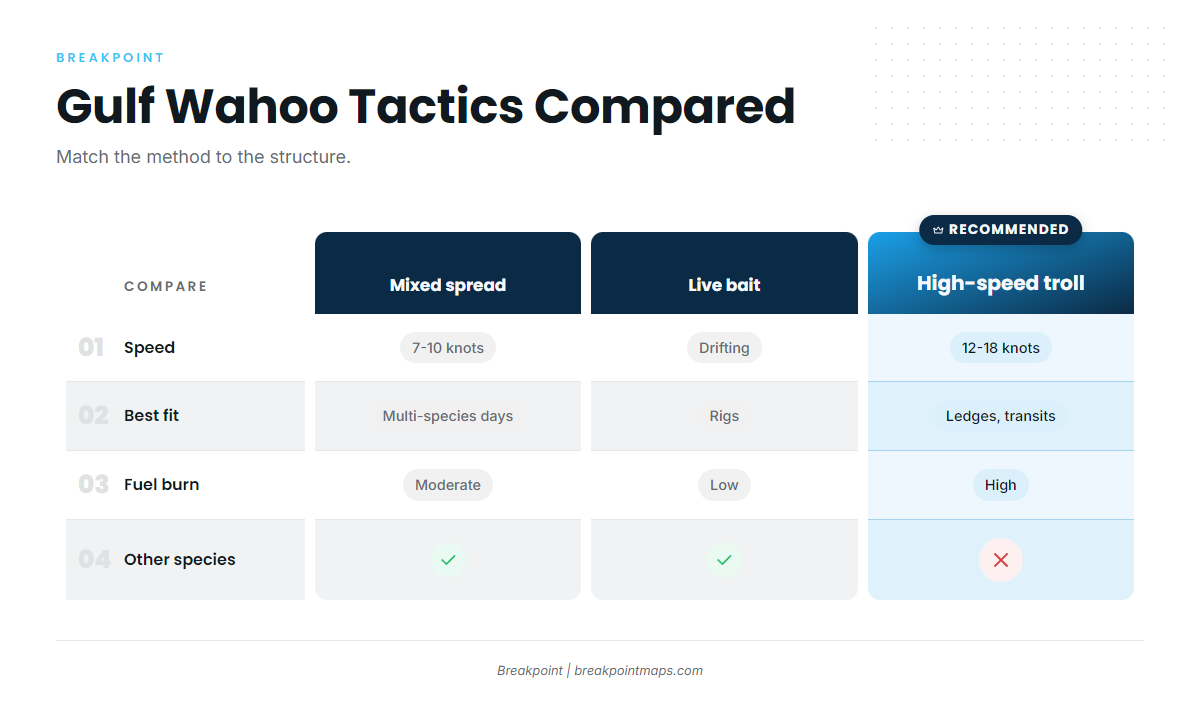
The rigging basics are in the species guide. Here is how Gulf crews adapt them.
| Method | Speed | Where it fits in the Gulf | Trade-off |
|---|---|---|---|
| High-speed trolling | 12 to 18 knots, 14 to 15 common (tackle blog); 10 to 15 and faster (Mossy Oak) | Covering ground between rigs and along ledges | Much higher fuel burn, fewer other pelagics |
| Mixed spread | 7 to 10 knots | Orange Beach and Venice multi-species days | Fewer dedicated wahoo bites than a speed spread, but still draws them |
| Deep plugs and planers | Varies | Fish holding deep at structure | Rigging is heavier and more specialized |
| Live bait at platforms | Slow or stationary | Rigs | Needs bait, and the right structure |
Mossy Oak calls live-baiting perhaps the most productive method. Their piece on high-speed trolling trade-offs covers the speed spread and the mixed spread in detail. For getting deep, Mossy Oak describes a planer with a short wire leader and a ballyhoo-and-Islander combination, or large-lipped plugs from Nomad or Halco.
Gear as anglers describe it:
- Wire: 6 to 8 feet of #7 to #9 single-strand wire, crimped, to a 9/0 to 11/0 J-hook, per a tackle blog. For dedicated wahoo, that source says wire wins every time.
- Mixed spreads: Run 2 or 3 wire rigs among the mono.
- Fluorocarbon: A Panhandle small-boat checklist uses 150 pound fluorocarbon on ballyhoo and plugs. Expect more bite-offs, and more bites from other species.
- Northern Gulf lure: Sport Fishing calls the Rapala X-Rap Magnum 30 one of the most popular and productive wahoo lures in the northern Gulf.
Crews do jig at rigs, but no source we found gives setup specifics. Ask your captain.
Questions to ask your captain
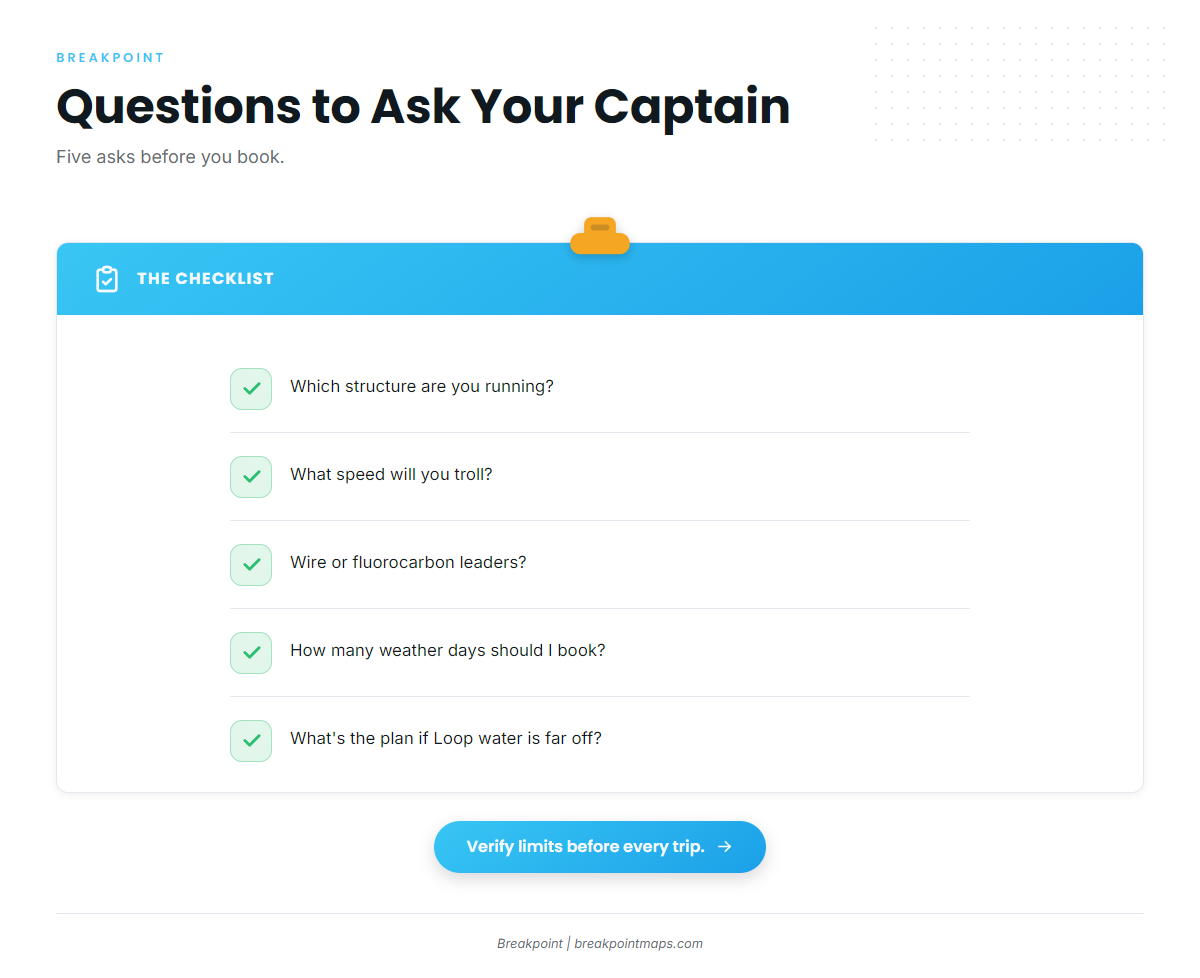
- Which structure are you running?
- What speed will you troll?
- Wire or fluorocarbon leaders?
- How many weather days should I book?
- What’s the plan if the Loop water is far off?
Frequently Asked Questions
When is the best time for wahoo fishing in the Gulf of Mexico?
It depends on the area. Sport Fishing reports a winter rig bite off Venice and the western Gulf, in January and February. Panhandle anglers report fish from late spring into fall. For wahoo fishing in the Gulf of Mexico, plan around water temperature and weather windows rather than a fixed calendar.
What trolling speed works for Gulf wahoo?
Dedicated high-speed trolling runs 12 to 18 knots, per a tackle blog. A mixed spread at 7 to 10 knots still draws wahoo while staying attractive to mahi, tuna and billfish, according to Mossy Oak. The cost of speed is fuel burn and fewer other species.
Wire or fluorocarbon leader?
A tackle blog recommends #7 to #9 single-strand wire for dedicated wahoo. A Panhandle small-boat checklist uses 150 pound fluorocarbon, which draws more mixed bites at the cost of bite-offs. In mixed spreads, run 2 or 3 wire rigs among the mono.
How far offshore do you need to go?
Panhandle anglers report most fish 15 to 30 miles out, with some caught under a mile from shore. Sport Fishing puts Venice winter rigs 15 to 30 miles off the coast. Distance depends on where the structure and blue water are that week.
Where do I check wahoo limits?
Start with the state agency for your waters, then NOAA Fisheries for federal waters. Verify before you fish, because limits and jurisdiction change.
Why does NOAA say "Gulf of America"?
Federal agencies, including NOAA, adopted the name in 2025. Use it when searching NOAA documents. Anglers and this page still say Gulf of Mexico.
Closing
Start from blue-water position and structure, and match speed and leader to the habitat you’re fishing. Log what you see. The published data is thin, and your own notes will likely be more useful than most of it.
Breakpoint’s hotspots feature scores likely wahoo water in the Gulf of Mexico using conditions like SST and seabed structure. It’s a starting point for where to look, not a promise of fish. Cloud-blocked passes and forecasts have limits, and chart layers are not for navigation.