Wahoo fishing at the Islamorada Humps means working small seamounts in the Straits of Florida, roughly 12 to 20 miles off Islamorada depending on source and departure point. The tops sit at about 290 to 409 ft, in water that drops past 1,000 ft around them. October to April is the peak window. For biology and general tackle, see our wahoo species guide. For seasonality up and down the coast, see our Atlantic Southeast wahoo guide. This page covers only the Humps.
Local boats run to the Marathon, 409 and Islamorada humps. Names for the smaller rises vary. The seamounts hold dolphin, blackfin tuna, sailfish and wahoo.
Sources disagree on depth. Good Karma Sportfishing writes that the Islamorada Hump rises to within 290 ft of the surface. trustedfish.co describes it as around 409 feet from 1,000 and puts the run at 40 to 50 minutes. Check your sounder and the NOAA chart.
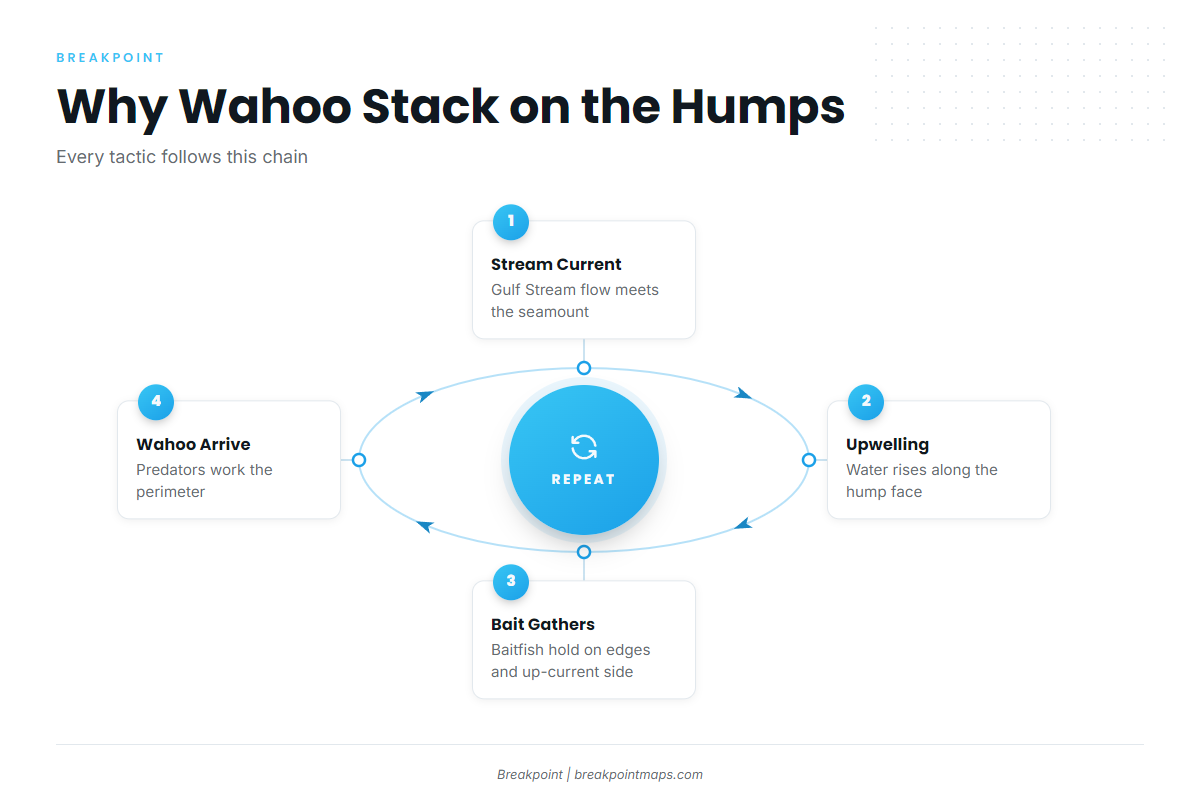
The tactics below rest on one chain of cause and effect: Gulf Stream current meets the seamount, which drives upwelling, which gathers bait, which draws wahoo to the edges. We hold this model with moderate confidence, and the sources agree on it.
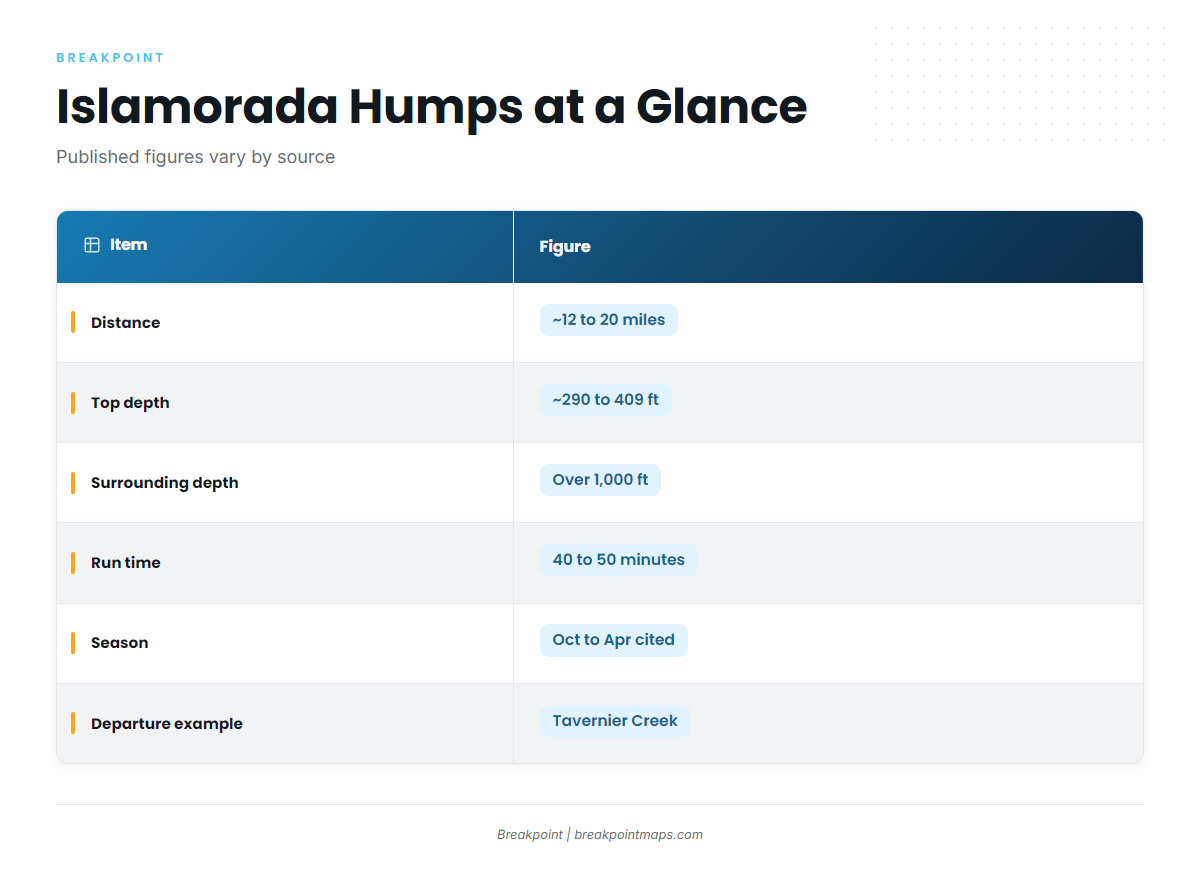
Islamorada Humps at a glance
| Item | Figure | Source note |
|---|---|---|
| Distance | ~12 to 20 miles (FishingBooker says ~15; trustedfish.co says "about 20") | Varies by departure point |
| Top depth | ~290 ft (Good Karma) to ~409 ft (trustedfish.co) | Unconfirmed; check your chart |
| Surrounding depth | Over 1,000 ft | trustedfish.co |
| Run time | 40 to 50 minutes depending on seas | trustedfish.co |
| Season | Cooler months; Oct to Apr cited | In The Spread; year-round catches possible |
| Departure example | Tavernier Creek | One sourced option, not a full list |
| Co-species | blackfin tuna, dolphin, sailfish, occasional marlin; snowy grouper and yelloweye snapper on bottom | trustedfish.co, FishingBooker |
Regional Differences
Compared with our Atlantic Southeast wahoo guide, this one piece of bottom differs in four ways:
- The Stream runs close. trustedfish.co says Islamorada runs push past the reef line into the Straits of Florida, where deep structure and Gulf Stream currents create strong upwellings. You reach blue water in under an hour.
- Steep, isolated relief. The bottom rises from over 1,000 ft to a few hundred feet, so fish concentrate on a small feature rather than along miles of ledge.
- Concentration cuts both ways. Fish stack on the structure, and so do boats. Many boats work the same few humps.
- Later, cooler-month season. Salt Water Sportsman notes that seamounts like the Islamorada Hump hold wahoo "especially later in the season." The regional guide covers the comparisons.
Habitat & Conditions at the Islamorada Humps
Condition calls at the Humps come down to four questions: how the current hits the relief, where the water edges sit, what the season and light are doing, and whether the sea state is worth the run.
Relief, Current and Upwelling
Current strikes the hump face, water rises, and bait holds on the up-current side and along the edges. In The Spread describes humps disrupting currents and creating eddies that concentrate baitfish. Current direction and strength decide which face is live on a given day, so check set and drift on arrival before choosing a pass line.
Temperature and Color Edges
Poppa Wahoo describes trolling color changes and edges at high speed as a core Islamorada approach. Sea-surface temperature breaks and chlorophyll color edges show where the Stream edge sits relative to the Humps before you commit fuel. Cloud can block satellite passes, and the data can lag the water. We give no temperature threshold because none is sourced.
Season and Time of Day
In The Spread ties the cooler months to fall and winter bait movements, October through April. Poppa Wahoo adds that wahoo are caught year-round in the Keys, with abundance varying. FishingBooker, a booking site, says wahoo are particularly active in the morning. Treat that as a claim rather than a finding.
Moon phase is a widely held captain belief. Good Karma suggests studying moon phases.
Sea State and Safety
Wind against the Stream stacks up steep, short seas. Morning is often the calmer window before the breeze builds. Check the NWS Key West marine forecast and the NDBC buoys by name before you commit to the run.
Visitors should note one piece of forum advice: The Hull Truth suggests spending daylight hours on trial runs out through the bridges and channels, plotting the course on GPS.
No one fully knows why a hump fires one day and sits dead the next. Current, bait, temperature and pressure all move.
Tactics for the Islamorada Humps
Every tactic here follows the chain described in the introduction. The details come from published practice, not Breakpoint’s own catch history.
Approach and Pass Direction
Work the perimeter and the up-current face rather than the top. One older forum thread from 2013 says wahoo usually hold on the perimeter of humps and wrecks, not right on top. The advice is dated, but it fits the upwelling mechanism.
Time each pass relative to the current so baits cross the upwelling edge. Mark bait on the up-current side of your sonar and adjust the next pass line.
Speed
Published and forum accounts range from about 12 to 25 knots for high-speed wahoo trolling. Most boats settle where their gear tracks cleanly. The 2013 forum source gives 15 to 25 knots. The slower rotation below runs at 7 to 11 knots.
Spread and Gear
A published mixed spread looks like this:
- Trolling plugs, rigged ballyhoo, and strips of artificial or dead bait. Good Karma says this spread covers wahoo, blackfin tuna and dolphin.
- Skirt colors from local charter writing: green/yellow and black/purple, with a dark jet head down the middle.
- Wire leader, standard against wahoo teeth. We give no spec numbers because none are sourced.
- Planers or downriggers to get baits below the surface.
High-Speed vs. Slower Planer Rotation
Salt Water Sportsman profiles pro tactics for wahoo that are not specific to the Humps. One pro drifts live baits on electric downriggers with 10 lb weights at 59 ft and 89 ft. Later in the morning he trolls at 7 to 11 knots, with lures on planers and ballyhoo on rigger lines. This is one alternative when the high-speed passes go quiet.
Co-Targets
Blackfin tuna, dolphin and sailfish share the ground. trustedfish.co reports year-round blackfin action on the humps with live baits and jigs. A mixed spread keeps you in the game, and a blackfin day can still turn into a wahoo day. See Regulations for the sailfish and bottom-fish rules.
Etiquette and Crowding
Forum advice says weekdays are much less crowded, and that working about a mile off the hump keeps you away from the fleet. Both are forum claims. Whatever the day, do not cut across another boat’s troll line or drift, and match the rotation already in place.
If You Book a Charter
Charters typically combine high-speed trolling with live bait. A charter-industry source says licenses are usually included. Confirm with the captain.
Planning Your Run
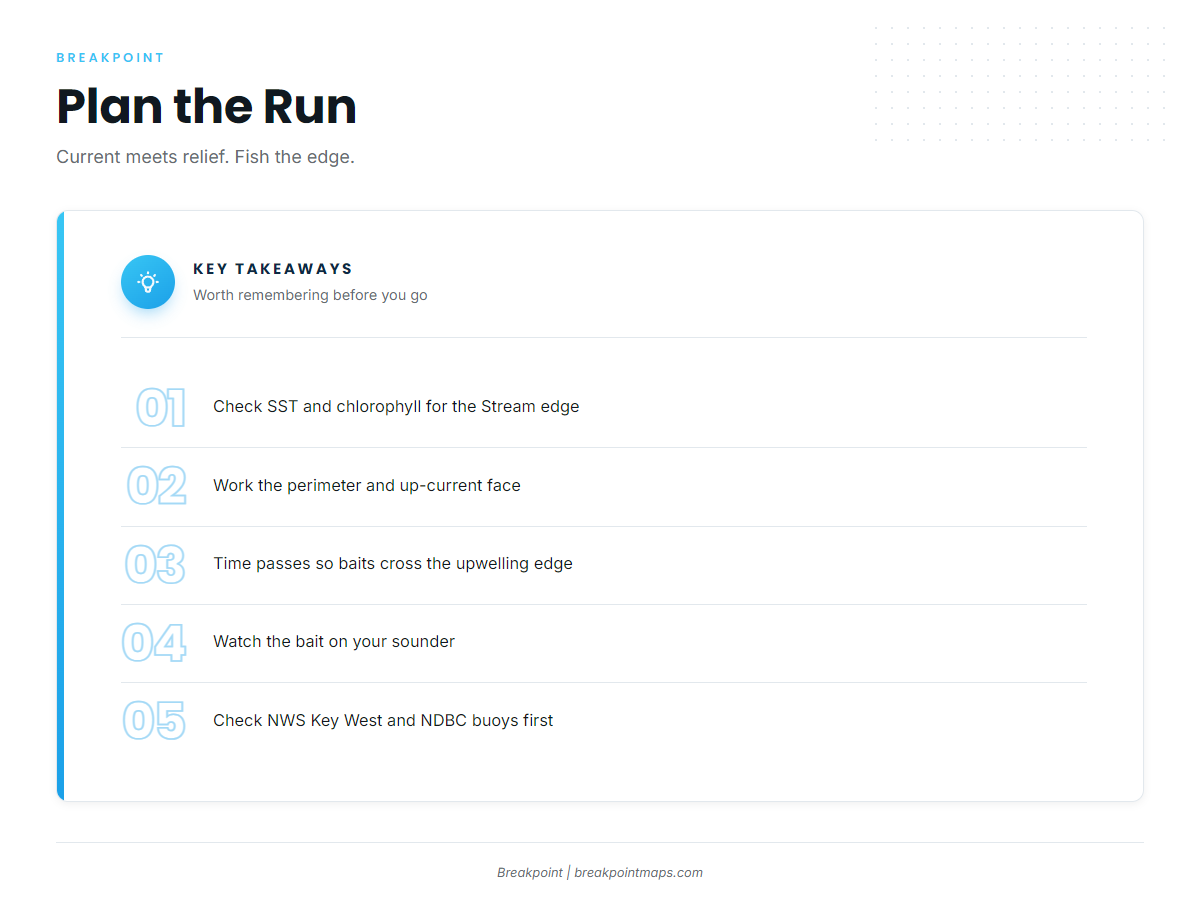
Current meets relief, so fish the edge, time the passes, and watch the bait.
Before the run, we check OBS SST and Chlorophyll in Breakpoint to see where the Stream edge sits relative to the Humps, and Chart Contours to plan passes around the perimeter. Chart layers are not for navigation.
We cannot promise fish, but these layers can help you decide where to look.
Frequently Asked Questions
How far offshore are the Islamorada Humps?
Roughly 12 to 20 miles, depending on the source and your departure point. trustedfish.co puts the run at 40 to 50 minutes depending on seas. FishingBooker says about 15 miles, and trustedfish.co elsewhere says about 20.
When is wahoo season at the Islamorada Humps?
Published sources point to the cooler months, October through April. Year-round catches are possible, with abundance varying by water temperature, currents and bait.
What is the wahoo bag limit in Florida?
Check the FWC and SAFMC pages, and confirm which rule applies where you fish, since federal and state rules can differ.
How fast do you troll for wahoo at the Humps?
Accounts range from about 12 to 25 knots, and the figures are anecdotal. A slower 7 to 11 knot rotation with planers and ballyhoo is also published. Most boats settle where their gear tracks cleanly.