White marlin fishing in the Gulf of Mexico is a far-offshore, blue-water fishery that follows Loop Current water, deep structure and bait. For the fundamentals (ID, biology, general tackle), start with our white marlin species guide. This page covers only what changes in the Gulf.
NOAA and other federal agencies call this water the Gulf of America, so that is the name you’ll see on regulation pages.
Below you’ll find:
- Timing by port: when Gulf white marlin show up, and why sources disagree
- Where to look: water first, then structure
- How to set up: what changes in the spread offshore of the northern Gulf
- The rules: federal permits, size, hooks and state licenses
We can’t promise fish. The Gulf changes week to week, and some of what drives these fish is still being studied.
Regional Differences
Gulf white marlin behave differently from the Mid-Atlantic run most guides assume. Marlin Magazine’s white marlin profile says fish that frequent the Yucatan in spring and early summer migrate toward the Gulf of Mexico to spawn in early summer. The same profile adds that these migratory patterns are still being studied, so be wary of any tidy story about where Gulf fish come from.
A marlin charter here means a long run offshore with no guaranteed bite. Plan your dates around the water as well as the calendar.
When the Fish Show Up: White Marlin Season in the Gulf of Mexico
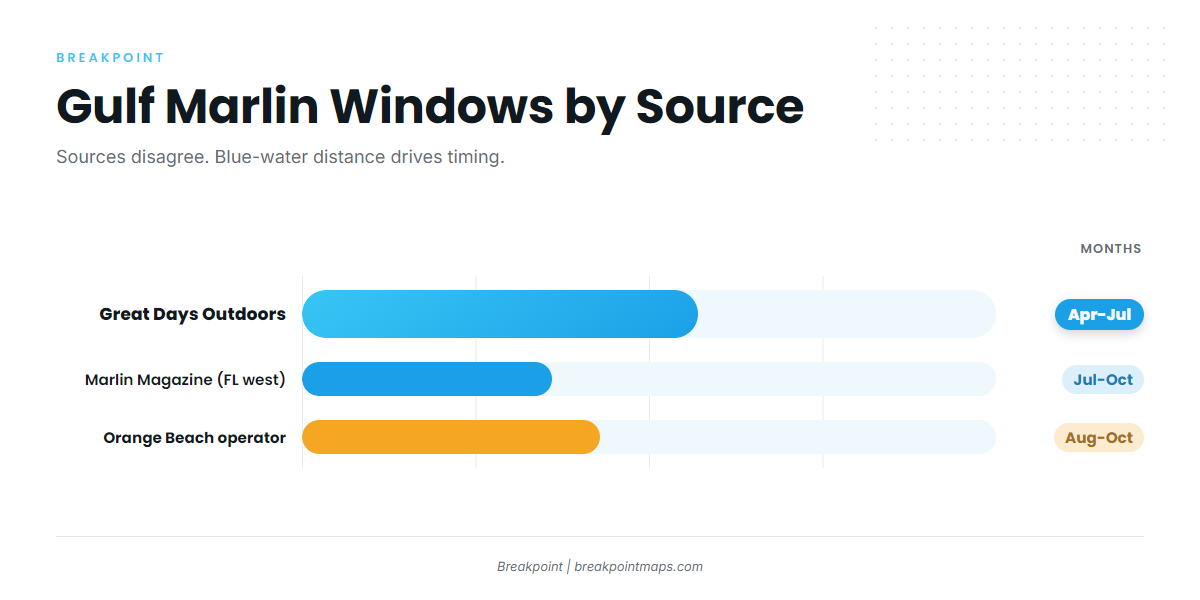
White marlin season in the Gulf of Mexico depends on who you ask and which port you fish from. The reported windows differ by source:
| Source / port | Window | Notes |
|---|---|---|
| Great Days Outdoors (Gulf-wide guide) | April through July | Catches possible year-round. See a Gulf-wide season guide. |
| Marlin Magazine’s Florida west coast coverage | Late July to early October | Most promising period for big billfish and tunas. Fishing is good just about year-round. |
| One Orange Beach charter operator | August, then September and October | Fish "just 30 miles southeast of Orange Beach." Operator report, see an Orange Beach charter operator. |
The windows differ mostly because blue water sits closer to some ports in some months. Year-to-year swings are real, and no calendar replaces a current look at the water.
Often a By-Catch of the Blue Marlin Trip
In the Gulf, white marlin commonly come up on trips aimed at blue marlin and tuna. Venicefishing.com notes that both species can be caught out of Venice, Louisiana, with bites near current rips and large schools of tuna. Targeting whites on purpose means changing the spread, which we cover in the tactics section below.
Longer Runs and Man-Made Structure
Distance is part of the Gulf equation. One Venice operator reports that marlin trips typically run between 30 and 100 miles offshore. Oil and gas platforms are the other Gulf-specific feature. An Alabama Gulf Coast guide, quoted by Gulf Shores and Orange Beach tourism, says blue and white marlin are caught through the summer "far offshore, around oil platforms and in the cobalt blue, deep waters of the Gulf."
Habitat & Conditions in the Gulf of Mexico
Read the Gulf in this order: water first, then edges, then structure. Warm, clear current water carries bait, edges concentrate it, and structure holds it. Fish follow all three.
The Loop Current and Its Eddies
The Loop Current is the Gulf’s source of warm blue water. Pieces of it break off as eddies and drift, and each one carries its own edges, where bait and predators stack up.
Marlin Magazine’s Florida west coast guidance tells anglers to check for filaments or spinoffs from the Loop Current, and it’s worth doing before you commit fuel. Eddies move between the day you check the chart and the day you run, sometimes by a lot. An edge within range of your port on Tuesday may not be there on Thursday.
Temperature and Blue Water
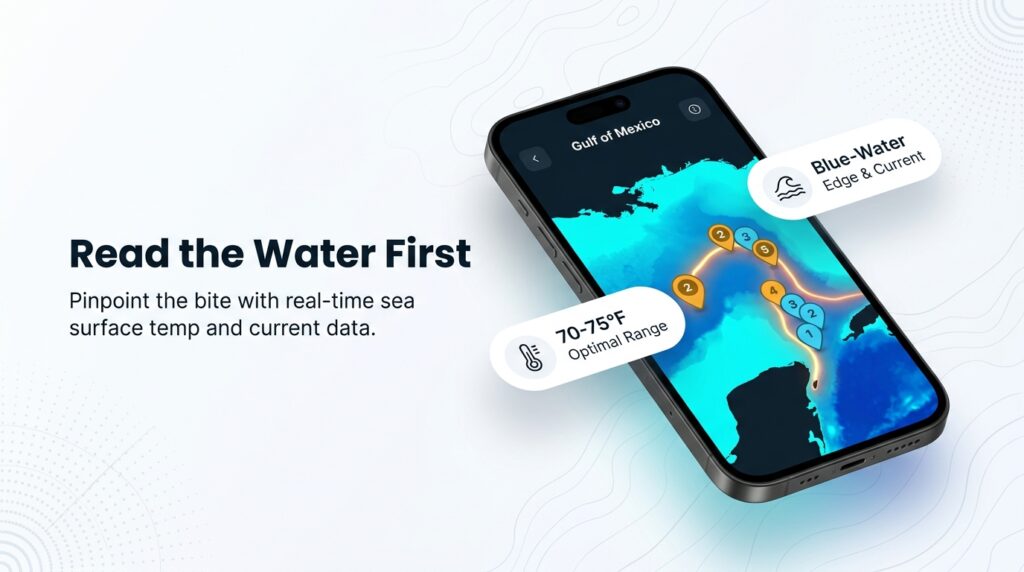
Marlin Magazine’s profile puts white marlin in water in the mid-70s. PELAGIC’s white marlin species profile is more specific: if you find bait offshore in deep blue 70 to 75 degree water, the white marlin will be nearby.
Water color matters here. Green water is turbid, nutrient-rich water influenced by rivers. Off the Mississippi, the river plume creates a green-to-blue edge worth watching on a chlorophyll chart.
Weed Lines, Canyons and Platforms
Three kinds of structure and floating habitat matter in the Gulf.
- Weed lines and sargassum: Floating weed shelters bait along its edges. The Venice operator notes fish spotted near weed lines.
- Canyon edges: Deep water off Alabama, the Panhandle and Louisiana has steep bottom that pushes current and bait up.
- Deepwater platforms: Platforms hold bait, and bait draws billfish. One Orange Beach guide says, "I’ve caught white marlin in as shallow as 350 feet, so if it looks fishy, start fishing."
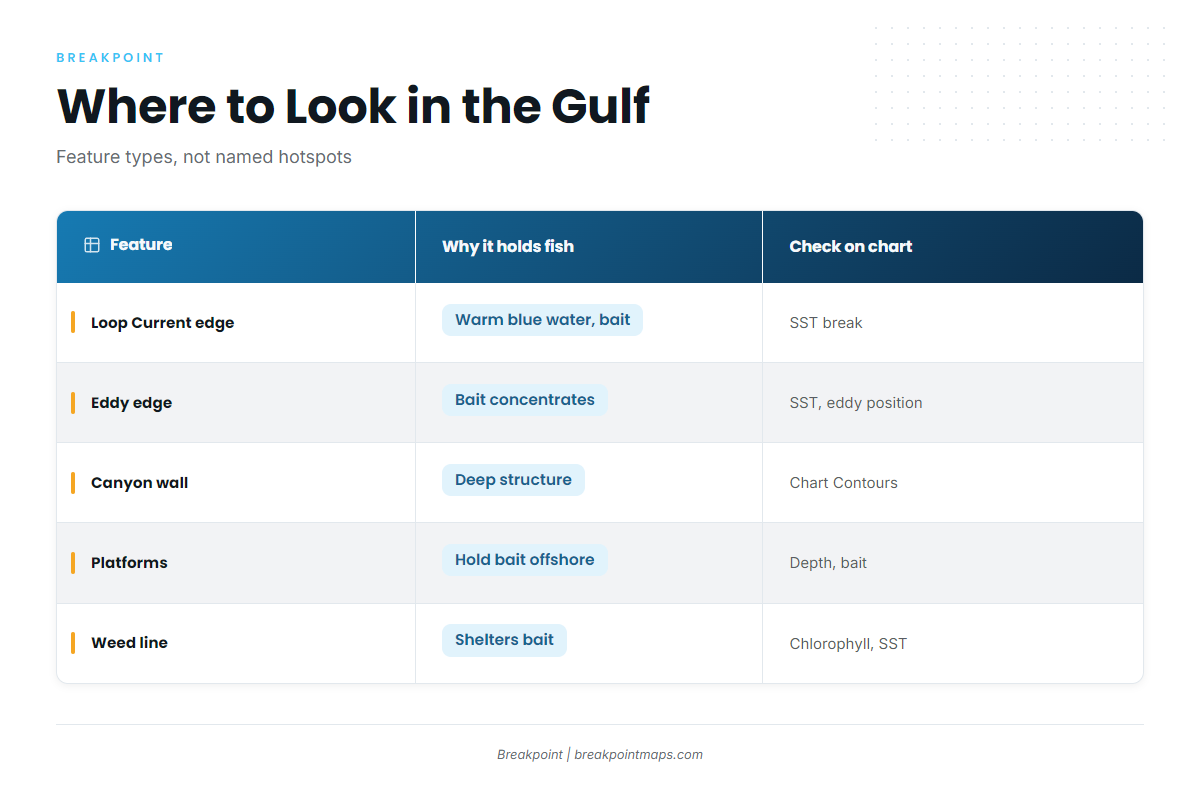
The table below shows how the features compare on the chart:
| Feature type | Why it can hold fish | What to check on the chart |
|---|---|---|
| Loop Current edge | Warm blue water meets cooler water and bait stacks along the break | Sea-surface temperature break, water color |
| Eddy edge | A moving temperature break with its own bait concentration | SST over several days, to see which way it drifts |
| Canyon wall | Steep bottom lifts current and bait | Depth contours, then SST and color over the top |
| Platform | Artificial structure holds bait in open water | Platform positions, then the blue-water edge nearby |
| Weed line | Floating cover shelters bait along the edge | Chlorophyll and color lines, plus what you see from the bridge |
Reading the Charts, and What They Can’t See
SST shows the edge, chlorophyll shows where green water ends, and Chart Contours shows depth and structure. None of them sees under cloud, and a satellite pass blocked by cloud is a gap, not a clear day. A forecast is a forecast.
Chart layers are not for navigation. Use official charts and your plotter to run the boat.
Tactics for the Gulf of Mexico
General rigging and spread basics are in our white marlin fundamentals. What follows is what differs offshore of the northern Gulf.
Find the Bait First
Start with bait before you put lines in the water. Great Days Outdoors advises starting to troll once a concentration of bait such as flying fish, hardtails, bonita or blackfin tuna shows up. That ties back to the 70 to 75 degree blue-water point above: bait in blue water in the right temperature range is the signal.
A Lighter Spread for Whites
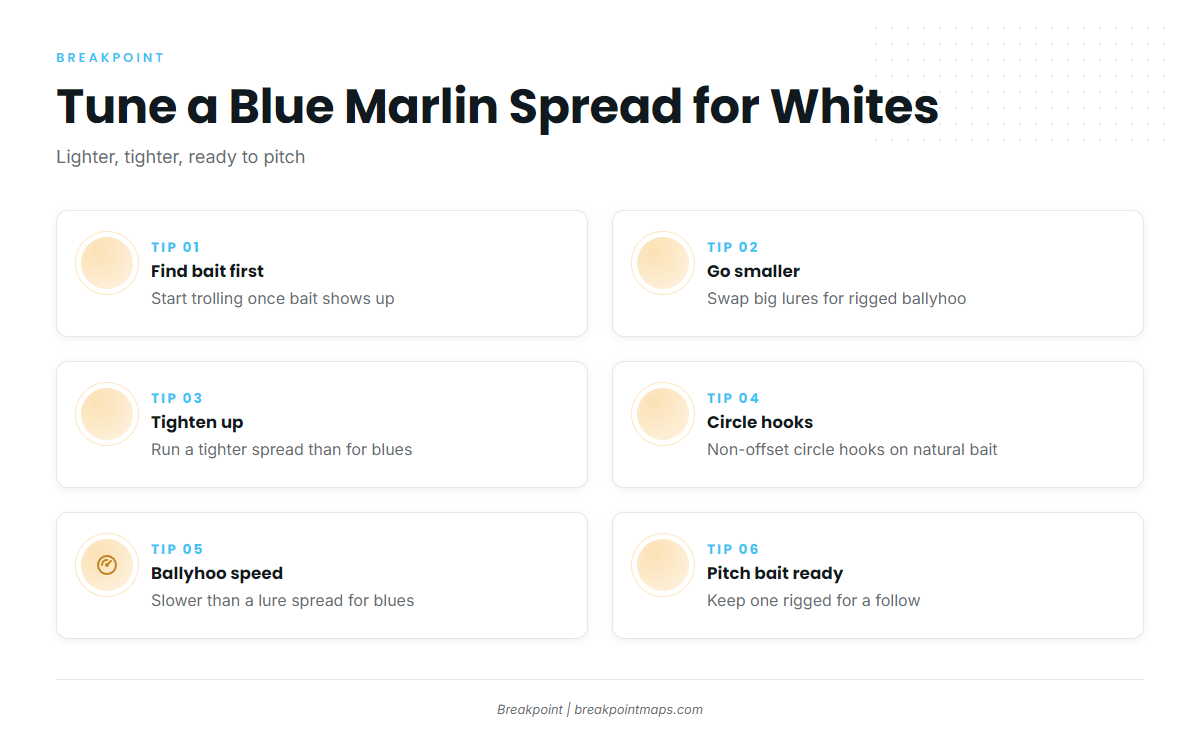
A blue marlin spread is built for bigger fish. For whites, shift the setup:
- Swap large lures for rigged ballyhoo on non-offset circle hooks (the circle-hook rule is covered in Regulations below).
- Run a tighter spread than you would for blues, trolled at ballyhoo speed, which is slower than a lure spread.
- Keep a pitch bait rigged and ready near the cockpit.
Expect missed bites. Marlin Magazine notes that white marlin are sneaky and each one eats a different way, so you can expect to miss a few, or more. That is normal and doesn’t mean your rigging is wrong.
Pitch-Baiting and Working Platforms
The Gulf Shores guide describes trolling and pitch baiting for billfish, white marlin in particular. Around platforms, work the structure and the edges where bait holds, and mind platform traffic and restrictions while you do.
Plan the Run
The Venice operator’s figures set expectations: 30 to 100 miles offshore, with fuel averaging 250 gallons per day. Those are one operator’s numbers for its own boats, so scale to yours. Check weather windows, fuel reserve and the latest chart before committing. A chart that looked good on Tuesday is only a hypothesis by Thursday.
FAQ
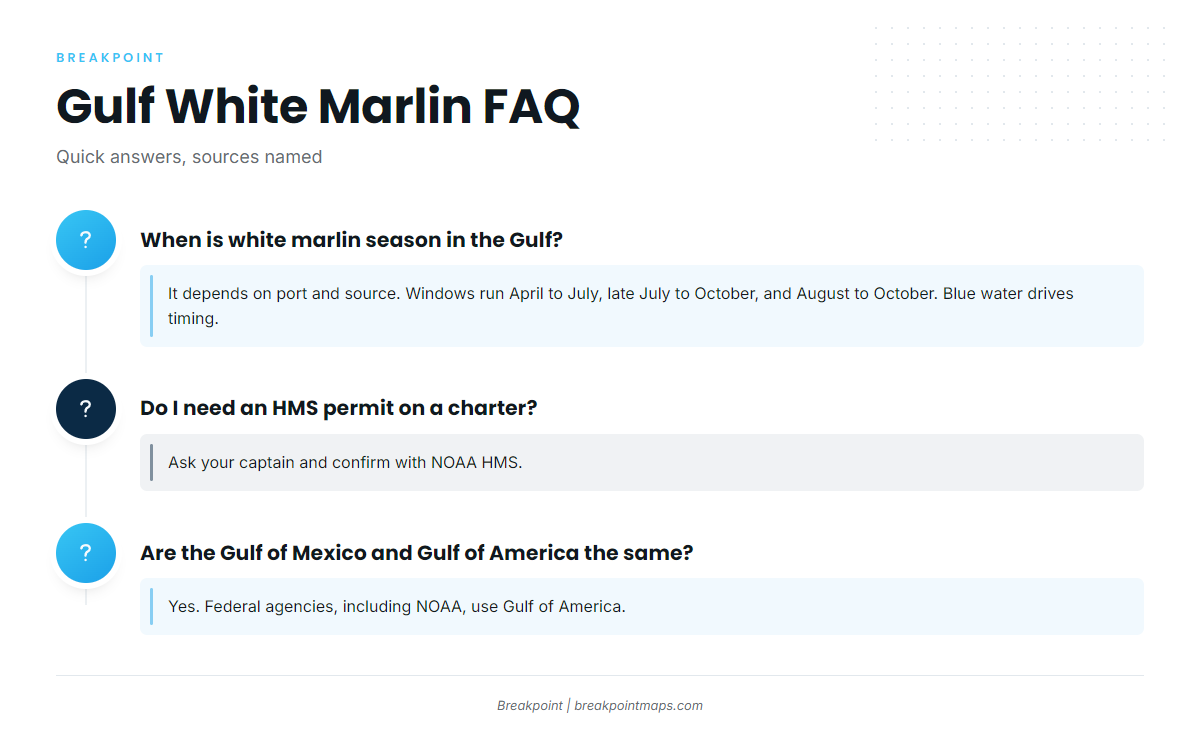
When is white marlin season in the Gulf of Mexico?
It depends on the port and the source. Great Days Outdoors gives April through July. Marlin Magazine’s Florida west coast coverage points to late July through early October. An Orange Beach operator fishes August through October. Blue-water proximity drives the timing more than the calendar does.
What is the minimum size for white marlin?
The federal minimum is 66 inches, measured as lower jaw fork length. Tournaments often set stricter minimums than the federal rule, so read your event rules too.
Do I need an HMS permit on a charter?
The boat must hold a valid HMS Angling or HMS Charter/Headboat permit to fish for Atlantic billfish, and that permit covers everyone fishing on board.
How do you tell a white marlin from a roundscale spearfish?
The two look very alike, which is why anglers mix them up. NOAA Fisheries HMS publishes identification guidance. Read it before your trip, since the two species share landing rules.
Are the Gulf of Mexico and Gulf of America the same?
Yes. Federal agencies, including NOAA, use Gulf of America. Regulation pages may use either name, so search under both.
Reading the Water Before You Run
The order that holds up is water, then structure, then bait, then spread.
Breakpoint’s hotspots feature scores white marlin in the Gulf of Mexico, so you can see where the edges line up before you commit fuel to a run. A score helps you decide where to look. It doesn’t promise fish.