Gag are the grouper most Gulf anglers mean when they say "grouper on the ledges." They fight hard and eat well, and the season has become very short. Today, Sept. 30, 2026, is the last day of the 2026 Gulf season, which runs Sept. 1-30 in state and federal waters (details and sources in Regulations below). This guide is Breakpoint’s baseline reference for the species. It draws on FWC, NOAA Fisheries and the fishery management councils, and it says where the science runs out.
The page covers how to identify a gag before it goes in the box, where they live across the Gulf, baseline tactics, and current rules with dates. If you already fish for gag in the South Atlantic, look for the Gulf difference notes.
Overview: What a Gag Grouper Is
The gag, Mycteroperca microlepis, is a shallow-water grouper of the western Atlantic and the Gulf of Mexico. Identification comes first because legality depends on it. It also sets up the life cycle behind today’s short seasons.
How to Identify a Gag Grouper
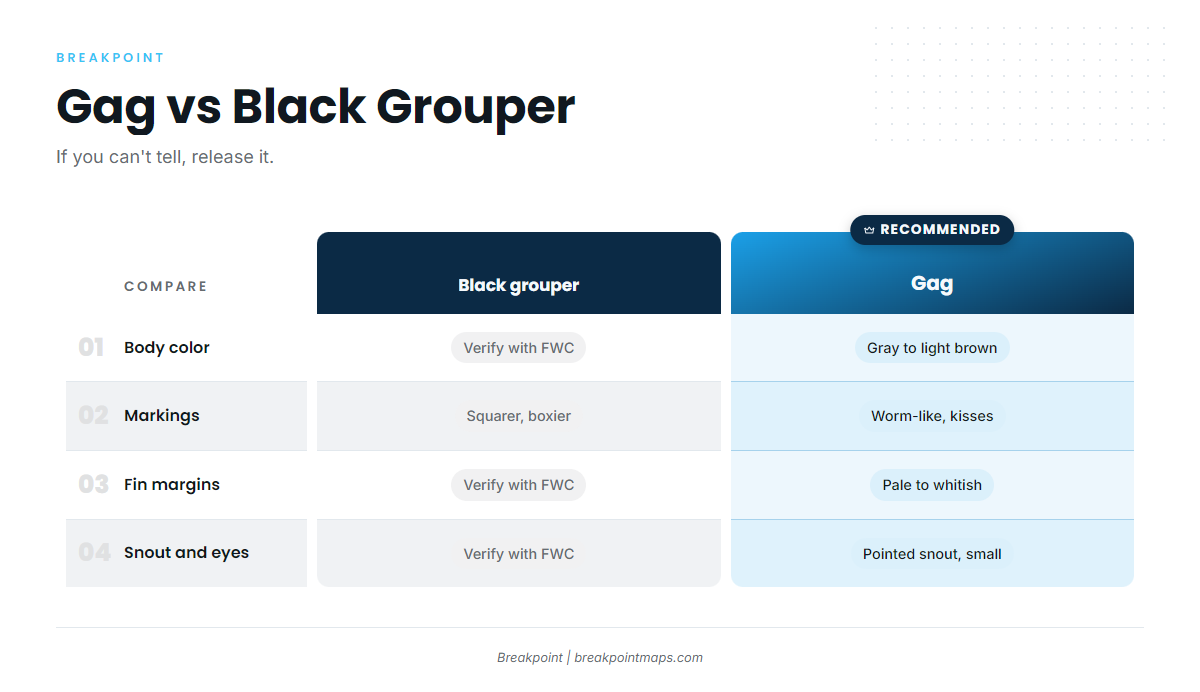
Gag are gray to light brown with darker, worm-like or "kiss-shaped" markings. They have a pointed snout and small eyes, and their fins shade to pale or whitish edges. Check that combination first at the boat.
Gag and black grouper are easy to confuse. The table compares the markings:
| Trait | Gag | Black grouper | Scamp |
|---|---|---|---|
| Body color | Gray to light brown | Not covered here | Verify with FWC ID resources |
| Marking shape | Worm-like, kiss-shaped | Squarer, boxier | Verify with FWC ID resources |
| Fin margins | Pale to whitish | Not covered here | Verify with FWC ID resources |
If you can’t say which it is, release it. Seasons and limits differ by species.
Behavior and the Sex Change
All gag start life as females, and some become males as they grow, which makes the species protogynous. Anglers call the males "copper bellies."
Adults are solitary or in groups of 5 to 50. They hold tight to structure and ambush prey that swims by. Gag are widely regarded as good eating, which is a large part of why anglers target them.
The sex change has direct consequences for management, covered in Regulations.
Habitat & Range: Where Gag Live in the Gulf
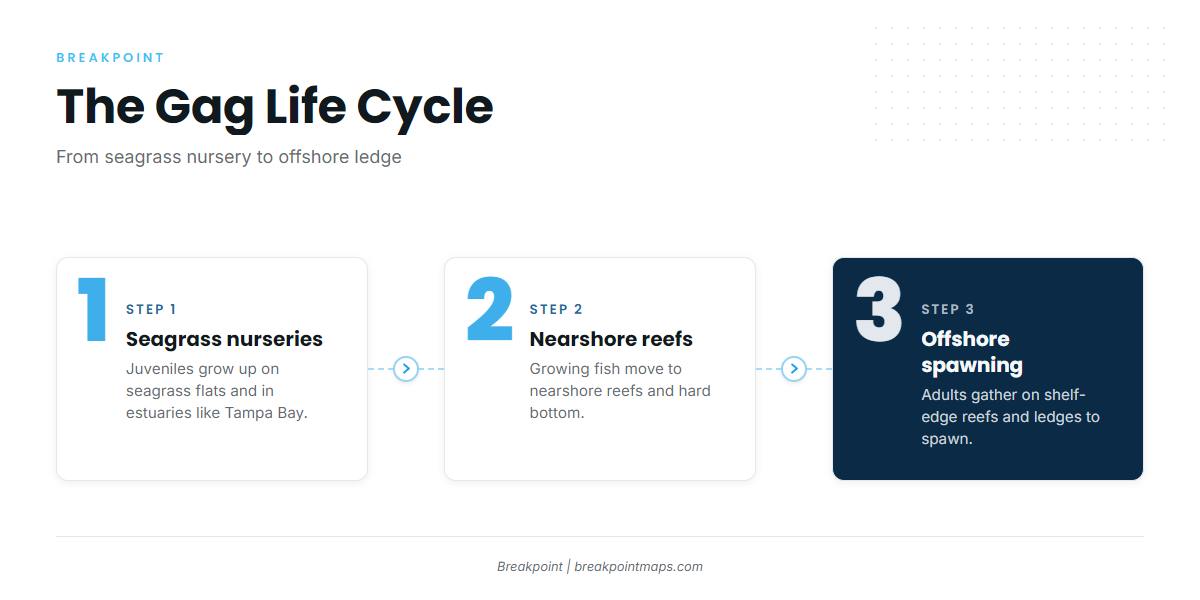
A gag’s life runs in three steps, as Ocean Conservancy describes it:
- Juveniles grow up in seagrass flats and estuaries that serve as nurseries.
- As they age, they move to nearshore reefs.
- Mature females join spawning aggregations on offshore reefs.
That progression explains where you find them and why the fishery is fragile.
From Seagrass Nursery to Offshore Ledge
Juvenile gag are all female. Ocean Conservancy names Tampa Bay as one of the estuaries that serve as nurseries, and Big Bend seagrass plays a similar role in general terms. For local detail, see our guide to gag grouper fishing off Tampa Bay. This page stays at the hub level.
Structure That Holds Gag
Take Me Fishing calls gag the most common grouper on ledges in the eastern Gulf of Mexico. Wrecks and oil rigs in shallow shelf waters also attract many gag.
Look for:
- Ledges
- Live bottom
- Hard bottom
- Wrecks and rigs
Fish structure rather than open sand.
Gag Grouper Depth by Season
Adult gag are usually on offshore hard bottom in 60 to 250 feet, rarely to 300 feet, and occasionally inshore on rocky or grassy bottom, per Take Me Fishing. The South Atlantic council gag profile puts adults over hard bottom in 60 to 500 feet. These are two source-specific ranges and shouldn’t be merged into one number.
Gag move closer to shore in colder months, a pattern widely reported by Florida Gulf guides and retailers. Capt. Louie Argiro, writing in Florida Sportsman in July 2024, reports gag in as little as 5 feet of water around Crystal River.
Where an individual fish will be on a given day can’t be predicted. These are patterns, not guarantees.
The Gulf Difference
Spawning timing is the clearest split. The NOAA Fisheries gag species profile gives the Gulf window as late January to mid-April, in aggregations on shelf-edge reefs and rocky ridges beside drop-offs. Each female releases 60,000 to 1.7 million eggs per spawn. The South Atlantic council puts spawning in February off the Carolinas and January through March in the Gulf.
Fall and winter shallow movement also makes nearshore ledges and live bottom productive in the eastern Gulf. The Gulf season is also short and set yearly, which is covered in Regulations.
Gag Grouper Fishing Tactics
Most gag are lost in the first few seconds, to the rocks. Everything below is widely used and documented by FWC, Take Me Fishing and working guides, and none of it is secret. FWC describes boat fishing for grouper as baits fished near the bottom on heavy tackle, using live fish or dead cut or whole bait.
Bait
Live pinfish, grunts, sardines and sand perch are the commonly used baits. Mullet and small mackerel are also used, and dead cut or whole bait works too.
Tackle and Rigs
Treat these as common ranges, not rules:
- 6’6" to 7′ heavy to extra-heavy conventional rod, rated 50 to 80 lb
- High-capacity reel with 65 to 80 lb braid for deeper offshore water
- Lighter gear, up to about 30 lb, often suggested around 50 feet
- Knocker or fish-finder (sliding sinker) rig with 4 to 16 oz of lead, depending on depth and current
- Fluorocarbon leader
Stop the Fish
The window between the bite and the fish reaching its hole decides the fight. Set the drag tight and lift immediately. If the fish gets back into its hole, it usually wins; if you keep it out, you usually do.
Trolling and Artificials
Trolling deep-diving plugs just above reef edges is a common way to locate fish, especially in shallower fall and winter water. Slow-pitch jigs are used for pressured fish. Argiro reports gag hitting plugs, swimbaits and topwaters in shallow Crystal River water.
The Gulf Difference
In fall and winter, shallow eastern Gulf ledges make trolling and lighter tackle more practical than in deep offshore water. If you use side-scan, apps or charts to find that structure, remember that chart layers are not for navigation.
Gag Grouper Regulations (Gulf of Mexico)
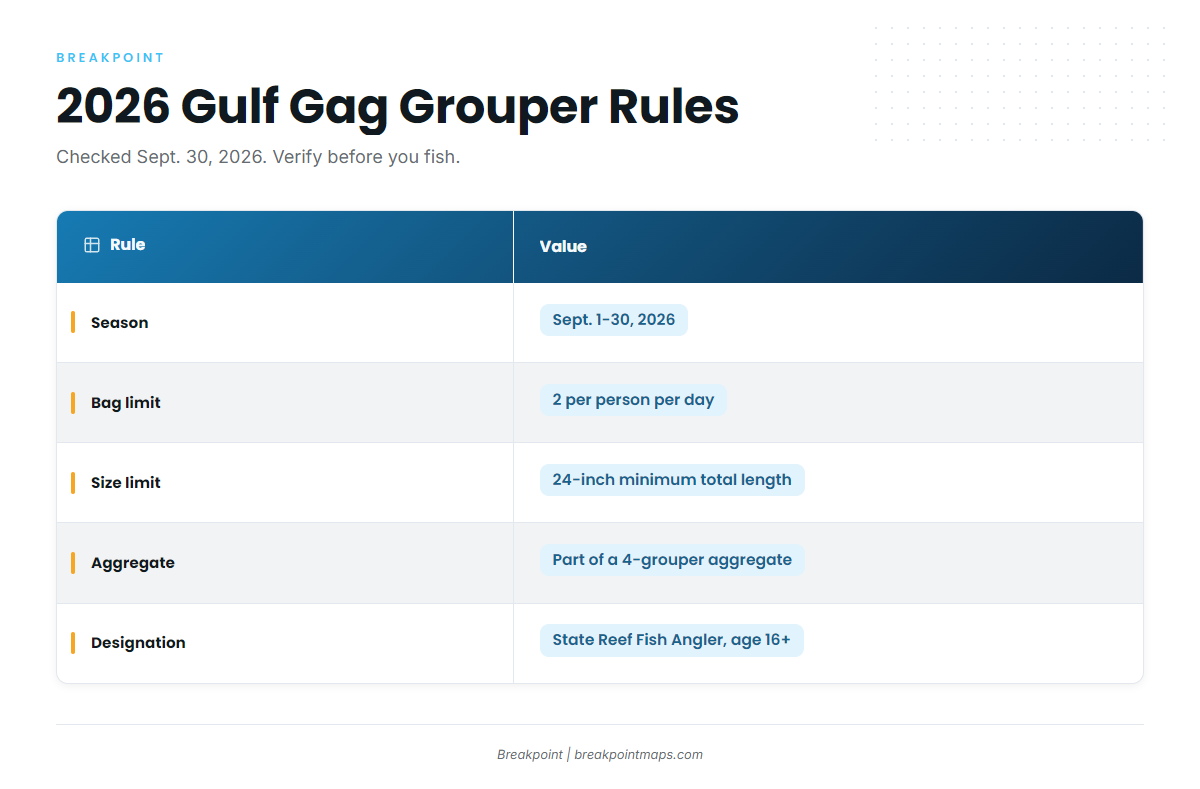
Verify before you fish. Agencies now call the Gulf of Mexico the Gulf of America, the name you’ll see on official pages.
| Rule | Value | Waters | Source |
|---|---|---|---|
| Season | Sept. 1-30, 2026 | State and federal | FWC |
| Bag limit | 2 gag per person per day | State and federal | FWC via 2026 bag and size limits |
| Size limit | 24-inch minimum total length | State and federal | FWC via Fox35 |
| Aggregate | Part of a 4-grouper aggregate | State and federal | FWC via Fox35 |
| Designation | State Reef Fish Angler, private boats, age 16+, free, annual | Florida | FWC |
| Release gear | See NOAA and Gulf Council requirements | Federal | NOAA and Gulf Council |
When Is Gag Grouper Season in the Gulf?
FWC modified the 2026 season for state waters to Sept. 1 through Sept. 30, consistent with federal waters. The season closes after today. Dates for 2027 are not set as of our check.
Why the Season Is So Short
Gulf gag were declared overfished in 2009 and rebuilt by 2014. A 2021 assessment found the stock impaired again. Research from the University of South Florida shows the male share has collapsed to 2-3% of the population, versus about 17% historically. FWC research published in 2020 found that regulations were "not sufficient for the male population to recover."
Seasons have followed. As WUSF reports, seasons have shrunk sharply: 41 days in 2023, 15 in 2024 and 14 in 2025.
This is where the sex change matters. Big males are rare, so the spawning stock is fragile. Science can’t yet fully explain why the male share stays low, and seasons shift yearly with harvest data.
State Reef Fish Angler Designation
Private-boat anglers age 16 and older who land gag in Florida need the State Reef Fish Angler designation. It is free and renews annually. Selected anglers may receive a State Reef Fish Survey mail survey, and that data feeds gag management. FWC is the source.
Release Gear, Barotrauma and Conservation
Barotrauma is a pressure injury from a fast ascent from depth. NOAA-backed practice is to release fish with a descending device. Federal Gulf reef fish rules include release-gear requirements. Check NOAA Fisheries and the Gulf Council for current specs.
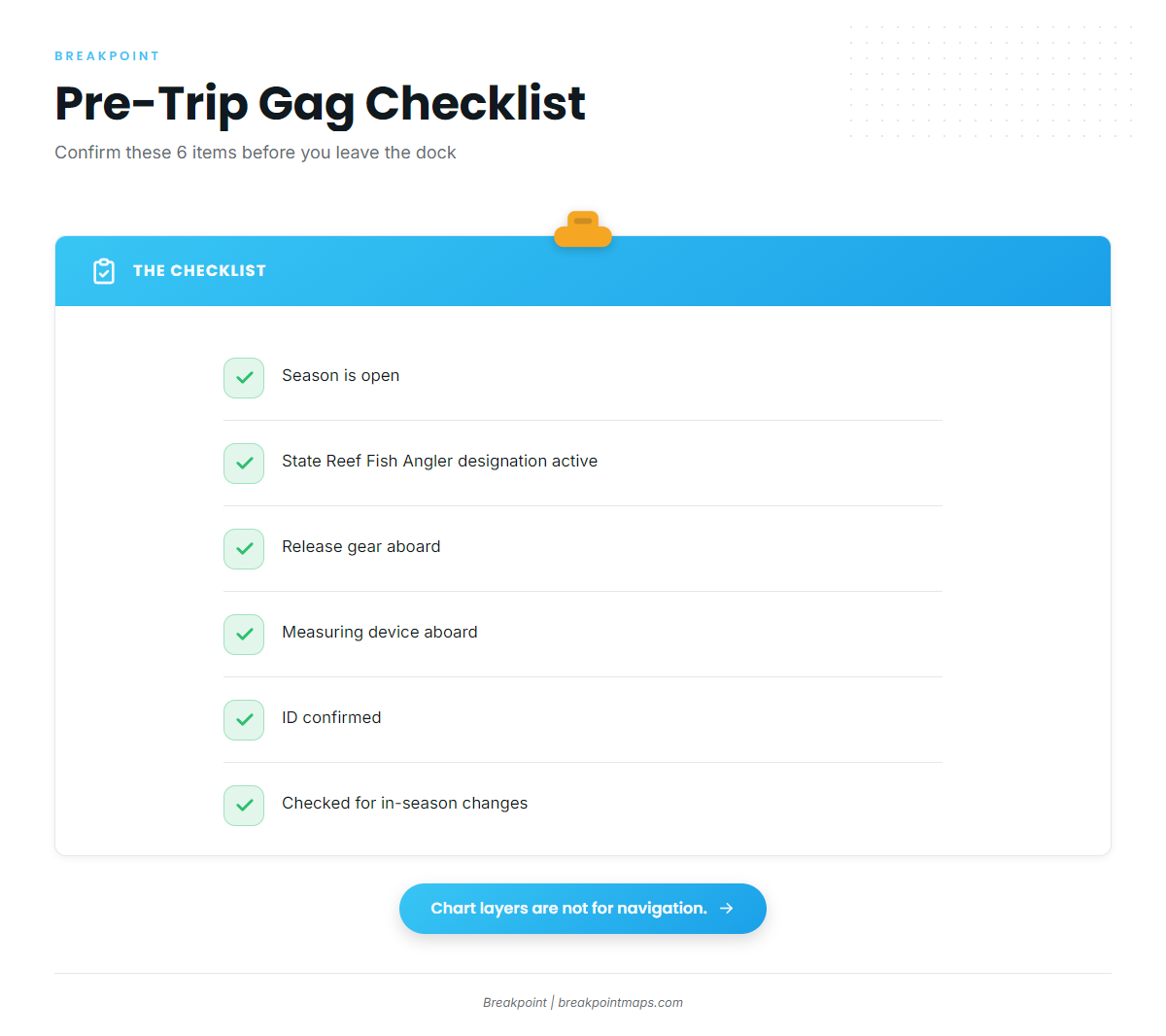
Run this pre-trip checklist:
- Season open
- State Reef Fish Angler designation active
- Release gear aboard
- Measuring device aboard
- ID confirmed
- Checked for in-season changes
Frequently Asked Questions
When is gag grouper season in the Gulf?
Sept. 1-30 in 2026, state and federal waters, per FWC. It closes after Sept. 30, and 2027 dates are not yet announced. Verify before fishing.
What is the gag grouper size and bag limit?
The limit is 2 per person per day, with a 24-inch minimum total length, within a 4-grouper aggregate. That is as reported from FWC’s 2026 announcement.
How do you tell gag from black grouper?
Gag have worm-like, kiss-shaped markings on a gray to light brown body. Black grouper markings are squarer. If you’re unsure, release the fish.
What depth are gag grouper in?
Adults are usually on hard bottom at 60 to 250 feet per Take Me Fishing, and 60 to 500 feet per SAFMC. They move shallower in colder months.
Do I need the State Reef Fish Angler designation?
Yes, if you fish from a private boat in Florida, are 16 or older and intend to land gag. It is free and annual, per FWC.
Conclusion and Where to Look Next
Confirm the ID, find the structure, and check the rules on the day. We’ll keep this guide updated as rules change.
Regional guides: gag grouper fishing off Tampa Bay.
When you plan the next trip, Breakpoint’s Hotspots and Fish Intel can help narrow down which ledges, hard bottom and conditions are worth a look before you burn fuel. They show where to look, not where the fish are guaranteed to be. Chart layers are not for navigation.