


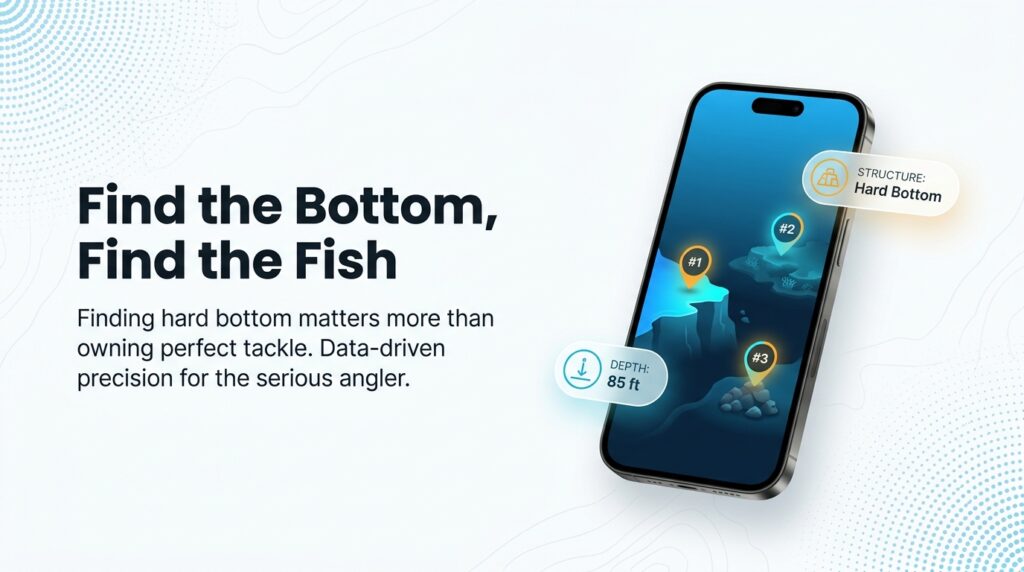
Red snapper season opens, the ramp fills, and the same questions come up: how far to run, what to tie on, and whether it’s even open off your state. Red snapper is a structure fish, and finding the right bottom matters more than owning the perfect rod.
This guide covers how to identify red snapper, where they live in the Gulf, how anglers commonly catch them, and how to keep them legally. Newcomers get a clear go or no-go picture, anglers coming from the Atlantic get the Gulf differences, and trip planners get a compliance checklist and the agencies that set the rules. Every rule and biology claim is cited to NOAA Fisheries, the Gulf Council, or the five Gulf state agencies, and we say so when the science is unsettled. Federal documents now use the name "Gulf of America," so you’ll see that on NOAA bulletins.
Verify before you go.
Quick Facts
- Scientific name: Lutjanus campechanus.
- Max age: 57 years, per the FWC red snapper biology page.
- Typical size vs. record: Commonly caught up to about 10 lb and 20 in, though typical and record sizes run larger, with fish over 40 lb taken. Treat that as general context, not an agency figure.
- Habitat: Hard structure such as natural reefs, ledges, wrecks, artificial reefs and oil and gas platforms, across the Gulf.
- Depth: Wide range, varies by region. See Habitat & Range.
- Federal for-hire rule: 16 in minimum and 2 fish per person, from the Gulf Council.
- Regs note: Private seasons are set by each state and change every year. Check the Regulations table.
Overview: Identifying Red Snapper and How They Behave
Red snapper (Lutjanus campechanus) are long-lived, structure-oriented reef fish found throughout the Gulf of Mexico. They have a red body, red eye and pointed anal fin.
Get the ID right first, because keeping the wrong species or an undersized fish is a harvest violation.
- Color: Pinkish to deep red.
- Eye: Red.
- Fins: A pointed anal fin.
- Face: Long and triangular.
- Juveniles: A dark spot on the upper back below the dorsal fin. Adults lose it.
Size matters beyond the tape. As FWC notes, red snapper are long-lived, early-maturing fish, and older, larger females contribute far more eggs than younger ones. That biology underlies most of the size and season rules below.
Gulf and South Atlantic red snapper are managed separately, so rules, seasons and councils differ. The details are in Regulations.
Red Snapper vs. Look-Alikes
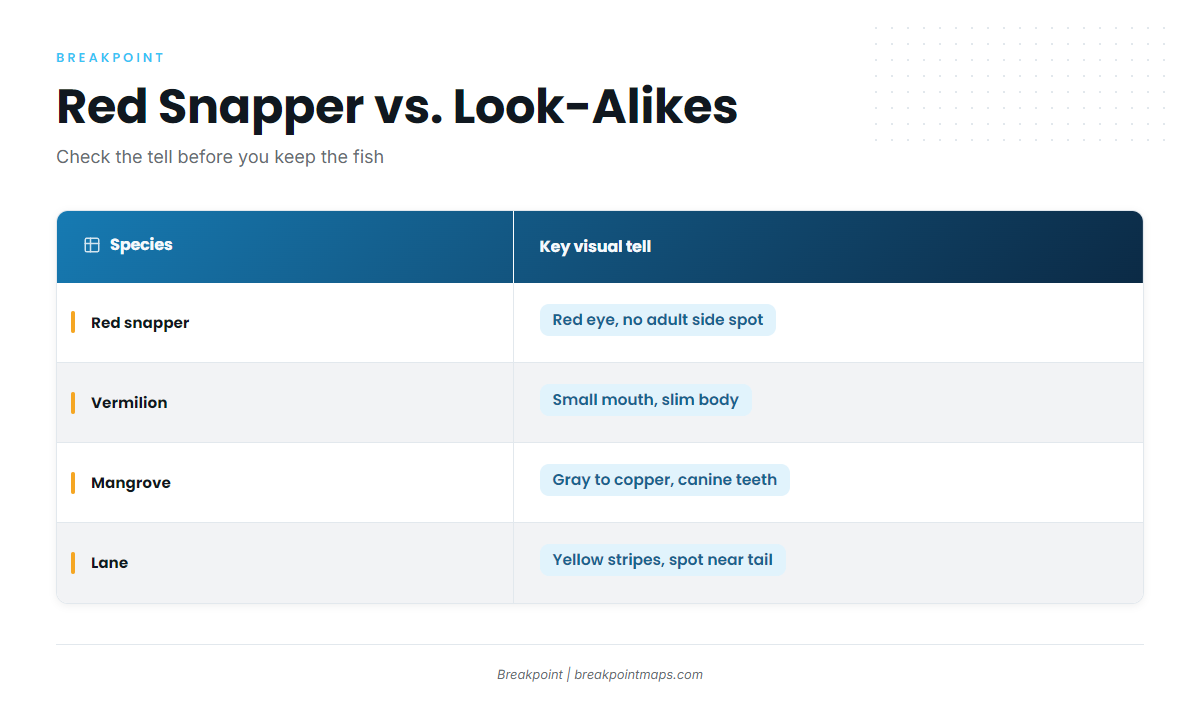
| Species | Key visual tell | Where commonly confused | Note |
|---|---|---|---|
| Red snapper | Red body, red eye, no dark lateral spot as an adult | Baseline for comparison | Long, triangular face and pointed anal fin |
| Vermilion snapper | Smaller mouth, more slender body, fine lines on the back | Same hard bottom, often caught together | Different rules apply, so confirm before you keep |
| Mangrove (gray) snapper | Gray to copper color, prominent canine teeth | Nearshore reefs and structure | Juveniles show a dark band through the eye |
| Lane snapper | Yellow horizontal stripes, dark spot near the tail | Reefs and hard bottom | The stripes separate it quickly |
If you are not sure, measure, photograph and release. A wrong ID is not a defense. Confirm every tell against the FWC and Gulf Council species pages before you rely on it.
How Red Snapper Behave Over Structure
Red snapper school over and around hard structure and feed on baitfish, squid and crustaceans. They ambush from the bottom, which is why structure holds them.
Anglers commonly report that smaller fish stay tight to the structure while larger fish range higher or hang off the edge. Sport Fishing Magazine describes trophy snapper suspend higher than you’d expect, at 30 to 40 ft over an 80 ft Alabama reef. Treat that as an observed pattern, not a rule.
Finding the fish is mostly a matter of finding the bottom, and that starts with depth. The mild, firm fillet is a major part of why anglers chase them.
Habitat & Range: Where Red Snapper Live in the Gulf
Red snapper live over hard structure across the Gulf of Mexico, from nearshore artificial reefs to deep offshore ledges and platforms.
Published depth figures depend on region and range widely. Retailer guides cite anything from 30 to 600 ft, so treat any single number with caution.
Structure that holds red snapper:
- Natural hard bottom and ledges.
- Rock piles and flat hard bottom with small relief.
- Wrecks.
- Permitted artificial reefs.
- Oil and gas platforms.
Eastern Gulf: Florida Panhandle and Alabama
The eastern Gulf mixes natural hard bottom and ledges with heavy artificial reef programs. Alabama’s permitted artificial reef zones, managed by ADCNR, are a well-known example.
For port-level detail on the Panhandle, see our guide to red snapper fishing off Destin.
The same bottom holds sibling species. Gag grouper, greater amberjack and gray triggerfish are commonly caught alongside red snapper.
Western Gulf: Louisiana and Texas
Oil and gas platforms are major habitat off Louisiana and Texas. They disrupt current and concentrate baitfish, and the fish that eat baitfish follow. Platform counts and locations change as structures are decommissioned or converted to reefs.
Gulf vs. Atlantic: What Changes for Visiting Anglers
- The Gulf is managed separately from the South Atlantic, with different councils and seasons.
- Artificial reefs and platforms carry an outsized share of Gulf habitat.
- Private seasons are set state by state.
Tactics: How to Catch Red Snapper
Most Gulf anglers catch red snapper on bottom rigs with circle hooks and natural bait, positioned directly over or just up-current of structure. Natural bait requires non-stainless circle hooks for Gulf reef fish. Details are in Regulations.
Rigs
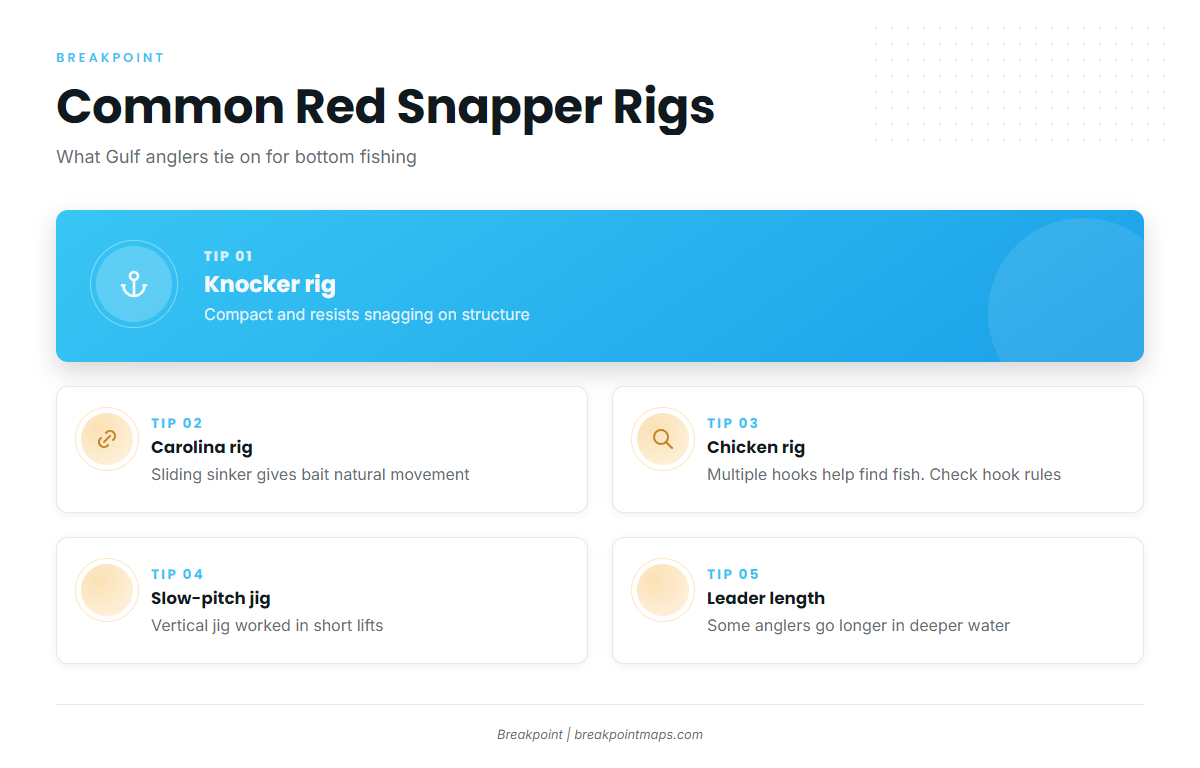
- Knocker rig: The sinker slides down onto the hook. It is compact and resists snagging on structure.
- Carolina rig: A sliding sinker, swivel and leader give the bait more natural movement. Anglers commonly use just enough weight to hold bottom.
- Chicken rig (dropper or hi-lo): Two or more hooks above a weight. It is useful for finding fish. Check that the rig is legal, including hook type, when using natural bait.
- Slow-pitch jig: A vertical jig worked in short lifts. Anglers report it is increasingly popular as an alternative to bait.
- Leader length: Some anglers go longer in deeper water.
- Rod, reel and line: Medium to heavy conventional or spinning gear, with braid commonly in the 20 to 50 lb range.
Bait
Common baits are cigar minnows, squid, pinfish, threadfin herring and small blue runners. One combination anglers use for bigger fish is a dead cigar minnow inside a whole squid, hooked through the squid’s tail and out through the minnow’s head.
Anchor vs. Drift vs. Spot-Lock
| Method | How it works | Best when | Tradeoffs |
|---|---|---|---|
| Anchor | Boat holds position over structure | Small, precise spots | Setup takes time, and tackle can foul on rough bottom |
| Drift | Boat moves across the bottom with current and wind | Scattered hard bottom | Hard to stay on a small spot |
| Spot-lock (trolling motor or GPS anchor) | Holds position electronically | Quick repositioning without an anchor on the reef | Draws battery, and strong current limits it |
Current direction decides where you set up. Position the boat so baits fall onto the structure rather than past it.
Sorting for Bigger Fish
These are common tactics, not guarantees. Anglers report that:
- Larger baits discourage shorts.
- Bigger fish sit higher in the water column, so try fishing above the bottom.
- Deeper or less-pressured structure tends to hold larger fish.
Sorting matters mainly for release: fewer shorts caught means fewer fish sent back with barotrauma.
Current, Chum and Predators
- Current: Adjust weight so the rig stays vertical.
- Chum: Light chumming can pull fish off structure. Results vary.
- Predators: Sharks and amberjack can take hooked fish. Anglers commonly move spots rather than keep feeding them.
- Finding spots: Public reef coordinates and bottom charts give you a starting list, and sonar confirms it.
Release & Barotrauma
Barotrauma happens when gas in a fish’s swim bladder expands as it is reeled up from depth. A descending device sends the fish back down to the pressure it came from.
Common signs:
- A stomach pushed out of the mouth.
- Bulging eyes.
- A bloated belly.
- Floating at the surface.
The DESCEND Act requires a descending device or venting tool rigged and ready when fishing for reef fish in Gulf federal waters. Check the current wording on NOAA Fisheries before you go. NOAA generally favors descending over venting. Device types include inverted weighted hooks, lip clamps and weighted crates.
How to Descend a Fish
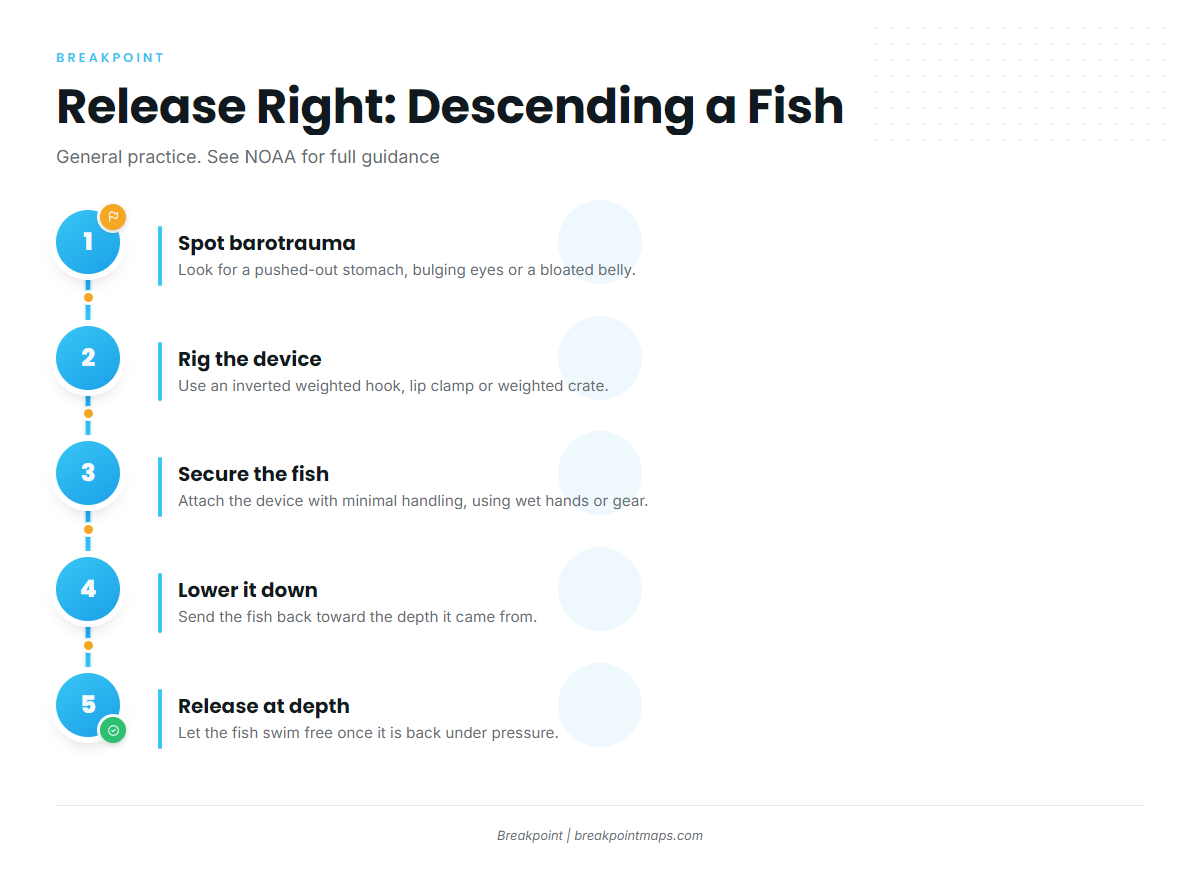
General practice; see NOAA guidance for specifics:
- Have the device rigged before the fish is on, so you are not searching for it with a fish on deck.
- Handle the fish quickly and keep it wet.
- Attach the device at the lip or jaw as the design requires.
- Lower the fish on a line or leader to the depth where it can swim off.
- Release the fish at depth using the device’s release, then retrieve the gear.
How well red snapper survive release at greater depths is still being studied. Descending improves the odds but does not guarantee survival.
What We Don’t Know
Stock size is still debated. The Harte Research Institute’s Great Red Snapper Count produced an estimate larger than earlier assessments, and how to use it in management remains contested. Release survival at depth is still being studied, and how fish move off pressured reefs is not well understood.
Frequently Asked Questions
How deep do red snapper live?
The range is wide and varies by region, and they hold over hard structure at nearly every depth. Retailer guides cite anything from 30 to 600 ft.
What is the size and bag limit for red snapper?
Federal for-hire is 16 in and 2 fish per person, per the Gulf Council. Private limits are set by state, so check the state-by-state table and confirm with your landing state’s agency before you fish.
When does red snapper season open?
It depends on the state and changes yearly. Each Gulf state sets its own private recreational season. See the dated table above and check FWC, ADCNR, MDMR, LDWF and TPWD for the current dates.
What is the best bait for red snapper?
Common baits are cigar minnows, squid, pinfish, threadfin herring and small blue runners. Natural bait requires non-stainless circle hooks for Gulf reef fish, so rig accordingly.
Do I need a descending device for red snapper?
Yes, for reef fish in Gulf federal waters. The DESCEND Act requires a descending device or venting tool rigged and ready. NOAA generally favors descending. Confirm the current wording on NOAA Fisheries.
How do I tell red snapper from vermilion snapper?
Red snapper are larger, with a red eye and a long triangular face. Vermilion are slimmer with a smaller mouth and fine lines on the back. Confirm against FWC or Gulf Council ID guidance before you keep a fish.
Conclusion and Where to Look Next
Structure holds the fish, depth decides how you rig for them, release gear protects what you send back, and your state’s rules decide what you can keep. Use this guide as a starting point and your state agency as the final word.
Regional guides: red snapper fishing off Destin.
Where you fish matters more than what you tie on. Breakpoint’s hotspots and Fish Intel show likely structure alongside layers like Chart Contours, so you can decide where to look before you burn the fuel. It can’t see who fished a spot yesterday, and it can’t promise fish. Chart layers are not for navigation.