


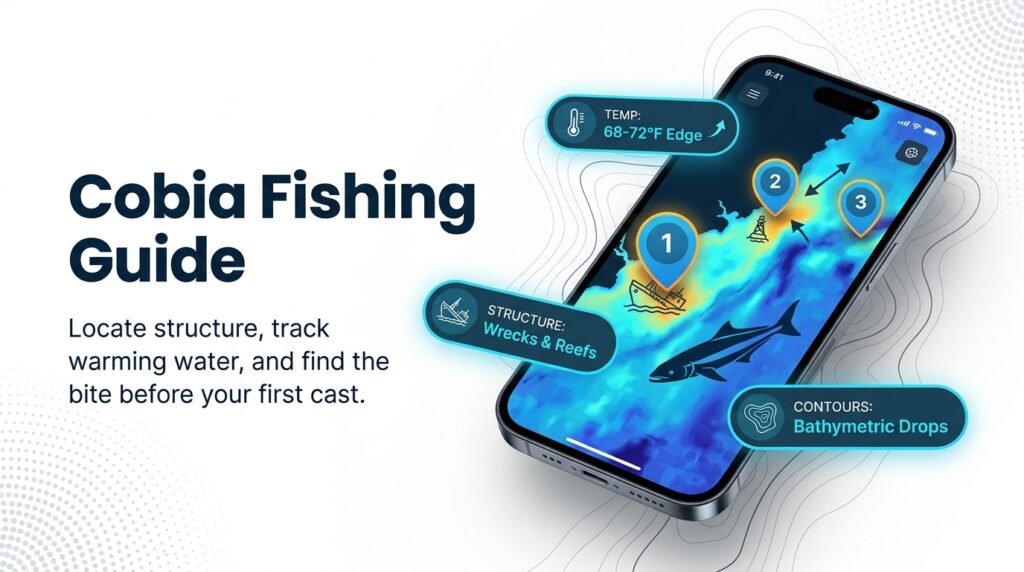
This guide covers how to identify a cobia (Rachycentron canadum), where the two stocks run across the Gulf of Mexico and the Atlantic Southeast, how to rig, and whose rules apply. Anglers chase cobia for a hard, stubborn fight and excellent table fare. Forums and older articles often give conflicting numbers, so check the managing agency before you act on any figure.
Cobia are seasonal and structure-oriented, and they reward preparation. We can’t promise fish, but we can help you decide where to look.
Quick Facts
| Item | Detail |
|---|---|
| Scientific name | Rachycentron canadum |
| Family | Rachycentridae, the only living member |
| Key ID marks | Dark brown-black lateral stripe, flat broad head, short separate dorsal spines, shark-like profile |
| Typical size | See the FWC species profile |
| Core timing | Northern Gulf March to October. Southern Gulf and south Florida November to March, per the Gulf Council. Atlantic: late spring into summer, Georgia northward. |
| Legal measurement | Fork length |
| Rules | See the Regulations section |
Overview: Cobia Identification and Behavior
What does a cobia look like?
A cobia has a long, torpedo-shaped body, a flat broad head and a dark brown-black lateral stripe, often bordered by paler bands. Short, separate spines sit ahead of the soft dorsal fin. It is the only member of the family Rachycentridae. Its blunt-nosed, brown profile leads to shark mix-ups from a distance, as this FishTalk beginner cobia guide notes.
Some guides describe a "white stripe." The stripe is dark; the paler bands beside it are what those writers are seeing.
Cobia vs shark and remora
Cobia have a blunt nose, brown color and horizontal pectoral fins, and they swim with sharks and other large animals, which explains the confusion. They are not related to sharks.
Check these tells when a fish shows at the surface:
- Head shape: A flat, broad head, not a shark’s pointed snout.
- Stripe: A dark lateral stripe along the side.
- Dorsal spines: Short, separate spines ahead of the soft dorsal fin.
- Company: Cobia often ride with rays and other large animals.
A remora looks similar in shape but is far smaller and carries a suction disc on the head.
Behavior
Cobia are curious. They often approach boats, orient to structure and follow rays, turtles, sharks and other large animals. That habit is how you find them: watch structure, and watch anything large moving through the water.
For tackle, think of an amberjack setup rather than a king mackerel one.
Habitat & Range: Where Cobia Fishing Happens
Cobia relate to structure and warming water, and their movements follow two distinct stocks with different rulebooks.
Two stocks: Gulf migratory group and Atlantic migratory group
Per ASMFC cobia stock information, the Gulf migratory group occurs throughout the Gulf and extends to Florida’s east coast. The Atlantic group occurs from Georgia north. Stock boundaries were confirmed in a 2018 Stock Identification Workshop, and stock structure continues to be investigated through tagging and genetic studies.
Some sources say the Gulf stock covers Florida’s entire east coast as though it were one rule set. The agencies treat Florida’s east coast as Gulf-group fish managed in their own Florida East Coast Zone.
Three layers decide which rules apply to you:
- Stock group: Which population the fish belongs to.
- Management zone: The Gulf Zone or the Florida East Coast Zone.
- State vs federal waters: Which agency’s rulebook applies where you fish.
A cobia off Jacksonville is a Gulf-group fish managed in the Florida East Coast Zone, and in state waters FWC rules apply. Verify the current boundary with the agencies before you fish.
For the Atlantic group from Georgia northward, see our Atlantic Southeast cobia guide.
Migration, wintering and the spring run
The Gulf Council says cobia can be found in the northern Gulf from March to October and in the southern Gulf and south Florida from November to March. See the Gulf Council cobia page. Our Gulf of Mexico cobia guide covers that water in detail.
Per Sport Fishing Magazine, Gulf fish push along the beaches in spring, while Atlantic fish move north as far as Chesapeake Bay in summer and return toward Florida in winter. See the science of cobia migration. Warming water drives the spring move north.
Run timing varies year to year, and scientists are still refining stock structure. Anglers report a thinner Panhandle spring run, and no one can fully explain the swings yet.
Structure: wrecks, buoys, platforms and rays
Cobia relate to structure and to moving objects. Common angler practice points to these:
- Nearshore wrecks and reefs.
- Channel markers and buoys.
- Platforms and rigs in the Gulf.
- Piers.
- Moving structure: rays, turtles, sharks and bait pods.
The regional guides below hold the specific lists.
If you already fish cobia elsewhere
The two coasts fish differently:
- Gulf: Beach-run sight casting from towers is the signature method.
- Atlantic: Anchored and live-bait fishing is more common, with sight casting when conditions allow.
- Management: Different bodies set the rules on each side.
- Florida East Coast Zone: Gulf-group fish, managed separately. Don’t assume the Atlantic rulebook applies.
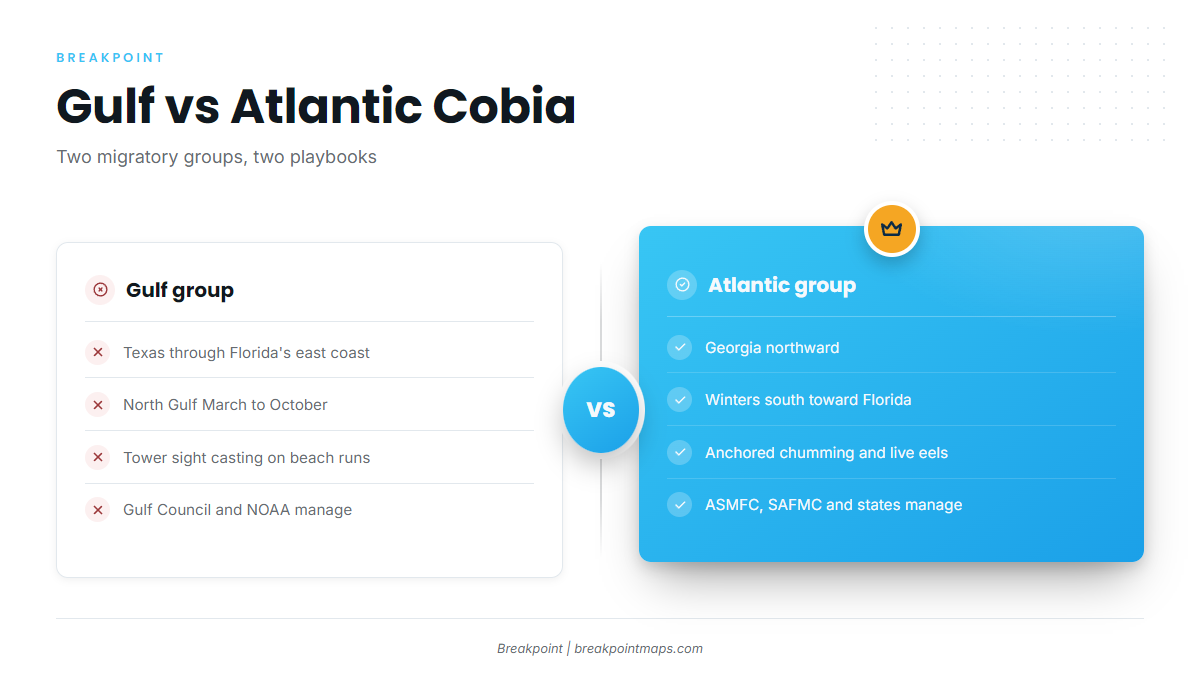
The table below lays it out.
Gulf vs Atlantic cobia
| Gulf group | Atlantic group | |
|---|---|---|
| Geographic range | Texas through Florida’s east coast. Florida’s east coast is managed as its own zone. | Georgia northward |
| Winter area | Southern Gulf and south Florida | Southward toward Florida waters |
| Peak local timing | Northern Gulf March to October (Gulf Council) | See the Atlantic Southeast guide |
| Dominant tactics | Tower sight casting on beach runs, plus structure and platforms | Anchored chumming, live eels and bait, sight casting |
| Managing bodies | Gulf Council and NOAA Fisheries (federal), plus state agencies | ASMFC in state waters, SAFMC and NOAA federally, plus states |
Regional guides
- Gulf of Mexico cobia guidethe whole Gulf, Texas to the Florida Panhandle.
- Atlantic Southeast cobiaGeorgia northward and the Atlantic rules.
- Cobia off Destinthe Panhandle beach run.
- Cobia off CharlestonSouth Carolina nearshore water.
Tactics: How Cobia Fishing Works
Four approaches cover most cobia fishing: sight casting, jigs, live bait and anchored chumming. Which one fits depends on the coast, the conditions and whether fish are visible.
Sight casting from towers
Cruise the beach on a clear, calm day with someone scanning from a tower. Look for singles, pods or fish riding rays. Lead the fish with your cast and keep a second rod ready. This is common practice on the Panhandle spring beach run; see cobia off Destin for that fishery.
Jigs and bucktails
FishTalk describes 1 to 3 ounce bucktails dressed with twister tails or large plastic teasers as a solid choice for sight fishing. Bright colors like white, chartreuse and pink are often most effective.
Live bait: eels, pogies, pinfish, croaker
Common live baits are eels, menhaden (pogies), pinfish and croaker. Hardy baits like eels and croaker tend to do best. Use circle hooks.
Anchored chumming and bottom fishing
Anchor near structure or channel edges, run a chum slick, and fish live and cut bait at several depths. This approach is common in Atlantic nearshore and bay fisheries. For a local example, see cobia off Charleston.
Tackle baseline
This is common practice, not a rule:
- 7 to 7.5 foot medium-heavy rods.
- 30 to 50 lb braid.
- 40 to 80 lb fluorocarbon leader.
- 1 to 3 oz bucktails.
- Circle hooks for live bait.
Amberjack-class tackle is close to this setup.
Landing a cobia
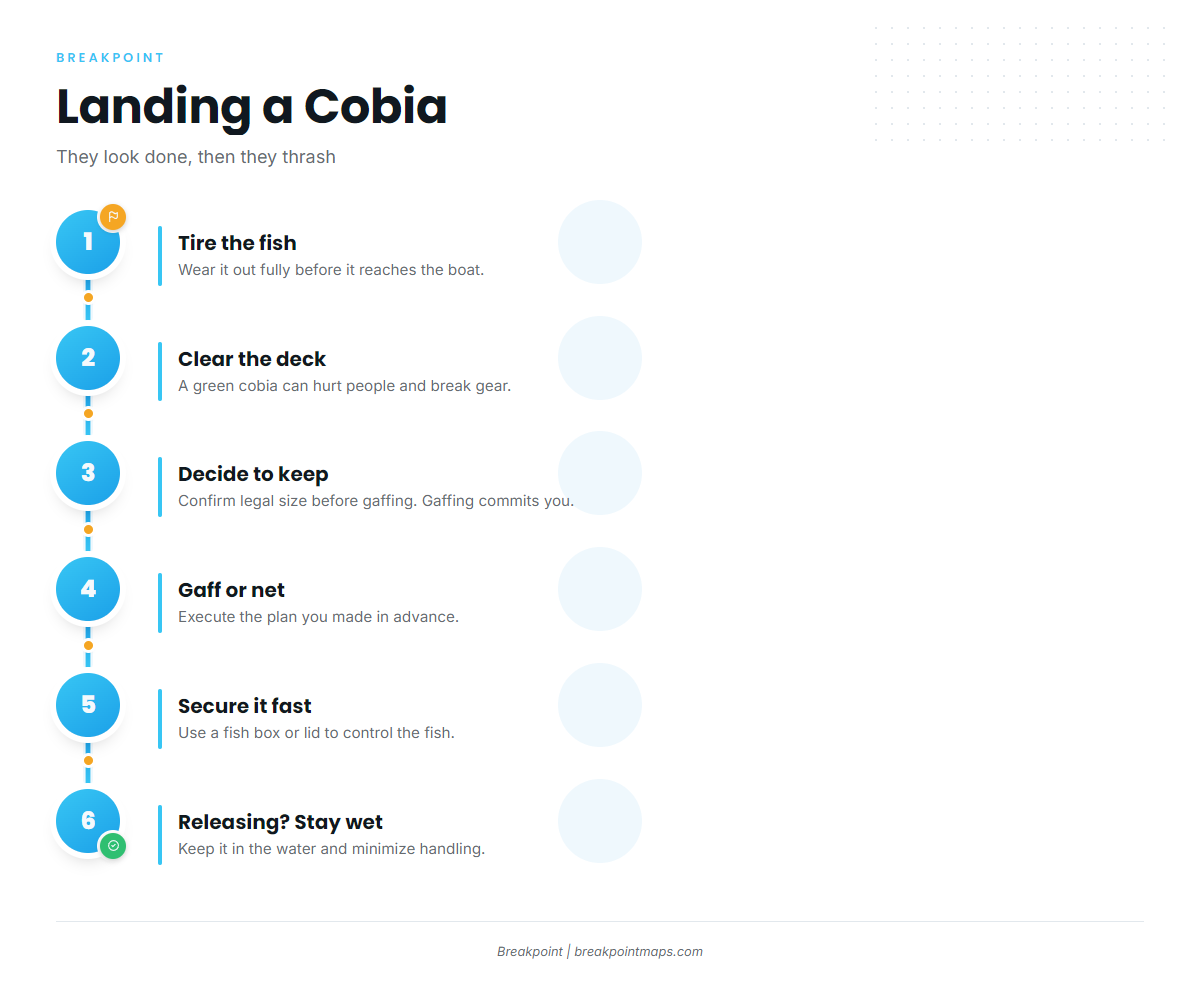
Cobia often look done at the boat and then thrash violently on deck, which can hurt people and break gear. Plan before the fish arrives.
- Tire the fish fully before you bring it to the boat.
- Clear the deck of loose gear and people.
- Decide in advance whether you are keeping the fish. Confirm it is legal size before gaffing, because gaffing commits you.
- Gaff or net as planned.
- Secure the fish right away in a fish box or under a lid.
- For releases, keep the fish in the water where possible and minimize handling.
Frequently Asked Questions
What does a cobia look like?
A cobia has a long, torpedo-shaped body, a flat broad head and a dark lateral stripe. Short, separate dorsal spines sit ahead of the soft dorsal fin. From a distance the brown, blunt-nosed profile looks like a shark, which is why people mistake it.
When is cobia season?
The Gulf Council says cobia are in the northern Gulf from March to October and in the southern Gulf and south Florida from November to March. On the Atlantic, think late spring into summer, Georgia north. Timing varies year to year.
What is the difference between Gulf and Atlantic cobia?
They are two stocks. The Gulf group runs throughout the Gulf and extends to Florida’s east coast. The Atlantic group occurs from Georgia north. Different bodies manage them, so the rules differ, and Florida’s east coast has its own zone.
What is the cobia size limit?
Florida and the federal Gulf and Florida East Coast Zones use 36 inches fork length. Other states set their own limits, so check the regulations table and your state agency before you keep a fish.
How do you measure fork length?
Measure from the tip of the snout, mouth closed, to the fork of the tail, in a straight line rather than over the curve of the body.
What is the best bait for cobia?
Common choices are live eels, menhaden, pinfish and croaker. For sight casting, 1 to 3 ounce bucktails in white, chartreuse or pink are a standard choice. This is common practice, not a rule.
Are cobia good to eat?
Yes. Cobia are widely regarded as excellent table fare, with firm white meat. Keep only legal fish, and measure before you commit.
Conclusion
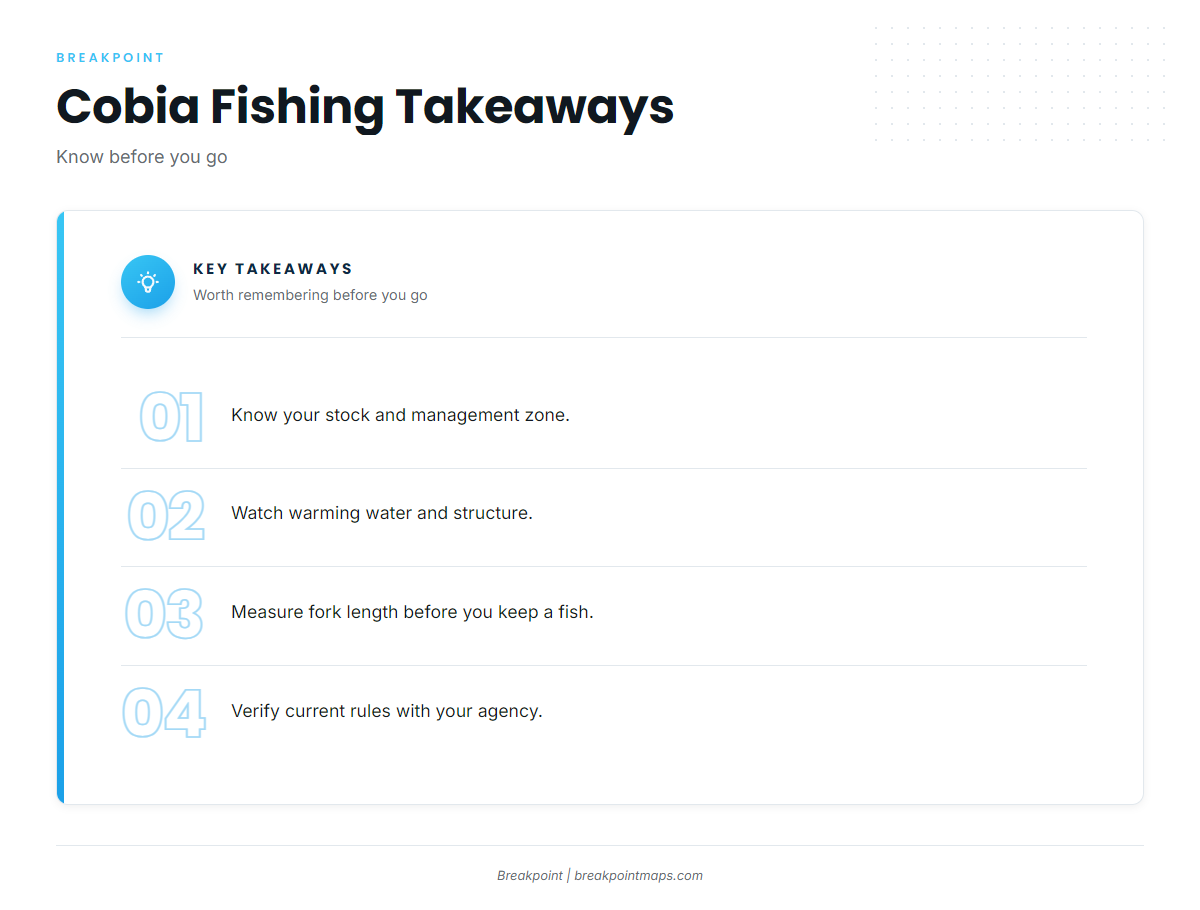
Know which stock and zone you are fishing, watch warming water and structure, measure fork length, and verify the rules before you leave the dock.
Cobia key on structure and warming water. Breakpoint’s hotspots and Fish Intel put structure, OBS SST and Chart Contours in one view, so you can decide where to look for cobia fishing on any given day. Chart layers are not for navigation.